
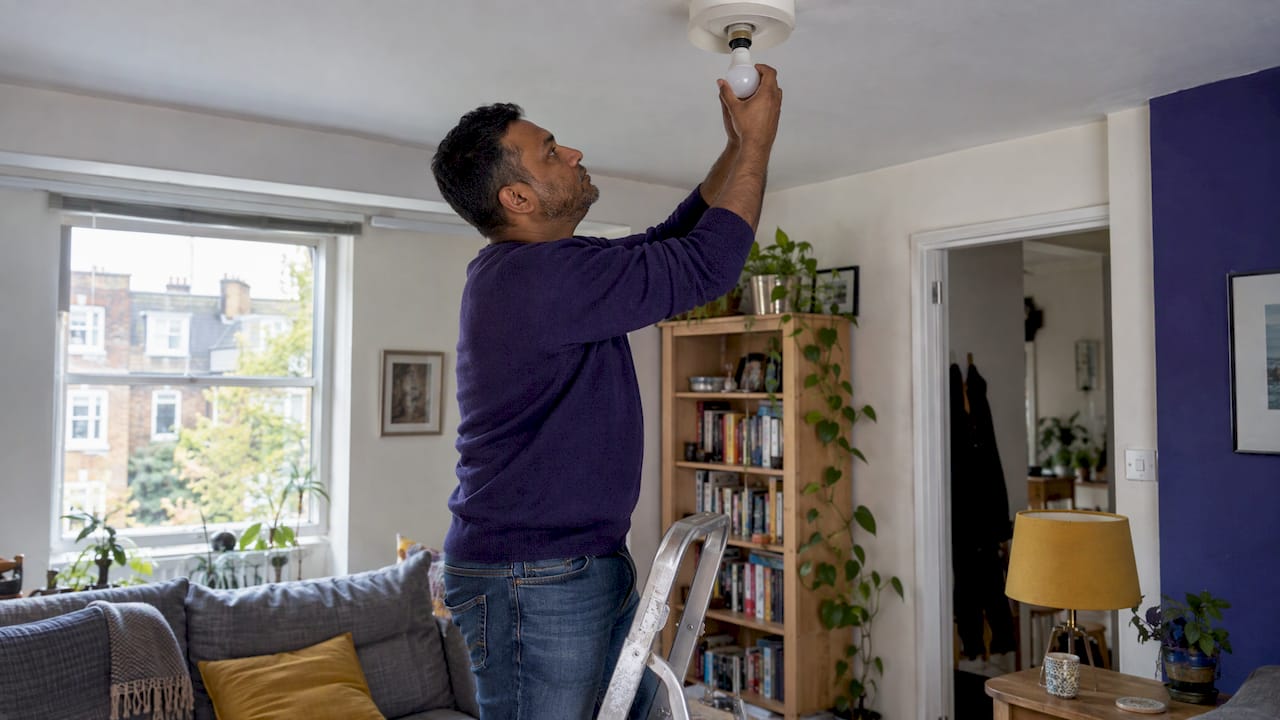
Energy saving means using less energy to get the result you want, whether that is a warm room, a lit office or a running appliance. You can do it by changing habits, by using more efficient equipment, or by combining the two. As an adjective, “energy-saving” describes a product or system built to use as little electricity, gas or other energy as possible.
That short answer holds in every dictionary and official source we checked. The detail is where it gets useful: the difference between saving and efficiency, how it applies to a London flat or a commercial unit, and what you can do about it. This guide covers all three.
TL;DR
- Energy saving is reducing the amount of energy you use while still getting the service you need.
- “Energy-saving” as an adjective describes products and systems that use as little energy as possible, such as LED bulbs or an efficient boiler.
- Energy conservation is about behaviour (turning things off or down). Energy efficiency is about technology (doing the same job with less energy). Most buildings benefit from both.
- For property owners and landlords, saving energy lowers bills and is closely tied to EPC ratings, SAP calculations and compliance work.
- A professional assessment shows which measures will make the biggest difference to a specific building.
Table of Contents
- The dictionary definition of energy saving
- How official bodies define it
- Energy saving vs energy efficiency vs energy conservation
- Why saving energy matters
- Energy saving in buildings: what actually helps
- Energy saving and your EPC
- Our view: saving energy starts with measuring it
- Beyond the basics: related ideas worth knowing
- Practical checklist for property owners and landlords
- Getting your property assessed
- FAQ
- Sources
The dictionary definition of energy saving
Dictionaries treat the phrase in two ways, depending on whether it is a noun or an adjective.
As an adjective, Cambridge Dictionary defines “energy-saving” as relating to products, systems and so on that use as little electricity, gas and similar energy as possible. Its examples include an energy-saving appliance, light or product, and an energy-saving initiative or measure. The Oxford Advanced Learner’s Dictionary gives a close variation: designed to avoid wasting electricity, gas or other forms of energy, with energy-saving light bulbs as a typical example.
As a concept, the phrase describes the act itself: the practice of cutting the energy you consume. Nothing in either definition says you must go without. The point is avoiding waste, not suffering a colder or darker home.
Word forms people confuse
- Energy saving (noun phrase): the act, or the amount of energy saved. “Loft insulation brought a real energy saving.”
- Energy-saving (adjective, usually hyphenated before a noun): describes something designed to waste less. “An energy-saving boiler.”
- Energy saver (noun): in everyday use, a product, setting or person that cuts energy use. Think of an energy-saving light bulb, or an “economy” mode on an appliance. Most dictionaries file this under the adjective form above rather than as a separate technical term.
- Energy conservation: the closest formal synonym, with a behavioural flavour, covered below.
If you need a single verb for the same idea, “conserve” is the standard one. Cambridge Dictionary defines conserve as keeping and protecting something from damage, change or waste, and its own example is about conserving fuel by adding extra insulation. “Cut down”, “reduce” and “economise” work in plainer speech.
How official bodies define it
Governments and agencies tend to go beyond the dictionary, because they use the term to set policy. The wording differs but the idea is the same.
- Germany. The Umweltbundesamt describes energy saving as achieving the desired performance with less final energy such as electricity and fuels. It names two strategies: efficiency (doing the same with less energy) and sufficiency (asking whether a need is really necessary, or going without).
- United Kingdom. The former Department of Energy & Climate Change defined energy efficiency, in its statistical summary, as the relationship between the energy consumed and the output it produces. Raising efficiency means using less energy for the same level of service, or the same energy for a higher level of service.
- International Energy Agency. The IEA’s saving energy page says we can save energy through simple changes in behaviour and habits, and by investing in more efficient products that cut both bills and environmental footprint.
The pattern is clear. Energy saving is always measured against a service you still receive. A building that is empty and switched off uses little energy, but that is not what anyone means by saving.
Energy saving vs energy efficiency vs energy conservation
The terms overlap in daily conversation, and many sources treat “energy saving” as the umbrella for the other two. The distinction is still worth knowing, because it tells you which lever to pull.
The US Energy Information Administration explains that efficiency generally relates to the technical performance of energy-consuming devices, while conservation generally involves actions to reduce energy use. Its examples are simple: installing energy-efficient lights is efficiency, and turning lights off when you do not need them is conservation.
| Energy conservation | Energy efficiency | |
|---|---|---|
| What changes | Behaviour and habits | Technology, equipment and the building itself |
| Typical example | Turning the thermostat down, switching lights off | Fitting insulation, a better boiler or LED lighting |
| Effect on comfort | May reduce comfort (a slightly cooler room) | Comfort stays the same or improves |
| Cost to start | Usually none | Usually an upfront cost, then lower running costs |
| Lasts | Only while the habit continues | Built in for the life of the measure |
The Stanford Understand Energy Learning Hub makes the same point with a heating example. Turning the thermostat down in winter is conservation, because the house is colder. Insulating the house is efficiency, because it stays warm while the heating works less hard.
Natural Resources Canada adds the practical conclusion for anyone who owns or manages a building: the best results come from combining both approaches. A better heater and better insulation let you keep the thermostat higher for the same energy, and sensible habits then stack on top.
Where sufficiency fits
The German agency’s second strategy, sufficiency, sits closest to conservation. It asks whether you need the service at all. Heating a spare room nobody uses is a clear case. For a landlord or business, this might mean zoning heating so empty areas are not conditioned, or switching off equipment overnight.
Why saving energy matters
The motivation differs by reader, but the reasons are well documented.
Lower bills. The US EPA notes that energy efficiency reduces bills by lowering energy use, making energy more affordable for families and businesses. The IEA describes using energy more wisely as more important than ever when high prices are hurting consumers and businesses.
Lower emissions. The EPA also calls efficiency one of the most cost-effective ways to reduce air pollution and greenhouse gas emissions.
Less pressure on the energy system. According to the EIA, reducing electricity consumption helps cut demand on the electric system, and high demand often means higher generation and transmission costs that may be passed on to customers.
Energy security. The European Commission has described saving energy as often the cheapest, safest and cleanest way to reduce reliance on fossil fuel imports, and says that using less supports security of supply.
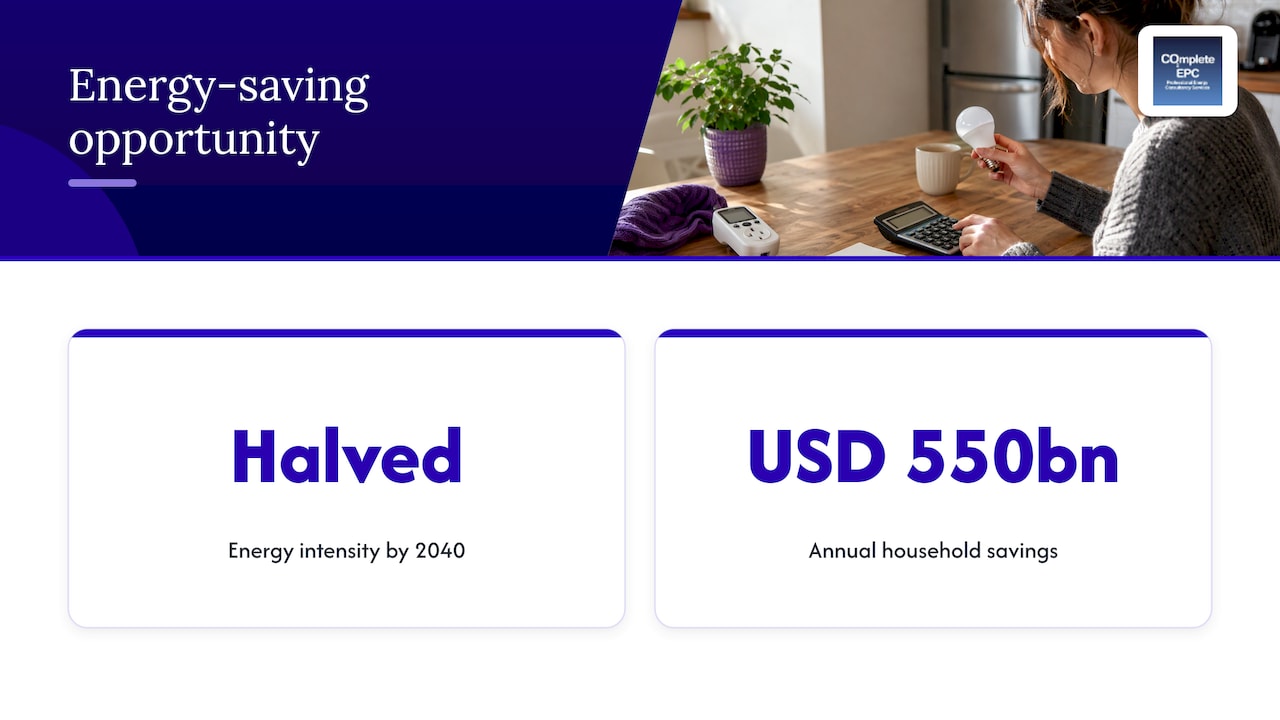
Scale of the opportunity. The IEA’s Reduce: Energy Efficiency report estimates that deploying the full range of currently available, economically viable efficiency solutions could halve energy intensity by 2040 compared with today, saving households worldwide USD 550 billion in annual energy costs.
For a London property owner these global arguments come down to something concrete: the building’s running costs, how attractive it is to tenants and buyers, and whether it meets the rules that apply to it.
Energy saving in buildings: what actually helps
Buildings are where energy saving gets practical. Heating, hot water, lighting, cooling and electrical equipment all draw energy, and each has both a behavioural and a technical lever.
Habits that reduce use
The IEA gives a figure worth remembering. Its saving energy guidance says lowering your thermostat by just 1°C saves around 7% of your heating energy, which it puts at an average bill reduction of €50 to €70 a year. It also says using a programmable thermostat to set 15°C while you sleep and 10°C when the home is empty can cut up to 10% a year off heating bills. These are international averages, so your own figure will depend on the property and your tariff.
Other behaviour changes follow the same logic:
- Switch off lights and equipment in rooms that are not in use.
- Heat only the spaces and hours that need it.
- Turn off standby devices where it is safe and practical.
- In offices and shops, set cooling and heating schedules to match opening hours.
Equipment and building upgrades
Technical measures change how much energy the building needs in the first place. Typical examples include loft and wall insulation, glazing, efficient heating controls, LED lighting and more efficient appliances. The IEA’s Energy Efficiency Policy Toolkit reports that buildings built after a building energy code is introduced can use up to 50% less energy, which shows how much design matters.
Upgrades often pay for themselves over time. ENERGY STAR gives a US example: a heat pump water heater could cost about $700 more than a standard electric one, yet typically saves around $3,500 over its life. Prices and savings in the UK will differ, but the shape of the trade-off is the same: a higher upfront cost against lower running costs.
Shared and multi-occupancy buildings
Blocks of flats and managed buildings have extra levers, such as communal heating, hydraulic balancing and meter-based billing. For a deeper look at reducing heating costs in apartment blocks, this German guide for property managers explains which measures make a measurable difference.
Energy saving and your EPC
If you own or let property in the UK, the most visible expression of energy saving is the energy performance certificate. An EPC rates a building’s energy efficiency and lists recommended improvements. Those recommendations are, in effect, a prioritised list of energy-saving measures for that specific property.
That is why an EPC is a sensible starting point rather than just a box to tick. Instead of guessing whether insulation, glazing or heating controls will help most, you get an assessment of the building itself. Our assessors deliver reports with recommendations for improvement, so you can see what to tackle first.
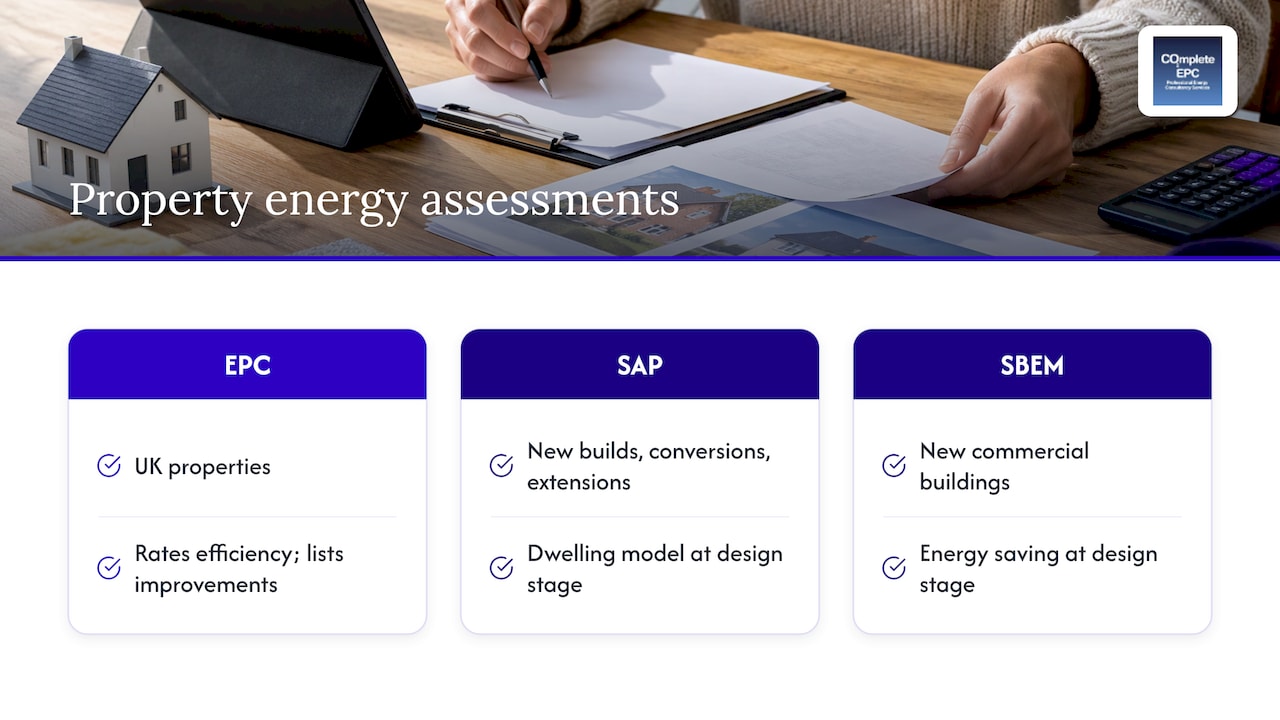
For new builds, conversions and extensions, the equivalent tool is the SAP calculation, which models a dwelling’s energy performance at design stage. For new commercial buildings it is SBEM. Both let you build energy saving into the design instead of retrofitting it later.
Which assessment suits which property
| Your situation | What you typically need |
|---|---|
| Selling or letting an existing home | Domestic EPC |
| Selling or letting a commercial unit | Commercial EPC |
| New home, conversion or extension | SAP calculation |
| New commercial building | SBEM calculation |
| Building with air conditioning | TM44 inspection |
| Planning application | Energy statement |
| Overheating risk in a design | TM59 / TM52 analysis |
The exact requirements for a given project depend on the property and the local planning authority, so confirm them with an assessor before you commit to a design or a listing.
Our view: saving energy starts with measuring it
We see the same pattern across London homes and commercial units. People talk about energy saving as if it were one thing, but it is really two: what you do and what your building does. Habits help, and they cost nothing. But the building decides the ceiling.
That is why we start with measurement. A properly carried out EPC or SAP calculation tells you where a property loses energy and which improvements deserve attention first. It turns a vague wish to save energy into a short, ordered list.
For landlords and owners, we think this is the most practical way to protect running costs, tenant appeal and compliance at the same time. Our qualified assessors work across domestic and commercial property, and our lowest-rate guarantee is there so that getting the facts is never the expensive part.
If you are planning a new build, extension or conversion, we would say the same thing more strongly: model the energy performance early. Changes cost far less on paper than on site.
Danny
Beyond the basics: related ideas worth knowing
Energy saving as a resource
The Stanford hub frames efficiency as a resource that can meet demand just like coal, gas, nuclear or solar. It calls the electricity saved “negawatts”, which emit no greenhouse gases and need no power plant. For building owners this is a useful way to think: every kilowatt-hour you avoid is one you do not need to buy.
Measured savings
Policy documents use a stricter definition. The EU’s Directive 2012/27/EU, as summarised in this 2025 academic monograph, defines energy savings as an amount of saved energy determined by measuring or estimating consumption before and after an improvement, normalised for external conditions such as weather. This is the logic behind before-and-after comparisons: a mild winter alone does not count as a saving.
Energy across a building’s life
Natural Resources Canada points out that energy is used at every stage of a building’s life, from design and planning to operation and decommissioning, and that good energy management lowers use in all of them. For owners, that supports an early, design-led approach.
Practical checklist for property owners and landlords
- Find out where you stand. Commission an EPC for each property so you know its current rating and the recommended improvements.
- Start with free changes. Review heating schedules, thermostat settings and lighting habits.
- Prioritise fabric. Insulation and draught proofing change how much energy the building needs at all.
- Upgrade equipment as it wears out. Choose efficient heating, lighting and appliances at replacement time.
- Plan new work with calculations. Use SAP for homes and SBEM for commercial buildings before design is fixed.
- Keep records. Certificates, inspection reports and calculations make sales, lettings and planning smoother.
- Review periodically. Once improvements are made, reassess to confirm the effect.
Getting your property assessed
If you want to know how your property performs, we provide energy performance certificates for homes and commercial buildings across London, covering north, east, west and central areas. Our qualified assessors produce clear reports with improvement recommendations, and our pricing is backed by a lowest-rate guarantee.
Start with a domestic energy performance certificate for a home or flat, or a commercial EPC for an office, shop or other non-domestic premises. Building something new? Our SAP calculations support new builds, conversions and extensions. Other services, including EICR, PAT testing and water calculations, are listed on our main site.
FAQ
What is a short definition of energy saving?
Energy saving is using less energy to achieve the same result, by changing behaviour, using more efficient equipment, or both. It aims to cut waste rather than reduce the comfort or service you receive. As an adjective, “energy-saving” describes products that use as little energy as possible.
What does energy saver mean?
In everyday use, an energy saver is a product, setting or habit that reduces how much energy something uses, such as an energy-saving bulb or an economy mode. It follows the dictionary sense of energy-saving: designed to avoid wasting electricity, gas or other energy. It can also describe a person who actively cuts their own consumption.
Is energy saving the same as energy efficiency?
Not quite. Efficiency refers to technology doing the same job with less energy, such as insulation or LED lighting. Conservation, the behavioural side of saving, means using less of a service, such as turning the heating down. Energy saving is the broad goal that both of these serve.
What is another word for saving energy?
The most common alternatives are conserving energy, reducing energy use, and cutting energy consumption. “Conserve” is the standard verb, meaning to protect something from waste or loss. In technical writing you will also see energy efficiency, depending on whether the focus is habits or equipment.
How can I find out what would save energy in my property?
An energy assessment is the most direct route. An EPC lists recommended improvements for the specific building, and a SAP or SBEM calculation does the same at design stage for new work. An assessor can explain which measures matter most for your property.
Sources
- ENERGY-SAVING | Cambridge Dictionary
- energy-saving | Oxford Advanced Learner’s Dictionary
- CONSERVE | Cambridge English Dictionary
- Energiesparen | Umweltbundesamt
- Energy Efficiency Statistical Summary | UK DECC
- Saving Energy | IEA
- Energy efficiency and conservation | US EIA
- Energy Efficiency | Stanford Understand Energy Learning Hub
- Energy efficiency basics | Natural Resources Canada
- What You Can Do About Climate Change: Energy | US EPA
- Communication from the Commission, 2022 | EUR-Lex
- Reduce: Energy Efficiency | IEA, 2020
- Energy Efficiency Policy Toolkit 2025 | IEA
- Energy Efficiency | ENERGY STAR
- Monograph 5, 2025 (EU Directive 2012/27/EU)