

If you let a home in England, you must have its electrical installation inspected and tested by a qualified person at least every five years, and before a new tenancy starts. The result is an Electrical Installation Condition Report (EICR). You then have set deadlines to give it to tenants and, on request, to the council. Wales, Scotland and Northern Ireland have their own versions of the same rule. We carry out EICRs and PAT testing for landlords across London, so this guide covers the process from booking to paperwork.
TL;DR
- In England, every rented home needs an EICR at least every five years, and one before each new tenancy begins (GOV.UK guidance).
- Give existing tenants the report within 28 days of the inspection and new tenants before they move in. The council can ask for a copy, and you have 7 days to supply it.
- Any C1 or C2 code, or an FI, makes the report unsatisfactory. Remedial work is due within 28 days, or sooner if the report says so.
- Councils in England can fine up to £40,000 per breach.
- Commercial landlords have no single fixed interval, but a five-yearly EICR is the usual way to show the installation is maintained safely.
Table of Contents
- What an EICR is and what it checks
- The rules in England
- Who counts as a qualified person
- What the codes mean and what to do next
- Penalties for getting it wrong
- Rules outside England
- EICRs for flats and HMOs
- Is PAT testing part of an EICR?
- Commercial property: what applies to landlords
- Build the EICR into your tenancy routine
- Booking your EICR in London
- Our view on EICRs
- FAQ
- Sources
What an EICR is and what it checks
An EICR is a report on the condition of a property’s fixed electrical installation: the wiring, consumer unit (fuse box), sockets and switches. The inspector does a visual inspection and runs tests on the circuits. Faults are recorded with classification codes, and the report ends with a satisfactory or unsatisfactory outcome (NICEIC).
The point of the exercise is safety. SELECT’s guidance on periodic inspection lists what it looks for: risk of electric shock and burns, fire and heat from defects, damage or deterioration, and anything that no longer meets the current wiring standard, BS 7671, in a way that could cause danger.
Two points catch landlords out:
- An EICR is a report, not a certificate. It judges the installation against the edition of BS 7671 current on the day of inspection, so an older installation can attract observations even if it met the rules when built.
- Limitations reduce its value. If rooms or circuits could not be accessed, the report says so. The more that is excluded, the less the report tells you (SELECT). Make sure tenants know when the inspector is coming, so the whole installation can be tested.
EICR or Electrical Installation Certificate?
An Electrical Installation Certificate (EIC) is issued after new installation work or a major alteration, such as a rewire. A new-build flat or freshly rewired house comes with one, and it covers you for five years. After that you need an EICR (NICEIC).
The rules in England
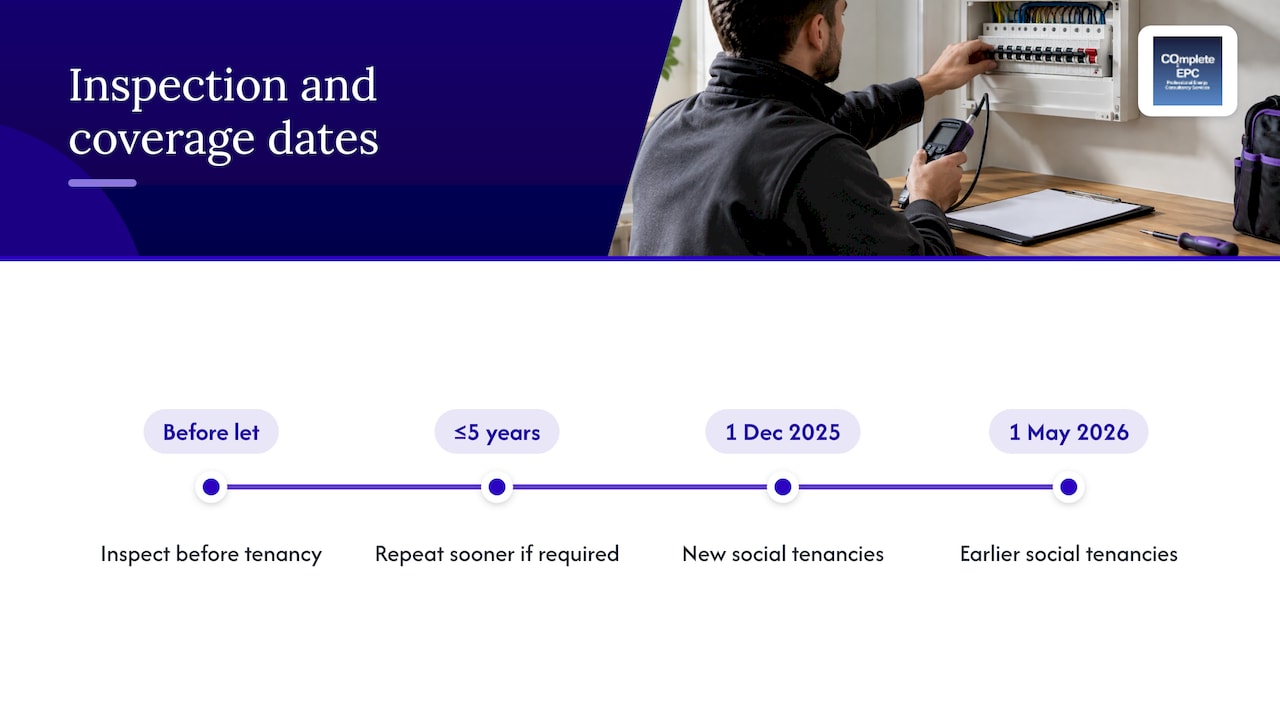
The Electrical Safety Standards regulations require a landlord who grants a specified tenancy to make sure every electrical installation is inspected and tested by a qualified person at intervals of no more than five years, or sooner if the last report says so. The inspection must also happen before the tenancy starts (legislation.gov.uk).
The regulations were extended to social landlords in 2025. They apply to tenancies granted after 1 December 2025, and to earlier tenancies from 1 May 2026 (GOV.UK). If you are a private landlord, the five-year cycle and the paperwork duties below are what apply to you.
What you must do with the report
The report must give the results of the inspection and the date by which the next one is due. Then:
- Give a copy to each existing tenant within 28 days of the inspection.
- Give a copy to a new tenant before they occupy the property.
- Give a copy to a prospective tenant within 28 days of a written request.
- Give a copy to the local housing authority within 7 days of a written request.
- Keep a copy until the next inspection is due, and hand it to the next inspector (GOV.UK).
Who counts as a qualified person
The regulations define a qualified person as someone competent to carry out the inspection, testing and any further investigative or remedial work (legislation.gov.uk). GOV.UK’s guidance says that person will usually belong to a competent person scheme. Ask for the inspector’s scheme registration before you book, and keep the details with the report. A report from someone with no relevant registration is a weak foundation if the council asks questions.
What the codes mean and what to do next
Every observation on the report gets a code (GOV.UK):
| Code | Meaning | What it means for you |
|---|---|---|
| C1 | Danger present, risk of injury | Report is unsatisfactory. Remedial work needed. |
| C2 | Potentially dangerous | Report is unsatisfactory. Remedial work needed. |
| FI | Further investigation required without delay | Report is unsatisfactory until the investigation is done. |
| C3 | Improvement recommended | No remedial work needed for a satisfactory report. |
If the report is unsatisfactory, the investigative or remedial work must be done by a qualified person within 28 days of the inspection, or sooner if the report specifies. You then obtain written confirmation that the work is complete. That confirmation, with the original report, goes to each existing tenant and to the local housing authority within 28 days of completion (legislation.gov.uk).
Acceptable confirmation includes a satisfactory EICR, an Electrical Installation Certificate or a Minor Electrical Installation Works Certificate (GOV.UK). Plan for this when you book. If the same business can inspect and carry out the fixes, the 28 days are far easier to hit than if you have to find a second contractor after the report lands.
Penalties for getting it wrong
Since 1 November 2025, local authorities in England can impose a financial penalty of up to £40,000 for a breach of the electrical safety duty, up from £30,000 (NRLA). If a landlord does not act on an unsatisfactory report, the council can arrange the remedial work, subject to tenant agreement, and recover the reasonable costs from the landlord (NRLA).
The practical lesson: a satisfactory wiring installation is only half the job. A missing copy for the tenant or a late reply to the council is a breach in its own right.
Rules outside England
If you own property in London, England’s rules are the ones you follow. If you also let elsewhere in the UK, the details differ:
| Nation | Interval | Key paperwork deadline |
|---|---|---|
| England | At least every 5 years, and before a tenancy starts | Existing tenants within 28 days; new tenants before occupation; council within 7 days of request |
| Wales | Valid Electrical Condition Report required | Copy to the contract-holder within 14 days of occupation date, and within 14 days of each later inspection (GOV.WALES) |
| Scotland | Before first let and at no more than 5-year intervals | Keep a copy for six years; give the latest EICR to a new tenant before the tenancy starts (gov.scot) |
| Northern Ireland | At intervals of no more than 5 years | Existing tenants within 28 days; council within 7 days of written request (legislation.gov.uk) |
Northern Ireland’s regulations began on 1 April 2025 for new private tenancies, and existing tenancies had to comply by 1 December 2025 (Department for Communities). In Wales, Rent Smart Wales warns that a landlord who does not give the tenant a copy is likely not meeting the fitness for human habitation standard, even if the wiring is fine (Rent Smart Wales).
EICRs for flats and HMOs
In England the duty is the same whether you let a house, a flat or a room in a shared property: the electrical installation in each let premises must be inspected and tested. For a flat, that means the installation in the flat itself. Where a building has shared supplies, such as communal lighting or a riser, check who is responsible for those parts with the freeholder or managing agent, and keep what they give you with your own report.
HMOs (houses in multiple occupation) are more likely to carry extra conditions through council licensing. Read your licence to see whether the council asks for a shorter interval, or for appliance testing on top of the EICR.
Is PAT testing part of an EICR?
No. An EICR covers the fixed installation. Portable appliance testing (PAT) checks plug-in items such as kettles, toasters and fridges, and should not be confused with an EICR (NICEIC). Private landlords in England do not have to check portable items, but they can ask the electrician to do a PAT test at the same visit (Shelter England).
If you supply appliances in a furnished let, adding PAT to the EICR visit is a sensible way to cover everything you provide in one appointment. We offer both.
Commercial property: what applies to landlords
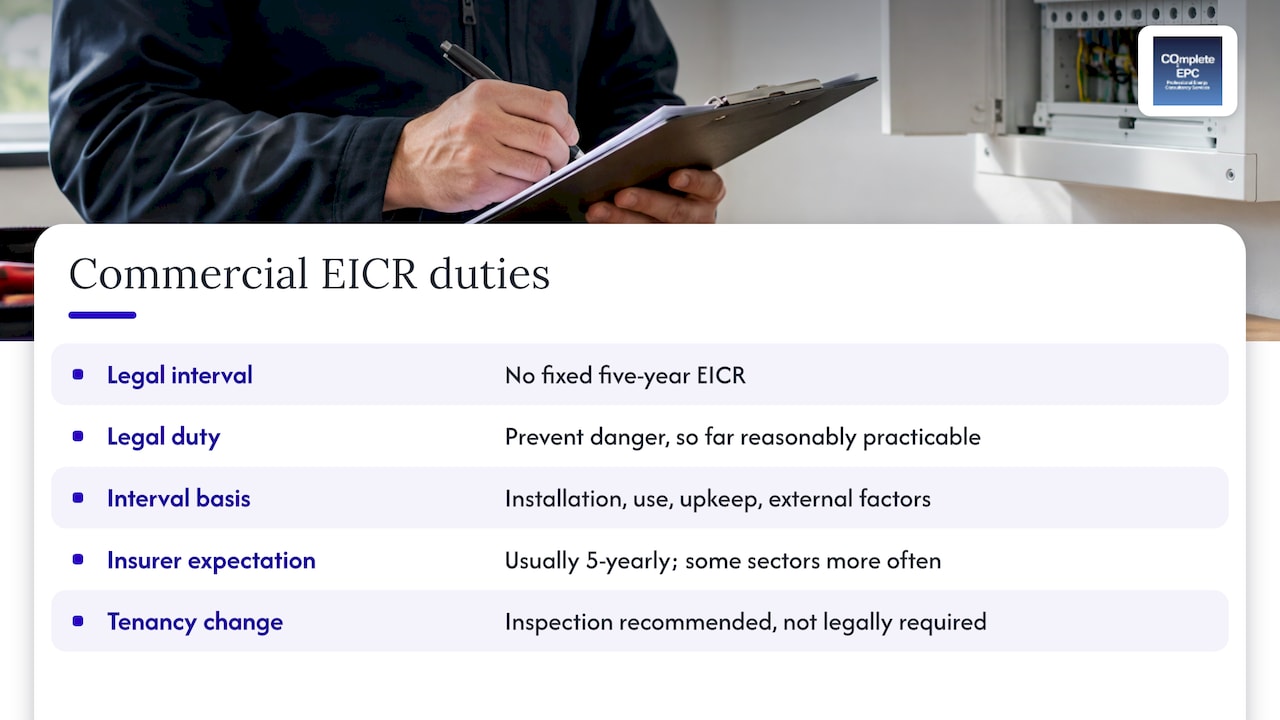
Commercial lets follow a different regime. There is no rule that fixes a five-year EICR in the way the England housing regulations do. Regulation 4(2) of the Electricity at Work Regulations 1989 requires electrical systems to be maintained so as to prevent danger, so far as reasonably practicable, and does not name EICRs or set an interval (IPAF).
In practice the periodic EICR is the recognised way to show you meet that duty. The interval depends on the type of installation, how it is used, how well it is maintained and the external influences on it, with the competent inspector setting later intervals (IET). Insurers generally expect inspection every five years in commercial premises, more often for some occupations, and at a change of occupation (Ecclesiastical Insurance). Inspection at change of tenancy is widely recommended rather than a legal requirement, but failing to maintain the installation can bring enforcement action and invalidate insurance (IPAF).
Who does the booking depends on the lease and on who controls the installation. Check the repair and maintenance clauses before assuming it falls to you or to the tenant.
Build the EICR into your tenancy routine
The landlords who stay compliant treat the EICR as part of a cycle rather than a one-off:
- Diarise the next due date from the report the day you receive it. The report itself states it.
- Book the inspection between tenancies where you can, so access is easy and any remedial work does not disrupt a tenant. A landlord turnover checklist is a good place to slot the electrical inspection alongside the other jobs that happen when a property is empty.
- Record when and how you sent the report, to which tenant, and keep it with the property file. The 28-day and 7-day deadlines are easiest to prove with a dated email.
- Keep the report until the next inspection and give it to the next inspector (GOV.UK).
Booking your EICR in London
Complete EPC provides EICR and PAT testing for landlords, alongside domestic and commercial EPCs, from our London base. Our UK lowest-rate guarantee is there so that compliance does not cost more than it should. If you are letting a home, a domestic EPC can be arranged with the same team, so the two certificates are dealt with together. Commercial landlords can pair the electrical report with a commercial EPC. To arrange an EICR, start at completeepc.co.uk.

Tell us the property type, the number of bedrooms or circuits if you know them, and when the current tenancy ends. That is enough to plan the inspection around your tenancy dates.
Our view on EICRs
Most of the landlord enquiries we hear about are not about wiring. They are about paperwork and timing: a report that arrived after the tenant moved in, a remedial job nobody booked, a copy nobody can find when the council asks.
That is why we think the EICR should sit in one routine with the rest of your compliance. We provide EICRs and PAT testing, EPCs and landlord compliance advice, so a London landlord can deal with one team rather than chasing several.
Our advice is simple. Put the due date in your diary, book the inspection before a tenancy starts, and send the report the same week you receive it. A report that is satisfactory and in the tenant’s inbox is the outcome you want.
Danny
FAQ
How often does a landlord need an EICR?
In England, at least every five years, or sooner if the last report specifies an earlier date, and before a new tenancy begins (legislation.gov.uk). Scotland and Northern Ireland also use a five-year maximum. A new-build or fully rewired property holding an EIC is covered for the first five years.
Do I have to give tenants a copy of the EICR?
Yes. In England, existing tenants must receive it within 28 days of the inspection, and new tenants before they occupy (GOV.UK). A prospective tenant can request it in writing and you then have 28 days. Keep proof of when you sent it.
What happens if my EICR is unsatisfactory?
A C1, C2 or FI code makes it unsatisfactory. You must have the remedial or investigative work done by a qualified person within 28 days, or sooner if the report says so. Then send the written confirmation and the report to tenants and the council within 28 days of completion (legislation.gov.uk).
Does a landlord need an EICR for commercial property?
No single rule sets a fixed interval. The Electricity at Work Regulations 1989 require installations to be maintained safely, and a periodic EICR is the usual evidence (IPAF). Check your lease to see whether you or your tenant controls the installation.
Is PAT testing a legal requirement for private landlords?
Not in England. Private landlords do not have to check portable appliances, though they can ask the electrician to include a PAT test (Shelter England). Scotland’s guidance includes equipment testing alongside the EICR.
Sources
- Electrical safety standards in the private and social rented sectors, GOV.UK
- The Electrical Safety Standards regulations 2020, legislation.gov.uk
- Electrical Installation Condition Reports, NICEIC
- Electrical Installation Condition Reporting, SELECT
- Electrical Safety Inspections, NRLA
- Renting Homes checklist, GOV.WALES
- Understanding EICR codes, Rent Smart Wales
- Repairing Standard guidance Annex D3, gov.scot
- Electrical Safety Standards for Private Tenancies Regulations (NI) 2024, legislation.gov.uk
- Electrical safety standards in private tenancies, Department for Communities NI
- Portable appliance testing, NICEIC
- Electrical safety in rented homes, Shelter England
- EICR Requirements for Commercial Properties (UK), IPAF
- Inspection and Testing FAQs, IET
- Electricity guidance note, Ecclesiastical Insurance
- Landlord turnover checklist