
If you let a commercial property in England or Wales, the Minimum Energy Efficiency Standards (MEES) mean it needs an Energy Performance Certificate (EPC) rating of E or better. An F or G rated building cannot lawfully be let or kept on the market unless you have made the required improvements or registered a valid exemption. The first step is a current, accurate commercial EPC. Our London assessors produce those for landlords, agents and businesses, and the recommendations report that comes with the certificate is what the rest of the MEES process rests on.
TL;DR
- The minimum EPC rating for privately rented non-domestic property in England and Wales is E. Since 1 April 2023 this applies to existing tenancies too, not just new lettings.
- Government proposals published in June 2026 point to EPC B from 2031 for rented buildings over 1,000 sq m. Smaller buildings stay at E, and none of this is law yet.
- If a property is below E, you either make the cost-effective improvements or register an exemption on the PRS Exemptions Register.
- Penalties run from £5,000 up to £150,000 depending on rateable value and how long the breach lasts, and breaches can be published.
- Start with a valid EPC and its recommendations report. Everything else follows from it.
Table of Contents
- What MEES means for a commercial landlord
- Do you need an EPC for a commercial building?
- The rule today: EPC E, and when it applies
- What the government is proposing next: EPC B from 2031
- Exemptions: what they are and how to register them
- How the seven-year payback test works
- Penalties for getting it wrong
- A sensible order of work for your portfolio
- Booking your commercial EPC with us
- Our view on MEES
- FAQ
- Sources
What MEES means for a commercial landlord
MEES for commercial property comes from the Energy Efficiency (Private Rented Property) (England and Wales) Regulations 2015. In plain terms, a landlord of an F or G rated non-domestic property must not grant a new tenancy, or continue to let, unless improvements are made or an exemption is registered. An EPC is a certificate that rates a building from A (most efficient) to G (least efficient) based on its fabric, heating, lighting and ventilation.
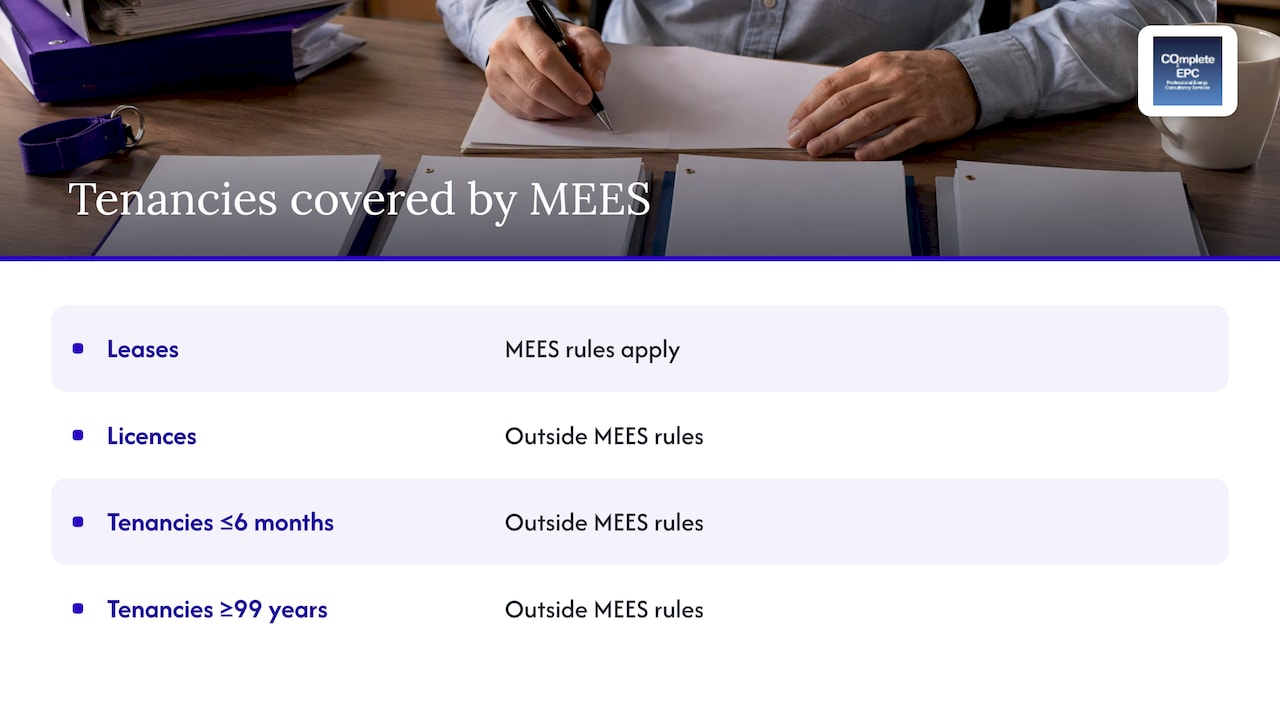
The rules apply to leases. Licences to occupy sit outside them, as do short tenancies of six months or less and very long tenancies of 99 years or more, according to the same legal analysis. If you are unsure whether your arrangement is a lease or a licence, get that confirmed before relying on it, because a solicitor is the right person to classify the agreement.
The rules also bite only where an EPC is required in the first place. Buildings that do not need one, such as listed buildings, places of worship, and industrial sites, workshops and non-residential agricultural buildings with low energy demand, fall outside the letting ban.
Do you need an EPC for a commercial building?
In most cases, yes. According to the government’s Rating Manual guidance, a commercial building needs an EPC when it is:
- rented out
- sold
- newly completed
- changed so that the number of parts used for separate occupation alters, with fixed heating, air conditioning or mechanical ventilation provided or extended
That last trigger catches landlords who split a floor into suites or install new systems during a refit. If you plan either, the EPC is part of the programme, not an afterthought.
For existing buildings we carry out commercial EPC assessments across London. Our commercial EPC service covers offices, shops and other non-domestic premises. For new commercial builds, the energy calculations are done with SBEM, the government-approved method for non-domestic buildings.
The rule today: EPC E, and when it applies
The standard is a minimum of E. The timeline matters because many landlords still think the rule only applies when a lease changes.
| Date | What applied |
|---|---|
| 1 April 2018 | Landlords could not grant a new tenancy, or extend or renew an existing one, on an F or G rated property |
| 1 April 2023 | Landlords must not continue to let an F or G rated property, even with no change in tenancy |
Both stages are set out in the GOV.UK landlord guidance. The practical effect is that a tenant sitting quietly in a unit on a rolling arrangement does not protect you. If the EPC says F or G and you have no exemption, you are already in breach.
A quick self-check for your portfolio:
- List every let non-domestic unit.
- Find the EPC for each and note the rating and the expiry date.
- Flag anything rated F or G, and anything without a valid certificate.
- For each flagged unit, read the recommendations report and decide between improvement and exemption.
In London, where many commercial buildings are older conversions, the F and G ratings tend to cluster in buildings with dated heating, poor glazing or little insulation. A fresh assessment by a qualified assessor sometimes shows a better rating than an old certificate, particularly where upgrades have been made since.
What the government is proposing next: EPC B from 2031
This is the part that causes most confusion, so here is where things stand. In its interim response of 18 June 2026, the government proposed:
- EPC B from 2031 for privately rented buildings over 1,000 sq m in England and Wales
- buildings under 1,000 sq m to remain at EPC E
- the earlier proposed EPC C milestone for 2027 not to be taken forward
- existing flexibility mechanisms, such as exemptions, to remain
The EPC B change needs secondary legislation, meaning rules made under an existing Act and passed through Parliament. Until that happens, the current minimum remains EPC E.
Law firm analysis describes this as a shift from a universal EPC B target to a size-targeted approach. For a London landlord, the sensible reading is:
- Under 1,000 sq m: E is your working standard. Keep your certificates valid and your ratings secure.
- Over 1,000 sq m: treat B as the direction of travel and plan upgrades into your normal refurbishment and lease cycle, rather than as a rush later.
When a building will need an upgrade anyway, doing the work in a planned programme tends to be easier than doing it under deadline. An assessor can show you which measures move the rating most.
Exemptions: what they are and how to register them
If a property is below E and cannot reasonably be brought up, you may be able to rely on an exemption. The GOV.UK guidance lists these:
- Seven-year payback: the improvements are not cost-effective.
- All relevant improvements made: you have done everything that can be done and the building is still below E.
- Consent refused: a third party or the tenant has refused consent for the work.
- Devaluation: an independent surveyor says the work would reduce the property’s value by more than 5%.
- New landlord: a six-month temporary exemption.
Each exemption is registered by the landlord or their agent on the PRS Exemptions Register, with the property address, exemption type and landlord details. Registration is self-certified. The exemption applies only from the point of registration, generally lasts five years, and does not pass to a new owner. That last point matters in a sale: a buyer cannot inherit your exemption and must register their own.
One point of caution on the all-improvements route: professional commentary notes that it lasts five years and is generally understood to apply where every recommended improvement in the EPC has been completed. Keep invoices and the updated certificate on file.
How the seven-year payback test works
Landlords must make “relevant energy efficiency improvements”. These are measures listed in the recommendations report that also appear in the Green Deal (Qualifying Energy Improvements) Order 2012 or Table 6 of Approved Document L2B. Cost-effectiveness is judged by the seven-year payback test: an improvement is relevant only if the expected energy bill savings over seven years from installation equal or exceed its cost. The calculation uses the approved methodology, current energy prices and actual purchase and installation costs.
A simple illustration, with figures that are examples only:
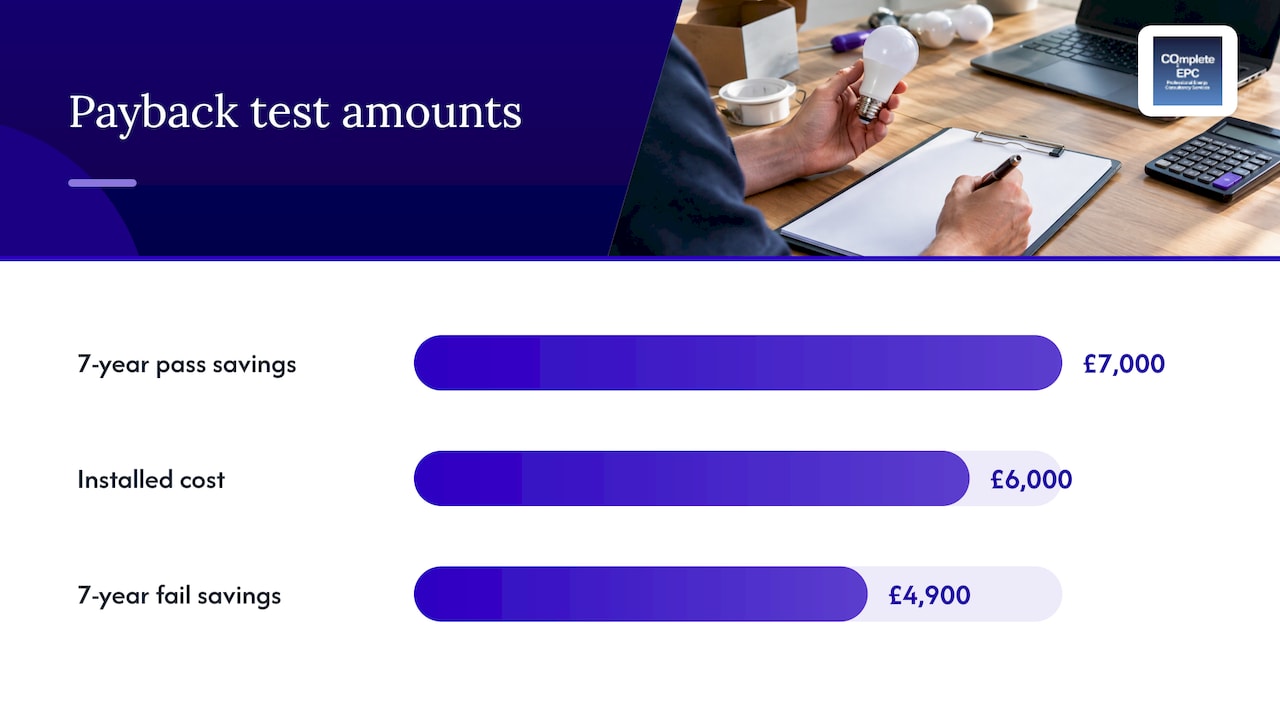
- A lighting upgrade costs £6,000 installed.
- The approved calculation shows savings of £1,000 a year.
- Over seven years that is £7,000, which is more than the cost, so the measure counts as relevant and you should carry it out.
If the same measure saved only £700 a year, the seven-year total would be £4,900, below the £6,000 cost. It would fail the test, you could not be compelled to install it, and you could register the position.
The test is applied measure by measure, which is why the recommendations report matters so much. A well-prepared EPC lists the measures clearly, so you can see which pass and which do not. We include practical energy-saving advice with our assessments, so the report works as a plan rather than a list of unexplained codes.
Penalties for getting it wrong
Enforcement sits with the local weights and measures authority, usually the council’s trading standards team. It can serve a compliance notice up to 12 months after a suspected breach, asking for documents, and a confirmed breach may lead to a financial penalty, according to the GOV.UK guidance. The penalty bands, as summarised by DLA Piper, are:
| Length of breach | Penalty | Cap |
|---|---|---|
| Under 3 months | Greater of £5,000 or 10% of rateable value | £50,000 |
| 3 months or more | Greater of £10,000 or 20% of rateable value | £150,000 |
Two worked examples:
- A unit with a rateable value of £40,000 let in breach for six months: 20% is £8,000, which is below the £10,000 floor, so the penalty is £10,000.
- A unit with a rateable value of £200,000 in breach for six months: 20% is £40,000, which is above the floor, so the penalty is £40,000.
The enforcing authority may also publish details of the breach on the public part of the PRS Exemptions Register. The lease itself stays valid and the tenant’s right to occupy continues, but the landlord remains exposed to enforcement, whether triggered by a complaint or by the authority acting on its own.
Enforcement is also set to get stronger. The government’s Energy Independence Bill factsheet, published on 4 November 2026, describes clearer inspection powers for local authorities, improved data-sharing, a new compliance database and a wider range of bodies that can be appointed to enforce the regulations. For landlords, the sensible response is to have the paperwork in order before anyone asks for it.
A sensible order of work for your portfolio
- Confirm which units need an EPC. Exempt building types are narrow, so check before assuming.
- Gather or commission certificates. Every let unit needs a valid one. Expired certificates are a common gap.
- Rank units by rating. F and G units come first, because they are the ones currently at risk.
- Read each recommendations report. Note which measures are likely to pass the seven-year test.
- Do the work or register the exemption. Register as soon as you rely on an exemption, because it applies only from registration.
- Diarise renewals. Exemptions generally last five years, and EPCs have their own expiry.
- Plan for larger buildings. If a unit is over 1,000 sq m, factor the proposed EPC B target into your upgrade timetable.
Where buildings have air conditioning systems, a TM44 inspection is a separate legal requirement that often comes up alongside an EPC review. If you are adding or extending a building, energy statements for planning and dynamic simulation modelling support the design stage, so the finished building starts with a strong rating.
Booking your commercial EPC with us
We provide commercial EPCs across London, carried out by qualified assessors, along with MEES advice and the related compliance work landlords tend to need at the same time. Our positioning is competitive pricing backed by a UK lowest-rate guarantee, so you can book the certificates for a whole portfolio without the cost running away from you.

If you manage several units, you can book them together and get one point of contact for ratings, recommendations and the next steps. Start with the commercial EPC page, or contact us through Complete EPC for electrical safety certification such as EICR and PAT testing alongside your energy work.
Our view on MEES
Most landlords we talk to are not worried about the rule itself. They are worried about not knowing where their buildings stand. Our advice is to treat the EPC as the starting document for everything else: the rating, the recommendations, the payback test and any exemption all depend on it.
The change since April 2023 is the one we would stress. It removed the comfortable idea that a quiet, long-standing tenancy was safe. If a unit is rated F or G, the question is now, not at the next lease event.
The proposed EPC B target for larger buildings is not law, and we would not tell anyone to act as if it were. But for buildings over 1,000 sq m, planning upgrades alongside normal refurbishment is simply good housekeeping. Our assessors can show you which measures matter, and our lowest-rate guarantee means a portfolio of certificates stays affordable.
Danny
FAQ
What EPC rating does a commercial property need to be let?
A privately rented non-domestic property needs an EPC rating of E or better. Since 1 April 2023 that applies to all existing lettings as well as new ones, unless a valid exemption is registered.
Will the EPC B requirement apply to all commercial landlords from 2031?
Not on the current proposals. The June 2026 interim response proposes EPC B from 2031 only for privately rented buildings over 1,000 sq m, and the change needs secondary legislation first. Smaller buildings stay at EPC E.
Can I still let a property rated F or G?
Only if you have made the relevant improvements or registered a valid exemption, such as the seven-year payback exemption. Exemptions apply from the date of registration and generally last five years. They do not transfer to a new owner.
Does a MEES breach cancel the lease?
No. The lease remains valid and the tenant can stay. The landlord, however, remains liable to enforcement action by the local weights and measures authority, including financial penalties.
Do all commercial buildings need an EPC?
Most do when they are rented, sold or newly built. Some are exempt, including listed buildings, places of worship, and low energy demand industrial, workshop and non-residential agricultural buildings. Where no EPC is required, the MEES letting ban does not apply.
Sources
- GOV.UK: Non-domestic private rented property, minimum energy efficiency standard, landlord guidance
- GOV.UK: Rating Manual Part 10, energy regulations, MEES and rating
- GOV.UK: MEES in the non-domestic private rented sector, interim response
- GOV.UK: Energy Independence Bill factsheet, non-domestic PRS MEES enforcement
- Higgs LLP: MEES regulations for commercial landlords and tenants
- Property Tax Partners: MEES for commercial property
- DLA Piper: Legal requirements for landlords, EPCs and MEES
- Baker McKenzie: MEES update for commercial lettings
- PwC UK: Energy regulation for commercial landlords