
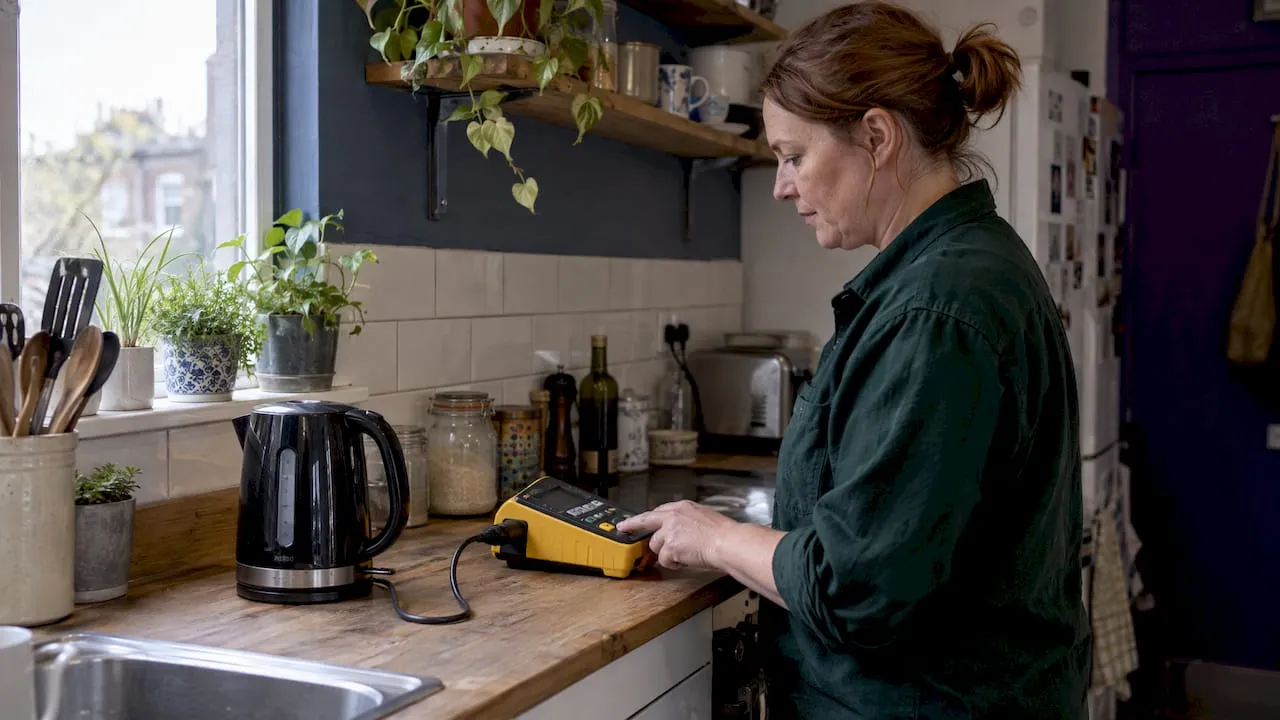
PAT stands for portable appliance testing: a combination of visual inspection and electrical testing that shows whether plug-in equipment such as kettles, lamps, toasters and office machines is safe to use. For landlords and businesses in London the useful question is not only “what is it?” but “does the law make me do it, and how do I show that my equipment is safe?”. The answers are different for a private landlord, a social landlord and an employer. We offer PAT testing and EICR inspections alongside our energy certificates, so the two checks can sit with one provider.
TL;DR
- PAT is a visual inspection plus electrical tests on portable appliances. Some faults show only on a test, and others show only on inspection, so the two work together.
- No law names PAT or sets an annual test. The Electricity at Work Regulations 1989 require equipment to be kept safe, and how you show that is a risk-assessment decision.
- For private landlords in England, the legal duty concerns the fixed wiring: an EICR at least every 5 years. PAT is a sensible way to look after the appliances you supply.
- Social landlords in England must also have the electrical equipment they provide checked at least every 5 years.
- Testing frequency is set by risk: the type of appliance, how it is used and where. HSE’s suggested intervals range from months to several years.
Table of Contents
- What PAT testing is
- Is PAT testing a legal requirement?
- PAT testing for landlords
- PAT testing for businesses and commercial property
- How often should PAT testing be done?
- What a PAT test checks
- Who can carry out PAT testing
- PAT testing and the EICR: why they belong together
- What we see as the right approach
- Booking PAT testing and EICR in London
- FAQ
- Sources
What PAT testing is
The Health and Safety Executive (HSE), Britain’s workplace safety regulator, describes PAT as the examination of electrical appliances and equipment to make sure they are safe to use. Most electrical safety defects can be found by visual examination, but some can only be found by testing, and visual examination is essential because some defects cannot be detected by testing alone.
In practice a PAT visit has two parts:
- Visual inspection. The tester looks at the plug, the cable, the casing and any signs of heat, damage, burning or wrongly fitted fuses.
- Electrical tests. A test instrument checks things you cannot see. HSE’s guidance on maintaining portable electrical equipment explains that loss of earth integrity, deterioration of insulation and internal contamination cannot be reliably found by looking alone.
The equipment is then passed or failed, and failed items are repaired or removed from use. A passed item is safe at the time of the test only. HSE’s low-risk guidance stresses that a PAT shows the item was safe at that moment and does not mean it will stay safe, which is why everyday user checks (a glance at the cable and plug before use) continue between tests.
What counts as a portable appliance
In plain terms, anything with a plug that can be moved: kettles, toasters, microwaves, table lamps, heaters, fans, hair dryers, vacuum cleaners, extension leads, desktop computers, monitors, printers and power tools. Fixed wiring, sockets, the consumer unit and light fittings are not portable appliances. They belong to the fixed installation, which is checked by a different inspection, the EICR, covered below.
Equipment classes in one minute
Testers talk about Class I and Class II. Class I equipment relies on an earth connection for safety, so it has an earth pin and needs the earth to be sound: kettles, toasters and many heaters fall here. Class II equipment is double-insulated and has no earth connection: many lamps, hairdryers and phone chargers. The class decides which tests apply and how often HSE’s tables suggest checking the item.
Is PAT testing a legal requirement?
Not by name. The Electricity at Work Regulations 1989 require electrical equipment that could cause injury to be maintained in a safe condition, but they do not say what must be done, by whom or how often, and they do not make PAT or annual testing a legal requirement. HSE also notes there is no legal requirement to label tested equipment or to keep records, although it regards records as good practice.
That is the position for employers. In reality, an employer who does nothing has no evidence that equipment is maintained. PAT, done at sensible intervals and recorded, is the most common way to show it. If an item has caused injury or a fire, a dated test record and a risk assessment are the evidence that you took your duty seriously.
PAT testing for landlords
This is where most London landlords get confused, because two different checks are mixed up under one name.
Private landlords in England
The Electrical Safety Standards in the Private Rented Sector (England) Regulations 2020 concern the electrical installation, meaning the fixed wiring. GOV.UK’s guidance says landlords must have the installations in rented properties inspected and tested by a qualified person at least every 5 years. The result is an Electrical Installation Condition Report (EICR). A copy goes to the tenant within 28 days, to a new tenant before they occupy, and to the local council within 7 days of a request.
PAT is not what this rule asks for. A clean set of PAT results does not replace an EICR, and an EICR does not test the toaster you left in the kitchen. They are complementary.
So do landlords need PAT testing? For a private let, no general rule names it. What many landlords do, particularly when they supply furnished or part-furnished homes, is have the appliances they provide inspected and tested at the same visit as the EICR, so that the whole electrical picture of the property is documented on the day the tenant moves in.
Social landlords in England
The same GOV.UK guidance has been extended to the social rented sector. Social landlords must also have the electrical equipment they provide under the tenancy, such as cookers, fridges and microwaves, checked by a qualified person at least every 5 years. They must obtain an in-service inspection and testing record. If equipment is unsafe, the tenant must be told immediately and the item replaced or made safe within 28 days. Tenants are responsible for their own equipment.
HMOs and shared houses
A house in multiple occupation (HMO) is a property let to several unrelated people who share facilities. HMOs are covered by the same installation rules as other rented homes, and the landlord usually supplies more shared equipment: kitchen appliances, communal heaters, a washing machine in a shared utility area. More appliances used by more people means more wear, which is a good argument for a shorter inspection interval in a risk assessment. Your local council’s HMO licensing team can tell you if it attaches electrical conditions to your licence, so check your licence terms.
Tenants’ own appliances
Appliances a tenant brings into the property are the tenant’s responsibility. Your duty relates to the installation and to the equipment you supply.
Furnished lets: a practical routine
For a landlord with furnished lets across north, east or west London, a routine that holds up is:
- Keep a list of every portable appliance you supply, by room.
- Have those appliances inspected and tested at the same time as the EICR, or at each change of tenancy for high-turnover lets.
- Remove or replace anything that fails, and keep the dated report.
- Ask tenants to report scorched plugs, frayed cables or tripping sockets immediately.
- Keep the EICR and PAT records together so you can produce them for the tenant, an agent or the council.
PAT testing for businesses and commercial property
If you employ people, the Electricity at Work Regulations apply to the equipment they use. Offices, shops, restaurants, salons, gyms, workshops and serviced offices all have portable equipment, and the dutyholder (usually the employer, landlord of a serviced space or the manager) is responsible for keeping it safe.
Landlords of commercial property should note the split of responsibility. If you supply equipment to a tenant, such as kitchen appliances in a serviced office, that equipment is part of what you must keep safe. If the tenant brings and uses their own, the tenant’s duty as an employer applies. Put this in writing in the lease or licence.
HSE’s guidance for low-risk environments says that user checks and visual inspections can be done by trained staff, not necessarily an electrician. Combined inspection and testing needs the right equipment and the knowledge to interpret results. In higher-risk settings such as kitchens, workshops, building sites and anywhere equipment is moved a lot, a competent tester is the safer route.
How often should PAT testing be done?
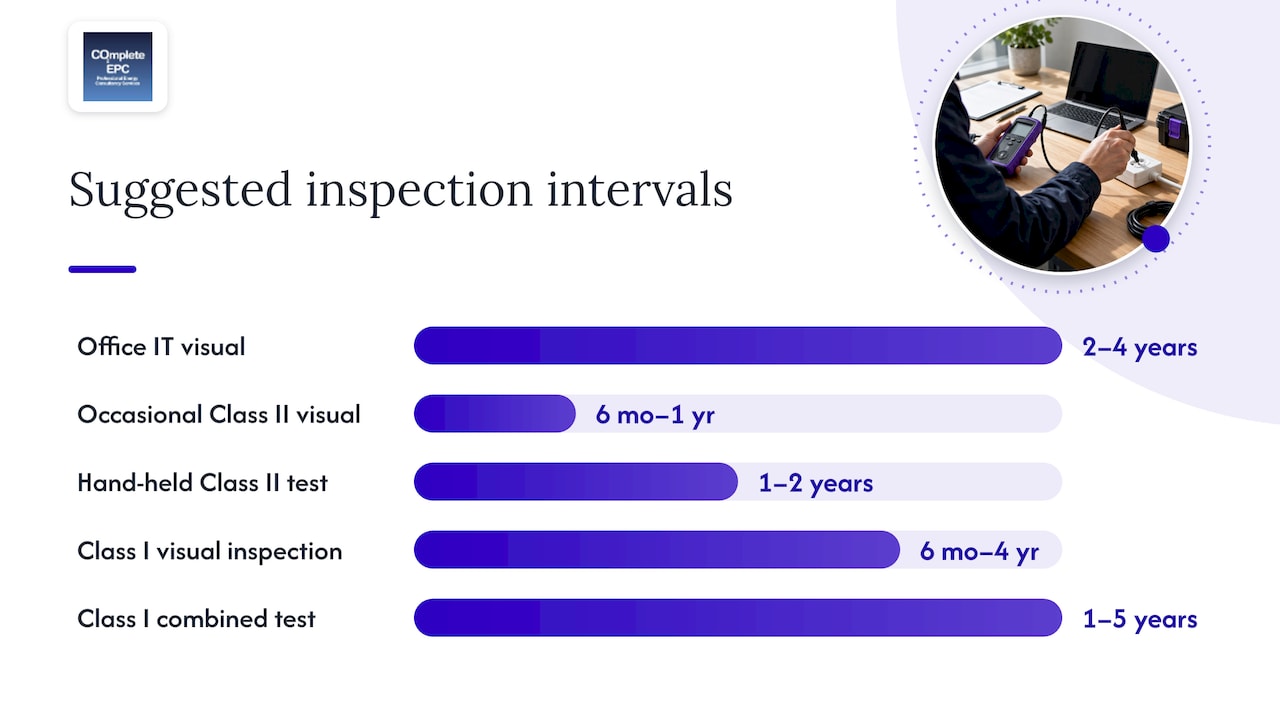
There is no single legal interval. HSE says deciding the frequency is a matter of judgement by the dutyholder, based on a risk assessment, and the intervals in its table are suggested starting points, not legal requirements. If few faults are found, the interval can be extended. If faults are common, shorten it.
The suggested initial intervals in HSE’s HSG107 give a feel for the range:
| Type of equipment | User checks | Formal visual inspection | Combined inspection and test |
|---|---|---|---|
| Office IT, rarely moved (desktops, photocopiers) | None | Every 2 to 4 years | None |
| Double-insulated (Class II) equipment moved occasionally | Yes | Every 6 months to 1 year | None |
| Hand-held Class II equipment | Yes | Per HSE table | Every 1 to 2 years |
| Earthed (Class I) equipment such as kettles | Yes | 6 months to 4 years, depending on the equipment | Every 1 to 5 years, depending on the equipment |
Source for all rows: HSE HSG107, Table 1. Read the full table for the other equipment types.
What changes the interval
- Environment. Damp, dusty, hot or outdoor conditions shorten intervals. HSE says additional regular inspections may be needed where a risk assessment shows it, for example where equipment is used in a harsh environment.
- How often it moves. A kettle that is lifted, filled and carried several times a day is under more stress than a desktop PC.
- Who uses it. Equipment used by the public, guests or tenants who change often has more variable care than equipment used by trained staff.
- Fault history. A failed item at the last test is a reason to look harder at similar equipment.
- Age and repairs. HSE notes combined inspection and testing is justified whenever equipment may be defective and after repair or modification.
A worked example
A landlord supplies a furnished two-bedroom flat in Hackney with a kettle, toaster, microwave, two lamps and a vacuum cleaner, and lets it on 12-month tenancies. The kettle and toaster are Class I and handled daily, so they sit at the shorter end of the HSE range. The lamps are mostly Class II and rarely moved, so they sit at the longer end. A practical plan is to inspect and test everything between tenancies, record the results, and review the interval after two cycles: if nothing fails, you have evidence for stretching it; if the kettle keeps failing, shorten it.
What a PAT test checks
A PAT instrument carries out a few core electrical measurements, chosen by the appliance class:
- Earth continuity. For Class I equipment, confirms the earth path from plug to metal casing is sound.
- Insulation resistance. Confirms the insulation between live parts and the user-accessible casing is intact.
- Polarity. Confirms live and neutral are wired the right way round, which matters for extension leads and fitted plugs.
- Further tests where relevant. Earth leakage and load tests for particular equipment such as power tools or IT equipment.
These are the tests behind the faults HSE describes: a broken earth wire inside a flexible cable, deteriorating insulation, or contamination. None of them is visible from outside. The visual inspection comes first and catches the rest: cracked casings, cables trapped by furniture, a plug warm from loose connections.
The tester should then label the equipment, report the result and flag any failures. HSE says labelling and records are not a legal requirement, but a dated label and a report are what make a test useful later: they show what was tested, when, and when the next check is due.
Who can carry out PAT testing
PAT does not have to be done by an electrician. HSE says the person needs greater knowledge and experience than for inspection alone, the right test equipment and the ability to interpret the results. In law that is a competent person: someone with enough technical knowledge or experience to prevent injury.
Can you do your own? A trained member of staff can do user checks and basic visual inspections in a low-risk office. Combined inspection and testing needs an instrument, training in using it and the confidence to say “fail”. For a landlord with several properties, or a business with dozens of items, buying equipment and learning to use it is rarely sensible compared with having it done and documented by a tester who does it every day.
PAT testing and the EICR: why they belong together
The EICR looks at the fixed installation: consumer unit, circuits, sockets, earthing and bonding. PAT looks at what plugs into it. A faulty socket can damage a good appliance, and a faulty appliance can trip a good circuit, so a property with both reports in hand has a complete record.
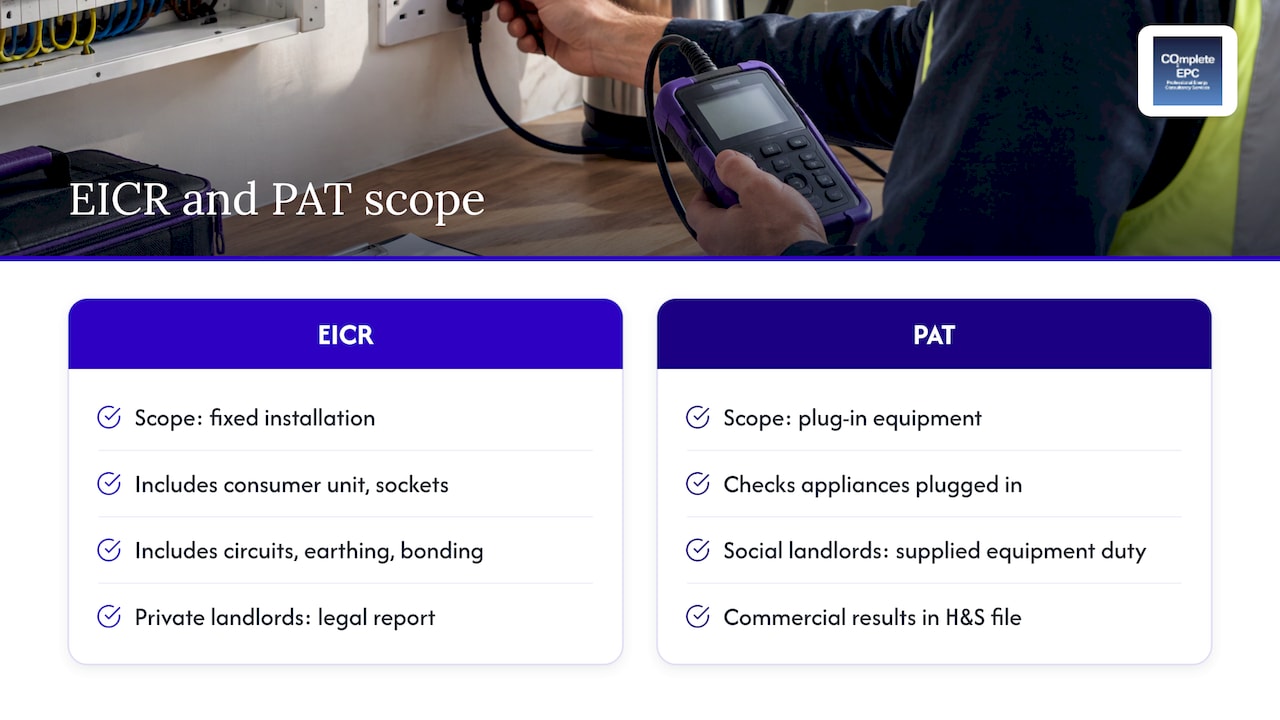
For private landlords the EICR is the legal document, at least every 5 years, with the copies and deadlines above. For social landlords, the equipment they supply is now part of the duty. For commercial landlords and employers, PAT results sit in the health and safety file next to the fixed wiring report.
If your property also needs an energy performance certificate, the same visit planning can help. Lettings in England generally need an EPC, and our domestic EPC service and commercial EPC service cover the energy side across London.
What we see as the right approach
We think of PAT as the routine that keeps the small things safe. The law does not name it, so the useful question is what evidence you would want if something went wrong: a dated inspection, a list of what was tested, a result for each item and a plan for the next check.
For London landlords we would pair it with the EICR. The EICR is the document that private landlords in England must have at least every 5 years. PAT then covers the kettle, toaster, lamps and heaters you supply. Doing both at the same visit keeps the paperwork in one place.
For businesses, we would start with a short risk assessment: what equipment you have, where it is used, how hard it is treated. Set the interval from that and adjust it with the results. Our team offers PAT testing and EICR alongside EPCs, SAP calculations and other compliance work for homes and commercial premises in London, so one provider can cover your certificates and your electrical safety records.
Danny
Booking PAT testing and EICR in London
If you manage rented homes, an HMO or commercial premises in London, you can ask us for PAT testing and EICR inspections. Have a list of the appliances you supply, the number of properties, and the date of your last EICR to hand. If you need an energy certificate for the same property, tell us at the same time.

We cover north, east, west and central London for EPCs and related compliance work, so the electrical checks and the energy certificate do not need separate arrangements.
FAQ
Do landlords need PAT testing?
Private landlords in England are not required by name to PAT test the appliances they supply. Their legal duty is an EICR on the fixed installation at least every 5 years. Social landlords must additionally have the electrical equipment they provide checked by a qualified person at least every 5 years. Many private landlords still test supplied appliances because it documents their safety.
How often should PAT testing be done?
There is no fixed legal interval. HSE says the frequency is a judgement based on a risk assessment, with suggested starting intervals ranging from a combined test every 1 to 5 years for earthed equipment such as kettles to a visual inspection every 2 to 4 years for rarely moved office IT. Shorten the interval when faults are found and extend it when results are consistently clean.
Does PAT testing have to be done by an electrician?
No. HSE says the tester does not need to be an electrician, but must be competent: they need the right equipment, the knowledge to use it and the ability to interpret the results. Visual inspections in low-risk workplaces can be done by trained staff.
What happens if an appliance fails?
It should be taken out of use, then repaired by a competent person or replaced. Failed items should be recorded in the test report so you can show what was done. In a social tenancy, unsafe provided equipment must be made safe or replaced within 28 days under the GOV.UK guidance.
Is a PAT test the same as an EICR?
No. A PAT test covers portable appliances. An EICR covers the fixed electrical installation of the building. Private landlords in England need the EICR by law, and PAT sits alongside it as good practice.
Sources
- HSE: PAT (portable appliance testing) answers to popular questions
- HSE HSG107: Maintaining portable electrical equipment
- HSE INDG236: Maintaining portable electrical equipment in low-risk environments
- HSE: Work using electrically powered equipment
- GOV.UK: Electrical safety standards in the private and social rented sectors guidance