

A better EPC rating lowers running costs, widens your pool of tenants, and can add a measurable premium to sale price or rent. From 1 October 2030, every private rented home in England and Wales must reach at least EPC C unless exempt, so acting now protects both income and legal standing.
The core benefits break down like this:
- Lower energy bills for whoever pays them, tenant or owner
- A sale-price and rent premium of roughly 4 to 6% for B/C-rated homes over D-rated equivalents
- Wider tenant demand and fewer void weeks between lets
- Continued legal right to let after the 2030 deadline
Your first move costs nothing: check your property’s existing rating and recommendations on GOV.UK’s certificate finder, then book a fresh assessment if the current one is missing, expired, or clearly outdated.
Key Takeaways
A better EPC rating cuts energy costs, adds a measurable sale and rent premium, shortens void periods, and keeps a rental property legally lettable past the 2030 deadline.
| Point | Details |
|---|---|
| Financial upside is threefold | Lower bills, a roughly 4 to 6% sale/rent premium for B/C bands, and better green mortgage terms compound together. |
| Voids often beat rent uplift | One avoided void month frequently outperforms a full year of rent increase from a higher rating. |
| Sequence fabric before heating | Insulation and draught-proofing usually deliver the biggest band jump for the lowest cost; defer heat pumps until budget allows. |
| The 2030 deadline is real | Private rented homes in England and Wales need EPC C by 1 October 2030 unless exempt, or risk becoming unlettable. |
| Start with a professional assessment | Completeepc’s domestic and commercial EPCs list recommended measures, costs and the achievable post-upgrade rating. |
Table of Contents
- The financial benefits of a better EPC rating
- How lettability and tenant demand shift with a higher rating
- Which upgrades actually move your EPC score
- Working out cost, payback and real ROI
- What the 2030 deadline means for your planning
- What a professional EPC assessment gives you
- Why the standard advice undersells voids and oversells rent uplift
- Get your EPC sorted before the deadline pressure builds
- Sources
- FAQ
The financial benefits of a better EPC rating
Three separate money streams improve when a property moves up the EPC scale, and they compound rather than compete.
Running costs fall first. An EPC’s recommended measures come with typical savings figures calculated using the SAP/RdSAP methodology. Who pockets that saving depends on your billing arrangement: owner-occupiers keep it directly, while landlords on all-inclusive rents see it show up as improved margin rather than a tenant utility bill.
Sale price and rent both respond to the rating. Hedonic price studies looking at UK transactions find B and C-rated homes commanding premiums of around 4 to 6% over equivalent D-rated properties, with F and G-rated homes trading at a discount instead. Regional variation is real. Buyers and tenants in areas with high energy awareness or high fuel costs price efficiency in more aggressively than elsewhere.
Lenders reward the improvement too. Green mortgage products increasingly offer preferential rates for A to C-rated properties, on the logic that better-insulated homes carry lower default risk from unaffordable bills.
Put these together and the picture becomes concrete:
- A £180,000 rental property moving from D to C might justify a 4% rent uplift, roughly £30 a month on a typical regional rent.
- A green mortgage discount of even 0.1 to 0.2 percentage points saves meaningful interest over a fixed term.
- One avoided month of void between tenancies is often worth more than a year of the rent uplift alone.
Add those three together and a single EPC upgrade can pay for itself well before the useful life of the measure runs out.
How lettability and tenant demand shift with a higher rating
Tenants increasingly filter listings by running cost, not just headline rent, and a colder, damper property simply attracts fewer applicants. A wider applicant pool means you can be more selective about references and affordability, not just fill the vacancy faster.
Void periods matter more than most landlords assume. Industry commentary consistently points to void reduction, not rent uplift, as the biggest single driver of net return for many landlords, because an empty property earns nothing while still costing insurance, council tax, and management fees.
- A property that lets one week faster each year recovers a sum that often exceeds a modest rent increase
- Warmer, better-insulated homes report fewer condensation and mould complaints, cutting reactive maintenance calls
- Comfortable properties tend to retain tenants longer, which itself avoids re-letting costs, referencing, and cleaning between tenancies
Pro Tip: Track your void weeks for the past two years before you commission any upgrade work. That single number often makes the business case for insulation or heating improvements clearer than any rent comparison.
Which upgrades actually move your EPC score
Not every improvement carries equal weight, and sequencing them wrong wastes money. Broadly, upgrades split into quick, cheap fabric fixes and bigger, costlier interventions.
Quick wins usually deliver the fastest payback and the least disruption:
- Loft insulation topped up to current recommended depth
- Cavity wall insulation, where the property has a suitable wall type
- LED lighting throughout, replacing older halogen or incandescent fittings
- Draught-proofing around doors, windows, and loft hatches
- Heating controls upgraded to a modern programmable thermostat with zoning
Bigger measures move the needle further but need more planning:
- Boiler replacement, particularly swapping an old back boiler or G-rated model for a modern condensing unit
- Air-source heat pumps, which suit well-insulated properties better than draughty ones
- Solid-wall insulation, internal or external, for pre-1920s properties without a cavity
- Triple glazing, though double glazing to a good standard often achieves most of the available uplift for less outlay
- Solar PV, which improves the rating and can offset daytime electricity use
Fabric measures like loft and cavity insulation tend to deliver the largest jump in banding for the lowest cost, because RdSAP weights heat loss heavily. Heating system upgrades deliver steadier ongoing bill savings but cost considerably more upfront and rarely shift a band on their own without accompanying fabric work.
Sequence the work: secure the quick fabric wins and controls first, since they’re cheap and improve the score almost immediately. Defer a heat pump or major heating swap until you have clarity on grants, budget, or a longer-term tenancy that justifies the investment.

Working out cost, payback and real ROI
The honest answer to “is this upgrade worth it” depends heavily on three things: your property’s construction era, the measure type, and how you’ll fund it.
Cost drivers worth checking before you commission anything:
- Pre-1920s solid-wall properties typically cost more to insulate than 1930s-onwards cavity-wall homes
- Fabric measures (insulation, draught-proofing) are almost always cheaper per band improvement than heating-system swaps
- Listed or conservation-area properties often need bespoke, more expensive solutions and planning permission
A simple ROI template you can apply to any single measure:
- Gather the EPC’s stated cost estimate and annual saving for the measure
- Divide cost by annual saving to get simple payback in years
- Adjust for any rent uplift or reduced void risk the improvement supports
- Subtract available grant funding from the gross cost before calculating payback
Government modelling for the private rented sector estimates average annual bill savings of roughly £105 to £233 depending on which improvement pathway a landlord takes, fabric-only versus fabric-plus-heating. That range, set against typical upgrade costs, is what most simple payback calculations should use as a starting assumption rather than an optimistic best case.
Grants through schemes listed on the government’s energy grants calculator can shorten payback considerably, sometimes covering a large share of insulation costs for eligible households.
What the 2030 deadline means for your planning
England and Wales private rented sector properties must reach a minimum EPC C by 1 October 2030 unless a valid exemption applies. Miss it without an exemption, and the property can become unlettable, not just less profitable.
This deadline is already shaping behaviour well ahead of the date itself. Buyers and lenders are starting to factor future compliance costs into valuations for D, E, and F-rated stock, and some mortgage products already price risk differently depending on the current rating.
A sensible timetable looks like this:
- Audit your portfolio now using existing EPCs or fresh assessments where certificates have lapsed
- Complete cheap fabric measures and controls first, since they’re fast and improve the score with minimal disruption
- Plan larger works, heat pumps or solid-wall insulation, around grant application windows rather than in isolation
- Check exemption rules carefully if a property genuinely cannot reach C cost-effectively, following the official MEES landlord guidance
Pro Tip: Don’t wait for 2029 to start. Grant schemes and installer availability tighten as the deadline approaches, and prices for heat pump installation tend to rise when demand spikes near a compliance date.
What a professional EPC assessment gives you
A domestic or commercial EPC from Completeepc gives you far more than a letter grade. It sets out your current rating, a full list of recommended measures, indicative costs for each, and the projected rating you’d achieve after completing them, calculated using the same SAP/RdSAP standards assessors use nationally.
That report becomes your roadmap, not just your compliance paperwork.
- Qualified, experienced assessors carry out every survey to current standards
- Completeepc guarantees competitive pricing against other UK providers
- Related services, including SAP calculations and overheating analysis, support new builds, conversions, and extensions alongside standard certification
Start by ordering a domestic EPC if you own residential rental stock, or a commercial EPC for retail, office, or industrial premises, then request quotes for the priority measures your report flags first.
Why the standard advice undersells voids and oversells rent uplift
Most guidance on EPC benefits leads with sale-price premiums and rent uplifts, because they’re the easiest numbers to quote. That framing misses where the real return usually sits.
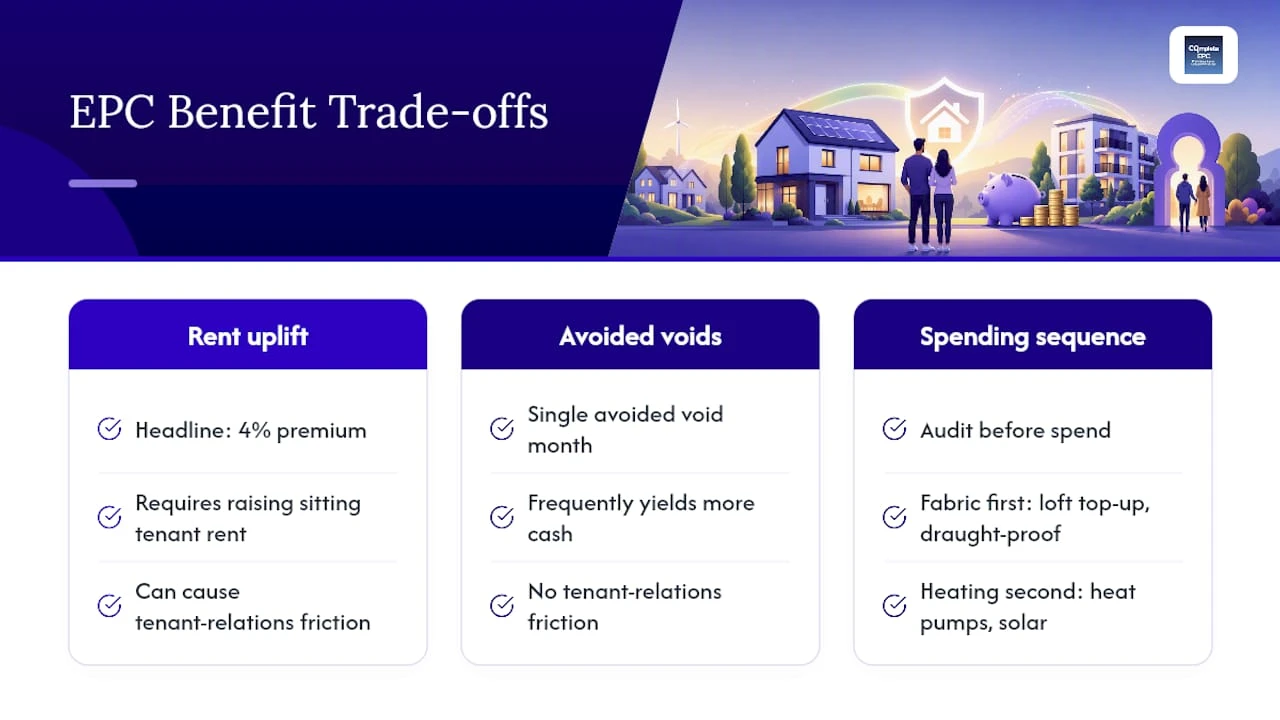
Reduced voids and better tenant retention typically outperform headline rent increases for landlords running ordinary buy-to-let portfolios, not luxury or high-demand stock. A 4% rent premium sounds impressive until you calculate it against a single avoided void month, which frequently delivers more cash with none of the tenant-relations friction that comes with raising rent on a sitting tenant.
The other gap in conventional advice is sequencing. Too many landlords jump straight to heat pumps or solar because they sound impressive, when a loft top-up and decent draught-proofing would move the band further for a fraction of the outlay. Fabric first, heating systems second, is not exciting advice, but it is the advice the numbers actually support.
Prioritise the audit before the spend. Know your current rating, know what the report actually recommends, and only then decide where the money goes.
Get your EPC sorted before the deadline pressure builds
Completeepc handles both domestic and commercial energy performance certificates across London, backed by qualified assessors and a lowest-price guarantee against other UK providers. Where this article has walked through bill savings, rent premiums, and the 2030 compliance deadline, Completeepc turns that guidance into a single practical step: a certificate with recommended measures, indicative costs, and the improved rating you could reach.
Landlords managing several properties benefit from bundling assessments together, while homeowners preparing to sell or remortgage get a clear improvement plan alongside the certificate itself. Beyond standard EPCs, Completeepc also covers SAP calculations, overheating analysis, and related compliance work for conversions and extensions.
If your current certificate has lapsed or you’ve never had one, book a domestic EPC or a commercial EPC today and get a clear improvement plan back within days.
Sources
FAQ
Does a higher EPC increase house value?
Yes. Studies of UK transactions show B and C-rated homes commanding premiums of roughly 4 to 6% over equivalent D-rated properties, with F and G-rated homes trading at a discount.
What improves your EPC rating?
Loft and cavity wall insulation, draught-proofing, LED lighting, and modern heating controls deliver the quickest gains; boiler replacement, heat pumps, solid-wall insulation, and solar PV deliver larger but costlier improvements.
How do I change my EPC from C to B?
Moving from C to B typically requires combining several fabric measures with a low-carbon heating upgrade, such as a heat pump or solar PV alongside solid-wall or floor insulation; a fresh EPC assessment will show which specific measures apply to your property.
Do landlords have to improve the EPC rating?
England and Wales landlords must reach a minimum EPC C by 1 October 2030 unless a valid exemption applies, or risk being unable to let the property legally.