

A commercial project EPC is required whenever a non‑domestic building is sold, let, or newly constructed and marketed. Before doing anything else, check the national register for a valid certificate, or instruct an accredited non‑domestic energy assessor if none exists. Skip this step and you risk a fine calculated from the building’s rateable value.
TL;DR:
- Most commercial EPC assessments use SBEM software, but complex buildings like those with atriums or special glazing require dynamic modelling for accuracy.
- Failing to lodge a valid EPC before marketing or during sale can lead to fines up to £5,000, especially for buildings over 500m² that are publicly accessible.
- Exemptions from immediate upgrade, such as listed buildings or those with a payback period exceeding seven years, can delay required improvements but must be properly documented and registered.
- Costs vary significantly based on building size and complexity, with assessments for large or complex structures typically taking several weeks and costing proportionally more.
- Future regulations may require over 1,000m² buildings to reach EPC B, urging owners to plan capital works with long-term compliance and value considerations in mind.
Table of Contents
- What a commercial EPC covers and how it’s produced
- Legal trigger points, MEES and penalties
- Exemptions and the 7‑year payback test
- How to commission a commercial project EPC
- How to improve an EPC rating
- Using an EPC across the project lifecycle
- Differences in EPC requirements across regions
- EPC results and green building certifications
- Future regulatory changes and the EPC policy roadmap
- Practical lessons from delivering commercial EPCs
- How Complete EPC can help with your commercial project
- Sources
- FAQ
What a commercial EPC covers and how it’s produced
A commercial EPC gives the building an asset rating from A to G, based on its fixed fabric and services rather than how the current occupier actually uses it. Alongside the certificate, the assessor issues a recommendation report listing improvement measures with indicative paybacks, so you can see roughly how long each upgrade takes to pay for itself.
Assessors use government‑approved software to model the building. Most straightforward commercial units are assessed with SBEM (Simplified Building Energy Model); larger or architecturally complex buildings, such as those with atriums, mixed-mode ventilation, or unusual glazing ratios, need Dynamic Simulation Modelling instead, because SBEM can’t capture that level of detail accurately.
During the site visit, the assessor typically checks:
- Wall, roof, and floor construction, plus insulation levels
- Lighting types and whether controls (sensors, daylight dimming) are fitted
- Heating, cooling, and ventilation systems, including age and controls
- Glazing specification and orientation
- Occupancy patterns and zoning, which affect the energy model’s assumptions
Once complete, the assessor must lodge the certificate on the national register. An EPC produced by an unaccredited assessor, or one never lodged, has no legal standing, whatever it says on the front page.
Legal trigger points, MEES and penalties
Three events trigger the legal duty to hold a valid commercial EPC: sale, letting, and construction followed by marketing. Under SI 2012/3118, regulation 7 requires you to commission the certificate before you start marketing the property, and regulation 6 requires you to make it available to a genuine prospective buyer or tenant on request.
Failure to provide a valid EPC can lead to fines between £500 and £5,000, depending on the building’s rateable value, according to GOV.UK guidance. A large city‑centre office block sits at the top of that range; a small retail unit sits nearer the bottom.
Minimum Energy Efficiency Standards (MEES) sit on top of this. It’s currently unlawful to grant a new lease, or renew an existing one, on a non‑domestic property rated below E, unless a registered exemption applies. The government has signalled its intent to raise the bar considerably: buildings over 1,000m² could eventually need to hit EPC B, though this remains at consultation stage with no confirmed deadline as of writing.
One more duty catches owners off guard: if your building exceeds 500m² and is frequently visited by the public, you must display the EPC somewhere visible, not just file it away for solicitors.
Exemptions and the 7‑year payback test
Not every sub‑E building needs immediate upgrading. Several exemption routes exist:
- Listed or protected buildings, where energy improvements would unacceptably alter character or appearance.
- Temporary buildings, typically in use for two years or less.
- Low‑energy industrial sites and workshops, including some agricultural buildings with minimal heating demand.
- Stand‑alone buildings under 50m² of usable floor area.
- The 7‑year payback exemption, where the cost of required works wouldn’t be recovered through energy savings within seven years.
That last route is the one most landlords actually rely on. It requires a proper costed assessment, usually from the assessor or an independent surveyor, showing the payback period exceeds seven years for at least one required improvement. The PRS exemptions guidance sets out the evidence you’ll need, and exemptions typically last five years before you must reassess and re‑register.
Pro Tip: Register your exemption before completion, not after. A pending sale or letting doesn’t pause the clock, and an unregistered exemption offers no legal protection if challenged.
How to commission a commercial project EPC
The legal duty to commission sits with the seller or landlord, not the agent, though most agents won’t market a property without confirmation an EPC has been instructed. That’s worth knowing if you’re relying on an agent to chase this for you.
To get an accurate quote, an assessor will typically ask for:
- Floor plans and gross internal floor areas for each zone
- A description of building services (heating, cooling, hot water, lighting)
- Details of any recent refurbishment or plant replacement
- Confirmation of the building’s primary use class
Check the assessor holds accreditation for non‑domestic work specifically, since domestic and commercial accreditations aren’t interchangeable. Realistic timescales run from a same‑week site visit for a straightforward retail unit to two or three weeks for a multi‑zone office block needing SBEM calculations, with lodgement typically following within days of the site visit.
Cost is driven mainly by size, complexity, and the number of zones the assessor has to model separately. A single‑storey warehouse costs considerably less to assess than a mixed‑use building needing Dynamic Simulation Modelling. Treat any quote given without seeing the floor plans as a rough estimate only, since complexity can shift the price significantly once the assessor sees the actual building.
How to improve an EPC rating
Recommendation reports rarely surprise experienced landlords. The measures tend to fall into a predictable order of cost effectiveness:
- LED lighting retrofits with occupancy or daylight controls, usually the fastest payback
- Heating and cooling controls, zoning, and BMS optimisation
- HVAC plant upgrades or replacement of ageing systems, planned properly rather than reactively when a unit fails
- Roof and cavity insulation improvements
- Glazing upgrades, generally the highest capital cost for the smallest incremental gain
The recommendation report’s indicative paybacks are your prioritisation tool. A staged investment plan that tackles low‑cost, fast‑payback measures first, then defers heavier fabric works into a planned refurbishment cycle, tends to deliver the best return on capital without disrupting occupiers.
Pro Tip: If your building has an unusual envelope, atypical mixed use, or high‑value refurbishment planned, commission DSM instead of relying on an SBEM‑based recommendation report. SBEM’s simplifications can understate the benefit of measures that a dynamic model would capture accurately.
Delivery isn’t always straightforward. Tenant consent, restrictive lease covenants, and listed building consent can all delay or block works that look simple on paper. Factor these constraints in before you commit capital based on the report alone.

Using an EPC across the project lifecycle
The certificate’s usefulness doesn’t end once it’s lodged. Ratings increasingly influence how valuers, lenders, and prospective tenants assess a building, with sub‑E properties facing real friction in transactions even outside MEES enforcement.
The recommendation report also doubles as a starting brief for contractors. Its listed measures translate directly into tender schedules, giving contractors a costed, prioritised scope rather than a vague upgrade instruction. When advertising or drafting transaction paperwork, reference the certificate’s lodgement number so solicitors and agents can verify it instantly on the register rather than chasing you for a copy. Keep a simple record of every EPC, exemption, and reassessment date across your portfolio; a certificate is valid for 10 years, and missing the renewal window at the wrong moment in a sale process is an avoidable headache.
Differences in EPC requirements across regions
England and Wales operate under the same regulatory framework, SI 2012/3118, with matching MEES thresholds and penalty structures. Scotland runs its own EPC regime with separate legislation, its own register, and different display and assessment rules, so a certificate valid south of the border carries no legal weight north of it. Northern Ireland similarly maintains distinct EPC regulations and its own accreditation bodies for assessors.
This matters most for developers or landlords with a multi-region portfolio. A regional retail chain with units in Manchester, Edinburgh, and Belfast can’t assume one assessor or one compliance calendar covers everything; each jurisdiction has its own lodgement register, its own exemption process, and occasionally its own timeline for regulatory change.
International readers should be equally cautious about assuming UK rules transfer elsewhere. The EU’s Energy Performance of Buildings Directive sets the broad framework across member states, but individual countries implement it with their own rating scales, validity periods, and enforcement penalties. A German Energieausweis and a UK commercial EPC serve a similar purpose but aren’t interchangeable documents, and neither satisfies the other jurisdiction’s legal requirement. If you’re managing commercial projects across borders, always confirm the specific national implementation rather than assuming equivalence, particularly around minimum standards and penalty regimes, which vary considerably in severity.
EPC results and green building certifications
An EPC rating and a sustainability certification like BREEAM or LEED aren’t the same thing, though they’re frequently confused. The EPC is a regulatory compliance document with a legal trigger point; BREEAM and LEED are voluntary assessment schemes that developers pursue for marketing, planning gain, or corporate ESG targets, and they assess a much wider range of criteria than energy alone, including water use, materials, ecology, and management processes.
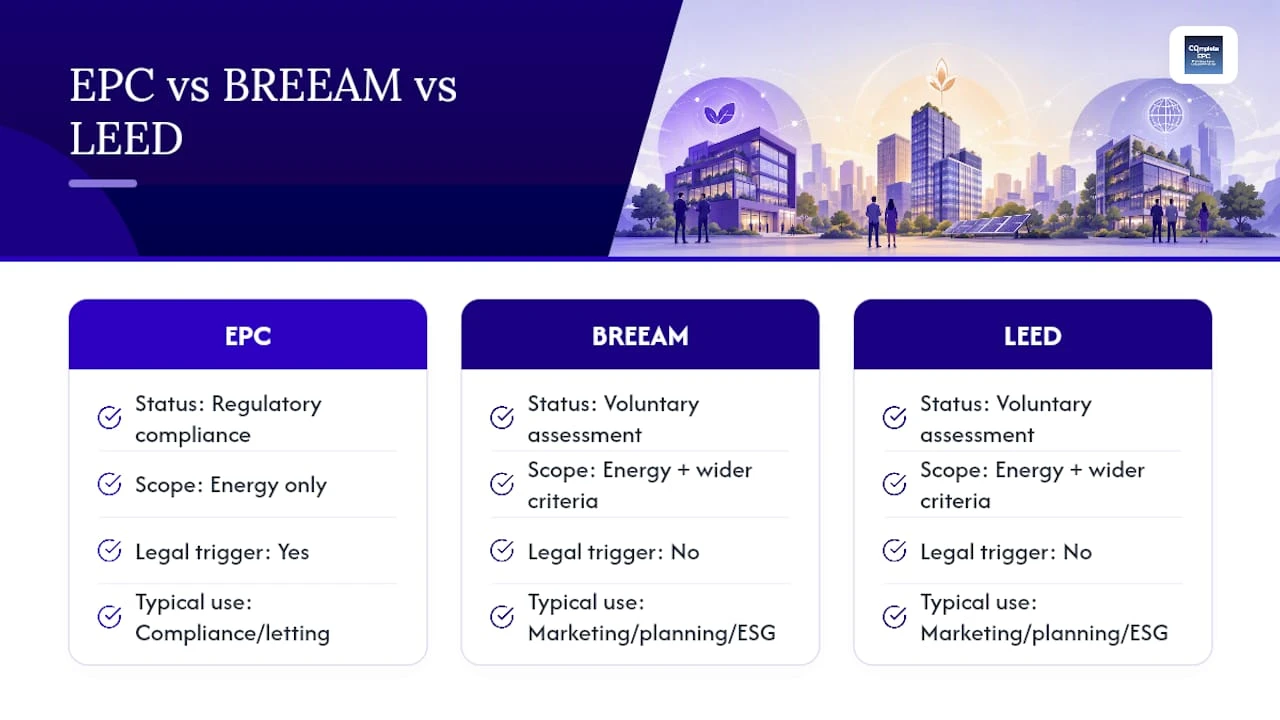
That said, the two overlap substantially on the energy side. A BREEAM assessment typically requires energy modelling data that closely mirrors what an SBEM or DSM assessment produces for the EPC, meaning the underlying building performance data can often feed both processes if commissioned together early in a project. Developers pursuing planning permission for larger commercial schemes increasingly find that an energy statement prepared for planning purposes shares significant technical groundwork with the eventual EPC assessment.
For landlords rather than developers, the practical takeaway is simpler: a strong EPC rating (B or A) is increasingly treated as a proxy signal for broader environmental performance by institutional investors and corporate tenants pursuing their own ESG reporting commitments, even where no formal green building certification exists on the asset. Getting the EPC right early isn’t just a compliance box tick; it’s increasingly part of how a building gets valued and let.
Future regulatory changes and the EPC policy roadmap
The direction of travel is unmistakable: tighter minimum standards, applied first to the largest and most energy-intensive commercial buildings. The government’s proposal to require EPC B for non‑domestic buildings over 1,000m² remains the single biggest change on the horizon, though it’s still subject to secondary legislation and hasn’t been given a confirmed enforcement date.
Owners of smaller commercial buildings shouldn’t assume they’re exempt from future tightening either; policy discussion has consistently flagged smaller thresholds as a likely second phase once the largest-building requirement beds in. Landlords planning capital works over the next five to ten years would do well to model for at least a B rating on larger assets, rather than treating the current E floor as a durable long-term target.
There’s also a quieter but consistent trend toward digitisation and register accuracy, with GOV.UK continuing to refine how certificates are lodged, verified, and cross-checked against Energy Performance of Buildings Data. For anyone managing a commercial project portfolio, the sensible approach is to treat every EPC commissioned today as a document that will need revisiting well before its ten-year expiry, not because the certificate itself will lapse early, but because the standard it’s measured against is very likely to move underneath it.
Practical lessons from delivering commercial EPCs
Three things consistently separate a smooth compliance process from a stressful one: checking the national register before instructing anyone, since a valid certificate might already exist; budgeting properly for DSM on complex buildings rather than being surprised mid‑project; and securing tenant consents for any works early, because that’s where timelines usually stall.
If you’re planning a commercial project and want to talk through what your building actually needs, get in touch with Complete EPC.
— Danny
How Complete EPC can help with your commercial project
Complete EPC is the practical alternative to juggling separate consultants for every compliance document your project needs. Instead of chasing a different specialist for your certificate, your SBEM calculation, and your overheating assessment, one team handles the Commercial EPC alongside related services including SAP Calculations, TM44 inspections, and TM59/TM52 assessments.
When you book an assessment, you get a site visit from an accredited non‑domestic assessor, a full recommendation report with indicative paybacks, certificate lodgement on the national register, and straightforward advice on MEES compliance or exemption eligibility where relevant. Pricing is guided by a lowest‑rate commitment against comparable UK providers, to avoid paying a premium for straightforward compliance work.
If you need a certificate for a sale, a letting, or a newly completed building, request a quote for your commercial EPC and get a realistic timeline before you commit to marketing.
FAQ
Do you need an EPC for a commercial building?
Yes, whenever the building is sold, let, or newly constructed and marketed for either. The duty falls on the seller or landlord, and GOV.UK confirms that failing to provide one can lead to fines between £500 and £5,000 depending on rateable value.
What are the EPC requirements for commercial properties?
The current legal minimum for granting or renewing a lease is EPC E, enforced under MEES. The government has proposed raising this to EPC B for buildings over 1,000m², though this hasn’t yet been confirmed in secondary legislation.
How much should a commercial EPC cost?
Cost depends heavily on the building’s size, complexity, and whether it needs SBEM or full Dynamic Simulation Modelling. Complete EPC doesn’t publish a fixed rate online, since accurate quotes depend on floor plans and services; current pricing is available directly through the Commercial EPC page.
Can you give me an example of a commercial project EPC?
A typical example is a landlord refurbishing a large office block before re‑letting: the assessor uses SBEM or DSM to model the building, issues an asset rating alongside a recommendation report listing measures like LED lighting and HVAC controls, and lodges the certificate on the national register before marketing begins.
What happens if my building fails the current MEES standard?
You can’t lawfully grant or renew a lease below EPC E unless a registered exemption applies, such as the 7‑year payback exemption. Most exemptions last five years before requiring reassessment.