

If you are letting or selling a shop, office, workshop or converted unit in London, you need a valid commercial EPC before you market it, and the rating on it decides whether you can let it at all. At Complete EPC, our qualified assessors produce commercial EPCs across London, and we also handle the SBEM and dynamic modelling work that sits behind more complex units. You can book a commercial EPC assessment directly. This guide explains what the assessment covers, when it is required, what moves the rating and how to prepare so the certificate reflects your unit properly.
TL;DR
- A commercial EPC is needed when a unit is let, sold or newly built, and when fixed heating, air conditioning or mechanical ventilation is added to a separately occupied part.
- Ratings run from A (most efficient) to G, and for lettings in England the legal minimum is band E.
- The rating comes from the building fabric and its services (heating, cooling, ventilation, lighting), not from the tenant’s appliances.
- Good paperwork matters: missing information forces the assessor to use cautious default assumptions that can pull the rating down.
- Certificates last 10 years, but a fine of £500 to £5,000 applies if one is not made available to a prospective buyer or tenant.
Table of Contents
- What a commercial unit EPC actually is
- When your unit needs an EPC
- What the rating means for letting: MEES
- How the assessment is carried out
- What to prepare before the assessor arrives
- What affects the rating of a retail unit or conversion
- Certificate validity and what happens after
- Our approach to commercial units
- Book your commercial unit EPC
- FAQ
- Sources
What a commercial unit EPC actually is
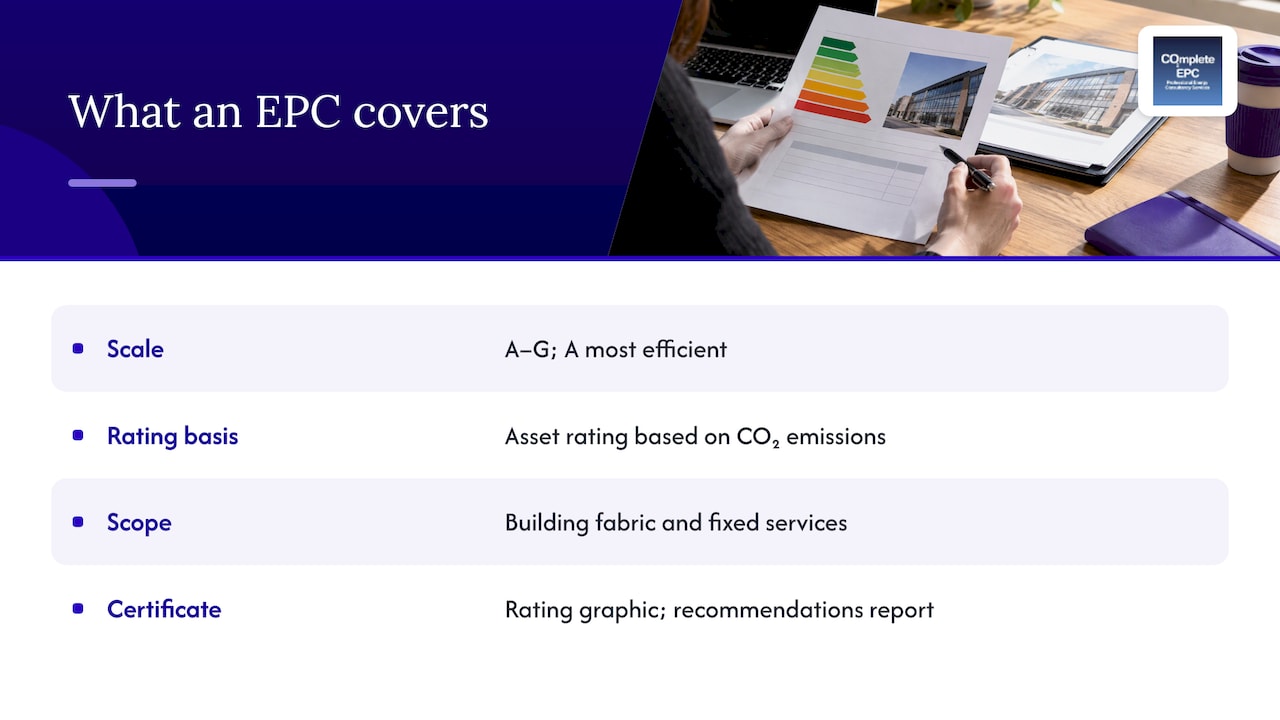
An Energy Performance Certificate (EPC) rates how energy efficient a building is on a scale of A to G, with A the most efficient, according to GOV.UK. For non-domestic property the rating is an asset rating based on CO2 emissions. It reflects the building itself, meaning its walls, roof, floors, glazing and its fixed services such as heating, ventilation and lighting, as set out in the government guide to EPCs for non-dwellings.
The certificate has two parts, as CIBSE Certification explains: a graphic showing the rating, and a recommendations report listing improvements. The rating does not judge how your tenant runs the business or what appliances they plug in. It judges what the unit is capable of given how it is built and serviced.
The same rules apply whether the premises are a corner shop in Walthamstow, an office floor in Holborn, a restaurant in Ealing or a warehouse unit in Enfield. What changes is the complexity of the assessment, which we cover below.
When your unit needs an EPC
GOV.UK states that you need an EPC for commercial premises when:
- you rent them out or sell them;
- a building under construction is completed;
- changes to separately occupied parts of a building involve providing or extending fixed heating, air conditioning or mechanical ventilation.
The official guidance adds a point that matters for retail: a shop unit in a shopping centre, or a single floor in an office building, can count as a part designed for separate occupation. That means it can need its own certificate. An EPC for one unit may be based on a similar representative unit in the same block.
If a unit has no fixed services to condition the indoor climate and nobody intends to install any, an EPC is not required. A fully unheated, unventilated shell is the typical example.
Commercial conversions
If you are converting a building to commercial use, for instance turning a former residential or industrial space into an office or café, the rule for completed construction and for new fixed services is the one to watch. Once the works finish and the unit has heating, cooling or mechanical ventilation, an EPC is needed before you let or sell. For new commercial builds and conversions, the calculation model used at design stage is SBEM, and it is worth having that work and the final EPC lined up so the figures agree.
Exemptions
The Energy Performance of Buildings Regulations exempt several building types, including:
- protected buildings where meeting the requirements would unacceptably alter them;
- places of worship;
- temporary buildings used for two years or less;
- low-energy industrial, workshop and non-residential agricultural buildings;
- stand-alone buildings under 50m².
GOV.UK also lists buildings due for demolition with the relevant consents. If your unit is on this list, you do not need a certificate. If you are unsure whether it qualifies, we can look at the specifics with you.
The penalty for not having one
Failing to make an EPC available to a prospective buyer or tenant can bring a fine of £500 to £5,000, based on the rateable value, per GOV.UK. Larger public-facing buildings have a further duty: a non-dwelling over 500m² that is frequently visited by the public must display a valid EPC if one has been made available.
What the rating means for letting: MEES
The Minimum Energy Efficiency Standard (MEES) is the rule that turns an EPC from paperwork into a commercial issue. Under DESNZ landlord guidance, the minimum for non-domestic lettings is band E. Since 1 April 2018 a landlord may not grant a new tenancy of an F or G rated property, and since 1 April 2023 may not continue letting one, subject to registered exemptions.
Three practical points follow for London landlords:
- Each unit needs its own certificate. The same guidance notes that individual retail units within larger buildings are required to have their own EPC.
- MEES applies where there is a lease. An owner-occupier is outside it, though still needs an EPC on sale.
- The method can move the band. The guidance notes that updates to EPC methodology can change a band even without improvement works, so a certificate lodged years ago may no longer tell you where you stand.
If your unit is currently F or G, the recommendations report is your route to E. Our team can explain which measures count and help you plan them. For the exact exemption rules, check the official guidance above before you let.
How the assessment is carried out
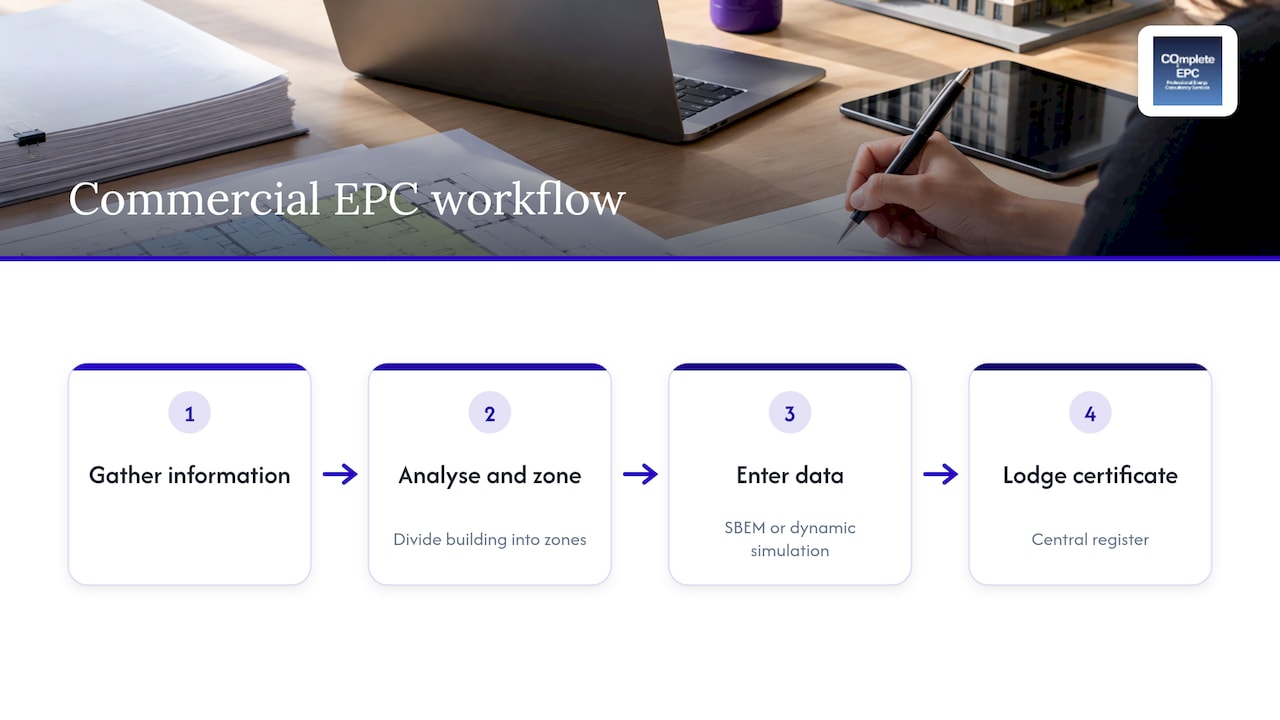
The government guide describes three stages: gathering building information, analysing the building and dividing it into zones, then entering the data into approved software. The software is either SBEM (the Simplified Building Energy Model) or, for more complex buildings, dynamic simulation modelling. The certificate is then lodged on the central register.
Three assessor levels
Commercial assessors work at different levels depending on the building. In broad terms:
| Level | Typical building | Method |
|---|---|---|
| Level 3 | Simple existing buildings such as small shops and restaurants | SBEM |
| Level 4 | Complex heating and ventilation, or new builds such as large offices and shops | SBEM |
| Level 5 | Buildings needing in-depth modelling, such as atria and complex ventilation | Dynamic simulation |
The split between levels is described by Elmhurst Energy’s guidance on commercial EPCs. Most high street shops and small offices in London fall into the simpler levels. A glass-fronted building with a central atrium is the kind that moves up.
What the assessor looks at
CIBSE Certification lists what an assessor may need: building size and the areas used for different activities, insulation levels, heating systems, how fresh air moves through the building, cooling, hot water, controls or building management systems, electricity supply, lighting, any on-site generation and how the building is used.
On a typical small unit, the site visit is a walk-round to measure and record these points. Larger multi-zone buildings take longer because each zone is recorded separately.
Conventions the assessor must follow
In England and Wales, assessors follow the non-domestic EPC conventions approved by DLUHC. These require assessors to avoid default values where possible and to record evidence for any default they use. They also contain specific rules for individual shop units in shopping centres with local heating plus central fresh air, which is a common London arrangement.
What to prepare before the assessor arrives
The quality of an EPC depends heavily on the information available. The Better Buildings Partnership’s guidance on energy performance standards notes that where an assessor cannot obtain information from the building team or from inspection, they must rely on assumptions that generally reflect worst-case scenarios. A poor assumption becomes a poorer rating.
Gather this before the visit:
- Floor plans and elevations, to scale if you have them, including any recent alterations or fit-out drawings.
- Access to every area, including plant rooms, roof spaces, back-of-house rooms and any space a tenant occupies. If the unit is let, tell the tenant in advance so nobody is locked out.
- Services information: boiler or heat pump details, heating and cooling by zone, ventilation, lighting types, fuel types and any building management system documents.
- Construction details: the year of build, wall and roof construction, glazing type, and any insulation work with dates.
- Previous certificates and reports, such as an air conditioning inspection or earlier EPC, so the assessor can see what has changed.
If you are the landlord of a shell-only unit and the tenant has installed the services, ask them for the equipment details. Having these ready means the assessor records the real installation rather than a cautious default.
What affects the rating of a retail unit or conversion
The rating compares your unit against a reference building of the same size, shape and use, according to the government guide. The main drivers are:
- Fabric: wall, roof and floor construction, and glazing.
- Zones and use: how each part is used and how it is occupied.
- Systems: heating, cooling, ventilation, hot water and lighting.
Two points surprise owners. First, fuel type now counts differently. Since the June 2022 change to the calculation method under Building Regulations Part L, the carbon factor for electricity has fallen to around a third of its earlier value and is now lower than gas, as set out in the Currie & Brown study for the Investment Property Federation. A unit heated electrically can therefore score better than it once did.
Second, the landlord’s influence depends on the lease. The same study observes that a landlord letting a shell-only retail unit has limited control over the services, since the occupier installs them, so the landlord’s main lever is the thermal performance of the fabric.
Practical ways to lift a rating
The recommendations report groups improvements by payback and marks them as low, medium or high impact. Common measures for London units include upgrading lighting, improving controls, insulating roof spaces and replacing ageing heating plant. Heating equipment is often the largest single factor, and why boiler efficiency matters applies to a small commercial unit with a gas boiler just as it does to a home. If you replace plant or add air conditioning, the new certificate should be commissioned after the works so it captures the improvement.
If the unit has air conditioning systems above the regulated size, a separate TM44 air conditioning inspection is a related requirement we also carry out.
Certificate validity and what happens after
An EPC is valid for 10 years, per GOV.UK. You can reuse it for new lettings or a sale within that period, unless you have made changes that affect the building’s energy performance or you want to reflect improvements in a better rating. After a recommendation is acted on, a fresh assessment records the new position, which matters if you are working towards band E to remain lettable.
Our approach to commercial units
Perspective
The section below is our own view.
Most commercial EPC problems we want to prevent start before the visit. A landlord books late, the plant details are in a tenant’s filing cabinet, and the certificate arrives with a rating no one expected. Our assessors are qualified and work across London, so a unit in a parade in Haringey, a converted warehouse in Hackney or an office floor in Hammersmith is recorded by someone who knows how these buildings are typically put together.
Our view is that the best EPC is the one you plan: confirm whether your unit needs one, collect the services information, and decide in advance whether the work is a straightforward SBEM job or something that needs dynamic modelling. We cover all of those routes, including SBEM for new commercial space, dynamic simulation, TM44 inspections and overheating analysis, so a conversion project does not need several separate providers.
We also stand behind our pricing. Our own positioning is a UK lowest-rate guarantee, with competitive fees for domestic and commercial work.
Danny
Book your commercial unit EPC
We provide commercial EPCs for shops, offices, restaurants, workshops and converted units across London, with SBEM and dynamic simulation modelling available when a project needs it. Pricing is not published on our site, so tell us the unit’s size, use and location and we will quote for it.
Start with our commercial EPC page, or visit Complete EPC to see the full range, including EICR and PAT testing for landlords who want their compliance handled together.
FAQ
Does every retail unit need its own EPC?
Usually, yes, when it is let or sold. Official guidance says a retail unit in a shopping centre can count as a part designed for separate occupation, and MEES guidance notes that individual retail units in larger buildings need their own EPC. The assessor may base a single unit’s certificate on a similar representative unit in the same block.
How long does a commercial EPC last?
All EPCs are valid for 10 years, according to GOV.UK. You can use the same certificate for several lettings or a sale in that period. Many owners commission a new one after significant works, such as new heating or lighting, so the rating reflects the improvement.
Do I need an EPC for business premises I occupy myself?
Not for occupying alone. The requirement is triggered by renting out, selling, completing construction, or adding fixed heating, cooling or ventilation to a separately occupied part. MEES applies only where there is a lease, so owner-occupied premises fall outside it, though a sale would still need an EPC.
What happens if my unit is rated F or G?
For lettings in England and Wales, the minimum is band E, so an F or G rated unit cannot lawfully be let unless a registered exemption applies. The recommendations report on your certificate shows the improvements to consider. We can help you plan them and reassess once the work is done.
Sources
- GOV.UK: Energy Performance Certificates for your business premises
- Government guide to EPCs for the construction, sale and let of non-dwellings
- The Energy Performance of Buildings (England and Wales) Regulations 2012
- DESNZ non-domestic private rented property minimum standard: landlord guidance
- CIBSE Certification: Energy Performance Certificates
- Non-domestic EPC conventions for England and Wales, Issue 8
- Better Buildings Partnership: GN 4.2 Energy performance standards
- Currie & Brown: Costing Energy Efficiency Improvements in Existing Buildings (IPF, April 2024)
- Elmhurst Energy: Commercial EPCs