

For residential landlords in London, keeping up with energy efficiency rules can feel like a maze. Increasing demand for transparent property performance means understanding the difference between a Display Energy Certificate and other energy documents is vital. By grasping the real meaning and core purpose of a Display Energy Certificate (DEC), landlords not only stay compliant but also gain practical insight to protect property value and attract environmentally conscious tenants.
Table of Contents
- DEC Certificate Meaning And Core Purpose
- Who Requires A DEC Certificate In London
- How A DEC Is Assessed And Displayed
- Legal Obligations And Renewal Timelines
- Costs, Penalties, And Common Mistakes
- DEC Versus EPC Explained For Landlords
Key Takeaways
| Point | Details |
|---|---|
| DEC Purpose | Display Energy Certificates are essential for public buildings in the UK, focusing on actual energy performance to enhance transparency and accountability. |
| Legal Requirements | Public buildings over 250 square metres must hold and display a DEC, which needs to be renewed annually to comply with legal standards. |
| Costs and Penalties | Obtaining a DEC involves assessment fees and renewal costs; non-compliance can lead to penalties ranging from £500 to £5,000. |
| Differentiation from EPCs | DECs apply specifically to public buildings and assess actual energy consumption, whereas Energy Performance Certificates focus on theoretical efficiency for residential properties. |
DEC certificate meaning and core purpose
A Display Energy Certificate (DEC) is a crucial document that reveals the actual energy performance of public buildings in the United Kingdom. Unlike standard Energy Performance Certificates (EPCs), DECs focus on real-world energy consumption rather than theoretical efficiency ratings.
The primary purpose of a DEC is to provide transparency about a building’s energy usage by displaying its operational energy performance. These certificates are mandatory for public buildings with a total floor area over 250 square metres that are frequently visited by the public. Key characteristics include:
- Displays actual energy consumption figures
- Updated annually based on real energy usage data
- Rated on an A-G scale, similar to household appliance ratings
- Prominently displayed in public areas to promote energy awareness
DEC certificates play a significant role in encouraging energy efficiency across public sector buildings. Humanitarian emergency response organisations understand the importance of systematic reporting, and similarly, these certificates provide a systematic approach to tracking and improving building energy performance.
The rating system provides a clear visual representation of a building’s energy efficiency, helping building managers and visitors understand current performance levels. By making energy consumption transparent, DECs motivate organisations to implement energy-saving strategies and reduce their carbon footprint.
Pro tip: Request a professional DEC assessment to identify potential energy-saving opportunities and improve your building’s environmental performance.
Who requires a DEC certificate in London
In London, Display Energy Certificates (DECs) are mandatory for specific types of public buildings and organisations. These certificates primarily target buildings that are frequently accessed by the public and have a substantial floor area, ensuring transparency in energy consumption across various sectors.
The key categories of buildings and organisations required to obtain a DEC certificate include:
- Public sector buildings over 250 square metres
- Government administrative offices
- Educational institutions like schools and universities
- Hospitals and healthcare facilities
- Museums and public libraries
- Community centres and sports facilities
- Local authority buildings
Specifically for London, certain business activities require safety permits that may intersect with DEC requirements. Transport and infrastructure organisations, particularly those managing large public spaces, must ensure they have appropriate energy performance documentation.
The regulations are particularly stringent for buildings that serve a high volume of public visitors. Each building must prominently display its DEC rating, which provides immediate insight into its energy efficiency and encourages ongoing improvements in environmental performance.
Buildings falling under these categories must renew their DEC annually to maintain compliance and demonstrate ongoing commitment to energy efficiency.
Additionally, heavy goods vehicle operators in Greater London must obtain specific safety permits, which underscores the city’s comprehensive approach to regulated documentation across various sectors.
Pro tip: Consult a professional energy assessor to determine whether your London-based building requires a Display Energy Certificate and ensure full regulatory compliance.
How a DEC is assessed and displayed
A Display Energy Certificate (DEC) assessment is a comprehensive process that involves detailed analysis of a building’s actual energy consumption and performance. Qualified energy assessors conduct thorough on-site evaluations to gather precise data about the building’s energy usage, infrastructure, and operational characteristics.
The assessment process typically involves several critical steps:
- Collecting 12 months of actual energy consumption data
- Measuring total floor area of the building
- Conducting a detailed physical inspection of energy systems
- Calculating energy performance based on real-world usage
- Generating a rating from A (most efficient) to G (least efficient)
- Preparing a supporting recommendations report
The resulting certificate must be publicly displayed in a prominent location, typically near the building’s main entrance or reception area. This transparency requirement ensures that visitors and occupants can immediately understand the building’s energy performance.
The energy rating is calculated by comparing actual energy consumption against standard benchmarks for similar building types, providing a realistic assessment of performance.
Certificate assessments follow rigorous accountability frameworks that ensure accuracy and reliability. Professional assessors must be accredited and follow standardised methodologies to maintain the integrity of the certification process.

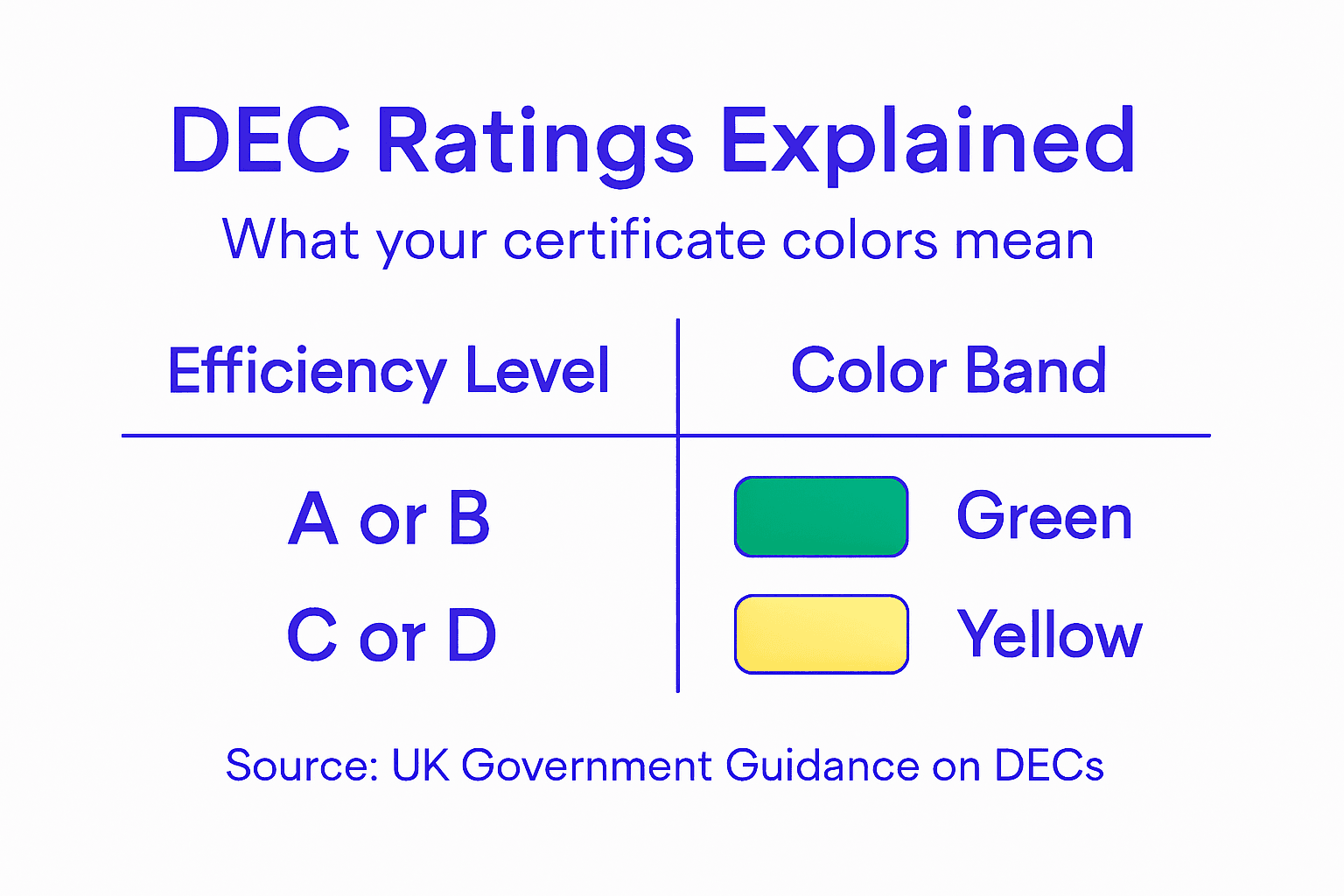
The visual display typically includes a coloured chart resembling household appliance ratings, with clear indicators showing the building’s current energy efficiency level and potential for improvement. This graphical representation makes complex energy data immediately understandable to non-technical audiences.
Pro tip: Request a comprehensive energy performance review alongside your DEC assessment to identify specific strategies for improving your building’s energy efficiency.
Legal obligations and renewal timelines
Display Energy Certificates (DECs) in London come with specific legal obligations that property owners must carefully navigate. These certificates are not simply optional documents but mandatory compliance requirements for public buildings, with clear regulatory frameworks governing their issuance and maintenance.
The key legal requirements for DEC certificates include:
- Annual renewal mandatory for all public buildings over 250 square metres
- Prominent display required in main public entrance areas
- Penalties for non-compliance ranging from £500 to £5,000
- Mandatory for buildings frequently visited by the public
- Must be updated with current 12-month energy consumption data
- Renewable within 10 months of previous certificate expiration
Regulatory oversight ensures comprehensive accountability through systematic reviews and verification processes. The renewal timeline is strictly enforced, with professional assessors conducting thorough evaluations to maintain the integrity of energy performance documentation.
Failure to obtain or display a valid DEC can result in significant financial penalties and potential legal enforcement actions.
Professional organisations and board-level governance play crucial roles in maintaining compliance standards. Trustees and regulatory bodies continuously monitor and enforce these legal requirements, ensuring that organisations meet their energy performance and reporting obligations.
The renewal process involves comprehensive documentation, including detailed energy consumption records, building infrastructure assessments, and verification of previous recommendations’ implementation. Building managers must proactively manage these timelines to avoid potential legal complications.
Here is a summary of main factors influencing DEC renewal and compliance for public buildings in London:
| Factor | Description | Impact if Neglected |
|---|---|---|
| Renewal timeline | Annual, strict deadline | Financial penalties up to £5,000 |
| Public display | Required at main entrance | Risk of legal enforcement actions |
| Documentation | Complete energy records needed | Assessment delays, additional costs |
| Recommendations | Addressed in follow-up reviews | Enhanced scrutiny by regulators |
Pro tip: Schedule your DEC assessment at least two months before expiration to ensure seamless renewal and maintain continuous legal compliance.
Costs, penalties, and common mistakes
Display Energy Certificates (DECs) involve various financial implications and potential penalties that property managers in London must carefully understand. The costs associated with obtaining and maintaining these certificates can vary depending on the building’s size, complexity, and specific energy assessment requirements.
Key financial considerations and potential penalties include:
- Initial assessment costs ranging from £100 to £500
- Annual renewal fees typically between £150 and £350
- Non-compliance penalties from £500 to £5,000
- Potential legal enforcement actions for repeated violations
- Additional costs for rectifying energy performance recommendations
- Potential impact on property valuation and rental potential
Regulatory bodies carefully monitor compliance with strict enforcement mechanisms. The financial risks of non-compliance can significantly outweigh the initial certificate costs, making proactive management crucial for building owners.
Neglecting DEC requirements can result in escalating penalties and potential legal complications that far exceed the cost of obtaining the certificate.
Common mistakes organisations make include inefficient fund allocation and documentation delays. These errors can lead to increased scrutiny, potential fines, and compromised operational status. Building managers must maintain meticulous records and ensure timely renewals to avoid unnecessary financial penalties.
The assessment process requires comprehensive documentation, including detailed energy consumption records, infrastructure evaluations, and proof of previous recommendations’ implementation. Incomplete or inaccurate documentation can trigger additional costs and potential regulatory interventions.
Pro tip: Budget for DEC assessment and potential improvement costs as part of your annual building maintenance strategy to avoid unexpected financial burdens.
DEC versus EPC explained for landlords
Display Energy Certificates (DECs) and Energy Performance Certificates (EPCs) are frequently confused, but they serve distinctly different purposes for London property owners. While they might sound similar, these certificates have unique applications and legal requirements that landlords must understand carefully.
Key differences between DECs and EPCs include:
- Purpose of certification
- Target building types
- Legal requirements
- Assessment methodologies
- Validity and renewal periods
- Intended audiences
Energy Performance Certificates are mandatory for landlords renting out properties, with specific legal implications. EPCs provide a comprehensive energy efficiency rating from A to G, directly impacting rental potential and property valuation.
Landlords must recognise that confusing these certificates can lead to significant legal and financial complications.
Display Energy Certificates, by contrast, primarily apply to public sector buildings and focus on actual energy consumption rather than theoretical efficiency. Unlike EPCs, which are critical for residential rentals, DECs are typically required for buildings frequently accessed by the public, such as government offices, schools, and hospitals.
Below is a concise comparison of Display Energy Certificates (DEC) versus Energy Performance Certificates (EPC):
| Certificate Type | Applies To | Assessment Basis | Validity Period |
|---|---|---|---|
| DEC | Public buildings | Actual energy consumption | 1 year |
| EPC | Residential properties | Theoretical building efficiency | 10 years |
The regulatory landscape means landlords must carefully understand property energy documentation to ensure full compliance. EPCs are directly relevant to residential lettings, with minimum efficiency standards progressively becoming more stringent.
Pro tip: Consult a professional energy assessor to clarify which certificates are specifically required for your London property portfolio.
Ensure Your London Building Meets DEC Requirements with Expert Support
Understanding the importance of a Display Energy Certificate in London means recognising key challenges such as strict annual renewals, the need for accurate energy consumption data, and avoiding costly penalties up to £5,000. Whether you manage a public sector building, educational institution, or healthcare facility, navigating legal obligations and maintaining a prominent energy performance display can be overwhelming.
At Complete EPC, we specialise in assisting property owners and managers to achieve full compliance seamlessly. Our qualified energy assessors provide precise DEC assessments backed by detailed reports and tailored recommendations. We help you tackle the common pitfalls of documentation delays and inefficient fund allocation so you can focus on improving your building’s energy efficiency and reducing your carbon footprint.
Act now to secure your DEC certification before renewal deadlines arrive. Visit Complete EPC to book your assessment today and benefit from competitive pricing alongside professional service. Don’t risk penalties or enforcement action—ensure your London property is fully compliant with confidence and expert support.
Frequently Asked Questions
What is a Display Energy Certificate (DEC)?
A Display Energy Certificate (DEC) is a document that provides information about the actual energy performance of public buildings in the UK, focusing on real-world energy consumption rather than theoretical efficiency ratings.
Who is required to obtain a DEC in London?
DECs are mandatory for public sector buildings over 250 square metres that are frequently visited by the public, including government offices, schools, hospitals, and community centres.
How is a DEC assessed and displayed?
A DEC is assessed through a thorough evaluation of a building’s actual energy consumption and performance by a qualified energy assessor, with results displayed prominently in public areas of the building.
What are the legal obligations regarding DEC renewals?
Public buildings must renew their DEC annually, prominently display it in the main entrance area, and face penalties ranging from £500 to £5,000 for non-compliance.
Recommended
- Why an EPC Certificate Is Essential for London Homeowners – Complete EPC
- The Essential London Guide to Energy Performance Certificates: Save Money and the Environment – Complete EPC
- Unlocking Energy Savings in London: Your Guide to EPC Certificates – Complete EPC
- EPC vs DEC Certificate: Complete UK Guide – Complete EPC