

The definition of energy assessor is straightforward: a qualified, accredited professional who inspects a building, records its energy-related features, and produces an Energy Performance Certificate (EPC) alongside a recommendation report. The two main outputs are the certificate itself and a list of prioritised improvements. You’ll typically find an assessor commissioned by:
- Homeowners selling or improving a property
- Landlords meeting rental compliance duties
- Estate agents preparing a listing
- Solicitors handling property transactions
Key Takeaways
An energy assessor’s authority comes from active accreditation scheme membership, not qualification alone, and their value lies in translating on-site evidence into a defensible EPC and prioritised improvement plan.
| Point | Details |
|---|---|
| Accreditation is mandatory | Only assessors with active scheme membership can lawfully lodge an EPC on the national register. |
| Two routes to registration | Formal Level 3 qualification or the APEL route for experienced practitioners with documented evidence. |
| Visits are non-invasive | Domestic assessments last 30 to 60 minutes and rely on visible evidence, not invasive checks. |
| Records must be traceable | Assessors must justify every value entered, including cases marked as “unknown”. |
| Complete EPC offers accredited assessors | Completeepc provides domestic and commercial EPCs across London with competitively priced, accredited assessments. |
Table of Contents
- What does an energy assessor do during an inspection?
- What qualifications does an energy assessor need?
- How does the energy assessment process work?
- What does an EPC report actually include?
- Which improvements do assessors recommend most often?
- What legal duties do energy assessors have?
- Are there different types of energy assessor?
- Who is legally required to commission an assessment?
- When exactly do you need to book an assessment?
- What does an energy assessment typically cost?
- How should you prepare for the assessment visit?
- What people get wrong about hiring an energy assessor
- Book a domestic EPC with Complete EPC
- Sources
- FAQ
What does an energy assessor do during an inspection?
An assessor’s job is observation and translation. They record what’s physically present in a building, then convert those observations into the standard inputs required by the UK’s official calculation methodologies: RdSAP for homes and SBEM for commercial buildings.
On a typical visit, an assessor checks:
- Heating system type, age and controls
- Insulation levels in the loft, walls and floor
- Window types and glazing (single, double, or secondary)
- Hot water system and cylinder insulation
- Lighting types and fixed services
- Room dimensions and floor areas
Assessments are non-invasive. An assessor won’t lift floorboards or drill into walls; they work from visible evidence, supported by National Occupational Standards that require thorough visual inspection and accurate measurement to justify every RdSAP entry.
A domestic visit generally takes 30 to 60 minutes, though loft access issues, unusual construction methods, or complicated heating setups can extend that.
Pro Tip: Clear access to your loft hatch and boiler cupboard before the assessor arrives. Blocked access is one of the most common reasons visits overrun.
What qualifications does an energy assessor need?
Not every energy adviser is legally entitled to issue a certificate. To lawfully lodge an EPC on the national register, an individual must hold active membership of an approved accreditation scheme — qualification alone doesn’t grant that right.
Two main routes lead to accreditation:
- Formal qualification, most commonly a Level 3 Certificate for Domestic Energy Assessors, built around National Occupational Standards for inspection and reporting.
- Accreditation of Prior Experiential Learning (APEL), which suits experienced practitioners without a formal qualification. This route requires documented evidence, assessed practical experience, and adherence to strict scheme criteria, including demonstrable competence with the relevant software.
Accreditation isn’t a one-off badge. Schemes require ongoing continuing professional development and are themselves subject to external monitoring, so the standard an assessor was trained to keeps being checked. If you want to verify someone’s status before booking, ask for their scheme membership number. A legitimate assessor will give it without hesitation.
How does the energy assessment process work?
The process runs in three phases: booking, the site visit, and post-visit reporting.
- Booking. You provide the property address, access details, and sometimes photos or floor plans in advance, which speeds up the visit.
- On-site inspection. The assessor arrives, works through the property systematically, records measurements, and photographs or notes evidence for anything non-standard, such as an unusual insulation type or a non-metered heating system.
- Data entry. Back at their desk, the assessor enters findings into government-approved software using the RdSAP or SBEM methodology, depending on the building type.
- Certificate issue and registration. Once calculated, the EPC is generated and lodged on the national register, making it publicly searchable against the property address.
For a typical domestic property, the full process, from visit to a registered certificate landing in your inbox, usually completes within a few working days. Larger commercial buildings assessed under SBEM tend to take longer, since the assessor must collate more building-services detail before producing a defensible result. If you need a certificate before exchanging contracts or listing a tenancy, book with enough lead time to absorb any delay caused by access problems or complex construction.
What does an EPC report actually include?
An EPC gives you two distinct pieces of information: a rating and a route to improve it.
- The asset rating. A band from A to G showing the property’s estimated energy efficiency, plus estimated annual energy costs and, where included, CO2 emissions.
- The recommendation report. A prioritised list of improvement measures, often framed by potential cost-effectiveness rather than a guaranteed payback figure.
Recommendations are ordered by practical impact. Industry guidance notes that assessors increasingly act as advisers, turning a compliance document into a genuine improvement roadmap rather than a box-ticking exercise.
Different readers use the same certificate for different purposes. A seller uses it to satisfy a legal disclosure requirement. A landlord uses it to check against minimum efficiency thresholds. A buyer uses the recommendations to budget for retrofit work before moving in.
Which improvements do assessors recommend most often?
Recommendation reports tend to repeat a handful of measures because they consistently deliver the best return for the least disruption:
- Loft and cavity wall insulation top-ups
- Boiler servicing or replacement with a more efficient model
- Upgrading single glazing to double glazing
- Installing efficient heating controls, such as thermostatic radiator valves
- Switching to LED lighting throughout
Assessors generally prioritise low-cost, high-impact measures first, since that approach increases uptake and delivers savings sooner than pushing straight to expensive structural work. Once you’ve reviewed the report, the practical next step is finding a qualified installer and checking whether any local grant or scheme covers part of the cost. Alphasolar’s energy efficiency guidance for homeowners is a useful companion read when weighing which measure to tackle first.
What legal duties do energy assessors have?
Accreditation comes with binding professional obligations, not just a certificate to frame.
- Assessors must exercise reasonable care and skill throughout the inspection and calculation.
- Any business or personal relationship with the property or its owner must be disclosed to avoid a conflict of interest.
- Only assessors with active accreditation scheme membership may lodge a certificate; a qualification without live membership is not sufficient.
- Assessors must keep traceable records explaining why specific values were entered, including cases where information was recorded as “unknown” rather than guessed.
That record-keeping matters more than it might sound. If a certificate is later challenged, whether by a buyer, a local authority, or the accreditation scheme itself, the paper trail is what proves the rating was defensible rather than assumed.
Are there different types of energy assessor?
Yes, and the distinction matters because the wrong specialist can’t legally issue the certificate you need. Three main categories exist:
Domestic Energy Assessors handle houses and flats, using RdSAP to produce the standard residential EPC. This is the category most homeowners and landlords will deal with.
Non-Domestic (Commercial) Energy Assessors cover offices, shops, warehouses and other commercial buildings. For existing buildings, they use SBEM, inspecting fabric and services and collating on-site and off-site information in line with the relevant national regulations. Commercial assessments generally take longer than domestic ones because building services are more complex.

Air-Conditioning Energy Assessors specialise in inspecting systems rated over 12kW, producing a distinct inspection report rather than a standard EPC. This category exists because air-conditioning efficiency is assessed separately from general building fabric.
Each category requires its own qualification pathway and accreditation, so a domestic assessor can’t simply issue a commercial certificate on the strength of residential training. If you’re unsure which category your property needs, check whether the building is used wholly for residential purposes; mixed-use buildings sometimes need both.
Who is legally required to commission an assessment?
The legal duty to obtain an EPC falls on whoever is marketing or letting the property, not on the assessor.
Property sellers must make a valid EPC available to prospective buyers before marketing begins, and estate agents will typically insist on this before listing.
Landlords must have a valid EPC in place before a new tenancy starts, and it must be provided to prospective tenants. Certificates remain valid for ten years unless the property changes materially in that time.
Developers and those carrying out major renovations affecting a significant proportion of a building’s envelope may trigger a fresh assessment requirement, since substantial changes to insulation or heating systems can shift the property into a different efficiency band.
Solicitors handling a sale will usually check for a valid, in-date EPC as a standard part of conveyancing, so gaps here can delay completion. If you’re a homeowner not currently selling or letting, you’re under no legal obligation to commission one at all, though many choose to anyway ahead of major works, simply to have a clear baseline.
When exactly do you need to book an assessment?
Three triggers cover almost every situation where a certificate becomes mandatory.
Selling a property. An EPC must exist before the property goes on the market; without one, agents can struggle to list it properly.
Letting a property. A new or renewed tenancy agreement requires a valid EPC in place beforehand, and an expired certificate needs renewing before the next let.
Major renovation or extension. Significant changes to a building’s thermal envelope, extensions, wholesale insulation upgrades, or heating system replacements, can require a new assessment to reflect the property’s revised performance.
Outside these triggers, an EPC from a previous assessment generally remains valid for its full ten-year term, so there’s no need to repeat the process unless one of the above situations arises or the certificate lapses. Landlords managing several properties often find it easier to track expiry dates centrally rather than reacting to each one individually, since a lapsed certificate at the point of a new tenancy can hold up move-in dates.
What does an energy assessment typically cost?
Pricing varies by property size, location and the assessor’s coverage area, but a few factors consistently drive the cost up or down. Larger properties take longer to inspect and calculate, so they generally cost more than a one-bedroom flat. Access difficulties, such as a loft that needs a ladder and extra time, or a property spread across several outbuildings, can also push the price up compared with a straightforward terrace.
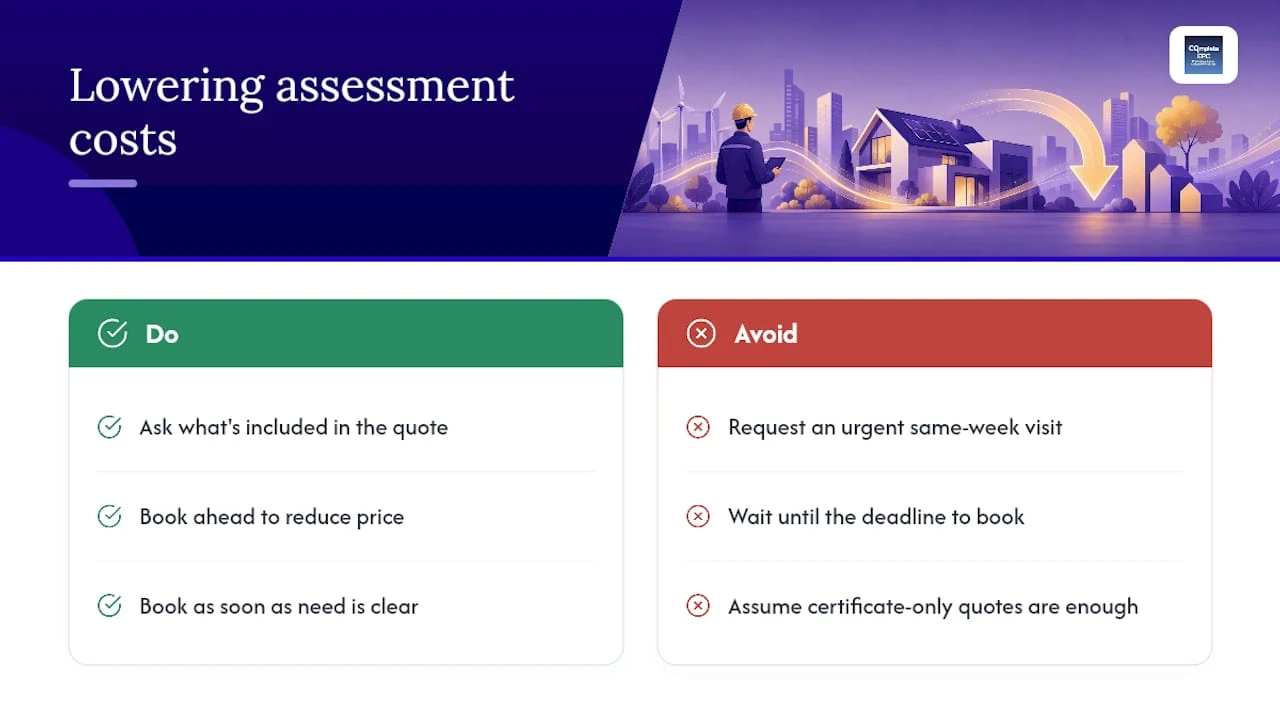
Commercial assessments using SBEM tend to cost more than domestic RdSAP assessments, reflecting the additional time needed to collate building-services information across a larger, more complex site. If you’re comparing quotes, ask exactly what’s included: some quotes cover only the certificate, while others bundle in a written recommendation report with more detail than the standard summary.
Booking ahead rather than requesting an urgent same-week visit typically works out cheaper too, since assessors can plan routes more efficiently when they’re not squeezing in a last-minute appointment. If a fixed completion date is looming, whether that’s a sale exchange or a new tenancy start, it’s worth booking as soon as the need becomes clear rather than waiting until the deadline is close.
How should you prepare for the assessment visit?
A little preparation shortens the visit and avoids a second trip. Clear access to the loft hatch, the boiler cupboard, and any external meter boxes before the assessor arrives. If insulation was added after the property was built, dig out any paperwork or receipts. It gives the assessor evidence to record rather than leaving a value as “unknown.”
Make sure someone who knows the property, ideally the owner or a tenant familiar with the heating system, is available to answer questions about installation dates or previous upgrades. If rooms are cluttered with furniture blocking windows or radiators, a quick tidy speeds up measurements considerably. For rented properties, giving tenants proper notice of the visit avoids access disputes on the day.
Finally, have the property address and any previous EPC reference number ready when booking. It helps the assessor check whether they’re updating an existing record or starting fresh.
What people get wrong about hiring an energy assessor
Most people treat the EPC as a one-off compliance hurdle, something to obtain and forget. That’s the single biggest misjudgement in how this process gets used. The certificate is genuinely more useful as a diagnostic tool than as a piece of paperwork, particularly the recommendation report, which most sellers and landlords barely glance at once the certificate is issued.
The conventional advice, “just get the cheapest EPC you can find”, also misses what actually protects you. Price matters less than whether the assessor holds active accreditation scheme membership and keeps proper records. A certificate built on sloppy record-keeping is one that falls apart under later scrutiny, whether from a buyer’s solicitor or the accreditation scheme itself.
If you take one thing from this article, prioritise verifying accreditation status before comparing prices. A cheap certificate from an unaccredited assessor isn’t valid at all; it can’t be lodged, which makes the saving worthless.
Book a domestic EPC with Complete EPC
If you need a certificate that stands up to scrutiny rather than a rushed compliance tick, Completeepc gives you accredited assessors covering domestic and commercial properties across London, with pricing built to be among the most competitive in the market rather than an afterthought bolted onto the invoice. Booking is straightforward: you provide the property address and access details, an assessor visits at a time that suits you, and you receive a registered certificate with a clear recommendation report, not just a rating on a page.
Every assessor working for Completeepc holds active scheme membership and keeps the kind of traceable records that hold up if a certificate is ever queried down the line. Start your booking on the domestic EPC page and get a fixed quote before you commit to a date.
Sources
- Domestic energy assessor | National Careers Service
- Energy assessors and accreditation schemes | Department of Finance (NI)
- Energy assessors – APEL framework (government publication)
- National Occupational Standards for energy inspection (RDSAP)
FAQ
What is the definition of an energy assessor?
An energy assessor is a qualified, accredited professional who inspects a building and produces an Energy Performance Certificate along with a prioritised recommendation report.
How do I check if an energy assessor is accredited?
Ask for their accreditation scheme membership number; a legitimate assessor holds active membership, which you can typically verify through the scheme directly.
What’s the difference between an energy assessor and an energy auditor?
An energy assessor produces a statutory EPC using standardised methodologies like RdSAP or SBEM, while an energy auditor often carries out a broader, non-statutory efficiency review without issuing a legal certificate.
How long does a domestic energy assessment take?
A typical domestic visit lasts between 30 and 60 minutes, though complex properties or restricted access can extend that.
Can I become an energy assessor without a formal qualification?
Yes, through the Accreditation of Prior Experiential Learning route, which requires documented evidence of relevant experience and assessment against strict scheme criteria.
Who books an EPC for a rental property?
The landlord is legally responsible for having a valid EPC in place before a new tenancy begins; Completeepc’s domestic EPC service covers this booking process for London landlords.