
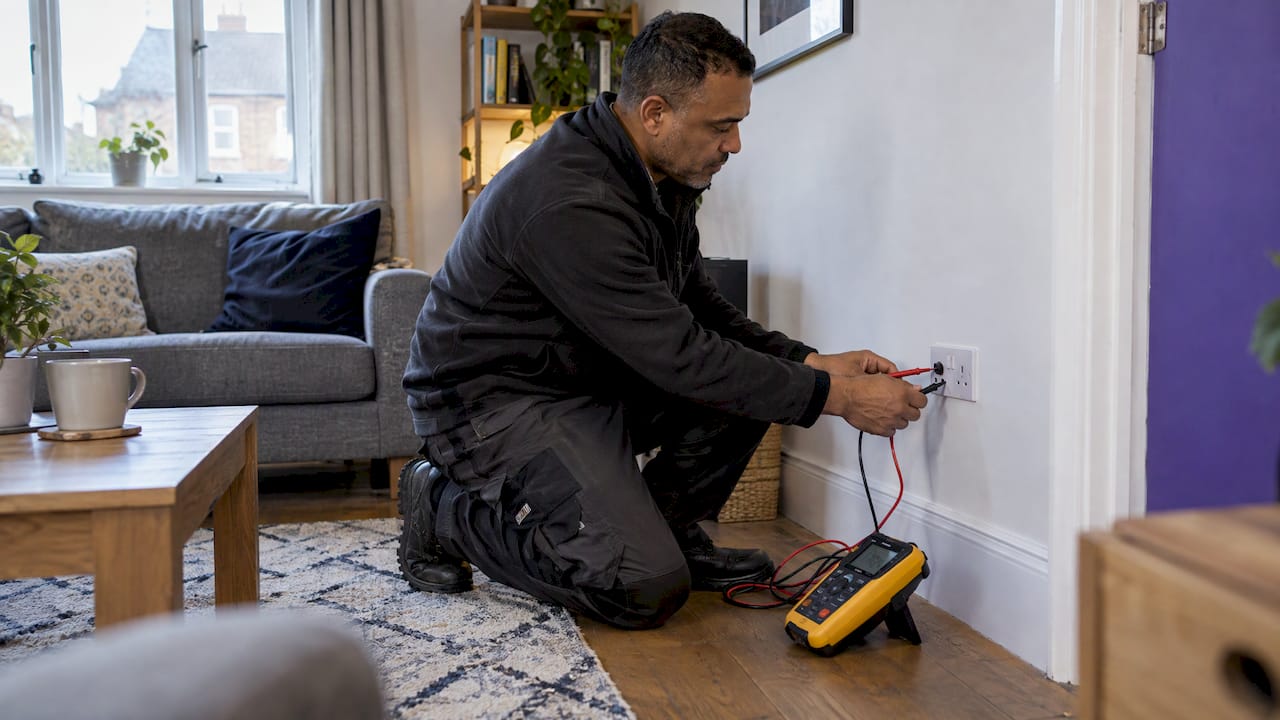
An EICR (Electrical Installation Condition Report) is the formal record of an inspection and test of the fixed electrical system in a property: the wiring, sockets, lights and fuse box. It ends with a plain verdict, satisfactory or unsatisfactory, and a list of coded findings. If you own, let or manage property in London, it is the document your tenants, your council, your insurer or a buyer may ask to see. We carry out EICRs alongside EPCs for London owners, landlords and businesses, so you can cover both compliance documents in one booking through Complete EPC.
TL;DR
- An EICR assesses the condition of an existing installation. It is a report, not a pass certificate, and it only covers the fixed electrics.
- The inspector checks visually, tests every circuit, codes any faults C1, C2, C3 or FI, and issues a report with an overall satisfactory or unsatisfactory outcome.
- In England, private landlords need an EICR at least every 5 years and before a new tenancy. C1, C2 and FI findings must be put right within 28 days, or sooner if the report says so.
- Owner-occupiers have no legal duty, but a check at least every 10 years is recommended. Commercial premises are commonly checked every 3 to 5 years.
- Price depends mainly on the number of circuits, so quote on that basis, not on bedrooms alone.
Table of Contents
- What an EICR inspection report actually is
- Who needs one, and how often
- What happens during an EICR inspection
- Reading the codes: C1, C2, C3 and FI
- What to do with an unsatisfactory report
- What does an EICR cost in London?
- How to prepare your property
- Why combine your EICR with other compliance work
- Our view: treat the EICR as a maintenance tool
- Book your EICR in London
- FAQ
- Sources
What an EICR inspection report actually is
NICEIC, the electrical contracting certification body, describes the EICR as a document produced after a comprehensive check of the electrical installation. It identifies age, wear and damage, and assesses fire and electric shock risk. You will also see it called an electrical safety check, fixed wire testing, or a periodic inspection report.
Two points catch people out.
First, it is a report, not a certificate. The IET/SELECT guidance on condition reporting states that it assesses the in-service condition of an installation against the edition of BS 7671 current at the time of inspection. BS 7671 is the UK wiring standard. A satisfactory result does not extend beyond the recommended date for the next inspection.
Second, it covers fixed parts only. GOV.UK guidance lists wiring, socket-outlets, light fittings and the consumer unit (fuse box), plus permanently connected equipment such as showers and extractors, and circuits for solar PV and battery storage. Your kettle, toaster and lamps are not part of it. Portable appliances are tested separately under PAT testing, which we also offer.
EICR or EIC: which document do you hold?
An Electrical Installation Certificate (EIC) is issued when new electrical work is done, such as a rewire, new circuits or a consumer unit replacement. An EICR is the periodic check of what is already there. For rented property, Electrical Safety First says an EIC is not equivalent to an EICR unless it covers a new build or a full rewire. If you had a consumer unit swapped last year, you still need an EICR for the rest of the installation.
Who needs one, and how often
Private landlords in England
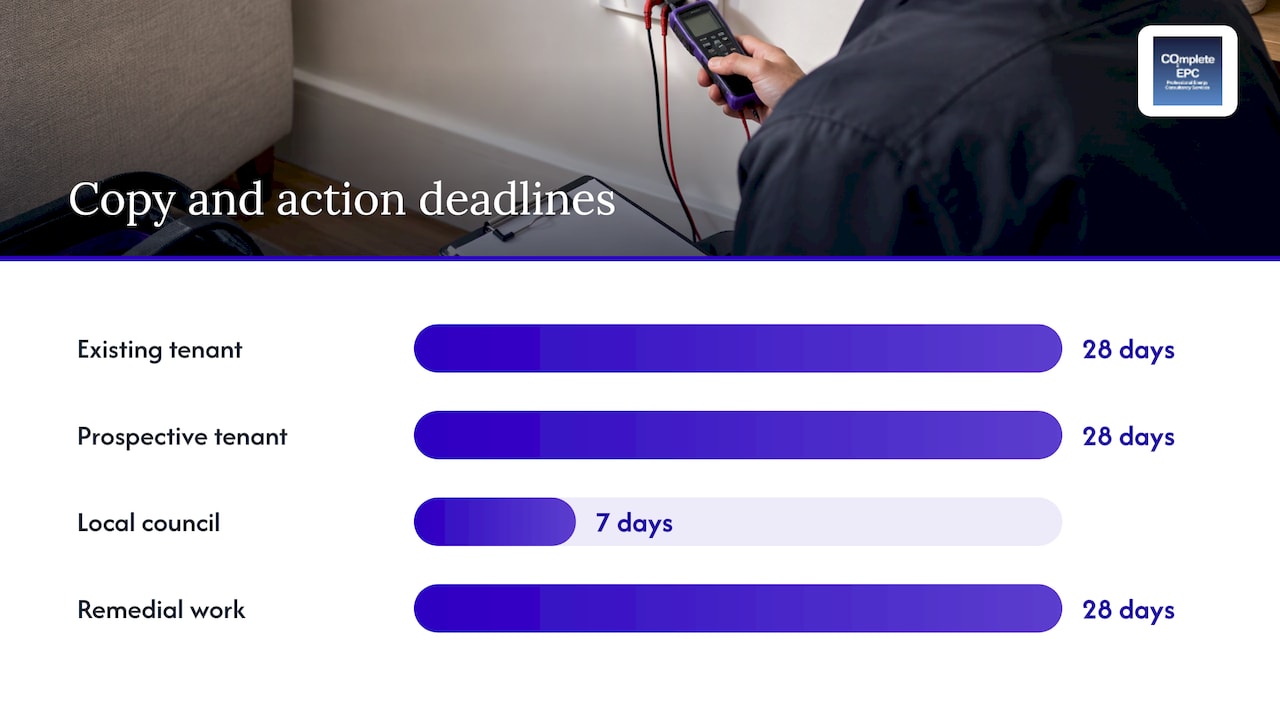
The Electrical Safety Standards in the Private Rented Sector (England) Regulations 2020, updated by 2025 amendment regulations, require landlords to have the installation inspected and tested by a qualified person at least every 5 years, or sooner if the previous report recommends it. A report must also be in place before a new tenancy starts. The same guidance sets the deadlines:
- a copy to an existing tenant within 28 days of the inspection;
- a copy to a new tenant before they move in;
- a copy to a prospective tenant within 28 days of a request;
- a copy to the local council within 7 days of a request;
- remedial or further investigation work completed within 28 days, or any shorter period stated in the report.
The maximum civil penalty for a breach was raised from £30,000 to £40,000 by the 2025 amendments, which also extended equivalent duties to social landlords.
A newly built or fully rewired property with an EIC does not need a separate EICR for 5 years from the date of that EIC, according to the GOV.UK guidance above.
Owner-occupiers and businesses
There is no legal requirement for an owner-occupied home. NICEIC notes that Electrical Safety First recommends an EICR at least once every 10 years. It is also sensible before you buy, after a long period without work on the wiring, or when an insurer asks. For commercial premises, a 3 to 5 year cycle is the usual recommendation, though your insurer, lease or the nature of the use may set it shorter.
If you are a London landlord, remember that this rule is England-wide, so it applies in every borough from Barnet to Barking.
What happens during an EICR inspection
The process follows four stages, as NICEIC sets out.
1. Visual inspection
The inspector looks for cracks, signs of overheating, outdated consumer units, missing covers and DIY alterations. This comes first for a reason. Electrical Safety First’s guidance for rented homes stresses that the inspection is the most important element and should precede testing, because defects found could make testing dangerous or skew the results. In a typical rented property it suggests checking at least one switch and lighting point per lighting circuit and one socket or fused connection unit per socket circuit, with more items inspected where defects turn up.
2. Testing the circuits
The inspector tests continuity, insulation resistance, polarity, earth fault loop impedance and RCD operation. An RCD is the device that cuts the power quickly if it detects a leak of current, for example through a person. The tests are run in a set order: dead tests first, to prove the installation can be safely re-energised, then live tests.
Expect the power to be off for part of the visit, circuit by circuit. Plan around freezers, home offices, servers and alarm systems. In a tenanted flat, give the tenant notice so access is not an issue.
3. Recording and coding faults
Anything that falls short of the standard is given an observation code. These are explained in the next section.
4. Issuing the report
The original report, based on the BS 7671 model forms, goes to the person who ordered the work. It comes with an inspection schedule and a schedule of circuit details and test results. The IET’s model form says it should normally run to at least five pages including those schedules. A one-page note saying “all fine” is not an EICR.
The IET/SELECT guidance also says each observation should describe the specific defect in clear language the person ordering the work can understand. Vague entries such as “poor” do not meet that standard. If your report reads that way, ask for it to be clarified.
Reading the codes: C1, C2, C3 and FI
According to GOV.UK guidance:
| Code | Meaning | Effect on the outcome |
|---|---|---|
| C1 | Danger present, risk of injury | Unsatisfactory. The inspector may make it safe before leaving |
| C2 | Potentially dangerous | Unsatisfactory |
| FI | Further investigation required without delay | Unsatisfactory |
| C3 | Improvement recommended | Does not on its own make the report unsatisfactory |
Somerset Council’s guidance puts it simply: any C1, C2 or FI code means the report is unsatisfactory, while a report with only C3 items is classed as satisfactory and carries no obligation to carry out work. The IET model form adds that C1 items should be made safe on discovery wherever practicable, and where that is not possible the owner or user must be told in writing as a matter of urgency.
A worked example
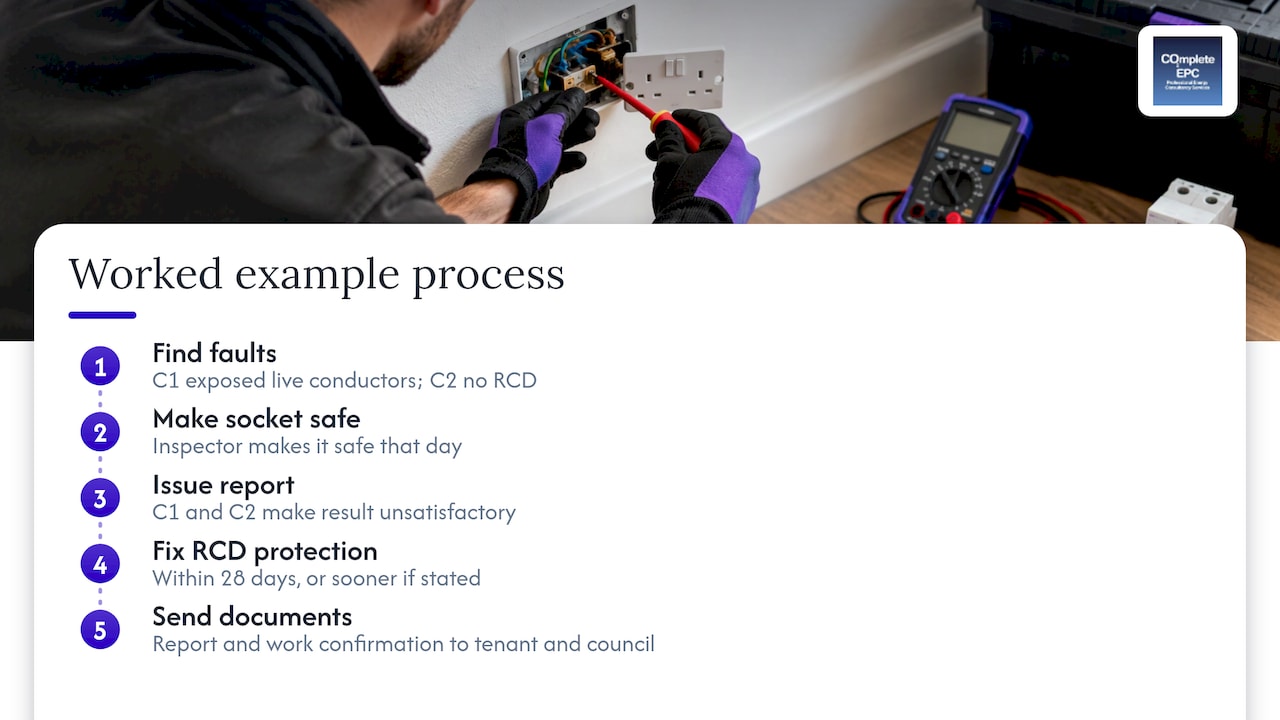
Imagine a two-bedroom rented flat in Walthamstow. The inspector finds a socket with exposed live conductors (C1), no RCD protection on a socket circuit (C2) and old-style cable colours with no other fault (C3). The inspector makes the socket safe on the day. The report is unsatisfactory because of the C1 and C2 items. The landlord must have the RCD protection fixed within 28 days of the inspection, or sooner if the report says so. Then the landlord sends the tenant and the council the report plus written confirmation that the work is done. The C3 item can be left alone or planned in at the next refurbishment.
What to do with an unsatisfactory report
The remedial clock runs from the inspection, and the report must be passed on quickly. The sequence for a landlord in England is:
- Read the report and note every C1, C2 and FI item, plus any shorter deadline the inspector has written in.
- Arrange the repairs or the further investigation promptly. Do not wait for a convenient moment.
- Obtain written confirmation that the work is complete. GOV.UK guidance accepts a satisfactory EICR, an EIC or a minor works certificate (MEIWC).
- Send the confirmation and the original report to the tenant and the local council within 28 days.
Shelter’s advice for tenants states the same expectations from the other side: the check must be done by a registered electrician, and tenants are entitled to a copy. Keep your own copy of everything with your tenancy records.
What does an EICR cost in London?
There is no single price, and anyone quoting one without asking questions is guessing. The main driver is the number of circuits, then the property type and whether it is occupied. Property Tax Partners reports a typical rental EICR costing between £100 and £250 in 2026, with larger houses and HMOs higher, and London and the South East often 20% to 40% above the national range for the same size. The same source notes that the report fee can be deducted against rental income.
The bigger variable is what comes after. Only C1, C2 and FI items must be fixed, and acting on C3 recommendations is optional. So the useful comparison between quotes is whether the price covers a full inspection and test of every circuit with schedules, not just the headline fee.
We do not publish a fixed EICR price. Our positioning is competitive pricing backed by a UK lowest-rate guarantee, so ask us for a quote for your property.
How to prepare your property
A little preparation avoids a wasted visit.
- Tell the inspector the facts up front: number of circuits if known, whether there is a solar PV or battery system, and any past electrical work.
- Clear access to the consumer unit, meters and any outbuilding supply, such as a garage or garden office.
- Arrange tenant access in writing and in good time. The 2025 amendments added a reasonable steps defence where a tenant blocks access, so keep a record of your attempts.
- Gather earlier paperwork: previous EICRs, EICs and minor works certificates help the inspector see what has changed.
- Plan the power cuts: tell occupants which circuits will be off and roughly when.
Why combine your EICR with other compliance work
Most London landlords and agents have several documents with different renewal dates: an EPC, an EICR, and for commercial buildings sometimes an air conditioning inspection. Managing them separately means more bookings, more access visits and more renewal diaries.
We offer an Electrical Installation Condition Report service alongside domestic EPCs and commercial EPCs, and our assessors work across London. For a portfolio, that means one provider for the certificates and the advice on what each result means for letting the property.
Our view: treat the EICR as a maintenance tool
Most owners come to us because a deadline or a buyer has forced the question. We would rather you saw the EICR the other way round: it is the one document that tells you what your wiring is actually doing behind the plaster.
The landlords who find it least painful are the ones who diarise the five-year date, book early, and read the observations rather than just the verdict. A C3 on an old consumer unit is a free warning. Budgeting for it before a tenancy change costs far less than a rushed repair after a C2.
We run EICRs alongside EPCs and other compliance work for London homeowners, landlords, agents and businesses, so you do not need separate providers for each document. Our qualified assessors can explain a report in plain language, and our lowest-rate guarantee is there so that cost never becomes the reason a check is put off.
Danny
Book your EICR in London
If you need an EICR for a rental, a sale or a commercial unit, we can arrange it with our qualified assessors anywhere in London. Tell us the property type and the number of circuits if you know it, and we will quote against our lowest-rate guarantee. Start at Complete EPC.

If you also need an EPC for the same property, our domestic EPC page covers that.
FAQ
Is an EICR the same as an electrical safety certificate?
People use the terms interchangeably, but strictly an EICR is a condition report, not a certificate. It records the state of an existing installation on the day of inspection. A certificate (an EIC) is issued for new work. Either can be called an electrical safety certificate in everyday speech.
How long does an EICR last?
For a privately rented home in England the maximum interval is 5 years, or less if the inspector recommends it. Owner-occupied homes are recommended every 10 years, and commercial premises commonly every 3 to 5 years. The result does not extend past the re-inspection date written on the report.
Who can carry out an EICR?
The regulations require a qualified person, and Shelter advises tenants that the check must be done by a registered electrician. The inspector must hold the competence to inspect, test and code an installation against BS 7671. Our assessors carry out EICRs for London properties.
What happens if my report is unsatisfactory?
An unsatisfactory result means at least one C1, C2 or FI code was recorded. In a rented property in England you must complete the work within 28 days, or sooner if the report says so. You then send written confirmation and the report to your tenant and the council within 28 days.
Do I have to fix C3 items?
No. A C3 means an improvement is recommended, and a report with only C3 items is satisfactory. Many owners still schedule them, since they often point to ageing equipment that will need attention eventually.
Sources
- NICEIC: Electrical Installation Condition Reports
- GOV.UK: Electrical safety standards in the private and social rented sectors
- IET: BS 7671 model EICR form
- Electrical Safety First: Best Practice Guide 10
- IET/SELECT: Best Practice Guide 4, Electrical Installation Condition Reporting
- Somerset Council: Electrical safety
- Shelter England: Electrical safety in rented homes
- Tenancy Agreement Service: Electrical safety standards regulations
- Property Tax Partners: EICR certificate cost