
To produce an energy performance certificate (EPC) in the UK, an assessor needs a recognised energy assessment qualification and membership of an approved accreditation scheme. For homes that usually means a Level 3 Certificate in Domestic Energy Assessment. For commercial buildings it means a Level 3 or Level 4 diploma in non-domestic energy assessment, depending on the building. This guide explains each route, who awards the qualifications, what registration involves, and how to check that the person you hire is qualified.
TL;DR
- Domestic EPCs: a Level 3 Certificate in Domestic Energy Assessment, then registration with an accreditation scheme.
- Commercial EPCs: a Level 3 Diploma in Non-Domestic Energy Assessments for existing buildings, or a Level 4 Diploma in Commercial Energy Assessments for new and existing buildings.
- Complex buildings need higher levels: the qualification level limits the buildings an assessor can assess.
- Scotland, Northern Ireland and Ireland each have their own registration rules on top of the qualification.
- If you are a landlord or owner, ask your assessor for their accreditation details before you book.
Table of Contents
- What an energy assessment involves
- The domestic route: Level 3 Domestic Energy Assessment
- The commercial route: non-domestic energy assessment
- Awarding bodies and typical costs
- Accreditation schemes: the step after the qualification
- Other routes: CIBSE and experience-based entry
- If you are in Ireland
- A step-by-step path to qualifying in England and Wales
- Our perspective
- Choosing a qualified assessor in London
- FAQ
- Sources
What an energy assessment involves
An energy assessment is a survey of a building that ends in an EPC and a report of recommendations. The assessor measures the property, records how it is built, and notes the heating and hot water systems. Those details go into approved calculation software, which produces the rating.
The official descriptions of the role are consistent. In Scotland, a domestic energy assessor collects data on dimensions, construction, heating and hot water, enters it into the government-approved RDSAP process, and makes sure the certificate and its data are on the relevant register before it goes to the person who asked for it. In Northern Ireland, assessors must carry out the work with reasonable care and skill, produce the EPC and recommendation report, and register the certificate first.
This is why qualification matters. The certificate is a legal document used in sales and lettings, and it is only valid if a competent, accredited person produced it.
The domestic route: Level 3 Domestic Energy Assessment
Most people who ask about energy assessment qualifications want to know how to become a domestic energy assessor (DEA). The entry qualification is at Level 3.
What the qualification covers
The City & Guilds Level 3 Certificate in Domestic Energy Assessment requires four mandatory units: professional practice, preparation, carrying out assessments, and producing and explaining domestic EPCs. That sequence mirrors the real job, from planning a visit to explaining the result to a client.
The ABBE version of the qualification is recorded on the Ofqual register as a Level 3 qualification with 120 guided learning hours and 250 total qualification time, a credit value of 25, and assessment by portfolio of evidence. In practical terms, that means coursework and evidence from real or practice assessments rather than a single exam.
Registration after the course
Passing the qualification does not let you issue certificates by itself. According to the ABBE specification, once qualified, DEAs register with an accreditation scheme to produce EPCs for individual existing homes. It also notes that these certificates are for existing homes, not newly built ones, and that EPCs have been compulsory at sale or let of domestic properties since 2008.
That last point is a useful dividing line. New homes are assessed through SAP calculations rather than the existing-dwelling process, which is a separate piece of work from a standard domestic EPC.
The commercial route: non-domestic energy assessment
Commercial buildings are more varied than homes, so the qualification structure has more levels.
Level 3, Level 4 and what each allows
The National Careers Service says people with no previous commercial assessing experience need to complete a Level 3 Diploma in Non-Domestic Energy Assessments for existing buildings, or a Level 4 Diploma in Commercial Energy Assessments for new and existing commercial buildings, or both.
The ABBE specification for its Level 4 Diploma states that non-domestic EPCs are produced by qualified and accredited assessors who hold a licence to practise. That licence comes from the Level 4 Diploma plus membership of a government-approved accreditation scheme. The qualification has five mandatory units and is aimed at learners aged 18 and over.
How complexity maps to levels
Training providers describe the levels by building type. Level 3 covers existing buildings with common characteristics and simple air conditioning, such as small shops and restaurants. Level 4 covers buildings with uncommon characteristics, more complex HVAC systems and any new-build non-domestic building, such as large offices. Level 5 covers buildings with features like atriums, automatic blind control and complex ventilation that need in-depth modelling software, such as airports and shopping centres.
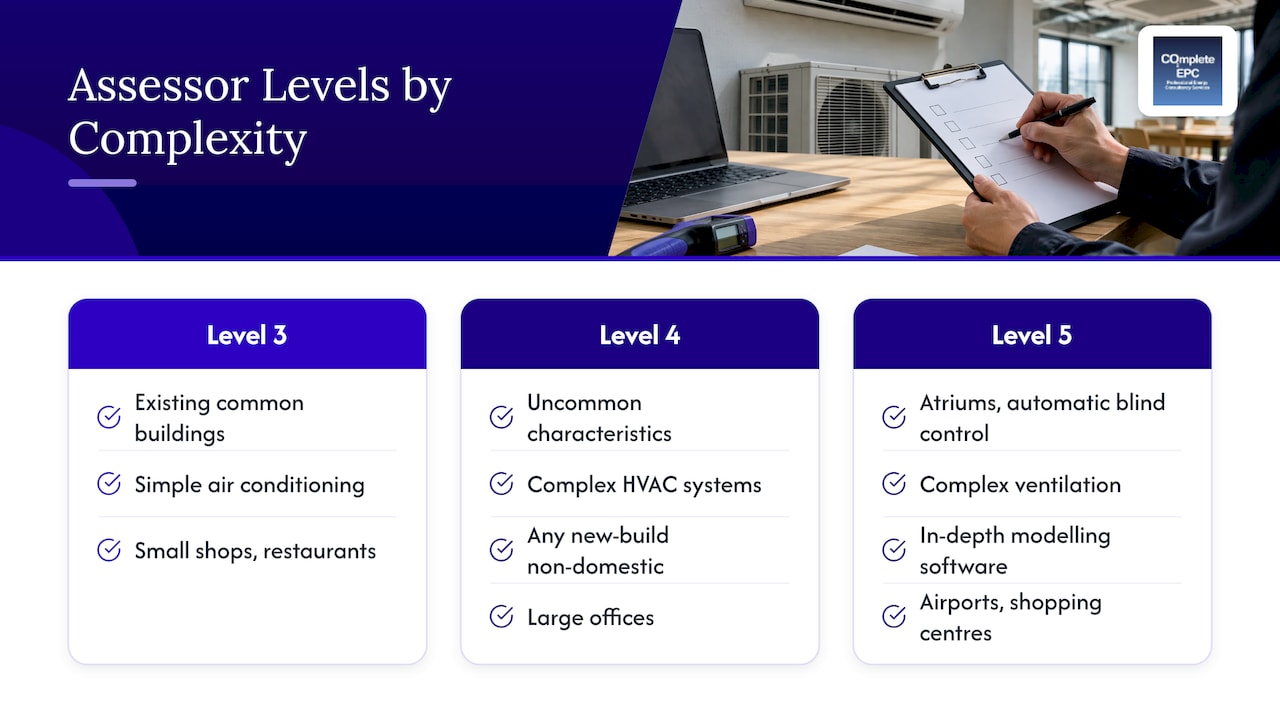
The same guidance says no specific qualifications or prior experience are needed to start the route, and that good maths helps but is not essential. The level you reach decides which buildings you can lawfully assess.
Awarding bodies and typical costs
Several awarding bodies offer regulated energy assessment qualifications. The Google results for this topic mention three for domestic assessment: the Awarding Body for the Built Environment (ABBE), City & Guilds and the National Association of Energy Services Companies. Here is what the research confirms for the main routes.
| Route | Qualification | Awarding body | Key facts |
|---|---|---|---|
| Domestic | Level 3 Certificate in Domestic Energy Assessment | City & Guilds | Four mandatory units |
| Domestic | Level 3 Certificate in Domestic Energy Assessment | ABBE | 120 guided learning hours, 250 total qualification time, 25 credits |
| Non-domestic | Level 3 Certificate and Level 4 Diploma in Non-Domestic Energy Assessment | City & Guilds | Level 4: 43 credits, 195 guided learning hours, 430 total qualification time |
| Non-domestic | Level 4 Diploma in Non-Domestic Energy Assessment | ABBE | Five mandatory units, licence to practise with scheme membership |
City & Guilds lists the UK fees for its Level 4 Diploma (codes 6361-04 and 6361-08) as £374 and £484 respectively, as shown on its 2025 page. Those are registration or assessment fees for the qualification itself, not the cost of a full training course, which training centres price separately. Check the awarding body’s current page before you budget.
Accreditation schemes: the step after the qualification
A qualification shows you have the knowledge. An accreditation scheme is how you are authorised to lodge certificates. Without it, an assessor cannot issue a valid EPC.
The rules are explicit in the devolved nations. In Scotland, you must be a member of an organisation approved by the Scottish Government, and this is a legal requirement for homes over 50 square metres when sold or rented. In effect, scheme membership decides who may issue domestic EPCs.
In Northern Ireland, qualification may be shown by a recognised awarding-body qualification or approved prior experience and learning equivalent to the National Occupational Standard. The assessor must also belong to an accreditation scheme, work within the limits of their qualification and accreditation, use the latest approved calculation software and register certificates before issuing them.
Other routes: CIBSE and experience-based entry
Not every assessor arrives through a college-style diploma. Experienced building services engineers can come through a professional body route.
For the EPC strand, CIBSE Certification requires applicants to complete the Low Carbon Consultant Building Design exam. For Display Energy Certificates, applicants complete the Building Operation exam, DEC theory and an ORCalc software assessment. Applicants must also show relevant technical knowledge and experience, provide CPD records and evidence of insurance, and pass a competence assessment in the relevant software.
CIBSE Certification’s 2025 annual report adds that it certifies individuals as energy assessors through the APEL route, where experience as well as knowledge and understanding is assessed, typically including design and specification of energy-using systems in buildings. This suits engineers who already work on building design, and it is how many assessors handle the more complex commercial buildings.
If you are in Ireland
Readers sometimes search for energy assessment qualifications from across the Irish Sea. The Irish system uses Building Energy Ratings (BER) instead of EPCs, and the rules differ.
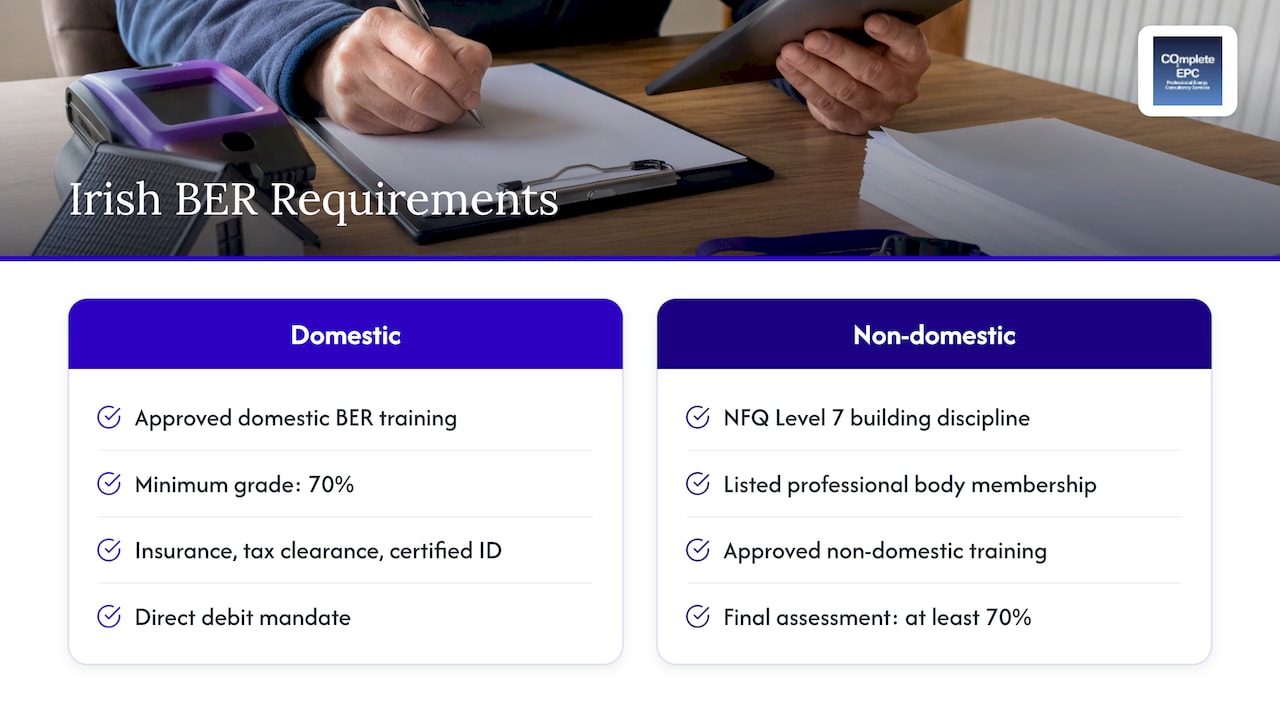
The Sustainable Energy Authority of Ireland (SEAI) states that BER and DEC assessors must be registered with it, and that it is an offence for unregistered persons to carry out and publish assessments. For domestic work, you must complete approved domestic BER training and achieve a minimum grade of 70%, then submit insurance, a Tax Clearance Certificate, certified ID, a direct debit mandate and acceptance of the Code of Practice.
SEAI also expects domestic assessors to have fundamental skills such as measured surveys, reading building drawings and awareness of building regulations.
The non-domestic bar is higher. You must hold an NFQ Level 7 qualification in a building or construction discipline, show membership of a listed professional body, and complete the approved non-domestic training course with at least 70% in the final assessment. The occupational standard published on 23 October 2025 sets out the pre-qualification subjects in detail.
A step-by-step path to qualifying in England and Wales
The sources above point to the same sequence for a new domestic assessor:
- Choose the route: domestic (Level 3) or non-domestic (Level 3 or Level 4, depending on the buildings you want to assess).
- Pick a regulated qualification from an awarding body such as City & Guilds or ABBE, and a training centre that delivers it.
- Complete the units and build your portfolio of evidence.
- Join an accreditation scheme and meet its requirements, which typically include insurance and a competence check in the approved software.
- Lodge certificates on the national register, working only within the limits of your qualification.
Commercial assessors follow the same pattern with the diploma that matches their target buildings. Those with design experience may consider the CIBSE route.
Our perspective
We see the effect of qualification every week. An EPC is not just a document that clears a sale or a letting. It is the starting point for decisions about insulation, heating and compliance, so the person who produces it needs to know what they are measuring and why.
That is why we work with qualified assessors who have extensive industry experience, and why we cover both domestic and commercial properties across London. A home in a Victorian terrace, a new-build flat and a small office all need different knowledge, and the qualification levels exist to reflect that.
Qualification also matters beyond the certificate. Our team works on SAP calculations for new builds, conversions and extensions, and on related reports such as overheating analysis and SBEM. Reports like these only help a project if they are accurate and accepted first time.
Our advice to landlords and owners is simple: choose an assessor on competence and accreditation first, then on price. We back our service with a lowest-rate guarantee, so you do not have to trade one for the other.
Danny
Choosing a qualified assessor in London
If you are a landlord, owner or business rather than a trainee, the practical question is how to hire well. Use the same logic the qualification framework gives you:
- Match the assessor to the building. A standard flat or house needs a domestic assessor. A shop, office or mixed-use building needs a non-domestic assessor with the right level for its complexity.
- Ask about accreditation. A qualification alone does not authorise an assessor to lodge certificates. Ask which scheme they belong to.
- Check what the report includes. A good assessment ends in an EPC and clear recommendations you can act on.
- Plan for new builds separately. New dwellings, conversions and extensions typically need SAP calculations rather than a standard existing-home EPC.
Book an assessment with Complete EPC
We provide EPCs for homes and commercial premises across London, with qualified assessors and a UK lowest-rate guarantee. For homes, start with our domestic EPC service. For offices, shops and other commercial buildings, see our commercial EPC service. Developers working on new builds or extensions can look at our SAP calculations, and larger commercial projects may need SBEM calculations. Contact us through the Complete EPC website for a quote.
FAQ
What qualification do I need to become a domestic energy assessor?
You need a Level 3 Certificate in Domestic Energy Assessment from a recognised awarding body such as City & Guilds or ABBE. After that, you register with an accreditation scheme so you can produce EPCs for existing homes.
What qualification do I need to assess commercial buildings?
For existing commercial buildings, a Level 3 Diploma in Non-Domestic Energy Assessments is the starting point. For new and existing commercial buildings, you need the Level 4 Diploma in Commercial Energy Assessments. Very complex buildings need higher-level skills and modelling software.
Do I need experience before starting an energy assessor course?
Not necessarily. Training guidance for the non-domestic route says no specific qualifications or prior experience are required to begin, although the level you complete limits the buildings you can assess. Experienced engineers may instead use an experience-based route, such as the CIBSE APEL route.
Is an assessor legally required to be accredited?
Yes. In Scotland you must belong to an approved organisation to issue domestic EPCs for homes over 50 square metres being sold or rented. In Northern Ireland, assessors must be in an accreditation scheme and work within their qualification limits. In England, the ABBE specification says qualified DEAs register with an accreditation scheme.
How do the rules differ in Ireland?
Ireland uses BER assessments run by SEAI, and only registered assessors may carry them out. Domestic applicants must pass approved training with at least 70%. Non-domestic applicants also need an NFQ Level 7 qualification in a building or construction discipline.
Sources
- Energy assessors and accreditation schemes, Department of Finance (Northern Ireland)
- Domestic energy assessor accreditation (Scotland), GOV.UK
- City & Guilds Level 3 Certificate in Domestic Energy Assessment handbook
- ABBE Level 3 Certificate in Domestic Energy Assessment, Ofqual register
- ABBE Level 3 Certificate in Domestic Energy Assessment specification
- Commercial energy assessor, National Careers Service
- ABBE Level 4 Diploma in Non-Domestic Energy Assessment specification
- Non-domestic energy assessor levels and complexity
- City & Guilds energy assessment qualifications
- Low Carbon Energy Assessors, CIBSE Certification
- CIBSE Certification Annual Report 2025
- BER Assessor Code of Practice, SEAI
- Register as a Domestic BER Assessor, SEAI
- Training and Skills of Domestic BER Assessors, SEAI
- Register as a Non-Domestic BER Assessor, SEAI
- Occupational Standard for non-domestic BER assessors, SEAI