

TL;DR:
- UK landlords must meet minimum EPC standards for energy efficiency by specific deadlines, with early action rewarding compliance. The 2026 reforms introduce dual metrics and new assessment requirements, emphasizing proactive planning and upgrades. Exemptions are personal and non-transferable, and non-compliance can result in fines up to £30,000 per property.
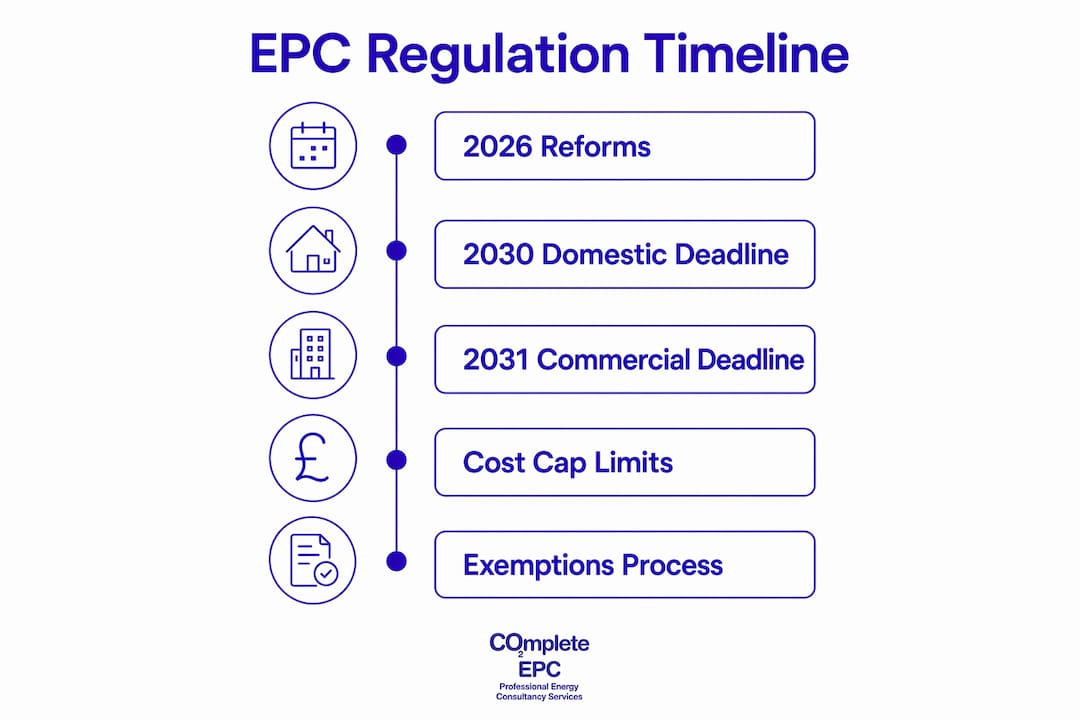
Energy efficiency regulations in the UK set mandatory minimum Energy Performance Certificate (EPC) standards that landlords and property owners must meet to legally let or sell buildings. The Minimum Energy Efficiency Standards (MEES), enforced under the Energy Efficiency (Private Rented Property) (England and Wales) Regulations 2015, govern both domestic and commercial properties. Domestic rented homes must reach EPC C by 2030, while commercial buildings over 1,000 sqm face an EPC B target by 2031. Significant reforms in 2026 are also reshaping how EPCs are assessed, making early action the most practical path for landlords and property owners across England and Wales.
What are the current energy efficiency regulations UK landlords must follow?

The current building energy efficiency laws divide requirements by property type and size. Domestic and commercial properties each face distinct deadlines, cost caps, and rating thresholds under MEES.
Domestic private rented properties
Domestic privately rented homes must achieve a minimum EPC C rating by 1 october 2030, with a maximum landlord expenditure cap of £10,000 per property. That cap includes the cost of commissioning the EPC assessment itself. Landlords who cannot reach EPC C within the cap can register an exemption rather than face a penalty.
A critical detail many landlords overlook: properties achieving EPC C before 1 october 2029 under the existing Energy Efficiency Rating (EER) metric are treated as compliant until that EPC expires. This “grandparenting” provision rewards early movers by deferring the need to comply with the new, more complex dual metric assessments introduced from 2027.
Commercial properties
Commercial properties over 1,000 sqm must reach EPC B by 2031. Smaller commercial buildings retain the existing EPC E minimum standard. The government confirmed it dropped the interim EPC C milestone for 2027 in the non-domestic sector. That decision simplifies the compliance timeline for commercial landlords but does not reduce the ultimate ambition of the EPC B target.
| Property type | Minimum rating | Deadline | Cost cap |
|---|---|---|---|
| Domestic rented (all sizes) | EPC C | 1 october 2030 | £10,000 |
| Commercial (over 1,000 sqm) | EPC B | 2031 | Not publicly listed |
| Commercial (under 1,000 sqm) | EPC E | Current | Not publicly listed |
Pro Tip: Commission your EPC assessment now, even if your current rating is D or E. Knowing your starting point lets you plan upgrades in stages rather than rushing before the 2030 deadline.
How will upcoming EPC reforms affect compliance from 2027?
The 2026 reforms to the Energy Performance of Buildings regime represent the most significant change to EPC assessment methodology in over a decade. Landlords who understand these changes now will be far better placed to act before the new rules take effect.
New-style domestic EPCs will introduce a dual metric standard, measuring both fabric performance and either smart readiness or heating system efficiency. This replaces the single EER metric that has underpinned MEES compliance since 2015. The change reflects government recognition that a single score can mask poor fabric insulation behind an efficient boiler, or vice versa.
Updated EPCs will also display secondary metrics including energy demand and a carbon metric alongside the primary ratings. A transition period will retain the old EER metric temporarily to support compliance assessment during the changeover. Legislation updating the Private Rented Sector Regulations is planned to come into force in 2027.
The practical steps landlords should take now are:
- Obtain a current EPC under the existing EER metric before the 2027 changeover.
- Review the fabric performance of your property, focusing on insulation, windows, and draught proofing.
- Assess your heating system against smart readiness criteria, including heat pump compatibility and smart controls.
- Plan any upgrades to address whichever metric presents the greater challenge for your property.
- Aim to achieve EPC C under the current metric before 1 october 2029 to benefit from grandparenting.
The dual metric approach balances bill savings and carbon reduction goals, giving landlords flexibility to improve heating systems or smart readiness according to their property’s specific characteristics. That flexibility is genuinely useful for landlords managing mixed portfolios where a single upgrade strategy rarely fits every property.
Pro Tip: If your property already meets EPC C under the current EER metric, get that certificate lodged before 1 october 2029. Grandparenting means you will not need to comply with the new dual metric standard until that EPC expires.
What exemptions exist under UK energy efficiency regulations?
Exemptions under MEES are not loopholes. They are structured flexibility mechanisms designed to prevent financially unworkable upgrade obligations. Understanding them is as important as understanding the standards themselves.
The key exemptions available to landlords include:
- Cost cap exemption: If all relevant improvements would cost more than £10,000 and the property still cannot reach EPC C, the landlord may register a cost cap exemption.
- Seven-year payback test: The seven-year payback test ensures only cost-effective improvements are mandated. If a specific measure does not pay back its cost within seven years through energy savings, it falls outside the mandatory requirement.
- Devaluation exemption: Where a surveyor confirms that carrying out improvements would reduce the market value of the property by more than 5%, the landlord can register a devaluation exemption.
- Third-party consent exemption: If a landlord cannot obtain necessary consent from a freeholder, local authority, or tenant to carry out works, an exemption applies.
Exemptions under non-domestic MEES are personal to each landlord and non-transferable on sale. A buyer acquiring a property with a registered exemption cannot rely on it. The new owner must reassess the property and apply for their own exemption if applicable. This has direct implications for property transactions, particularly in the commercial sector, where buyers should factor compliance costs into due diligence.
Exemptions are registered on the PRS Exemptions Register. Fines for non-compliance with PRS MEES Regulations can reach £30,000 per property per breach. The government is also introducing a new PRS Database to track rented properties and monitor compliance status. Landlords who assume non-compliance will go undetected face a significant financial risk.
Pro Tip: Always obtain three contractor quotes before registering a cost cap exemption. Regulators expect landlords to demonstrate they have genuinely explored all cost-effective options before claiming the cap.
What practical steps can landlords take to meet energy performance regulations?
Compliance with energy performance regulations is a planning exercise as much as a building works exercise. Landlords who treat it as a last-minute task consistently face higher costs and fewer options.
The recommended approach follows a clear sequence:
- Commission an EPC assessment. A qualified assessor will produce a report showing your current rating and a list of recommended improvements with estimated costs and savings. Completeepc provides domestic EPC assessments and commercial EPC assessments across London, carried out by experienced, accredited assessors.
- Prioritise fabric improvements first. Loft insulation, cavity wall insulation, and double glazing deliver lasting energy savings regardless of which heating system you install. Fabric improvements also score well under both the current EER metric and the incoming fabric performance metric.
- Upgrade heating systems where fabric alone is insufficient. Heat pumps, modern condensing boilers, and smart heating controls can move a property from EPC D to EPC C in many cases. Smart readiness is now a formal metric under the 2026 reforms, so these upgrades carry dual compliance value.
- Schedule works to meet the 2030 and 2031 deadlines with time to spare. Contractor availability tightens significantly as deadlines approach. Landlords who begin works in 2027 or 2028 will have more choice and lower costs than those who wait until 2029.
- Register any exemptions promptly. If a property genuinely cannot reach the required rating within the cost cap, register the exemption on the PRS Exemptions Register before the compliance deadline passes.
- Monitor and maintain compliance post-upgrade. An EPC is valid for ten years, but building works, changes to heating systems, or extensions can affect your rating. Review your EPC whenever you make significant changes to the property.
Landlords with large portfolios should prioritise properties with the lowest current ratings and the greatest gap to close. A property currently rated F or G requires a fundamentally different upgrade plan than one rated D. Understanding your EPC rating across your entire portfolio is the starting point for any credible compliance plan.
Compliance also carries commercial benefits beyond avoiding fines. Properties with higher EPC ratings attract better tenants, command stronger rents in many markets, and are easier to finance and sell. The benefits of an EPC extend well beyond regulatory box-ticking.
Key takeaways
Meeting UK energy efficiency regulations requires early action, clear planning, and an accurate EPC assessment as the foundation for every compliance decision.
| Point | Details |
|---|---|
| Domestic deadline is 2030 | Rented homes must reach EPC C by 1 october 2030, with a £10,000 landlord expenditure cap. |
| Commercial target is EPC B | Properties over 1,000 sqm must reach EPC B by 2031; smaller buildings remain at EPC E. |
| Grandparenting rewards early movers | Achieving EPC C before 1 october 2029 defers compliance with the new dual metric standard until EPC expiry. |
| Exemptions are personal and non-transferable | Devaluation and cost cap exemptions do not pass to new owners on sale; buyers must apply independently. |
| Fines reach £30,000 per breach | Non-compliance with PRS MEES Regulations carries penalties of up to £30,000 per property per breach. |
Why I think most landlords are approaching this the wrong way
Most landlords I speak with are treating the 2030 deadline as a distant problem. That is a mistake, and the maths make it clear. A property currently rated EPC E or F may need insulation, new glazing, and a heating system upgrade to reach EPC C. Coordinating three separate contractors, obtaining planning consent where required, and managing tenants through the works takes time. Leaving this until 2028 or 2029 means competing with thousands of other landlords for the same contractors, at inflated prices, with no margin for delay.
The grandparenting provision is the most underused tool in the current regulatory framework. Most landlords miss the strategic advantage of achieving EPC C before 1 october 2029 under the old EER metric, which defers the need to comply with the new dual metric standard until that EPC expires. That could mean deferring the more complex assessment by a full ten years. Acting now is not just about avoiding fines. It is about buying time.
The exemption rules also catch landlords out, particularly in the commercial sector. Exemptions are personal to the landlord and non-transferable on sale. I have seen transactions stall because a buyer discovered mid-deal that the seller’s exemption would not carry over. That is a due diligence failure that a good EPC assessment and legal advice could have prevented. Build compliance into your property management strategy now, not as a reaction to a deadline.
— Danny
How Completeepc can support your compliance
Completeepc works with landlords, property owners, and businesses across London to deliver accurate, up-to-date EPC assessments for both domestic and commercial properties. Every assessment is carried out by a qualified, accredited assessor who understands the current MEES requirements and the 2026 reform changes. Whether you need a domestic EPC to confirm your rental property meets the 2030 standard, or a commercial EPC to plan your route to EPC B by 2031, Completeepc provides clear reports with practical improvement recommendations. Contact Completeepc for a competitive quote and expert guidance tailored to your property.
FAQ
What is the minimum EPC rating for rented homes in the UK?
Domestic privately rented homes in England and Wales must achieve a minimum EPC C rating by 1 october 2030. A £10,000 landlord expenditure cap applies, and exemptions are available where the cap is reached before the required rating is met.
What happens if a landlord does not comply with MEES?
Fines for non-compliance with PRS MEES Regulations can reach £30,000 per property per breach. The government is introducing a new PRS Database to track compliance across the rented sector.
Do EPC exemptions transfer to a new owner when a property is sold?
No. Exemptions under MEES are personal to the landlord who registered them. A new owner must carry out their own assessment and apply for exemptions independently if they apply.
What are the new EPC metrics being introduced in 2026?
The 2026 reforms introduce a dual metric standard measuring fabric performance and either smart readiness or heating system efficiency. Secondary metrics including energy demand and a carbon score will also appear on new-style EPCs. Legislation is planned to come into force in 2027.
Do commercial properties face the same EPC requirements as domestic ones?
No. Commercial properties over 1,000 sqm must reach EPC B by 2031. Smaller commercial buildings currently maintain the EPC E minimum standard. The interim EPC C milestone for 2027 in the commercial sector was dropped and will not be pursued.