
Energy efficient tech is any product, system or control that gives you the same heating, lighting or cooling while using less energy. For a UK property owner, landlord or business, the useful question is which technologies are worth installing in your building, in what order, and how to prove the result. This guide covers the main options, what they can save, how the UK’s Energy Technology List fits in, and how an energy assessment turns guesswork into a plan.
TL;DR
- Energy efficiency means getting the same service (heat, light, cooling) from less energy, so the best technology is the one that suits your building and how it is used.
- Typical wins are LED lighting, heat pumps, smart controls and metering, glazing and insulation. Savings depend on the building, so measure before and after.
- In the UK, the Energy Technology List (ETL) is a government-backed list of products in the top 25% for efficiency in their class. It is not the same as US schemes such as ENERGY STAR.
- An EPC, SAP or SBEM calculation shows where your property loses energy and which upgrades matter most.
- Fabric first, controls second, new equipment third is a sound order for most buildings.
Table of Contents
- What energy efficient technology actually means
- Passive and active measures: two ways to save
- The main technologies, by what they do
- How much can you save?
- Choosing products: the Energy Technology List
- Where to start: fabric, controls, equipment
- Perspective: what we see on London properties
- How the right assessment supports your technology choices
- Common mistakes with energy efficient tech
- FAQ
- Sources
What energy efficient technology actually means
Energy efficiency compares the service you get, such as warmth or light, with the energy used to produce it. A more efficient product delivers the same service with less energy, as the US Department of Energy explains. Nothing is switched off and nobody sits in the cold. The waste is removed.
Lighting is the clearest example. Efficient LED bulbs give the same light as incandescent bulbs using 75 to 80 percent less electricity. Stanford’s energy learning hub goes further and treats efficiency as a resource in its own right: each unit saved is a unit that never has to be generated, sometimes called a negawatt.
That matters to you for a practical reason. Efficient equipment can cost more upfront, but investing in efficiency can reduce consumption and save money in the long run. The job is to pick measures where that payback is real for your building.
Passive and active measures: two ways to save
It helps to split efficiency measures into two families. Passive measures build energy conservation into the design of the building, while active measures rely on engineered systems and the selection and operation of efficient equipment.
| Type | What it covers | Typical London examples |
|---|---|---|
| Passive | Fabric and design that reduce demand | Loft and wall insulation, double or triple glazing, draught-proofing, shading, orientation |
| Active | Equipment and controls that supply or manage energy | LED lighting, heat pumps, smart thermostats, building management systems, solar PV, batteries |
Passive measures tend to work quietly for decades and need little maintenance. Active measures can deliver bigger changes in running costs but need correct sizing, commissioning and sometimes software. Most good retrofits use both.
The main technologies, by what they do
A useful framework comes from the IEA’s work on building renovation, which identifies 14 main technologies grouped into demand reduction, energy distribution and supply, and energy storage. The same report notes that costs vary between countries, so treat any figure from abroad as a guide to scale, not a quote for your property.
Reducing demand: lighting, glazing and insulation
This is where most buildings should start. Lighting is quick to change and easy to measure. LED bulbs cost about 75 percent less to operate than incandescent bulbs and last about six times longer, which is why they appear on nearly every retrofit list for shops, offices and rented flats.
Insulation, draught-proofing and better windows reduce how much heat you need in the first place. They also create what engineers call interactive effects. Efficient lighting or high-efficiency windows can cut cooling loads, which may allow a smaller chiller and lower capital cost. In other words, measures help each other, and the order you do them in changes the size of the equipment you need to buy.
Heating and hot water: heat pumps and controls
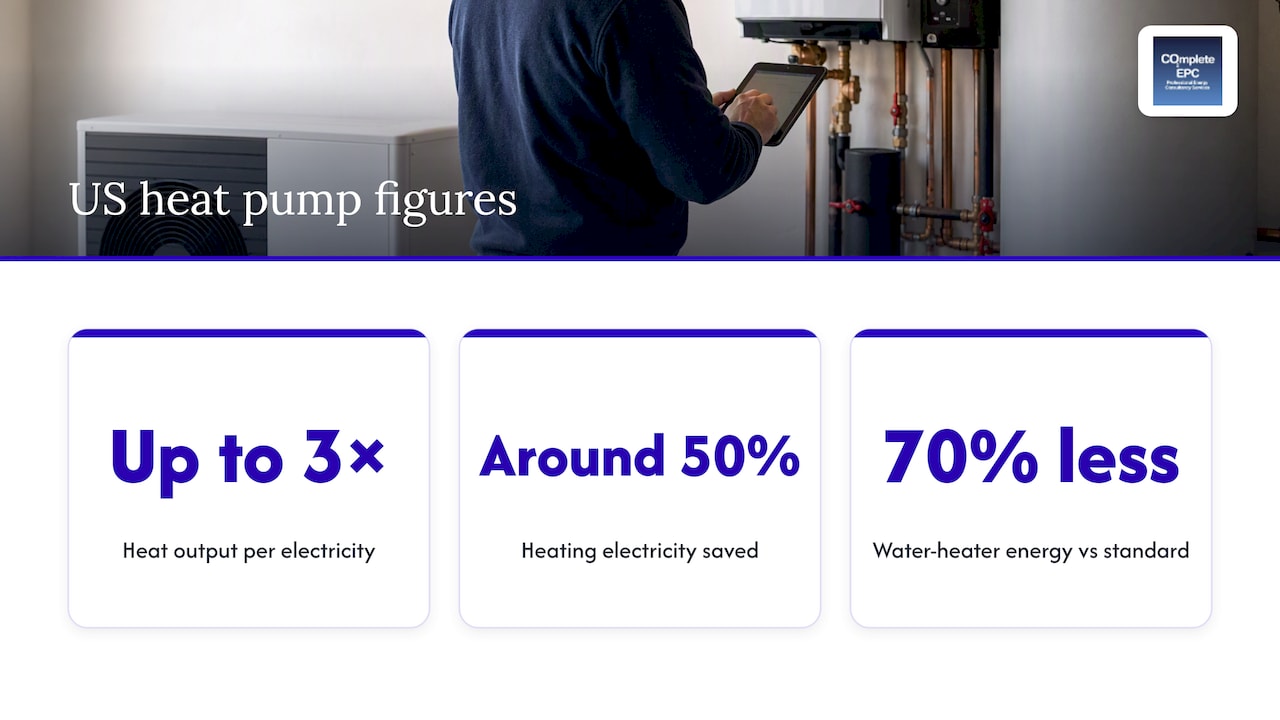
Heat pumps move heat rather than generate it. The US Department of Energy says they provide up to three times more heat than the electricity they use and can cut electricity use for heating by around 50 percent compared with electric furnaces or baseboard heaters. A UK property comparison is different, because many London homes heat with gas boilers, so the saving depends on your current system, insulation and the radiators or underfloor heating you have.
Hot water follows the same logic. A US ENERGY STAR heat pump water heater uses 70 percent less energy on average than a standard electric water heater. That is an American figure for American appliances, so use it to understand the principle, not to forecast your bill.
If you manage flats, heating is usually the biggest controllable cost. A German property management firm sets out ways of cutting heating costs in apartment blocks, including the role of balancing, metering and tenant behaviour, which carry across to London conversions and purpose-built blocks.
Smart controls and energy efficient software
People often ask what “energy efficient software” is. It is control logic that stops equipment wasting energy: programmable thermostats, occupancy-based lighting, scheduling, and variable-speed motors. Stanford’s learning hub notes that computerised controls can reduce energy use automatically without affecting the service.
At larger scale, building automation and energy monitoring systems are the backbone of newer approaches. The IEA overview lists building automation control, energy monitoring, thermal and electrical storage, photovoltaics, smart windows and phase-change materials among the technologies discussed. For a small landlord, the realistic version is a smart thermostat and a sub-meter. For an office or hotel, it is a full building management system.
Generation and storage: solar PV and batteries
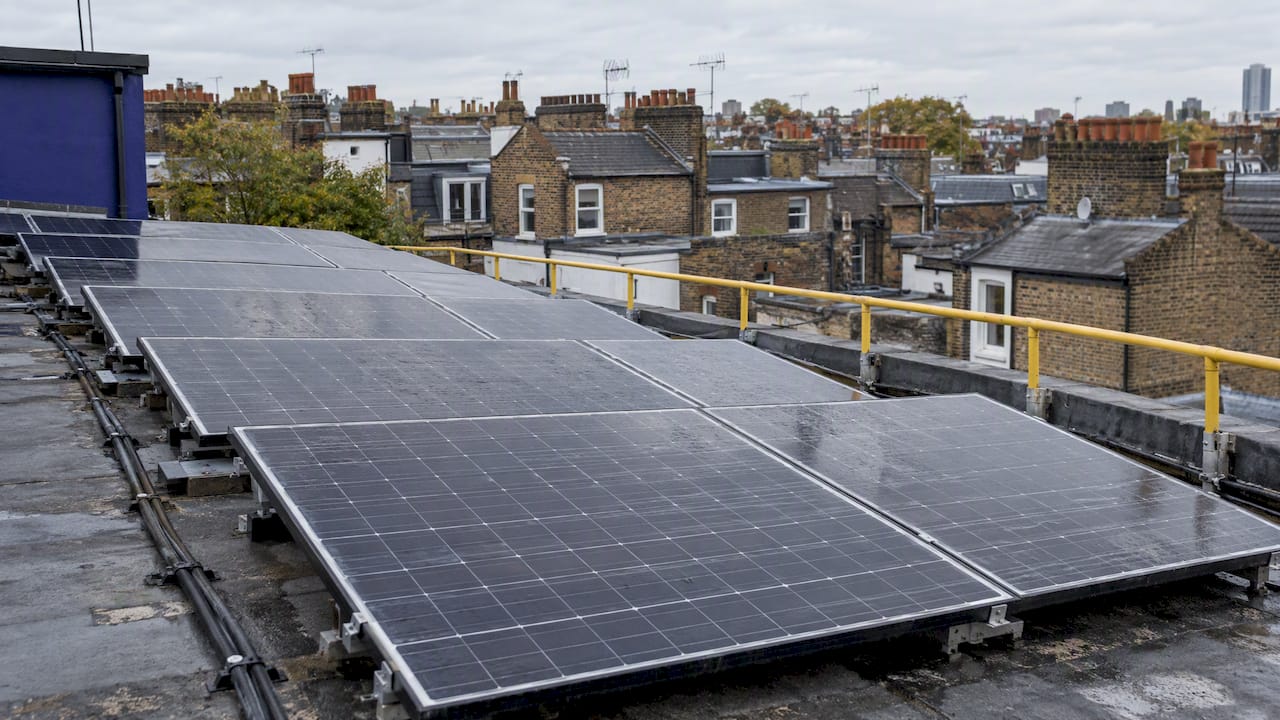
Solar panels and batteries do not reduce demand, but they change when and where you buy energy. A US federal demonstration building combined a PV array, lighting controls, building automation upgrades, battery storage and advanced power strips. The idea is a grid-interactive building that can shift use to balance peak demand or periods of plentiful renewable generation.
For a home or small business, the sensible order is to cut demand first, then size generation to the lower load. Panels sized for a leaky building are paying to heat the street.
A Polish retrofit firm describes this full-package thinking in its guide to achieving a near-zero energy bill home, combining audits, heat pumps, photovoltaics and storage. It is a useful picture of where a whole-house approach can go.
How much can you save?
Honest answer: it depends on the building, the starting point and how it is used. Published figures show the range, but they come from specific buildings.
- A retrofit at a US medical centre in Phoenix cut energy consumption by 25 percent using storage and on-site generation to shift loads.
- The Hong Kong Building Energy Conservation guide and its Retrofit Calculator estimate approximate costs and savings for specific office and hotel buildings.
- Costs vary with site conditions. One federal list puts a small wind turbine system at $5,760 per 1 kW of capacity, but notes that construction and zoning change the figure. Small wind is rarely suited to dense London sites.
Three things drive your own result:
- Your starting point. Replacing old halogen lighting saves far more than swapping already-efficient lamps.
- Building fabric. A heat pump in a poorly insulated solid-wall house will work harder than one in a well-insulated flat.
- How you run it. Controls only save energy if they are set up and used properly.
The cost of an efficient technology is the extra cost over the conventional option, or the full cost of an added measure. Compare it that way when you ask for quotes: what is the difference over what you would have bought anyway, and how fast does the running-cost saving repay it?
Choosing products: the Energy Technology List
In the UK, the Energy Technology List is the reference point for buying efficient equipment. The ETL is backed by the Department for Energy Security and Net Zero and is free to use. It states that listed products are in the top 25% most efficient in their class, across 21 technology categories that include heat pumps and solar thermal collectors.
The criteria behind it sit in the Energy Technology Criteria List. That document explains that the criteria cover functional specification, energy efficiency and other performance measures, aiming to identify the top 10 to 25% of products in each type. Criteria are revised over time, so check the current ETL pages before relying on a particular product category.
Two cautions help here:
- ETL criteria are UK government criteria. ENERGY STAR is a US label, and figures quoted in this article from US sources describe US products. Do not assume one scheme equals the other.
- A product on the list is efficient as a product. Whether it suits your building still depends on sizing, installation and the fabric it serves.
Where to start: fabric, controls, equipment
For most UK properties, this order works well:
- Find out where you stand. Get an energy assessment so you know your current rating and the recommended measures.
- Fix the fabric. Draught-proofing, loft insulation, glazing and wall insulation where suitable.
- Add controls and metering. Thermostats, zoning, timers and monitoring show you what is being used.
- Replace equipment. Lighting, boilers or heat pumps, ventilation and cooling, selected for the lowered demand.
- Consider generation and storage. Size solar and batteries to your reduced load.
- Reassess. A new certificate or calculation records the improvement.
The Asian Development Bank’s handbook on building efficiency shows how broad this field is, with chapters on technologies, certification schemes, financing instruments and business models. The point for you: technology is only one part. Certification and finance shape what actually gets built.
Perspective: what we see on London properties
We assess homes and commercial buildings across London, and the pattern is consistent. Owners often start by asking about a specific gadget, such as solar panels or a smart thermostat, before they know how their building performs. An EPC usually reveals that cheaper, less glamorous measures come first.
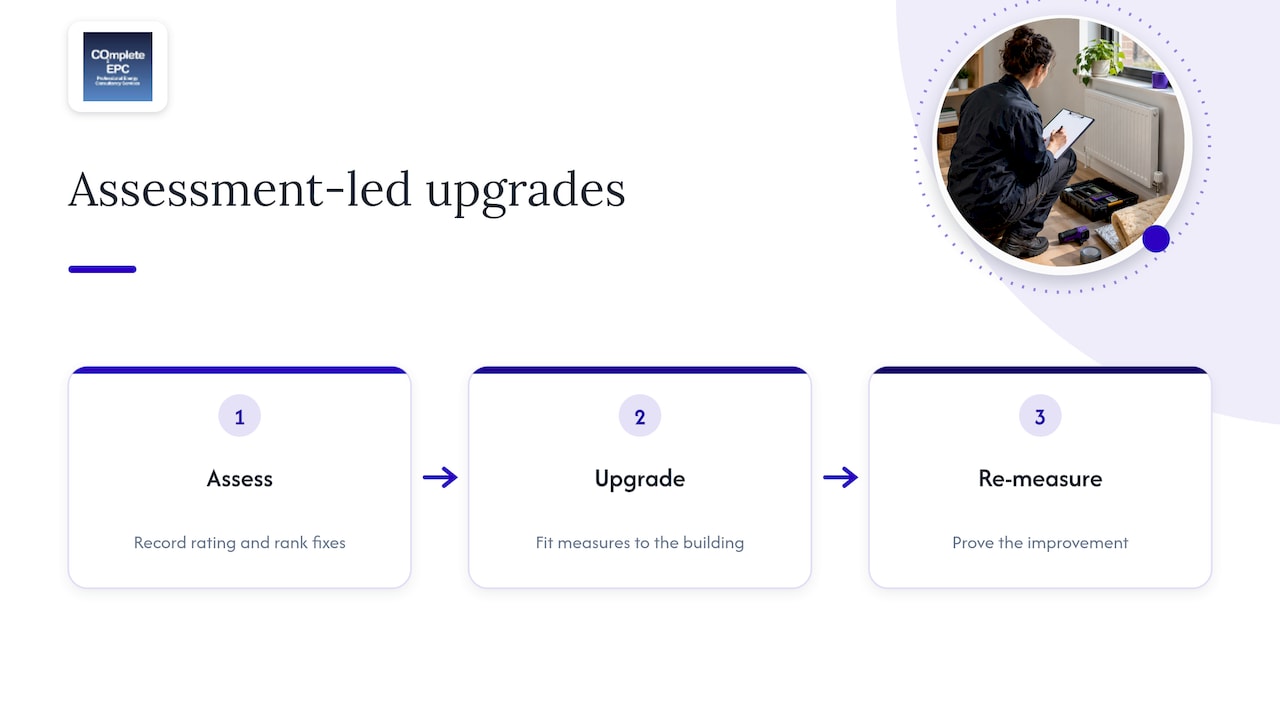
Our view is that the assessment is the most valuable piece of technology in the process, because it replaces opinion with a recorded rating and a ranked list of improvements. The best technology is the one that fits the building, and no product is efficient in the wrong place.
We also see that landlords and developers benefit from thinking about compliance early. Measures chosen at design stage, backed by SAP or SBEM calculations, cost far less than fixes made after a certificate disappoints. Our advice: measure first, upgrade in order, and re-measure to prove it.
— Danny
How the right assessment supports your technology choices
Different buildings need different evidence. We provide the assessments that show which technologies matter:
| You are… | Assessment that helps | Our page |
|---|---|---|
| Selling or letting a home | Domestic EPC | Domestic Energy Performance Certificate |
| Selling or letting a commercial unit | Commercial EPC | Commercial EPC |
| Building, converting or extending homes | SAP calculations | SAP Calculations |
| Building new commercial space | SBEM calculations | SBEM Calculations |
| Running air conditioning | TM44 inspection | TM44 Inspection of Air Conditioning Systems |
| Worried about summer heat in flats | TM59 and TM52 analysis | TM59 Overheating Assessment and TM52 Thermal Comfort Analysis |
| Applying for planning | Energy statement | Energy Statements for Planning |
For complex buildings, dynamic simulation modelling tests how a design performs through the year before you commit to equipment.
Book an EPC from our London team
If you own, let or manage property in London, we provide EPCs for domestic and commercial buildings, with reports that include recommendations for improvement. Our qualified assessors cover north, east, west and central London, and we also offer electrical safety testing such as EICR and PAT alongside energy work. Start on our Domestic EPC page, or contact us through the Complete EPC homepage to talk through a commercial or new-build project.
Common mistakes with energy efficient tech
- Buying equipment before reducing demand. Oversized boilers, heat pumps and solar systems cost more and perform worse.
- Trusting headline savings. A percentage from a different country, building or fuel is not your forecast. Use figures to understand scale only.
- Ignoring interactions. Better glazing and lighting change cooling and heating loads, which affects equipment size.
- Skipping commissioning. Controls that are installed but never set up save little.
- Not recording the improvement. Without a new assessment, you cannot show a buyer, tenant or regulator what changed.
There is also no universal answer. The IEA’s overview points out that no ready-made renovation solution fits every climate and use, and that analysing how technologies interact can improve cost-effectiveness. For a London terrace, a Victorian conversion and a glazed office, the best package will differ.
FAQ
What are the new technologies for energy efficiency?
Current building technologies include building automation and energy monitoring, thermal and electrical storage, solar PV, smart windows and phase-change materials, according to the IEA’s technology overview. For most UK owners, proven measures such as insulation, LEDs, heat pumps and smart controls deliver the most reliable return. Newer tech makes sense once the basics are done.
What is an example of an energy efficient device?
An LED bulb is the simplest example. It produces the same light as an incandescent bulb while using 75 to 80 percent less electricity. Heat pumps and smart thermostats are other common examples in homes and small businesses.
What is energy efficient software?
It is control software that reduces waste without lowering the service you get. Examples include programmable thermostats, scheduling, and variable-speed motor controls. In larger buildings it also includes building management and energy monitoring systems.
What are the ETL criteria?
The ETL criteria set out functional and energy efficiency requirements that a product must meet to be listed. Listed products aim to be in the top 10 to 25% of their type. The criteria differ for each of the technology categories, so check the current ETL pages for the one you are buying.
Do I need an EPC before choosing efficiency upgrades?
Not legally, but it is a sensible first step. An EPC gives you a rating and a list of recommended improvements for your specific property. That helps you rank measures instead of guessing, and a fresh certificate afterwards records the benefit.
Sources
- Take Five: What Is Energy Efficiency? (US Department of Energy)
- Energy Efficiency 101 (Resources for the Future)
- Energy Efficiency (Stanford Understand Energy)
- Technical Guidelines for Energy Efficiency and Conservation in Commercial Buildings (ERIA)
- Overview of available and emerging technology for building renovation (IEA EBC Annex 75)
- Key Grid-Interactive Efficient Building Technologies (US Department of Energy)
- ENERGY STAR Action Workbook for Small Business: Appendices
- ENERGY STAR: Energy Efficiency
- Energy Saver guide 2022 (US Department of Energy)
- A Guide for the Selection of Energy Efficient Technologies
- A Guide to Energy Efficient Retrofits of Office and Hotel Buildings (BEC Hong Kong)
- Energy Technology List (Department for Energy Security and Net Zero)
- Energy Technology Criteria List 2021 Rev 1
- Handbook on Energy Efficiency in Buildings (Asian Development Bank)
- Heizkosten senken im Mehrfamilienhaus
- Dom bez rachunków za energię