
Search the official Energy Performance of Buildings register on Gov to find an energy performance certificate by postcode. Enter the full postcode, pick the correct address from the list, and you can view or download the EPC straight away, showing the rating, the potential rating, the issue and expiry dates, and the improvements an assessor recommends.
If nothing appears, there are usually three explanations:
- The property has never had an EPC lodged on the register.
- The certificate has expired (they run for 10 years) or was lodged under a different address format.
- The owner has opted out of public listing, which happens more often than most buyers expect.
The register itself is substantial. It holds millions of certificates for domestic and commercial properties across England and Wales, making it the only dataset worth trusting for this kind of check.
Key Takeaways
Finding an EPC by postcode is fast and free on the official register, but a missing result usually means opt-out, expiry, or a genuine gap that only a new accredited assessment can fix.
| Point | Details |
|---|---|
| Start with the official register | Search Gov by full postcode before trying anything else. |
| Confirm the exact address | Postcodes often cover multiple properties, so match the property description and floor area carefully. |
| Understand why results go missing | Opt-out, expiry after 10 years, or no certificate ever being lodged are the three main causes. |
| Know who pays | The seller or landlord must commission and pay for the EPC, not the buyer or tenant. |
| Book Completeepc for a new certificate | Completeepc arranges accredited domestic and commercial EPC assessments across London with direct register lodgement. |
Table of Contents
- Searching the register by postcode step by step
- What does an EPC rating actually tell you?
- Why might a postcode search show no certificate?
- Who has to pay for the EPC, and what does it cost?
- Booking a new EPC with an accredited assessor
- Why the postcode search gets overcomplicated
- Book a compliant EPC assessment in London
- Sources
- FAQ
Searching the register by postcode step by step
The process takes under a minute once you know what to expect. Here’s the sequence:
- Go to the official service. Open Find an energy certificate on GOV.UK and enter the full postcode, not just the outward code (the first half). A partial postcode returns too many results to be useful.
- Choose the right address. Many postcodes cover a whole street or a block of flats, so you’ll often see several properties listed. Select the exact address line, including flat or unit number where relevant.
- Check the property description. Where more than one result looks similar, the certificate’s property description and floor area help you confirm you’ve picked the right one rather than the neighbour’s flat.
- Find the certificate reference. Each valid EPC carries a unique reference number, shown near the top of the record. Note this down if you need it for conveyancing or mortgage paperwork.
- Download or print the PDF. The full certificate opens as a downloadable document showing the rating, the assessor’s accreditation number, and the issue and expiry dates.
Pro Tip: If a search returns nothing under the exact address, try the street name search instead of the postcode. Some older certificates were lodged with slightly different formatting, and the street search catches records the postcode filter misses.
Solicitors handling a sale will usually want the certificate reference rather than the PDF itself, since it’s quicker to verify against the register later.
What does an EPC rating actually tell you?
The headline figure is a band from A to G, with A representing the most efficient homes and G the least. A property rated A or B tends to have notably lower heating and hot water costs than one rated E or F, though the exact saving depends on how the home is used day to day.
Alongside the current rating sits a potential rating: what the property could achieve if the assessor’s recommended improvements were carried out. Treat this as a guide to the scale of possible improvement rather than a promise, since the potential figure assumes measures are installed correctly and doesn’t account for every property’s quirks.
Three fields are worth checking every time:
- Issue and expiry dates — a valid certificate must not have passed its 10 year expiry.
- Property description — confirm it matches the address, particularly for flats and converted buildings.
- Recommended improvements — usually loft insulation, glazing upgrades, or heating controls, each with an estimated cost saving.
Why might a postcode search show no certificate?
A blank result doesn’t always mean the property has never been assessed. Property owners are permitted to opt out of public listing, so a certificate may exist on the register without appearing in a standard search. This is worth knowing before you assume a seller has skipped their legal obligations.
If the property genuinely has no certificate, or the one on record has expired, a new assessment is required before the home can be marketed for sale or let. Practical next steps if your search comes back empty:
- Try alternative spellings of the street name, or search by certificate number if the agent has provided one.
- Ask the seller or letting agent directly for the certificate reference; they’re legally required to hold one before marketing.
- If no valid certificate exists, arrange a new assessment with an accredited assessor rather than waiting for one to surface.
Who has to pay for the EPC, and what does it cost?
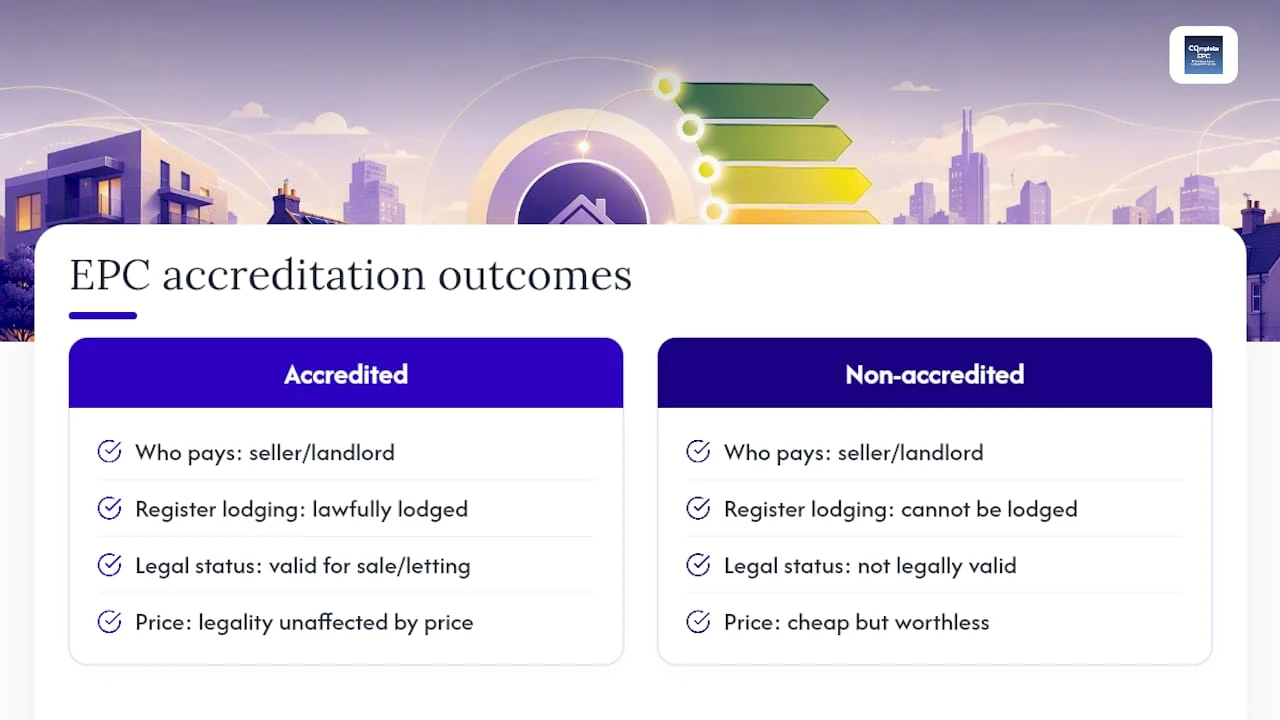
Responsibility here isn’t ambiguous. GOV.UK states plainly that the seller or landlord must commission and pay for the EPC and provide it to prospective buyers or tenants before the property goes to market. Buyers and renters should never be asked to cover this cost themselves.
Prices vary by property size and location. Market guides put typical domestic EPC costs at roughly £60 to £200, with small flats sitting at the lower end and larger or more complex houses at the higher end.
One check matters more than price: the assessor must hold accreditation from an approved scheme. An EPC produced by someone without that accreditation cannot be lawfully lodged on the register, which means it’s worthless for a sale or letting, however cheap it was.
Booking a new EPC with an accredited assessor
If your postcode search comes up empty and the property needs a certificate, the fix is straightforward: book an assessment with a properly accredited assessor. Completeepc handles domestic and commercial EPC bookings across London, using qualified assessors who lodge every certificate directly on the official register once the assessment is complete.
Booking is quick if you have the basics ready:
- Full postcode and property address.
- Property type (flat, terrace, semi, detached, or commercial unit).
- Access details, such as whether a key holder needs to be present.
Turnaround is typically fast for standard domestic properties, and the finished report covers the current rating, the potential rating, and a list of recommended improvements, exactly the fields you’d check on any certificate pulled from the register. Because accredited assessors lodge certificates directly, there’s no delay waiting for a third party to upload the record before conveyancing can proceed.
Pro Tip: Have your postcode and rough floor area ready when you enquire. Assessors can often give a firmer turnaround estimate on the spot rather than after a back-and-forth over email.
For business premises, the process is the same in principle but the assessment itself differs, since commercial buildings are assessed against different benchmarks depending on use class and floor area.
Why the postcode search gets overcomplicated
Most guidance on this topic buries the useful part under paragraphs of context nobody asked for. The reality is simpler: the register works well, opt-outs and expiries account for nearly every “missing” result, and the fields worth reading are the rating, the potential rating, and the expiry date. Everything else is secondary.
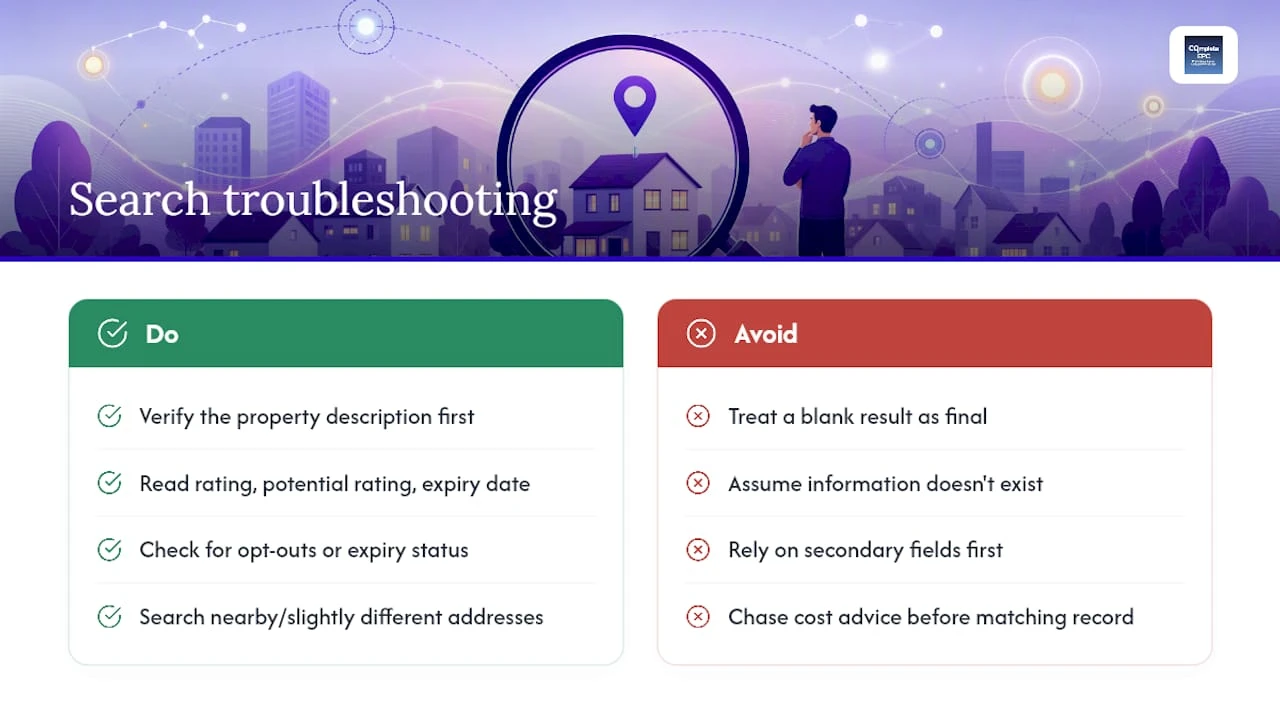
Where conventional advice falls short is in treating a blank search result as a dead end. It rarely is. Most of the time it means the certificate is opted out, lodged under a slightly different address, or simply expired, not that the information doesn’t exist at all. Solicitors and agents chase the certificate reference for exactly this reason.
My view is that readers should prioritise verifying the property description over anything else when a postcode returns multiple addresses. Get that wrong and you’re reading someone else’s insulation recommendations, not the property you’re actually buying or renting. Everything downstream, from cost estimates to improvement advice, depends on having matched the right record first.
— Danny
Book a compliant EPC assessment in London
Completeepc offers a direct route to a valid certificate when the register comes up empty or a property’s EPC has expired, without the wait that comes from chasing agents or third parties for paperwork. Unlike relying on an unaccredited assessor or a generic online quote tool, Completeepc uses qualified assessors who lodge certificates straight onto the official register, so there’s no gap between assessment and a document that’s actually usable for a sale or letting.
Homeowners and landlords across London can book a domestic EPC for houses and flats, while businesses needing certification for offices, retail units, or other non-residential premises can arrange a commercial EPC. Get in touch with your postcode and property type to receive a quote and confirm the next available appointment.
Sources
FAQ
How can I find the EPC certificate for a property?
Use the official Find an energy certificate service on GOV.UK and search by full postcode, street name and town, or certificate reference number.
How much should an EPC certificate cost?
Domestic EPCs typically range from around £60 to £200 depending on property size and complexity, with London and the South East often carrying a premium of 10 to 30%.
Can I do my own energy performance certificate?
No. A valid EPC must be produced and lodged on the official register by a government-accredited energy assessor; self-assessments cannot be lawfully lodged or used for a sale or letting.
Can I get a free EPC certificate?
There’s no cost to search for an existing certificate on the register, but commissioning a new EPC always requires paying an accredited assessor, a cost that falls on the seller or landlord by law.