

TL;DR:
- Energy rating definitions provide a standardized framework for assessing a building’s energy efficiency, with the UK EPC scale ranging from A to G. Private rental properties in England and Wales must meet at least a Band E rating under MEES regulations, with assessments based on government-approved software utilizing detailed on-site data. Understanding the distinction between asset and operational ratings helps property owners accurately interpret energy performance and compliance needs.
Energy rating definitions are standardised classifications that measure the energy efficiency of a building or appliance, expressed as a score or letter band used for regulatory compliance, cost assessment, and environmental benchmarking. In the UK, the most widely recognised system is the Energy Performance Certificate (EPC), which uses an A to G scale to grade properties from most to least efficient. Understanding these definitions is not optional for property owners and tenants. The Minimum Energy Efficiency Standards (MEES) in England and Wales legally require private rented properties to meet at least Band E, making accurate knowledge of rating classifications a direct compliance requirement. Whether you own a flat in London or manage a commercial portfolio, knowing how ratings are defined, calculated, and applied is the foundation of every energy decision you make.
What are the main energy rating scales and classifications?
The UK EPC rating scale runs from A to G, with each band corresponding to a specific score range. Band A covers scores 92 to 100, representing the most efficient properties, while Band G covers scores 1 to 20, the least efficient. The full breakdown is as follows:

| Band | Score range | Typical description |
|---|---|---|
| A | 92–100 | Highly efficient, very low running costs |
| B | 81–91 | Efficient, above average performance |
| C | 69–80 | Good performance, moderate costs |
| D | 55–68 | Average UK property performance |
| E | 39–54 | Below average, minimum legal threshold for rentals |
| F | 21–38 | Poor performance, high running costs |
| G | 1–20 | Very poor, significant improvement needed |
Band E is the critical regulatory threshold. MEES compliance requires that all privately rented properties in England and Wales hold at least a Band E rating unless a valid exemption applies. Properties rated F or G cannot legally be let without an exemption registered on the EPC exemption register.
Ireland operates a separate system called the Building Energy Rating (BER). From 24 May 2026, Ireland’s BER scale shifts from a 15-class A to G structure to a new 8-class system. The top classification is now “A-Zero” (A0), reserved for fossil fuel-free homes, aligning Ireland with broader EU energy performance directives. This change reflects a Europe-wide push to standardise how near-zero energy buildings are classified and recognised.
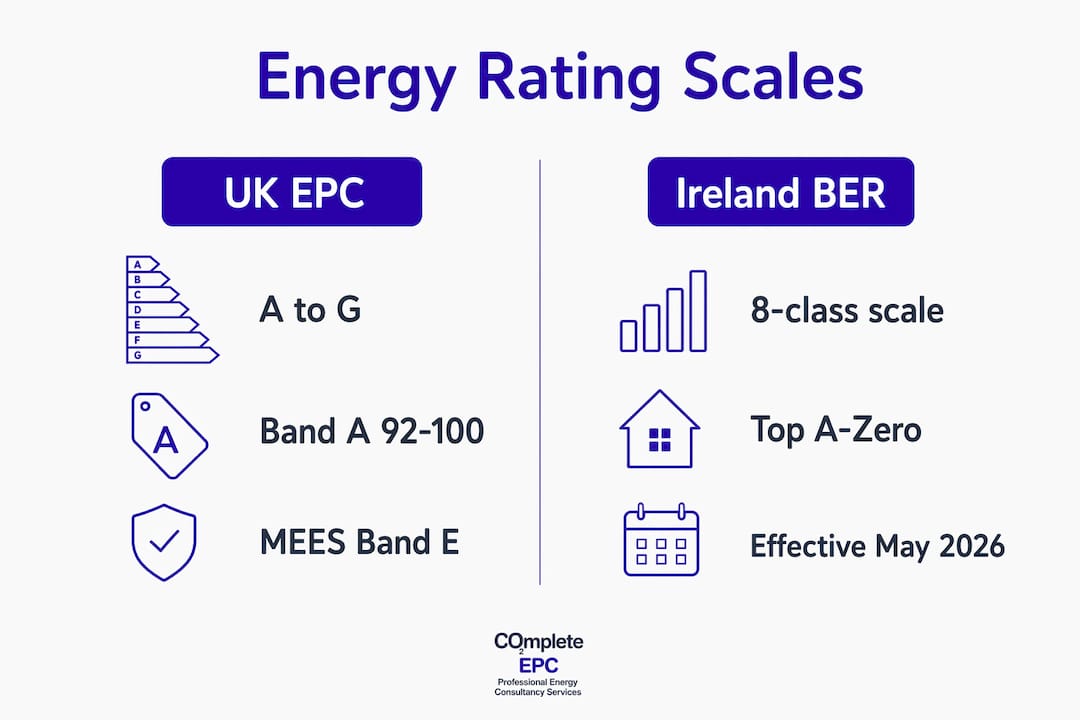
Both the UK EPC and the Irish BER serve the same core purpose: they provide a standardised, comparable snapshot of a building’s energy performance for use in property sales, lettings, and regulatory reporting.
How are energy ratings assessed and calculated in buildings?
Energy ratings for buildings are not estimated by eye or guesswork. They follow defined methodologies that qualified assessors apply on-site, feeding collected data into government-approved software to produce a score. The process differs slightly depending on whether a property is new or existing.
For new dwellings in England and Wales, assessors use the Standard Assessment Procedure (SAP). For existing homes, they use the Reduced Data SAP, known as RdSAP. As of March 2026, SAP 10.3 and RdSAP10 are mandated for all new and existing dwelling assessments in England and Wales. This update introduced revised carbon emission factors and updated fuel cost data, which means ratings produced under SAP 10.3 may differ from those calculated under earlier versions.
A typical on-site assessment follows this sequence:
- The assessor visits the property and records construction details, including wall type, floor construction, and roof insulation.
- Heating system data is collected, covering boiler type, controls, and fuel source.
- Window glazing, lighting, and any renewable energy installations are documented.
- All data is entered into government-approved SAP software, which calculates the energy score and assigns the letter band.
- The assessor lodges the certificate on the national register, where it remains valid for ten years.
For commercial buildings, the methodology switches to the National Calculation Method (NCM), which models energy use based on building type, services, and occupancy patterns. The NCM produces a Display Energy Certificate (DEC) for public buildings and an EPC for commercial properties being sold or let.
Pro Tip: If your property has had recent improvements such as a new boiler or loft insulation added since the last certificate was issued, commission a fresh assessment rather than relying on an outdated rating. A new certificate could move you up a band and strengthen your compliance position.
Understanding SAP versus EPC assessments helps you know which methodology applies to your property type and what data the assessor will need from you on the day.
What is the difference between asset and operational energy ratings?
This distinction matters more than most property owners realise, and confusing the two leads to unrealistic expectations about energy bills.
An asset rating is a modelled estimate of how much energy a building would use under standardised occupancy conditions. It is based entirely on the building’s physical fabric and fixed services, including insulation levels, heating system efficiency, and glazing. Asset ratings use a standardised model so that two properties can be compared fairly, regardless of how their occupants actually behave. The EPC rating on your certificate is an asset rating.
An operational rating, by contrast, is calculated from actual measured energy consumption over a defined period, typically twelve months. It reflects how the building is genuinely used, including heating habits, occupancy hours, and appliance use. Operational ratings are used in Display Energy Certificates for public buildings and are increasingly discussed in the context of EPC reform.
The practical implications are significant:
- Two homes with identical EPC bands can have very different actual energy bills depending on how many people live there and how they heat the property.
- A property with a Band C asset rating occupied by a large family running the heating constantly may cost more to run than a Band D property occupied by a single person.
- Operational ratings vary with occupant behaviour, which is precisely why asset ratings exist as a neutral comparison tool.
The EPC rating tells you what the building can do under standard conditions. It does not tell you what your energy bill will be. Use it as a benchmark for improvement, not as a prediction of cost.
There is a growing policy trend toward Energy Cost Ratings expressed in pounds per square metre per year, which would give consumers a clearer financial picture alongside the letter band. Scotland is leading this reform discussion, and it may influence future UK-wide EPC methodology.
How do energy rating definitions support compliance and property improvement?
Knowing the precise definition of each rating band is the starting point for every compliance and improvement decision. Without that clarity, property owners risk misreading their obligations or missing retrofit opportunities that could move them up a band.
The MEES framework is the most immediate compliance driver for landlords. Band E is the legal minimum for privately rented properties in England and Wales, and enforcement action can follow if a property is let below this threshold without a registered exemption. The government has signalled intentions to raise this threshold to Band C in future years, making early improvement planning worthwhile.
Key points for applying energy rating definitions to compliance and improvement:
- Certificate validity: EPC certificates are valid for ten years. If your certificate is approaching expiry or if significant works have been carried out, reassessment is advisable before any sale or new tenancy begins.
- Potential rating: Every EPC includes a current rating and a potential rating based on recommendations. The potential rating shows the band achievable if all suggested improvements are implemented. For older properties, physical constraints may limit how high the potential rating can reach.
- Retrofit priorities: Loft insulation, cavity wall insulation, and heating controls typically offer the highest score improvements per pound spent. Solar photovoltaic panels and heat pumps can deliver larger band jumps but require greater upfront investment.
- Historic buildings: Listed buildings and properties in conservation areas often face restrictions on certain improvements. The potential rating may show Band B, but planning constraints can make that target unrealistic in practice.
Pro Tip: Ask your assessor to run a sensitivity analysis during the assessment. This shows which individual improvements would move you across a band boundary, so you can prioritise spending where it has the most measurable regulatory impact.
Research shows that mandatory home energy rating policies increase property sale prices and drive retrofit activity at a scale that voluntary schemes do not achieve. This means a higher EPC band is not just a compliance tick-box. It is a measurable factor in home value that buyers and lenders increasingly scrutinise.
Small improvements also accumulate. Incremental home improvements may not individually shift a band, but they improve the overall energy profile of the property and reduce running costs for occupants. Tracking these changes and commissioning a new EPC after a package of works is the most accurate way to capture their full benefit.
Key takeaways
Energy rating definitions provide the standardised framework that property owners and tenants must understand to meet compliance obligations, plan improvements, and accurately interpret what a certificate score means in practice.
| Point | Details |
|---|---|
| UK EPC scale runs A to G | Band A scores 92 to 100; Band G scores 1 to 20, with Band E as the legal rental minimum. |
| SAP 10.3 mandated from March 2026 | New and existing dwellings in England and Wales must use updated SAP 10.3 and RdSAP10 methodologies. |
| Asset rating differs from operational | The EPC reflects modelled standard use, not your actual energy bill or occupant behaviour. |
| Potential rating is aspirational | Physical and regulatory constraints can prevent a property from reaching its stated potential band. |
| MEES sets Band E as the floor | Private rented properties below Band E cannot legally be let without a registered exemption. |
Why I think most property owners misread their EPC
Working in energy performance, the single most common misunderstanding I encounter is the assumption that an EPC rating directly predicts energy bills. It does not. The rating is a standardised model, and two properties with identical Band D certificates can have annual energy costs that differ by hundreds of pounds depending on occupancy, heating habits, and appliance use.
The second misconception is around the potential rating. I have seen landlords invest in expensive measures chasing a Band B shown on the potential section, only to find that listed building restrictions or the age of the construction means Band C is the realistic ceiling. The potential rating is a useful guide, not a guarantee. Always ask your assessor what is physically and legally achievable before committing to a retrofit programme.
What I find genuinely underappreciated is the cumulative value of smaller improvements. Draught-proofing, upgrading to LED lighting, and fitting a smart thermostat will not individually shift your band. Together, they reduce your running costs and improve your score within the band, which matters when the government raises the MEES threshold to Band C. Properties already sitting at the upper end of Band D will need far less work than those at the lower end. Starting now, even with modest measures, puts you in a much stronger position. You can explore practical steps through home efficiency upgrades that make a measurable difference without requiring full-scale renovation.
— Danny
Get a professional EPC assessment for your property
Understanding energy rating definitions is the first step. Acting on them is what protects your compliance position and your property’s value. Completeepc provides professional EPC assessments for both domestic and commercial properties across London, carried out by qualified assessors using the latest SAP 10.3 and RdSAP10 methodologies. Every certificate is lodged on the national register and comes with a full set of improvement recommendations tailored to your property. Whether you need a domestic EPC for a rental property, a sale, or a remortgage, or a commercial EPC to meet your legal obligations, Completeepc offers competitive pricing with a UK lowest-rate guarantee. Contact Completeepc today to book your assessment and receive your certificate promptly.
FAQ
What does an EPC rating of Band D mean?
Band D covers SAP scores of 55 to 68 and represents average UK property performance. It meets the current MEES legal minimum for rented properties but falls below the Band C threshold that government policy is expected to require in future years.
How long is an EPC certificate valid for?
An EPC certificate is valid for ten years from the date of issue. A new assessment is recommended sooner if significant energy improvements have been made, as a fresh certificate will reflect the updated rating.
What is the difference between SAP and RdSAP?
SAP (Standard Assessment Procedure) is used for new dwellings and requires a full set of construction data. RdSAP (Reduced Data SAP) is used for existing homes and uses a reduced dataset, with some values inferred from standard assumptions where full data is unavailable.
Can a listed building achieve a Band A EPC rating?
In most cases, no. Historic buildings face physical and regulatory limits that prevent the installation of measures needed to reach the highest bands. The potential rating on the EPC may show Band B or C as the realistic ceiling rather than Band A.
What is Ireland’s A-Zero BER classification?
A-Zero (A0) is the top classification in Ireland’s revised 8-class BER system, effective from 24 May 2026. It is awarded to fossil fuel-free homes that meet the highest energy performance standards, aligning with EU near-zero energy building requirements.