
Energy saving means using less energy to get the same result, whether that comes from a behaviour change, a more efficient product or a property upgrade. It covers everything from switching off a light to fitting insulation, and the outcome is always the same: lower bills and lower carbon emissions. For UK households and businesses, that makes it one of the most direct ways to cut costs this year.
TL;DR:
- Most energy savings come from changing habits, like turning off appliances, while longer-term upgrades include insulation and upgraded heating systems.
- Measures like fitting a home energy monitor can reduce household electricity use by 5 to 15 percent in the first year.
- The biggest energy savings often result from combining behavior changes with physical upgrades to the property, such as insulation or smart thermostats.
- An energy performance certificate provides specific, costed recommendations for property upgrades that can significantly improve efficiency.
- Starting with free habit adjustments and obtaining qualified assessments before investing in major upgrades maximizes savings and avoids unnecessary spending.
Table of Contents
- What does energy saving actually mean?
- Why energy saving matters for households and businesses
- Everyday actions that start saving energy today
- Longer-term upgrades worth investing in
- How an EPC turns the idea of energy saving into property action
- Our view on where to start with energy saving
- How we can help you act on an energy assessment
- FAQ
- Sources
What does energy saving actually mean?
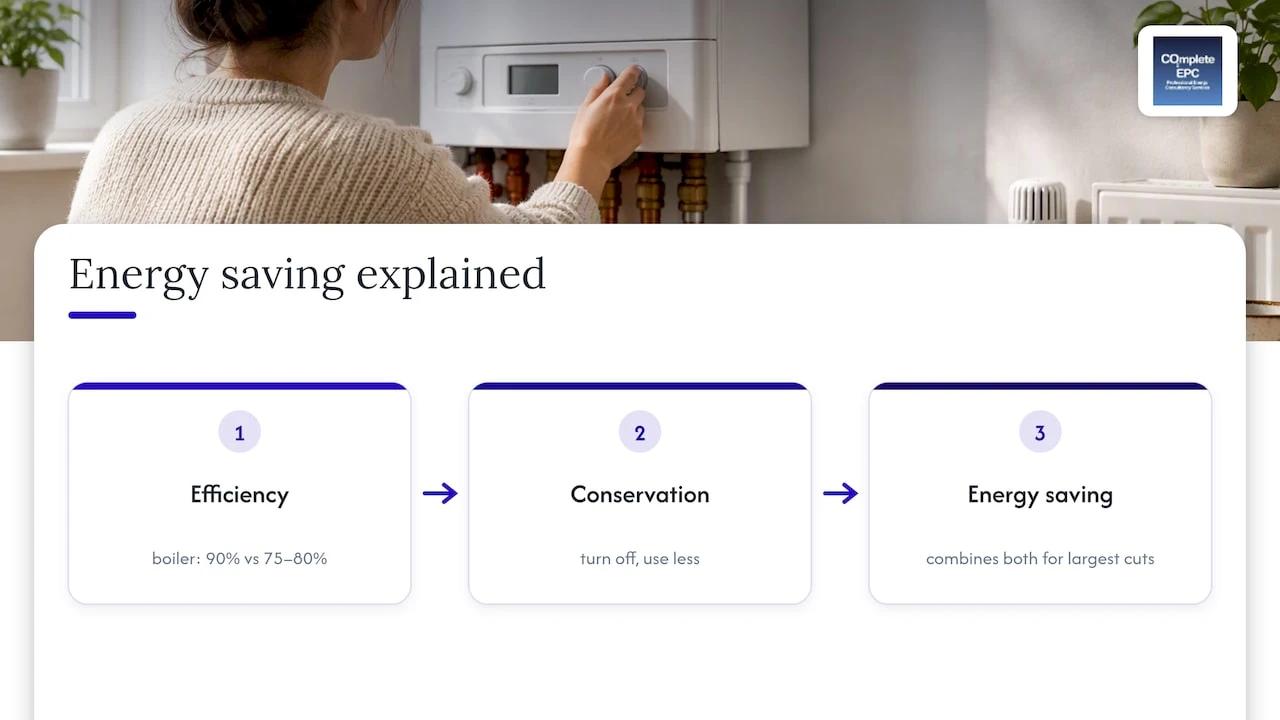
Energy saving refers to reducing energy consumption by using energy resources more effectively, whether through a habit, a product choice or a physical upgrade to a building, as Erewash Borough Council sets out. Energy efficiency is a narrower, more technical idea: it describes how well a product or system converts energy into useful output. A condensing gas boiler can reach seasonal efficiencies of up to 90%, against 75 to 80% for a standard boiler, according to the same council guidance, which means two households can use the same heating system but still see different bills depending on how it is run.
Energy conservation sits closer to behaviour: turning things off, using less, choosing not to run an appliance unnecessarily. In practice the three ideas overlap constantly. Swapping an old bulb for an LED is an efficiency gain. Remembering to switch it off when you leave the room is conservation. Doing both at once is energy saving in its fullest sense, and it is this combination, habit plus hardware, that delivers the biggest reductions in a typical home or office.
Why energy saving matters for households and businesses
Lower energy use means lower bills, and it also means lower carbon emissions, since most electricity and gas still carries a carbon cost at the point of generation or combustion. For a typical office, heating can account for 20 to 40% of total energy costs, according to the Carbon Trust, which shows how much is riding on a single system working efficiently. Fitting a Building Energy Management System can cut total energy costs by around 10% or more in many offices, the same guidance notes, often without any change to how staff work day to day.
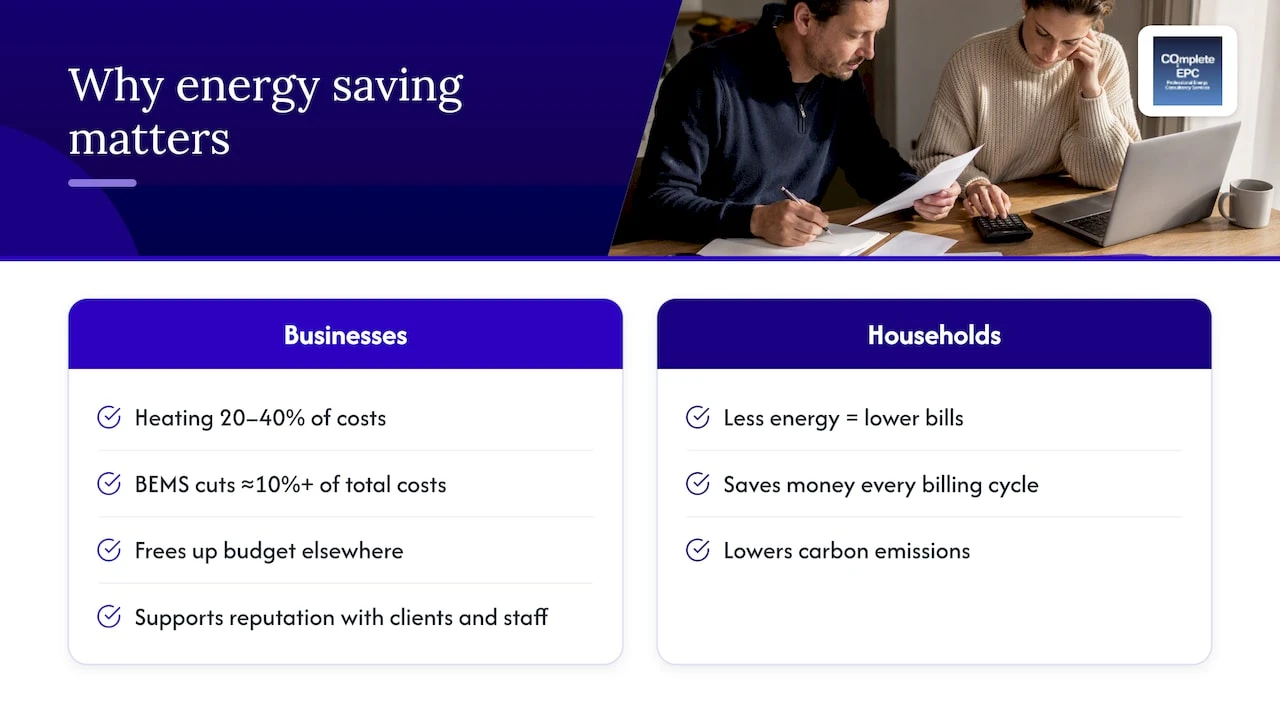
For businesses, the benefits extend past the energy bill itself. Lower running costs free up budget elsewhere, and visible commitment to reducing consumption tends to support reputation with clients and staff. For households, the logic is simpler but no less powerful: less energy bought is less money spent, every single billing cycle.
Everyday actions that start saving energy today
Small habits add up quickly, and none of these require spending money before you start.
- Turn appliances off at the plug rather than leaving them on standby, since standby waste is estimated at around 8% of a typical electricity bill, per nidirect.
- Switch off at the socket consistently and you could save a modest amount per year on an average household bill, the same source suggests.
- Wash clothes at 30°C instead of higher temperatures, a change recommended by the Energy Saving Trust.
- Replace remaining halogen or incandescent bulbs with LEDs, which use a fraction of the electricity for the same light output.
- Turn radiators down rather than off entirely, since fully switching off heating in a room can encourage condensation and damp, as the Clean Energy Campaign notes.
- Drop your thermostat by a single degree and leave it there for a week to see the difference on your next bill.
- Fit a home energy monitor: small-scale trials found household electricity use fell by 5 to 15% in the first year once consumption became visible, according to nidirect.
- Take a meter reading before and after a change so you can see, in real figures, whether it worked.
Longer-term upgrades worth investing in
Once the free and low-cost changes are in place, the bigger gains come from the building itself. Loft and cavity wall insulation, draught-proofing around doors and windows, and upgrading single glazing all reduce the amount of heat a property loses in the first place, and well-fitted roofing plays a direct part in that, as this guide to roofing and insulation explains.
Heating systems are the next priority:
- A condensing boiler offers a clear efficiency step up from an older, non-condensing model.
- A heat pump can deliver heat using significantly less primary energy than a gas boiler in a well-insulated property, though the fabric work above usually needs to come first.
- Solar panels and battery storage reduce reliance on the grid, and the Energy Saving Trust’s tools and calculators can help estimate what a specific property might gain.
- Smart thermostats and, for commercial buildings, a full Building Energy Management System give ongoing control rather than a one-off fix.
The sensible order is behaviour first, low-cost fixes second, capital investment last, a hierarchy the Energy Saving Trust also sets out.
Pro Tip: Measure your energy use for a few weeks before and after any upgrade, so you have real figures to judge whether the investment is paying off.
How an EPC turns the idea of energy saving into property action
A Domestic Energy Performance Certificate rates a property’s current efficiency and lists specific recommendations, each with an estimated cost and an estimated saving, so the general idea of energy saving becomes a concrete, costed plan for that building. Government guidance on improving energy efficiency confirms that EPC-based recommendations and related funding routes are designed to work together in exactly this way. Where the everyday actions above run out of impact, an EPC points towards the fabric and heating upgrades likely to matter most. A fresh assessment is worth arranging whenever you are letting, selling or planning major improvement work.
Our view on where to start with energy saving
Start with what costs nothing: the habits in this piece. Measure the effect before you spend a penny on equipment, because a monitored habit tells you more than a guess ever will. When you are ready to commit money, whether that is insulation, a heat pump or a full retrofit, get a qualified assessment first rather than buying on instinct.
— Danny
How we can help you act on an energy assessment
We carry out Domestic EPCs and Commercial EPCs across London, giving you a clear, costed list of the upgrades worth doing first. We also handle SAP Calculations for new builds and extensions. Request an assessment whenever you need a property-specific starting point rather than general advice.
FAQ
What do you mean by energy-saving?
Energy saving means reducing the amount of energy a person, home or business uses to achieve the same outcome, whether through a habit, a more efficient product or a building upgrade. It is distinct from energy efficiency, which refers specifically to how well equipment converts energy into useful output, as Erewash Borough Council explains.
What does it mean to save energy?
Saving energy means using less of it for the same task, such as heating a room, washing clothes or lighting a space, without losing the benefit you need from that task. It can come from a free behaviour change or from investing in better equipment or insulation.
What is a word for saving energy?
Common alternative terms include energy conservation, which leans towards behaviour, and energy efficiency, which leans towards technical performance of equipment. All three terms describe routes to the same outcome: lower consumption for the same result.
What are 5 ways to save energy?
Turning appliances off at the plug, washing at 30°C, switching to LED bulbs, turning your thermostat down by one degree and fitting a home energy monitor are five practical starting points, recommended by the Energy Saving Trust and nidirect. None of these require spending money upfront.