
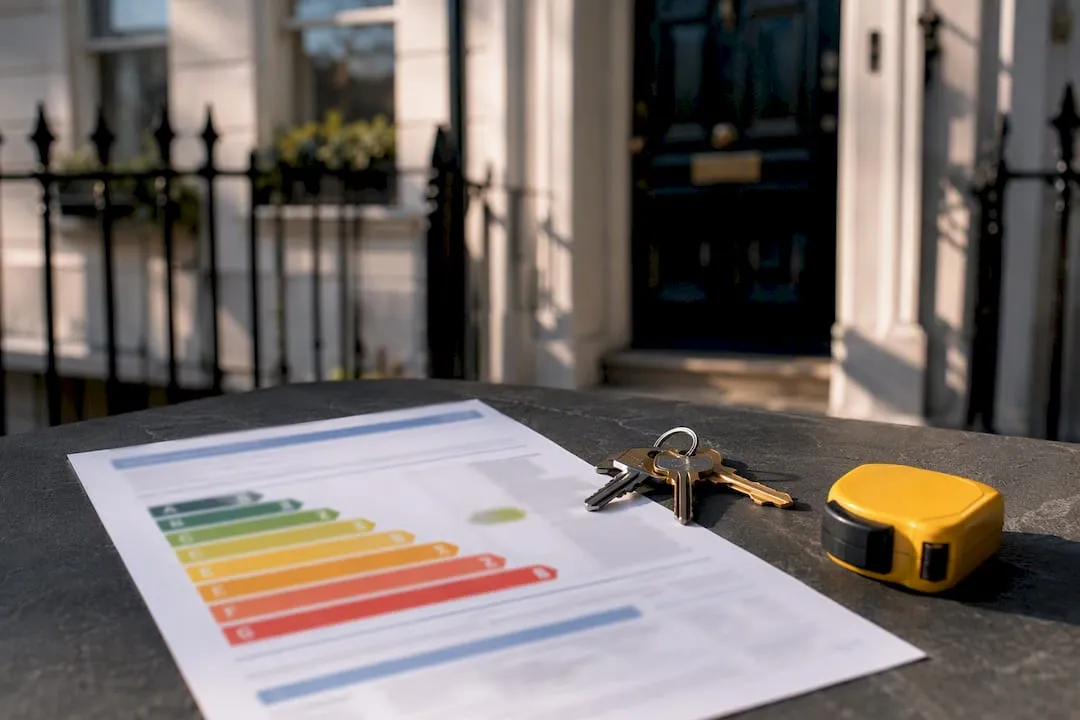
The “energy star” you see referenced on a property listing is the Energy Performance Certificate rating: a letter grade from A to G that scores how energy efficient a building is. That grade comes from a SAP or RdSAP assessment, stays valid for 10 years, and directly affects whether a landlord can legally let a property under the Minimum Energy Efficiency Standards. If you own, sell, or manage property, the first thing to check is where your building sits on that scale and whether it clears the compliance floor.
TL;DR:
- The EPC score is based on the building’s fabric and fixed services, not actual energy bills or occupant behavior, making identical houses on the same street often carry the same rating despite different costs.
- The recommended measures, such as insulation and heating upgrades, are listed by cost-effectiveness, with small improvements potentially shifting a property one band higher and avoiding legal or market risks.
- An EPC’s current and potential ratings, along with costed recommendations and expiry date, inform owners whether upgrades are financially viable and legally necessary for compliance.
- The legal standing of EPCs means properties below the minimum energy efficiency standards risk fines and reduced marketability, with some exemptions available for listed buildings or cost-prohibitive improvements.
- The US Energy Star label is a separate voluntary scheme for appliances and buildings in America, with no direct relevance to the UK property market or EPC ratings.
Table of Contents
- What an EPC energy rating measures and how the score is calculated
- Reading the current rating, potential rating, and recommendations box
- Why the energy rating matters for sales, lettings, and MEES compliance
- From reading the certificate to fixing the numbers
- Where the American Energy Star label comes from
- How EPC ratings and the US Energy Star scheme actually differ
- What certification actually delivers for the people who hold it
- What efficient rating systems mean for energy use and emissions
- Examples of where the Energy Star label and EPC ratings actually appear
- Complete EPC’s perspective: what a proper assessment actually gives you
- Book a domestic EPC with Complete EPC
- Sources
- FAQ
What an EPC energy rating measures and how the score is calculated
An EPC rating is an asset rating, not a bill. It scores the building itself, its insulation, heating system, glazing, and fixed services, using standardised assumptions about occupancy and usage rather than how the current occupants actually live. Two identical houses on the same street can carry the same EPC band while their owners pay very different heating bills, because the certificate is designed as a comparison tool for buyers and tenants, not a measure of one household’s habits.
The number behind the letter comes from the Standard Assessment Procedure, or SAP, for new dwellings, and its reduced form, RdSAP, for existing homes where a full physical survey of every material and system isn’t practical. Both produce a numeric score that then maps onto a letter band. RdSAP works from what an assessor can observe and measure on-site: wall construction, loft insulation depth, glazing type, and the heating system installed.
The band ranges are fixed points, not rough guides, generally running from A at the top end for very efficient new builds with excellent fabric and low-carbon heating, down to G at the bottom for the least efficient properties that almost always need remedial work
A property sitting at 40 points is technically an E, but it’s one insulation upgrade away from D. That closeness matters more than most owners realise.
Reading the current rating, potential rating, and recommendations box
Every EPC carries two numbers side by side: the current rating and the potential rating. The current figure reflects the property as it stands today. The potential figure isn’t aspirational guesswork. It’s modelled specifically on the assumption that the cost-effective measures listed in the recommendations box get implemented.
The recommendations box itself follows a consistent structure:
- The measure — loft insulation, a heating control upgrade, double glazing, and so on
- Indicative installation cost — a rough cost band, not a quote
- Estimated annual saving — what that measure typically saves on energy bills
- Resulting rating — the band the property would reach once that measure, and any measures above it, are in place
Read the box in order. Measures are usually listed by cost-effectiveness, so the first two or three items often deliver the biggest jump in rating for the smallest outlay.
Pro Tip: Don’t aim to just scrape past a band threshold. A property sitting at 39 points (bottom of band E) is one bad boiler winter away from slipping to F. Push improvements far enough to build a genuine buffer above the minimum, not just clear it by a point or two.
That buffer matters because band boundaries are hard regulatory lines, not soft guidance. The difference between a SAP score of 38 and 39 is the difference between a legally lettable property and one that isn’t, so a single insulation job or heating upgrade can change a property’s legal status overnight.
Why the energy rating matters for sales, lettings, and MEES compliance
An EPC isn’t optional paperwork. It’s a legal requirement whenever a property is constructed, sold, or let, and once produced, it must be lodged on the central Energy Performance of Buildings register before marketing begins. Estate agents can’t legally advertise a property without a valid certificate on file, and solicitors handling a transaction will expect to see the reference number as a matter of course.
Key compliance points property professionals need to track:
- Validity runs for 10 years from the date of assessment, so a certificate commissioned in 2016 has likely already expired
- MEES sets a legal floor for rented property energy efficiency, and landlords letting below that floor risk fines and enforcement action unless a valid exemption is registered
- Exemptions exist for cases like listed buildings or situations where the cost of improvement genuinely outweighs the benefit, but they must be formally registered, not simply assumed
- The rating reflects the building fabric and fixed services used for compliance, which is why non-domestic EPCs follow the same lodging and register requirements as domestic ones
Beyond the legal floor, the rating shapes marketability directly. Buyers increasingly ask about running costs before viewing, and a poor band can slow a sale or knock money off an offer. Some lenders and insurers now factor efficiency ratings into their own risk assessments too, which means a weak EPC can complicate financing as well as tenancy.
From reading the certificate to fixing the numbers
Once you’ve got the certificate in hand, there’s a short list of details worth noting before you do anything else:
- The certificate’s unique reference number, so you (or your solicitor) can pull it from the register instantly
- Current band and score, and potential band and score
- Every recommended measure listed, in the order given
- The estimated cost and payback period against each measure
- The expiry date, so you know exactly when a fresh assessment becomes due
From there, the improvements that move a property most reliably between bands tend to be the same handful:
- Loft and cavity wall insulation — often the cheapest points-per-pound improvement available
- Heating controls — thermostatic radiator valves and programmable timers, a low-cost fix with a real SAP impact
- Boiler replacement — a bigger outlay, but usually the single biggest jump for an older, inefficient system
- Glazing upgrades — double or triple glazing, more effective on older single-glazed stock than on already-glazed properties
- Solar PV — meaningful uplift, though the payback period is longer than fabric measures
Pro Tip: If you’re planning a loft conversion, extension, or new build rather than remediating an existing property, you need a SAP calculation, not a standard EPC. The two serve different purposes, and ordering the wrong one wastes time and money at exactly the stage you can least afford it.
Knowing when to simply order a fresh EPC versus commissioning a full retrofit plan comes down to scale. A straightforward re-assessment suits a property nearing its 10-year expiry with no major works planned. A full plan makes more sense when you’re weighing multiple upgrade paths and need the costed comparison before committing budget.
Where the American Energy Star label comes from
The Energy Star mark that appears on appliances in the United States is a separate scheme entirely, run by the US Environmental Protection Agency and Department of Energy. It began in 1992 as a voluntary labelling programme, initially covering computers and monitors, before expanding to cover a huge range of household appliances, electronics, and eventually whole buildings.
Its purpose was straightforward: give American consumers a quick, trusted signal that a product used meaningfully less energy than the standard model on the shelf next to it. Manufacturers submit products for testing against efficiency benchmarks set by the agencies, and only qualifying models earn the mark.
It’s worth being clear about this distinction because the phrase “energy star” gets used loosely, and property professionals in the UK searching for guidance can easily land on American appliance content when what they actually need is EPC guidance. The scheme has no jurisdiction in the UK property market and plays no role in UK sales, lettings, or compliance. If you’re dealing with a British EPC, the American label is a different system built for a different market and a different purpose entirely.
How EPC ratings and the US Energy Star scheme actually differ
The two systems look superficially similar, a simple grading system meant to signal efficiency at a glance, but they work on completely different logic. An EPC rates an entire building as a single asset, weighing insulation, heating, glazing, and fixed services together into one letter grade from A to G. The American scheme rates individual products or appliances against a category benchmark, so a fridge either qualifies or it doesn’t.
An EPC is also a legal requirement tied to property transactions in the UK, with statutory validity and compliance consequences under MEES. Energy Star, by contrast, is a voluntary labelling scheme with no bearing on whether a sale or tenancy can legally proceed.
The scoring methods differ too. EPC bands come from a calculated SAP or RdSAP score mapped against fixed numeric ranges, giving every property a comparable, auditable figure. The American label doesn’t publish a comparable single score for the property itself, since it certifies products and, separately, whole buildings against performance benchmarks rather than assigning a universal letter grade.
For a UK property professional, the practical takeaway is simple: when a client, colleague, or search result mentions “energy star” in a British property context, they almost certainly mean the EPC rating, not the American appliance scheme.
What certification actually delivers for the people who hold it
The American Energy Star label exists to reward measurable performance, and that structure carries lessons UK property professionals will recognise. For a consumer buying a qualifying appliance, the benefit is straightforward: independently verified lower running costs against products that haven’t met the same benchmark. For a business labelling a commercial building, certification signals verified performance to investors, tenants, and regulators who increasingly ask for evidence rather than assurances.
The parallel with EPCs is direct even though the schemes are unconnected. A strong EPC band delivers the same kind of reassurance to a UK buyer or tenant that Energy Star certification gives an American consumer: independently assessed proof that a property or product performs better than a comparable one that hasn’t been assessed, or has been assessed and scored lower.
That’s precisely why the current and potential ratings on a UK EPC carry real weight in a transaction. They’re not marketing copy. They’re a standardised, third-party assessment that a buyer, tenant, solicitor, or lender can trust without needing to independently verify the building’s fabric themselves.
What efficient rating systems mean for energy use and emissions
Efficiency labelling schemes, whether that’s the EPC banding system or the American appliance scheme, exist because visible ratings change buying and letting behaviour. When a rating is displayed prominently, buyers and tenants factor it into their decision, and that demand pressure pushes owners and manufacturers toward higher-performing products and buildings over time.
In the UK property market specifically, the EPC’s headline Energy Efficiency Rating is routinely paired with an environmental impact metric, reflecting the carbon emissions associated with running the building as assessed. A higher band doesn’t just mean lower bills for the eventual occupant. It means less energy drawn from the grid overall, and where that energy is still carbon intensive, lower emissions attributable to that property across its life.
This is the practical link between an individual EPC and the wider push toward decarbonising the UK’s building stock. Every property nudged from an F to a D through insulation and heating upgrades is one less inefficient building drawing disproportionately on energy supply, which is precisely why government policy leans on EPC bands as the lever for driving MEES compliance rather than leaving efficiency improvements voluntary.
Examples of where the Energy Star label and EPC ratings actually appear
In the United States, the Energy Star mark turns up on refrigerators, washing machines, dishwashers, televisions, and computer monitors sold at retail, as well as on commercial and residential buildings that have gone through a separate whole-building certification process. Look for the blue Energy Star logo on the appliance itself or its packaging; it won’t appear on a property listing in the UK, because it isn’t part of the British system at all.
In the UK, the equivalent visible marker is the coloured A to G bar chart on the front page of every EPC, whether that’s for a two-bedroom terrace being sold, a commercial office being let, or a new-build flat completed last month. You’ll see it referenced on property portal listings, in solicitors’ transaction packs, and on the certificate itself once lodged on the national register. Non-domestic buildings, from warehouses to retail units, carry the same style of certificate under separate but parallel rules. If you’re a landlord or agent working in England or Wales, this bar chart, not the American logo, is the “energy star” that governs what you can legally market and let.
Complete EPC’s perspective: what a proper assessment actually gives you
A rating on a page is only as good as the assessment behind it. Assessors work through the same SAP and RdSAP methodology covered above, but the value sits in how the output is delivered: a transparent scoring breakdown, costed recommendations you can actually act on, and correct lodging on the official register so the certificate holds up under any solicitor’s scrutiny.
That level of detail is what separates a certificate that just states a band from one that gives a landlord or agent a genuine plan for improvement. When the numbers are close to a threshold, and they often are, that clarity is what lets a client decide whether to act now or risk a compliance gap later.
— Danny
Book a domestic EPC with Complete EPC
If you need a Domestic Energy Performance Certificate for a sale, letting, or compliance check, Complete EPC handles the assessment from booking through to lodging on the official register, without the drawn-out quoting process some larger consultancies default to. The business is built around transparent pricing for property owners, landlords, and agents who need a reliable rating without the runaround.
Booking is straightforward: provide the property address, access details, and your preferred date, and a qualified assessor takes it from there. Turnaround is typically fast, and you’ll come away with a clear breakdown of your current band, your potential band, and exactly which measures would close the gap between them. If your certificate has lapsed or you’re weighing a SAP calculation for a new build or extension instead, get in touch through the domestic EPC page and start the booking process today.
FAQ
What does the energy star rating mean on a UK property?
It refers to the EPC energy efficiency rating, a letter grade from A to G calculated using SAP or RdSAP that reflects how energy efficient the building’s fabric and fixed services are.
Is the EPC rating the same as the US Energy Star label?
No. The EPC is a UK legal requirement rating a building’s efficiency, while Energy Star is a separate, voluntary American scheme that certifies appliances and buildings against US benchmarks.
How long does an EPC stay valid?
An EPC is valid for 10 years from its assessment date, after which a new certificate is needed for any sale, let, or marketing.
What’s the minimum EPC band for renting out a property?
MEES sets a compliance floor that currently rules out letting properties rated F or G, unless a registered exemption applies, so landlords should check their band against the current threshold before marketing a tenancy.
Can I improve my EPC rating without major building work?
Yes. Measures like heating controls, loft insulation, and draught-proofing often deliver a real SAP score improvement for relatively low cost, sometimes enough to shift a property a full band.
Where do I get a Domestic Energy Performance Certificate?
You can book a Domestic Energy Performance Certificate through a qualified assessor such as Complete EPC, who will survey the property, calculate the rating, and lodge it on the official register.