

Nearly 27 percent of British Energy Performance Certificates are reported to contain at least one error, sparking concerns over property rating accuracy for buyers and investors. Understanding EPC data is vital because these certificates influence property values and legal responsibilities across England and beyond. This guide uncovers the hidden truths behind EPC assessments and clears up widespread misconceptions, offering practical advice so British property owners can make confident, informed decisions.
Table of Contents
- EPC Data Defined And Common Misconceptions
- Types Of EPCs For Domestic And Commercial Use
- How EPC Assessments And Ratings Work
- Legal Duties For London Landlords And Sellers
- Costs, Benefits, And Improving EPC Ratings
Key Takeaways
| Point | Details |
|---|---|
| EPC Data Accuracy | Approximately 27% of EPCs contain errors, highlighting the need for careful verification of assessment details. |
| Types of EPCs | Domestic and commercial EPCs differ significantly in focus and assessment methodologies, necessitating the correct type for property type. |
| Legal Obligations | Landlords and sellers in London must provide a valid EPC when renting or selling to avoid penalties and ensure transparency. |
| Impact of EPC Ratings | Higher EPC ratings enhance property value and reduce energy costs, making efficiency improvements a strategic long-term investment. |
EPC Data Defined and Common Misconceptions
An Energy Performance Certificate (EPC) represents a comprehensive assessment of a property’s energy efficiency, providing crucial insights into its environmental performance and potential running costs. These certificates utilise standardised metrics to evaluate buildings, offering property owners and potential buyers a clear understanding of energy consumption patterns.
Understanding EPC data requires recognising its complexity. Research from Leeds Beckett University reveals significant variability in certificate accuracy, highlighting that approximately 27% of EPCs contain at least one error. These discrepancies often emerge from inconsistent assessments of building parameters such as floor types, wall construction, and architectural configurations. Such variations can substantially impact the reported energy efficiency rating, potentially misleading property owners and investors.
Common misconceptions about EPC data frequently centre around its perceived precision. Measurement studies indicate substantial rating variability, with standard deviations ranging from ±8.0 points at lower ratings to ±2.4 at higher ratings. This variability means that properties might be incorrectly classified into different energy efficiency bands, which can significantly influence property valuations and potential investment decisions.
Pro Tip – Certificate Verification: Always request a detailed breakdown of your EPC assessment and cross-reference the recorded building characteristics with your actual property to ensure maximum accuracy and reliability.
Types of EPCs for Domestic and Commercial Use
Energy Performance Certificates (EPCs) are essential assessments that categorise properties based on their energy efficiency, with distinct approaches for domestic and commercial buildings. The UK government mandates EPCs for all properties when constructed, sold, or rented, ensuring comprehensive energy performance evaluation across different property types.
For domestic properties, EPCs focus on residential buildings like houses and flats, assessing specific residential energy consumption factors. These certificates examine elements such as wall insulation, heating systems, hot water infrastructure, and overall thermal performance. Homeowners receive a rating from A (most efficient) to G (least efficient), providing clear insights into potential energy costs and environmental impact.
Commercial EPCs differ significantly, targeting office buildings, retail spaces, and other non-residential structures. Larger commercial properties over 500 square metres, particularly those frequently visited by the public, are required to display their EPC prominently. These assessments evaluate more complex systems including advanced heating, ventilation, air conditioning, lighting infrastructure, and overall building energy management strategies. The certification process considers unique commercial characteristics like occupancy patterns, technological systems, and specific energy consumption requirements.
Pro Tip – Certificate Selection: Always ensure you obtain the correct type of EPC specific to your property type, as domestic and commercial certificates involve distinctly different assessment methodologies and regulatory requirements.
Here is a summary comparing key differences between Domestic and Commercial EPCs:
| Aspect | Domestic EPC | Commercial EPC |
|---|---|---|
| Main Purpose | Assess homes and flats | Assess offices and commercial spaces |
| Rating Focus | Wall insulation, heating, hot water | HVAC, lighting, energy management |
| Who Receives It | Homeowners, buyers, tenants | Business owners, landlords |
| Display Requirement | Not required for display | Display required for large properties |
| Methodology Complexity | Standard building features | Factors in use, occupancy, technology |
How EPC Assessments and Ratings Work
Energy Performance Certificates (EPCs) represent a comprehensive evaluation of a property’s energy efficiency, utilising a standardised assessment methodology that provides crucial insights for property owners and potential buyers. EPC assessments meticulously examine multiple factors to determine a building’s energy performance rating, creating a systematic approach to understanding energy consumption and environmental impact.
The assessment process involves a detailed inspection of critical building characteristics, including wall and roof insulation, heating systems, windows, lighting infrastructure, and overall construction materials. Qualified assessors conduct a thorough survey, measuring thermal efficiency, heat loss potential, and energy consumption patterns. Each property receives a rating on a scale from A to G, with A representing the most energy-efficient properties and G indicating the least efficient structures. This rating provides an immediate visual representation of a building’s energy performance, allowing potential occupants to understand potential energy costs and environmental implications.

Beyond the numerical rating, EPC documents offer comprehensive insights into potential energy costs and carbon dioxide emissions, presenting recommendations for improving energy efficiency. These recommendations range from simple interventions like draught-proofing and improved insulation to more extensive upgrades such as installing modern heating systems or implementing renewable energy technologies. The certificate remains valid for 10 years, providing a consistent benchmark for property energy performance and serving as a critical tool for informed decision-making in property transactions.
Pro Tip – Efficiency Insights: Request a detailed breakdown of your EPC assessment to understand specific recommendations for improving your property’s energy performance and potential cost savings.
Legal Duties for London Landlords and Sellers
Energy Performance Certificates (EPCs) represent a critical legal requirement for property transactions in London, imposing specific obligations on landlords and sellers. Regulations mandate that property owners must provide an EPC when renting out or selling a property, with strict consequences for non-compliance that can significantly impact property transactions.
The legal framework surrounding EPCs is comprehensive and stringent. Landlords and sellers must ensure they obtain a valid certificate before marketing their property, with certificates remaining legally valid for 10 years. Failure to provide an EPC can result in substantial financial penalties ranging from £500 to £5,000, depending on the property’s rateable value. These fines are designed to encourage proactive energy efficiency reporting and ensure potential buyers or tenants receive transparent information about a property’s energy performance.
The Energy Performance of Buildings Regulations 2012 establish clear requirements for property transactions, extending beyond residential properties to include commercial spaces and public buildings. Specific requirements vary depending on property type, with larger public buildings over 250 square metres required to display a Display Energy Certificate (DEC). Property owners must not only obtain the certificate but also make it readily available to prospective buyers or tenants, ensuring full transparency about the building’s energy efficiency characteristics.
Pro Tip – Documentation Readiness: Always keep your EPC updated and easily accessible, preparing a digital and physical copy before initiating any property sale or rental process to avoid potential legal complications.
Costs, Benefits, and Improving EPC Ratings
Energy Performance Certificates represent a strategic investment for property owners, with costs varying significantly depending on the property’s complexity and size. The government guidelines indicate that obtaining an EPC can lead to substantial long-term financial benefits, including reduced energy consumption and increased property market value.
The financial implications of EPC ratings extend beyond the initial certification cost. Properties with higher energy efficiency ratings typically command premium prices in the London property market, attracting environmentally conscious buyers and tenants. Improvements can range from simple interventions like draught-proofing and insulation upgrades to more comprehensive retrofitting of heating systems. Each enhancement not only improves the property’s EPC rating but potentially reduces annual energy expenditure by hundreds of pounds.
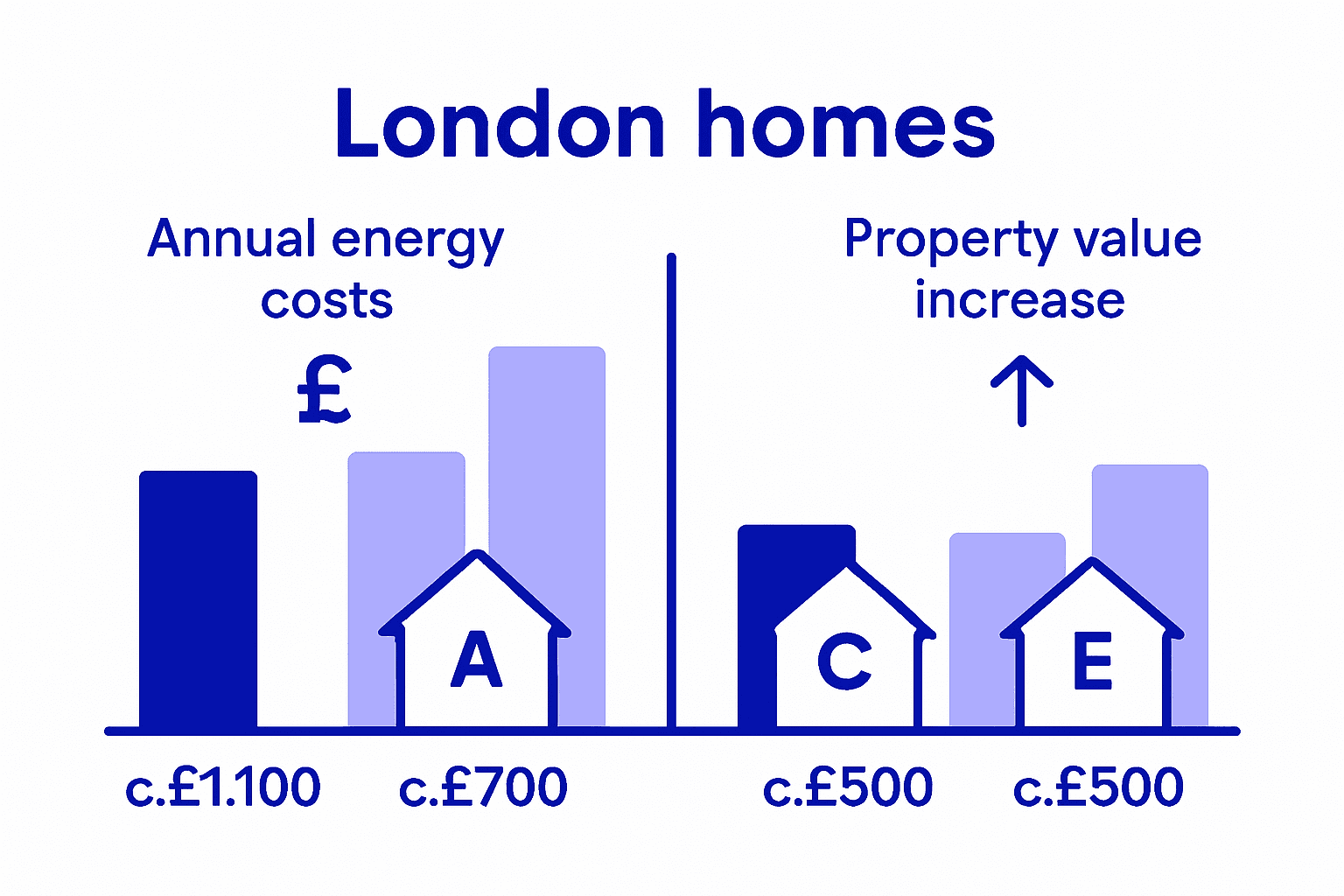
Energy performance recommendations provide a roadmap for property owners seeking to enhance their building’s efficiency, with targeted improvements capable of dramatically transforming a property’s rating. Strategic upgrades such as installing double-glazed windows, improving roof insulation, upgrading to more efficient heating systems, and implementing smart temperature controls can elevate a property’s EPC rating by multiple bands. These improvements not only reduce carbon emissions but also create more comfortable living environments and potentially increase property market value.
Below is a table outlining practical ways to improve EPC ratings and their typical impact areas:
| Upgrade Type | Expected EPC Benefit | Additional Advantages |
|---|---|---|
| Loft insulation | Multiple rating bands higher | Lower energy bills |
| Double glazing | Improved thermal efficiency | Reduced noise, improved comfort |
| Efficient boiler | Higher heating system score | More reliable heating, fewer repairs |
| Smart controls | Optimised energy usage | Greater control over environment |
| Solar panels | Renewable energy contribution | Reduced carbon emissions |
Pro Tip – Efficiency Investment: Prioritise energy efficiency improvements that offer the most significant rating boost relative to their implementation cost, focusing on interventions that provide the best return on investment.
Navigate EPC Data Challenges with Expert Support from Complete EPC
Understanding EPC data and its complexities is vital for London property owners aiming to comply with legal duties while maximising their property’s energy efficiency and market value. The variability in EPC accuracy and the distinct requirements for domestic and commercial certifications can create confusion and risk costly non-compliance penalties. With Complete EPC, you gain access to qualified assessors who deliver precise, reliable energy performance certificates tailored to your property’s unique characteristics. This helps you avoid common pitfalls such as inaccurate ratings and ensures your EPC report includes actionable recommendations for boosting energy efficiency.
Don’t let misunderstandings around EPC data affect your property transactions or energy cost savings. Discover how Complete EPC’s professional services can guide you through the certification process swiftly and affordably. Take control now by visiting Complete EPC to request your assessment. Learn more about legal obligations for landlords and sellers and explore how our detailed reports offer practical steps to improve your EPC rating and energy performance. Act today to secure compliance and make smarter energy decisions for your London property.
Frequently Asked Questions
What is an Energy Performance Certificate (EPC)?
An Energy Performance Certificate (EPC) is an assessment that evaluates a property’s energy efficiency, providing insights into its environmental performance and expected energy costs.
How accurate are EPC ratings?
EPC ratings can vary significantly, with research indicating that about 27% of EPCs have at least one error. This variability can affect property classifications, leading to potential misinformation regarding energy efficiency.
What are the different types of EPCs?
EPCs are categorised into domestic and commercial types. Domestic EPCs assess residential properties like homes and flats, while commercial EPCs focus on non-residential buildings such as offices and retail spaces.
What are the legal requirements for having an EPC?
Property owners must obtain a valid EPC before selling or renting their property. Certificates are valid for 10 years, and penalties can apply for non-compliance, making it essential to ensure you have an up-to-date EPC.
Recommended
- London’s Guide to EPC: What You Need to Know to Boost Property Value – Complete EPC
- Understanding EPCs in London: Why They Matter for Property Owners – Complete EPC
- The Role of Energy Performance Certificates in London’s Property Market – Complete EPC
- London’s Ultimate Guide to Energy Performance Certificates: Enhance Your Property’s Efficiency – Complete EPC