

If you let residential property in England or Wales, you must hold a valid Energy Performance Certificate and comply with the Minimum Energy Efficiency Standard. If your property currently sits at F or G, you cannot lawfully continue letting it without either carrying out improvements or registering a valid exemption. That is the whole rule in one sentence. Everything else in EPC documentation for landlords is about proving it.
Three things sit at the centre of this: the Minimum Energy Efficiency Standard (MEES), the ten-year validity window on a lodged EPC, and the PRS Exemptions Register, which is where you log any legitimate reason you cannot yet meet the standard. Completeepc works with landlords across London who need one or all three sorted before a tenancy starts, before a mortgage lender asks questions, or before a compliance notice is issued.
Here’s your checklist for the next 7 to 30 days:
- Check your current EPC. Search the national register by postcode to see if one exists, what rating it holds, and when it expires.
- Gather your paperwork. Locate invoices, installer certificates, and any building control sign-offs for insulation, boiler, or glazing work already carried out.
- Book an accredited assessor if you need one. If there’s no valid EPC, or the rating is F or G with no exemption logged, get an inspection booked before you market the property again.
Key Takeaways
Landlords who hold a valid, in-date EPC and keep organised evidence of every improvement are the ones who sail through enforcement checks and transition smoothly into the 2030 reforms.
| Point | Details |
|---|---|
| Check your EPC now | Search the national register by postcode to confirm your rating and expiry date. |
| Keep every invoice | Retain installer invoices, certificates, and photos for the full ten-year EPC validity period. |
| Register exemptions properly | Match your evidence to the exact exemption category before submitting to the PRS Exemptions Register. |
| Plan for 2029 and 2030 | Track spend against the future £10,000 cost cap and aim for EPC C before the transitional deadline. |
| Use an accredited assessor | Completeepc’s domestic EPC service lodges valid, register-ready certificates and helps organise your evidence. |
Table of Contents
- Which properties actually need an EPC documentation for landlords check
- When MEES bites: key dates for EPC C reforms and existing rules
- What documents you must give tenants and keep on file
- Getting a valid EPC: who’s qualified and what happens on the visit
- Turning EPC recommendations into a real improvement plan
- EPC exemptions: categories, evidence, and how long they last
- What happens if you’re caught out: enforcement and penalties
- What the reforms actually change for your next retrofit decision
- How Completeepc helps you get the paperwork right
- Sources
- FAQ
Which properties actually need an EPC documentation for landlords check
MEES doesn’t apply universally, and the first job is working out whether your specific letting falls inside the scope of the regulations at all.
The rules apply to most assured tenancies, assured shorthold tenancies, and regulated tenancies under the Energy Efficiency (Private Rented Property) (England and Wales) Regulations 2015. If you grant a new tenancy, renew an existing one, or simply continue letting under a periodic arrangement, the property needs a valid EPC on record. Certain lettings sit outside scope: some room-only lets in shared houses without exclusive occupation, listed buildings where energy efficiency work would unacceptably alter the character of the property, and a handful of holiday-let and short-term arrangements. If you’re unsure whether a listed building exemption genuinely applies, don’t assume it does. Local conservation officers interpret “unacceptable alteration” narrowly, and plenty of landlords discover their listed status doesn’t excuse them at all.
Checking whether an EPC already exists is straightforward. Search the address on the find-an-EPC service, which pulls from the same national register an assessor lodges to. If a certificate turns up, note its expiry date and rating band. If the building has since been extended, had a loft conversion, or had significant fabric changes, the existing EPC may no longer reflect reality, even if it’s technically still “valid” for ten years. A prospective tenant relying on that certificate to judge running costs is being misled, and an out-of-date EPC does nothing to protect you if enforcement officers question whether it still represents the property.
Ask yourself three questions before moving on: Does a valid, in-date EPC exist for this property? Has the building changed materially since that EPC was produced? And does the current rating sit at E or above? A “no” to any of these means you have work to do before your next letting.
When MEES bites: key dates for EPC C reforms and existing rules
The existing MEES timeline is already fully in force, and it’s worth being precise about it because the dates changed what “compliant” meant twice already.
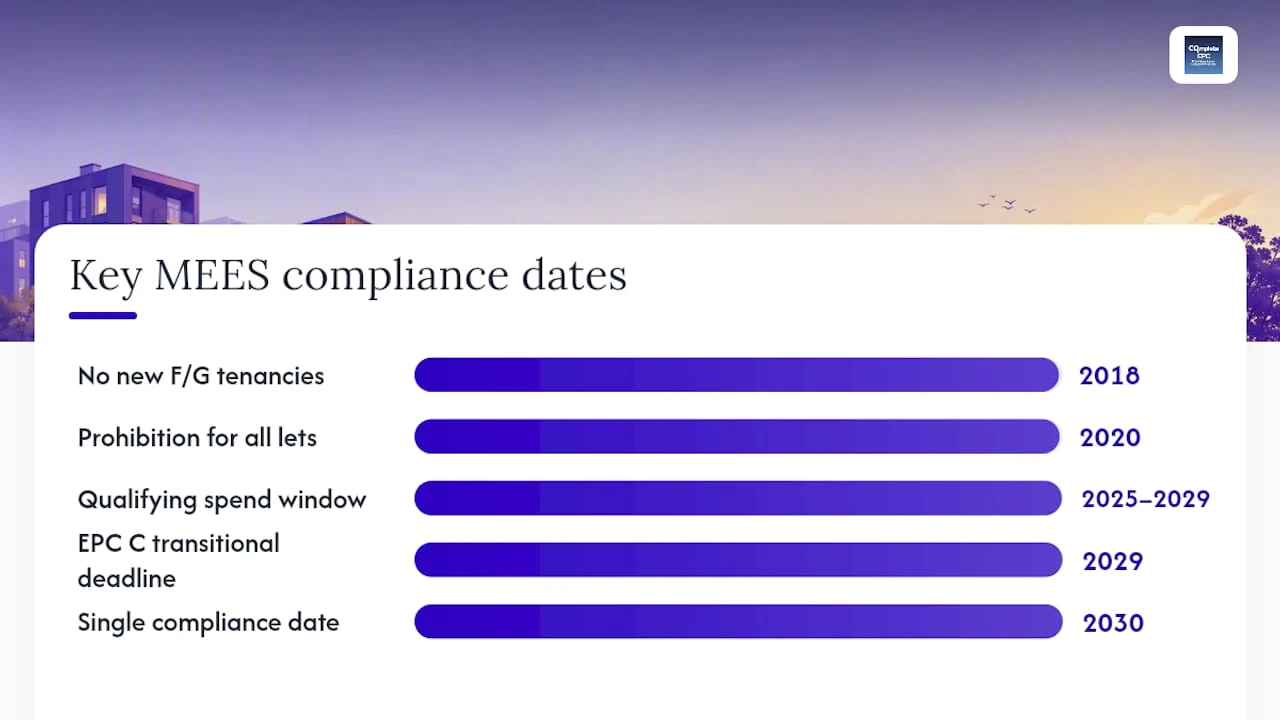
Since 1 April 2018, landlords cannot grant a new tenancy on a relevant domestic property rated F or G. Since 1 April 2020, that prohibition extended to every relevant property already let, not just new lettings, unless a valid exemption sits on the PRS Exemptions Register. Those two dates are why an EPC that reads F today is not a paperwork problem you can quietly ignore. It’s an active breach the moment you continue letting without registering an exemption.
The next wave concerns EPC band C, and here the government has now confirmed the shape of the reform rather than leaving it as a consultation proposal. Existing EPC C ratings achieved before 1 October 2029 will be recognised until they expire, giving landlords who act early a real transitional benefit. The single compliance date for the new higher standard is 1 October 2030.
| Date | What happens |
|---|---|
| 1 April 2018 | No new tenancies granted on F or G rated properties |
| 1 April 2020 | Prohibition extends to all existing lets, not just new ones |
| 1 October 2025–30 September 2029 | Qualifying spend (excluding fossil fuel heating) can count towards the new £10,000 cost cap |
| 1 October 2029 | Deadline for an EPC C achieved to be recognised under transitional rules |
| 1 October 2030 | Single compliance date for the reformed higher standard |
The cost cap is changing alongside the rating requirement. Under existing MEES rules, the exemption threshold allows landlords to register a high-cost exemption once they’ve spent an amount up to a specified limit without reaching E. Under the reformed regime, that cap rises to £10,000 per property, a significant jump that reflects the higher standard being targeted.
One detail catches landlords out: the government requirement in some cases to commission a new-style EPC before starting retrofit works, not just after. An outdated EPC’s recommendations may point you toward measures that no longer make sense under the reformed metrics. Commissioning fresh advice before you spend money on cavity wall insulation or a new boiler avoids paying twice for the wrong upgrade.
What documents you must give tenants and keep on file
Prospective tenants are legally entitled to see the EPC before they commit to a tenancy, and you need a defensible paper trail if a local authority ever asks questions.
Give every prospective tenant a copy of the current EPC, or at minimum the report reference number so they can pull it from the national register themselves. This should happen before they sign, not as an afterthought once they’ve moved in.
For your own records, keep the following:
- The lodged EPC as a PDF, plus the report reference number for quick lookup.
- Invoices from every installer for insulation, glazing, heating system, or renewable measures.
- Building control completion certificates for structural or fabric work.
- FENSA certificates for replacement windows and doors, or equivalent competent person scheme documentation.
- Dated photographs of installed measures where practical, particularly for insulation that gets covered over.
- Any exemption registration confirmation from the PRS Exemptions Register, including its registered start and expiry dates.
An EPC lodged on the register stays valid for ten years, but the supporting invoices and certificates need to survive that entire period too, since enforcement officers can ask for evidence of works carried out years earlier. Keep digital copies in a folder named by property address and year of works, not buried in a general inbox. A simple convention such as “12 Elm Street, loft insulation, invoice, March 2024” saves hours when an assessor or trading standards officer asks for proof.
Getting a valid EPC: who’s qualified and what happens on the visit
Only an accredited domestic energy assessor who belongs to a government-approved accreditation scheme can legally produce an EPC. No landlord, letting agent, or unaccredited surveyor can self-certify, no matter how confident they are about the building’s performance.
Booking works much like arranging any property inspection. You contact an accredited assessor, agree a date, and prepare access to every room including lofts, cupboards housing the boiler, and any outbuildings that form part of the demise. On the visit, the assessor records the building’s age and construction type, checks glazing throughout, inspects insulation where visible, notes the heating system and fuel type, and records thermostat and control locations. They will ask about extensions or conversions, since these change the floor area and construction assumptions the software uses.
Once the assessment is complete, the assessor lodges the certificate directly to the national register. You don’t submit anything yourself. The EPC becomes searchable within a few days and carries its own report reference number for future retrieval.
Pro Tip: Ask the assessor in advance what documentary evidence they’ll accept for existing improvements. An assessor working from visible inspection alone may record loft insulation as thinner than it actually is if it’s been covered by boarding, whereas a supporting invoice or installer certificate can correct the record on the spot.
Turning EPC recommendations into a real improvement plan
Every EPC comes with a recommendations report, and under MEES, those recommendations define what counts as a “relevant energy efficiency improvement” for your property specifically. This matters because exemption applications hinge on having attempted the improvements your own report identifies, not some generic list of measures.
Costs and outcomes vary considerably by building type, age, and existing fabric, so treat the figures below as planning bands rather than quotes.
Solid wall insulation frequently pushes a property towards or past the current £3,500 cost cap on its own, which is precisely why a dedicated exemption category exists for it.
Pro Tip: Collect installer quotes before committing to any single measure, and keep every quote even for work you don’t proceed with. If you later apply for a high-cost exemption, having multiple comparative quotes on file demonstrates you genuinely explored your options rather than picking the first number you saw.
Spend incurred between 1 October 2025 and 30 September 2029, excluding fossil fuel heating installations, can be counted towards the forthcoming £10,000 cost cap under the reformed rules. Record the exact date of each invoice now, even if you’re years away from needing the cap calculation, because retroactively proving spend dates from memory is far harder than filing the paperwork properly the first time.
EPC exemptions: categories, evidence, and how long they last
Exemptions exist for landlords who cannot reasonably reach the required standard, but every category demands specific evidence, and registering one without that evidence invites rejection or later challenge.
The main categories under current MEES guidance are:
- All relevant improvements made. You’ve completed every measure the EPC recommends, or as many as the cost cap allows, and the property still doesn’t reach E. Evidence: EPC recommendations report plus invoices for completed works.
- High cost exemption. You’ve spent up to the cost cap (currently £3,500, rising to £10,000 under the reformed standard) without reaching the required band. Evidence: itemised quotes and invoices showing spend reached the cap.
- Wall insulation exemption. A qualified surveyor confirms that cavity wall or solid wall insulation would negatively affect the building’s fabric. Evidence: a written report from an appropriately qualified professional.
- Third-party consent exemption. A tenant, freeholder, planning authority, or lender refuses consent for the required works. Evidence: written correspondence showing consent was sought and refused.
- Property devaluation exemption. An independent surveyor confirms the improvement would reduce the property’s market value by more than 5%. Evidence: a valuation report from a RICS-qualified surveyor.
- Temporary exemption for new landlords. Applies for six months after suddenly becoming a landlord, such as through inheritance. Evidence: proof of the date ownership transferred.
Most current exemptions run for five years from registration. Under the reformed rules tied to the new cost cap and negative-impact categories, some exemptions extend to ten years, reflecting the longer investment cycle the higher standard implies.
Registration happens directly on the PRS Exemptions Register, where you create an account, select the relevant exemption category, and upload your supporting evidence. If an exemption is about to expire, don’t wait for it to lapse before acting. Book a fresh assessment or gather updated evidence in the final few months so there’s no gap where the property sits in breach without cover.

What happens if you’re caught out: enforcement and penalties
Local authorities, typically through their trading standards teams, hold enforcement powers for MEES breaches, and the process usually follows a predictable path.
An investigation, often triggered by a tenant complaint or a routine licensing check, comes first. If the authority finds a breach, they issue a compliance notice requesting information such as the EPC, evidence of any exemption, or details of remedial works. Failure to respond adequately or continuing to let in breach can lead to a financial penalty. Local authorities can also request a copy of the EPC for inspection at any point, and can take enforcement action up to six months after a failure has been corrected, so simply fixing the problem quietly afterwards doesn’t guarantee you avoid a penalty.
If you’re served a compliance notice, respond promptly with your current EPC, any exemption registration confirmation, and every invoice or certificate proving works you’ve carried out. Landlords who’ve kept organised records tend to resolve these notices quickly. Those who scramble to find paperwork after the fact often face longer investigations and harsher outcomes, simply because the authority has nothing to weigh against the apparent breach.
What the reforms actually change for your next retrofit decision
The reformed MEES framework introduces a dual-metric structure that’s worth understanding now, even though the compliance date sits in 2030.
Future EPCs will assess a primary fabric performance standard, covering insulation, glazing, and the building envelope, alongside a secondary metric that landlords can choose between: either heating system performance or smart readiness. This landlord discretion over the secondary metric is a genuine departure from the single-score approach most people associate with EPCs today, and it means two similar properties could take different upgrade routes to reach the same compliant outcome.
Transitional recognition works in your favour if you act before the deadline. An EPC C achieved before 1 October 2029 stays recognised until it expires naturally, even after the new higher standard takes effect. Properties that haven’t reached EER C by that date will generally need a new-style EPC commissioned before retrofit works begin, so the upgrade is guided by current metrics rather than an outdated recommendations list.
A practical action plan by timeframe:
- Now: Check your current EPC rating, gather every invoice for past improvements, and note whether you’re close to band C.
- 2025 to 2029: Prioritise fabric measures, record all qualifying spend against the future £10,000 cap, and aim for a genuine EPC C rather than a marginal E.
- 2029 to 2030: If you haven’t reached C, commission a new-style EPC before starting further works, and budget for the secondary metric choice, heating system or smart readiness, that suits your property best.
The government’s partial response to the wider reforms also signals a move towards requiring valid EPCs at the point of marketing, with further detail expected in 2026. That’s a tightening of the current flexibility, and landlords who wait until a tenant is lined up before checking their EPC status may find that window closing.
Practical viewpoint: how a busy landlord should prioritise effort
Most landlords treat the EPC as a box to tick once every ten years, then panic when a rating turns out lower than expected. That instinct is backwards. The certificate itself is cheap and quick to obtain. The evidence trail behind it is what actually protects you, and it’s the part almost everyone neglects until an enforcement notice forces the issue.
If you manage one or two properties, start by pulling every invoice you can find for work done in the last decade, even work that felt minor at the time. Loft insulation top-ups, a boiler swap, replacement double glazing. Half of it probably counts towards your cost cap calculation and you’ve likely thrown the paperwork away already. Fabric measures, insulation and draught proofing especially, tend to offer the best rating improvement per pound spent, so they’re where a smaller portfolio should focus first rather than jumping straight to a full boiler replacement.
If you run a larger portfolio, the maths changes. A spreadsheet tracking each property’s current band, exemption status, and expiry date becomes essential, because the administrative burden of ten separate EPC lifecycles is where things slip. Commissioning a fresh, voluntary EPC ahead of any planned retrofit, even before you’re forced to, gives you a clearer roadmap than working from a five-year-old recommendations report that no longer reflects current metrics or your building’s actual condition.
Pro Tip: Document everything before the assessor arrives, not after. A folder of dated photographs and invoices handed to the assessor at the start of the visit can shift a marginal EPC rating in your favour, because the software gives credit for verified measures it can’t otherwise see.
How Completeepc helps you get the paperwork right
Completeepc is the practical route for landlords who want an accredited assessment without chasing quotes from multiple assessors or guessing whether their evidence will hold up. Our assessors are members of government-approved accreditation schemes, so every certificate we lodge is fully valid for enforcement and lettings purposes, and we work specifically to help you assemble the invoices, certificates, and photographic evidence that make exemption applications and future cost-cap claims stick.
For most rented homes, our domestic EPC service covers the full assessment, from booking through to lodging your certificate on the national register. If your portfolio includes retail units, offices, or mixed-use buildings, our commercial EPC service handles the separate assessment those properties require. We also offer SAP calculations and practical energy efficiency advice where you’re planning retrofit works and want the numbers checked before you commit to a measure.
If your current EPC has expired, doesn’t exist, or reads F or G with no exemption registered, get a quote for a domestic assessment today and have your documentation sorted before it becomes a compliance problem.
Sources
Bookmark these official pages for anything MEES-related that this guide hasn’t covered in full:
- Gov
- Improving the energy performance of PRS homes: government response (PDF)
- The Energy Efficiency (Private Rented Property) (England and Wales) Regulations 2015
- Find an energy certificate – GOV.UK
This article is general information, not a substitute for advice from a qualified lawyer. Consult a qualified legal professional about your own circumstances before acting on anything here.
FAQ
Do landlords have to have an EPC certificate?
Yes. Any landlord letting a relevant residential property in England or Wales must hold a valid EPC and provide it, or its reference number, to prospective tenants before they sign a tenancy.
What are the new EPC rules for landlords by 2030?
The government has confirmed a dual-metric standard with a single compliance date of 1 October 2030, alongside a £10,000 cost cap and transitional recognition for EPC C ratings achieved before 1 October 2029.
Can I produce my own EPC certificate?
No. Only an accredited domestic energy assessor registered with a government-approved accreditation scheme can legally carry out the assessment and lodge a valid EPC.
How much does an EPC certificate cost?
Costs vary by assessor, property size, and location rather than following a fixed national price, so it’s worth getting a direct quote from an accredited provider such as Completeepc for your specific property.