

Did you know that over 19 million homes in England and Wales now have an Energy Performance Certificate? Energy ratings play a serious role in property transactions and day-to-day costs for owners and renters alike. Whether you want to lower bills, meet legal standards, or simply make your home more comfortable, understanding these certificates can guide smart decisions about energy improvement and compliance.
Table of Contents
- Epcs For Domestic Property Explained
- Types Of Domestic Epc Assessments
- Epc Legal Requirements In London
- Assessment Process And What To Expect
- Costs, Validity, And Compliance Issues
- Improving Your Epc Rating Effectively
Key Takeaways
| Point | Details |
|---|---|
| EPC Importance | Energy Performance Certificates (EPCs) are mandatory for property transactions and provide insights on energy efficiency, helping homeowners and landlords reduce costs and improve property value. |
| Assessment Methods | EPCs utilize two methodologies: SAP for new dwellings and RdSAP for existing properties, ensuring tailored evaluations of energy performance. |
| Legal Compliance | Property owners must obtain and display an EPC prior to marketing, with penalties for non-compliance potentially reaching £5,000. |
| Improvement Strategies | Enhancing an EPC rating can be achieved through strategic investments in insulation, energy-efficient systems, and government incentives to offset costs. |
EPCs for Domestic Property Explained
An Energy Performance Certificate (EPC) provides a comprehensive assessment of a property’s energy efficiency and environmental impact, delivering critical insights for homeowners, landlords, and potential buyers. According to Office for National Statistics, these certificates are mandatory for all buildings when constructed, sold, or rented, offering a standardised rating system that helps individuals understand their property’s energy performance.
The EPC rating system ranges from A to G, with A representing the most energy-efficient properties and G representing the least efficient. Home Building explains that this rating provides more than just a score – it includes detailed recommendations for improving a property’s energy performance. These recommendations can help property owners:
- Reduce energy consumption
- Lower utility bills
- Decrease carbon emissions
- Increase property value
- Improve overall building comfort
Obtaining an EPC involves a professional energy assessor conducting a thorough inspection of your property. The assessment covers multiple aspects of energy efficiency, including:
- Insulation quality
- Heating systems
- Windows and doors
- Lighting
- Renewable energy installations
The resulting certificate not only provides a current energy efficiency rating but also estimates potential improvements and their associated costs. This means property owners can make informed decisions about energy upgrades, potentially saving significant money on future energy expenses and contributing to broader environmental sustainability efforts.
Types of Domestic EPC Assessments
Domestic Energy Performance Certificates (EPCs) utilize two primary assessment methodologies, each tailored to different property types and construction stages. Wikipedia highlights that these assessments are conducted using the Standard Assessment Procedure (SAP) for new dwellings and the Reduced Data SAP (RdSAP) for existing properties, ensuring a comprehensive evaluation of energy efficiency across different building scenarios.
The Standard Assessment Procedure (SAP) is designed specifically for newly constructed properties, providing a detailed and precise analysis of energy performance. This method allows assessors to use comprehensive building specifications and theoretical models to determine energy efficiency. Key characteristics of SAP include:
- Evaluation of building fabric and insulation
- Assessment of heating and hot water systems
- Calculation of potential energy consumption
- Precise measurement of carbon dioxide emissions
- Detailed analysis of renewable energy potential
In contrast, the Reduced Data SAP (RdSAP) is used for existing dwellings, offering a more flexible approach to energy assessment. Simply Business notes that the latest RdSAP 10 methodology, set to be introduced in June 2025, will significantly enhance accuracy by prioritizing actual evidence over previous assumptions. This approach requires property owners to provide specific information, making the assessment more tailored and precise.
The RdSAP methodology recognises that existing properties have unique characteristics that cannot always be evaluated using standard theoretical models. It allows assessors to:
- Use approximation techniques for older buildings
- Account for historical modifications
- Incorporate visual and physical property inspections
- Consider practical limitations of existing structures
- Provide realistic energy improvement recommendations
Understanding these assessment types helps property owners and potential buyers comprehend the nuanced approach to evaluating energy performance, ensuring a more accurate representation of a property’s true energy efficiency potential.

Here’s a comparison of SAP and RdSAP assessment methodologies for domestic EPCs:
| Criteria | SAP (New Dwellings) | RdSAP (Existing Dwellings) |
|---|---|---|
| Purpose | New property assessment | Existing property assessment |
| Data Used | Full building specifications | On-site evidence Visual inspection |
| Assessment Detail | Highly detailed calculation | Flexible, uses approximation |
| Focus Areas | Building fabric Heating systems CO2 emissions |
Historical modifications Practical limitations |
| Update/Revision | Regular updates | New RdSAP 10 from June 2025 |
| Typical Outcome | Precise energy rating Specific improvements |
Realistic energy rating Tailored recommendations |
EPC Legal Requirements in London
Navigating the legal landscape of Energy Performance Certificates (EPCs) in London requires a clear understanding of mandatory requirements and potential implications for property owners. Government regulations stipulate that EPCs are compulsory for all properties when they are constructed, sold, or let, with specific exceptions that property owners must carefully consider.
The legal obligations for obtaining an EPC in London cover multiple scenarios, including:
- Selling a residential or commercial property
- Renting out a property to new tenants
- Constructing a new building
- Modifying an existing property significantly
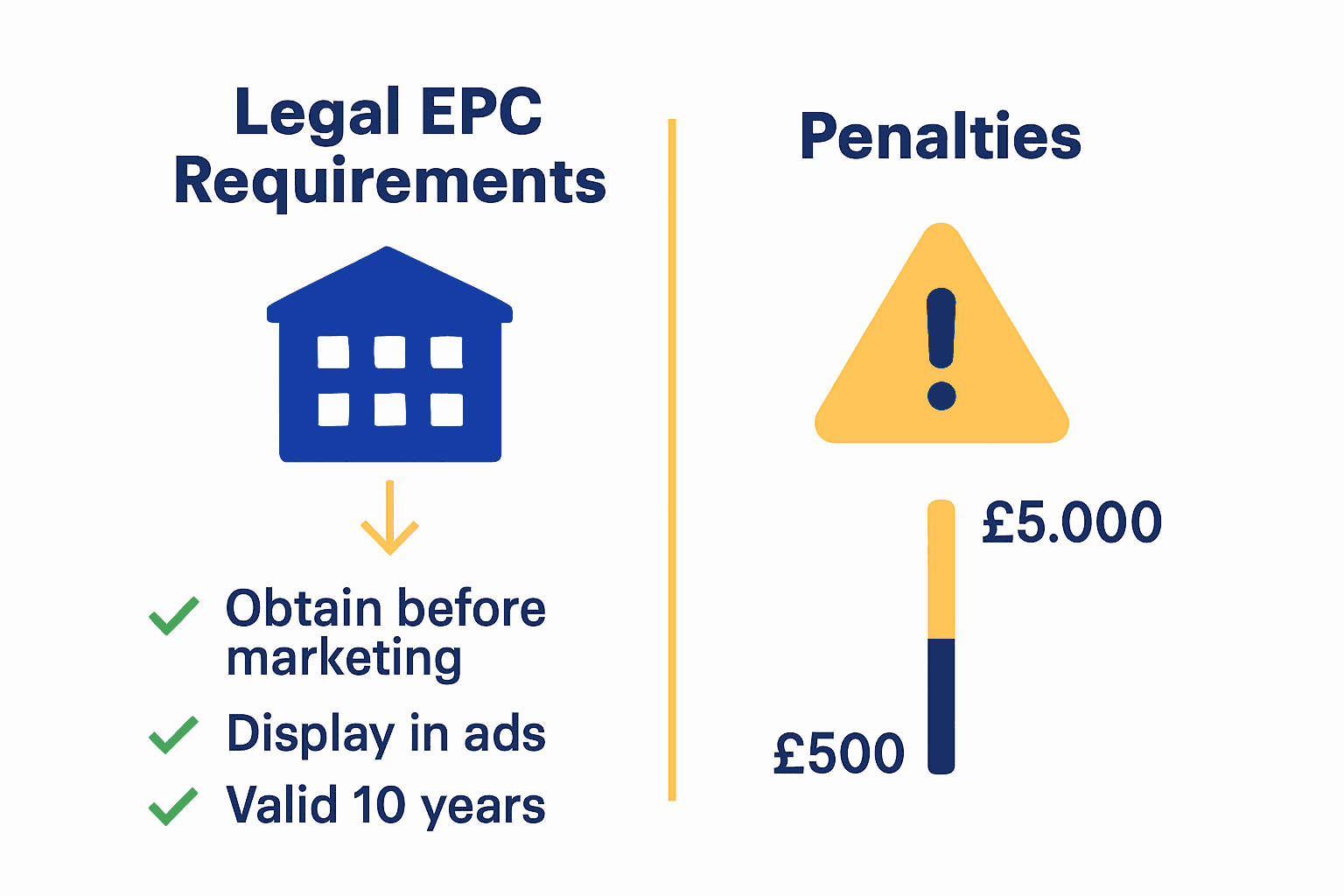
Key legal requirements emphasize that an EPC must be:
- Obtained before marketing the property
- Made available to potential buyers or tenants
- Displayed prominently in property advertisements
- Valid for a maximum of 10 years
Property owners face potential financial penalties for non-compliance. These can range from £500 to £5,000 depending on the property type and duration of the violation. Landlords, in particular, must ensure their properties meet minimum energy efficiency standards, with properties rated below an E being potentially unlawful to rent.
Special considerations exist for certain property types. Listed buildings, places of worship, temporary structures, and some industrial sites might be exempt from full EPC requirements. However, owners are still encouraged to obtain assessments to understand their property’s energy performance and potential improvement opportunities. Proactively managing EPC compliance not only avoids legal complications but can also enhance property value and reduce long-term energy costs.
Assessment Process and What to Expect
Obtaining an Energy Performance Certificate (EPC) involves a structured and professional assessment of your property’s energy efficiency. Get Agent outlines a straightforward process that begins with finding an accredited assessor and ends with receiving a comprehensive certificate, typically within 24 hours of the assessment.
The initial preparation for an EPC assessment requires several key steps:
- Research and select a qualified, accredited energy assessor
- Schedule a convenient assessment time
- Ensure complete access to all areas of the property
- Gather relevant documentation about the property’s construction and previous energy improvements
Home Building explains that the assessment involves a thorough evaluation of the property’s energy use, focusing on multiple critical aspects. During the on-site inspection, the assessor will systematically examine:
- Building construction and insulation
- Heating and hot water systems
- Lighting installations
- Windows and doors
- Potential renewable energy capabilities
The assessor will use specialized equipment and conduct a detailed visual inspection, measuring and documenting various elements that contribute to the property’s overall energy performance. They will take precise measurements, photograph key areas, and create a comprehensive record of the property’s energy characteristics.
Following the assessment, you will receive a detailed Energy Performance Certificate that provides:
- An energy efficiency rating from A (most efficient) to G (least efficient)
- Estimated energy costs
- Specific recommendations for improving energy performance
- Potential cost savings from implementing suggested upgrades
- Carbon emission ratings
By understanding this process, property owners can approach their EPC assessment with confidence, knowing exactly what to expect and how to prepare for a smooth and informative evaluation of their property’s energy efficiency.
Costs, Validity, and Compliance Issues
Understanding the financial and regulatory aspects of Energy Performance Certificates (EPCs) is crucial for property owners navigating the complex landscape of energy efficiency requirements. Get Agent provides clear guidance on the cost structure, noting that EPC assessments typically range from £35 to £120, depending on the property’s size and the specific service provider.
The financial considerations for obtaining an EPC include:
- Initial assessment costs
- Potential upgrades recommended in the certificate
- Long-term energy savings
- Potential property value improvements
- Avoiding non-compliance penalties
Home Building highlights a critical regulatory milestone: by 2030, the UK government will require all houses sold or rented to achieve an EPC rating of ‘C’ or above. This mandate comes with significant potential consequences, with non-compliant property owners facing fines up to £5,000.
The validity and compliance timeline for EPCs involves several key points:
- Each EPC is valid for 10 years from the date of issue
- The certificate must be renewed before expiration for continued compliance
- Properties must meet minimum energy efficiency standards
- Failure to obtain or display a valid EPC can result in substantial financial penalties
- Different regulations apply to residential and commercial properties
Property owners should view EPC compliance not as a bureaucratic burden, but as an opportunity to improve their property’s energy efficiency, reduce long-term energy costs, and contribute to broader environmental sustainability efforts. Proactively managing your property’s energy performance can result in significant financial and environmental benefits, transforming a regulatory requirement into a strategic advantage.
Improving Your EPC Rating Effectively
Enhancing your property’s Energy Performance Certificate (EPC) rating requires a strategic approach to improving energy efficiency. Simply Business provides valuable insights, noting that landlords can significantly improve their ratings through targeted investments, with expenditure capped at £15,000 and various support schemes available to manage affordability challenges.
The most impactful improvements for boosting your EPC rating include:
- Installing high-quality wall and roof insulation
- Upgrading to double or triple-glazed windows
- Implementing solar panel systems
- Replacing outdated heating systems
- Improving overall building draft-proofing
Wikipedia highlights the broader context of energy efficiency improvements through initiatives like the Great British Insulation Scheme, which aligns with the UK’s Net Zero ambitions. Property owners can leverage these national programmes to offset some of the costs associated with energy efficiency upgrades.
A strategic approach to EPC rating improvement involves:
- Conducting a comprehensive energy audit
- Prioritizing most cost-effective improvements
- Exploring available government grants and incentives
- Implementing improvements systematically
- Tracking and documenting energy performance changes
Property owners should view EPC rating improvements as an investment rather than an expense. Each enhancement not only contributes to meeting regulatory requirements but also offers tangible benefits such as reduced energy bills, increased property value, and a smaller carbon footprint. By taking a proactive and informed approach, you can transform your property’s energy efficiency and contribute to broader environmental sustainability efforts.
Take Control of Your Energy Performance Compliance Today
Navigating the complexities of EPC requirements can feel overwhelming, especially with evolving regulations like the new RdSAP 10 and the looming 2030 minimum rating rules. Property owners in London face clear challenges: securing accurate assessments, avoiding hefty fines, and making well-informed decisions to improve their property’s energy efficiency and value. If you want clear, trustworthy insights and seamless support, Complete EPC is here to help.
With expert assessors who understand both SAP and RdSAP methodologies, our team delivers detailed certificates tailored to your property. We ensure compliance with all legal mandates while identifying practical, cost-effective improvements. Don’t leave it to chance when it comes to your property’s energy future. Visit Complete EPC now to get your assessment started and see how simple meeting your obligations can be. Act today to avoid penalties and start saving on energy costs with confidence.
Frequently Asked Questions
What is an Energy Performance Certificate (EPC)?
An Energy Performance Certificate (EPC) evaluates a property’s energy efficiency and environmental impact, providing a rating from A (most efficient) to G (least efficient), along with recommendations for improvement.
How is an EPC obtained for my property?
To obtain an EPC, you must schedule a visit from an accredited energy assessor who will conduct a thorough inspection of your property, evaluating factors like insulation, heating systems, and energy-efficient features. You will receive the certificate, usually within 24 hours of the assessment.
What are the legal requirements for EPCs in London?
EPCs are mandatory for all properties being sold, rented, or constructed, and must be obtained before marketing the property. They are valid for 10 years and must meet minimum energy efficiency standards, with potential fines for non-compliance.
How can I improve my EPC rating?
You can improve your EPC rating by making energy-efficient upgrades such as adding insulation, upgrading windows to double or triple glazing, installing solar panels, and modernizing heating systems. Conducting a comprehensive energy audit can help prioritize the most cost-effective improvements.