

There are two different things people mean by “EPC exemption”. The first is a building that does not need an energy performance certificate at all, such as a place of worship or a genuinely temporary structure. The second is a landlord exemption from the Minimum Energy Efficiency Standard (MEES), which lets you rent out a property rated F or G if you register a valid reason on the PRS Exemptions Register. This guide covers both for England and Wales, and shows where Scotland and Northern Ireland differ.
TL;DR
- Some buildings never need an EPC, including temporary buildings, places of worship and some small standalone buildings. Listed status alone does not guarantee this.
- A landlord exemption is different: it lets you let an F or G rated home, but only if you register it and hold the evidence.
- The cost cap is £3,500 including VAT, and most registered exemptions last five years.
- Letting without a valid EPC or exemption can bring penalties of up to £5,000 per property in England and Wales.
Table of Contents
- Exempt from having an EPC versus exempt from MEES
- Buildings that do not need an EPC
- The MEES exemptions a landlord can register
- How to register an exemption
- How long an exemption lasts
- Penalties for getting it wrong
- Scotland and Northern Ireland
- Our view: exemptions are a last resort
- Get the right EPC first
- FAQ
- Sources
Exempt from having an EPC versus exempt from MEES
The two exemptions answer different questions, and mixing them up is the commonest mistake landlords make.
Exempt from needing an EPC means the law does not ask for a certificate when the building is sold, let or built. The GOV.UK guidance on EPCs has a section on when you do not need one.
Exempt from MEES applies to a property that does need an EPC. The certificate shows F or G, you cannot reasonably bring it up to E, and you register a recognised ground. The EPC still has to exist and be valid. The exemption only protects you from the ban on letting a sub-standard property.
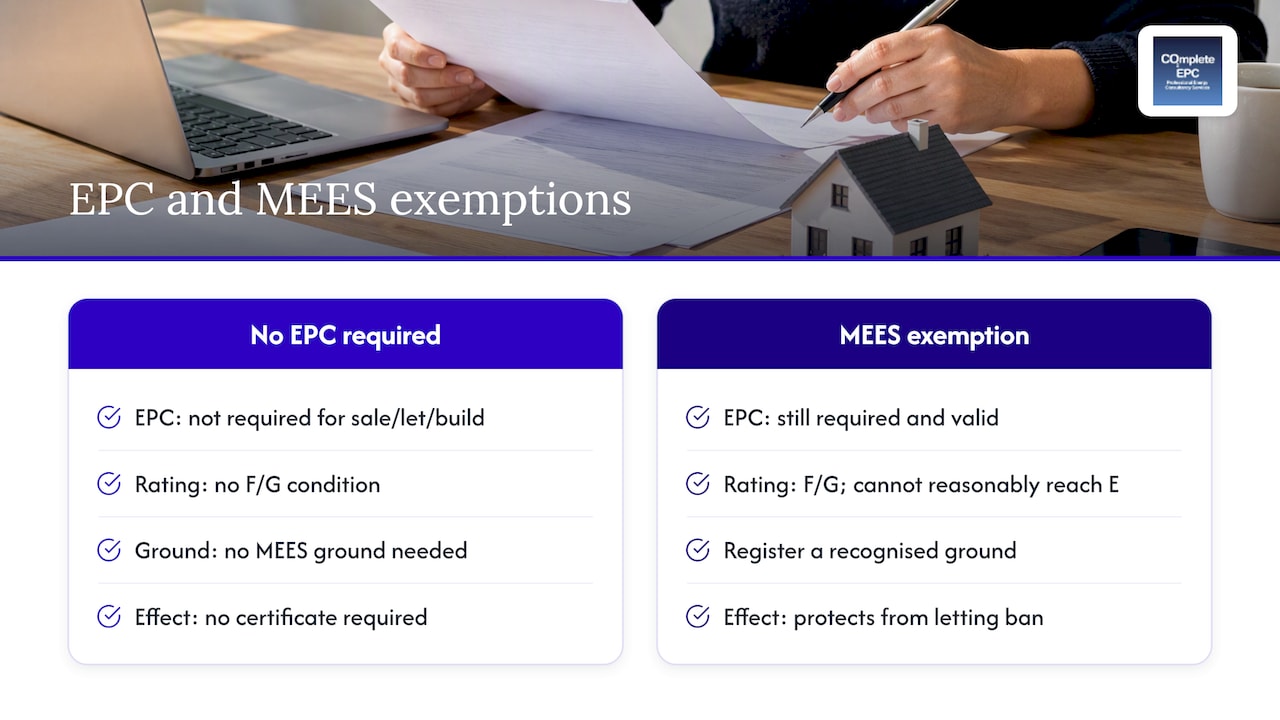
The MEES rules apply to domestic private rented properties let on a relevant tenancy that legally require an EPC. A property rated F or G must be improved to E or have a valid exemption registered.
Buildings that do not need an EPC
In England and Wales the standard list of buildings that can fall outside the requirement is short. Reported summaries of the Energy Performance of Buildings (England and Wales) Regulations 2012 give it as:
- a building that is statutorily listed or officially protected, where meeting the minimum requirements would unacceptably change its character;
- a place of worship;
- a temporary building used for under two years;
- a detached building under 50m² that is not used as a dwelling.
GOV.UK confirms that temporary buildings used for a limited time are among the cases where no EPC is needed. Check the current wording on that page before you rely on any category.
Listed buildings are not automatically exempt
This is where owners are caught out. A council guidance page states that you do not need an EPC if you can demonstrate the building is listed or officially protected and the minimum energy performance requirements would unacceptably alter it. The test is about whether the improvements an EPC would normally suggest, such as replacement windows or wall insulation, would damage the building’s character or appearance.
In practice, a Victorian terrace in a London conservation area that is not listed gets no relief at all. A listed townhouse may qualify, but only if the changes needed would conflict with its protection. If modest, sympathetic improvements are possible, the argument for exemption weakens. Speak to your local authority’s conservation officer before you decide.
Let or sold anyway? Get the EPC
Many owners of exempt buildings still choose to commission a certificate. It gives buyers and tenants a clear energy rating and a list of recommendations, and it removes any doubt if a local authority later asks whether the exemption applied. If you are unsure whether your property falls under an exemption, an assessor can tell you on the day of the visit.
The MEES exemptions a landlord can register
If your domestic let is rated F or G, you must first make improvements up to the cost cap. If the property still cannot reach E, or the improvements are not possible, you may register an exemption. The official guidance lists these grounds: all improvements made, high cost, wall insulation, third-party consent, property devaluation, and temporary new landlord status. Each has its own evidence.
| Exemption | When it applies | Evidence to expect |
|---|---|---|
| All improvements made | Every relevant improvement that can be installed has been, and the property is still below E | Records of the work carried out, and an EPC showing the rating |
| High cost | Even after spending up to £3,500 including VAT, the property cannot reach E | Quotes showing the cost of improvements exceeds the cap |
| Wall insulation | A qualified assessor advises that wall insulation would damage the structure or the fabric | Written advice from a suitably qualified professional |
| Third-party consent | A tenant, lender or freeholder, or a planning body, refuses consent | Written proof that consent was requested and refused |
| Property devaluation | A surveyor’s report shows works would reduce the market value by more than 5% | A report by an RICS-registered or equivalent surveyor |
| New landlord | You have just become the landlord, for example by inheritance or purchase | Details of when and how you took on the property |
The wording of the conditions and the evidence required are set out in the government’s guidance on PRS exemptions and evidence. Read the relevant section in full before applying, because the evidence rules are specific.
One ground deserves a note. A devaluation exemption requires evidence that improvements would devalue the property by more than 5%. A surveyor’s report is the strongest way to show it.
Understanding the £3,500 cost cap
The cap is £3,500 including VAT. It is the most you are expected to spend on qualifying improvements to reach E. If you can bring the property up to E for less, you must do so. If the cheapest route to E costs more than the cap, you spend up to the cap and then register the high-cost exemption.
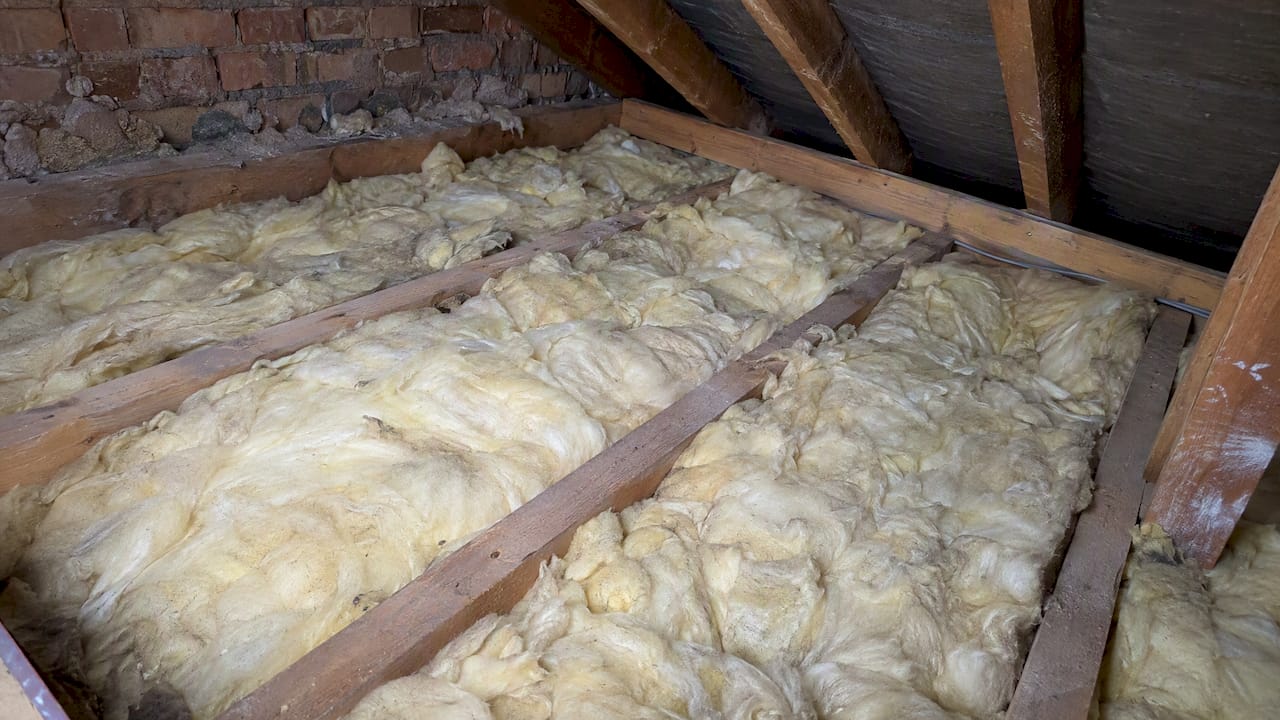
Here is a worked example. A flat rated F has an EPC recommending loft insulation, a boiler upgrade and heating controls. Loft insulation brings it to E on its own for a modest outlay. The landlord cannot claim the high-cost exemption, because E is reachable within the cap. A different flat, rated G, needs several measures. After the first two the rating is still F and the quotes for the next step take the total over £3,500. That landlord has a case, provided the quotes are kept.
How to register an exemption
Registration is self-certified. Exemptions in England and Wales are registered by the landlord or their agent on the PRS Exemptions Register. The council can ask to see your evidence, so treat the paperwork seriously even though nobody checks it at the point of registration.
- Get a valid EPC. Its rating and recommendations are the starting point for every exemption claim.
- Complete the improvements you can. Install the measures that fall within the cost cap and keep invoices.
- Collect the evidence for your ground. Quotes, a surveyor’s report, written refusals or whatever the guidance specifies.
- Register online. Use the GOV.UK register service. You sign in with GOV.UK One Login and provide the landlord details, the property address, a valid EPC and evidence of eligibility.
- Keep copies. Hold the confirmation and evidence for the duration of the exemption.
Landlords sometimes ask an agent to do the registration. That is allowed, but you remain responsible for the accuracy of what is registered.
How long an exemption lasts
Most registered exemptions run for five years. After that they expire. You must then try again to improve the property to the minimum standard, and if that is still not possible, apply for a fresh exemption. Diarise the end date at the time you register.
The new landlord exemption is temporary by design. It gives you time to bring the property to standard, or to register another ground, after you take it on.
Exemptions are also personal to the landlord. A council policy notes that registered exemptions in England are generally not transferable to a new owner if the property is sold. A buyer who intends to let the property must check the rating and work out their own position. Sellers of tenanted flats should flag this early, because it can affect the buyer’s plans.
An EPC itself is valid for 10 years, or until a newer one is produced for the same building. Because an exemption relies on a valid EPC, keep both dates in step.
Penalties for getting it wrong
In England and Wales, local authorities enforce MEES. They may issue penalties up to £5,000 in total per property and publish details of the breach. Publication can damage a landlord’s reputation as well as their finances.
The usual causes are:
- letting while the EPC shows F or G with no exemption registered;
- relying on an exemption that has expired;
- registering an exemption without evidence that would stand up to a council request;
- assuming an exemption transferred from the previous owner.
The fix in each case is the same: check the rating, check the register and check the dates before you sign a tenancy.
Scotland and Northern Ireland
The regime above is for England and Wales. Other parts of the UK work differently.
Scotland. The Scottish Government has published draft regulations proposing a minimum heat retention rating of C for domestic private rented properties by 1 April 2028, enforced by local authorities through compliance and penalty notices. These are proposals, so check the latest position on gov.scot.
Northern Ireland. All private landlords must register with the Landlord Registration Scheme, and those who do not may face prosecution or fines. For EPC questions in Northern Ireland, the Department of Finance FAQ is the place to start.
If you own property in more than one nation, treat each as a separate rulebook.
Our view: exemptions are a last resort
We see landlords arrive with the same question every month: “Can I just register an exemption?” Sometimes the answer is yes. More often the better answer is to read the EPC properly first.
The recommendations on a certificate are not decoration. Many F and G rated London flats reach E with a handful of inexpensive measures, and an accurate assessment shows which ones. An inaccurate or out-of-date EPC can send you down the wrong road, either spending money you did not need to spend or claiming an exemption you cannot support.
That is why we put the quality of the assessment first. Our qualified assessors carry out domestic and commercial EPCs across London, and we back our service with a lowest-rate guarantee. If an exemption turns out to be the right route, you will have a valid certificate and a clear list of what was and was not possible, which is the foundation for any evidence you need to register.
Danny
Get the right EPC first
Every exemption claim, whether for a listed building or an F rated rental, starts with a valid and accurate certificate. We provide a domestic EPC for homes and landlords across London, and a commercial EPC for offices, shops and other non-domestic premises. Tell us at booking if the building is listed or if you are considering an exemption, and we will make sure the report covers what you need. You can also reach us through Complete EPC.
FAQ
Is an EPC legally required?
Generally yes, for a property that is built, sold or let, unless an exemption applies. GOV.UK sets out when you do not need one. The person selling, or the landlord or letting agent, must show the EPC to buyers and tenants.
What is the penalty for not having an EPC or complying with MEES?
For MEES breaches in England and Wales, councils can impose penalties up to £5,000 in total per property and publish the details. Check the rules with your local authority for the specific case.
What does an F rating mean for letting a property?
In England and Wales, a domestic rental rated F or G must be improved to E or have a valid exemption registered before it can be let on a relevant tenancy. The EPC recommendations show the measures to try first.
Does a listed building automatically avoid needing an EPC?
No. The building must be listed or officially protected and the minimum requirements must unacceptably alter its character or appearance. If sympathetic improvements are possible, the exemption may not apply.
Can I transfer my exemption when I sell?
Generally not. Registered exemptions in England are not usually transferable to a new owner, so a buyer who plans to let the property needs to check the rating and register their own exemption if one is justified.
Sources
- Domestic private rented property: minimum energy efficiency standard, landlord guidance (GOV.UK)
- Guidance on PRS exemptions and Exemptions Register evidence requirements (GOV.UK)
- Register a private rented sector energy standards exemption (GOV.UK)
- Energy performance certificates when selling a home (GOV.UK)
- A guide to EPCs for the marketing, sale and let of dwellings (GOV.UK)
- Minimum Energy Efficiency Standards (Coventry City Council)
- Minimum Energy Efficiency Standards Policy (Gravesham Borough Council)
- Do I need an EPC if my property is a listed building? (Consumer Rights)
- Draft Energy Efficiency (Domestic Private Rented Property) (Scotland) Regulations (Scottish Government)
- Landlord Registration process (nidirect)
- Energy Performance Certificates FAQ (Department of Finance, Northern Ireland)