

Improve your EPC most cost-effectively by starting with insulation top-ups, draught-proofing and better heating controls before considering bigger fabric or heating work, and check the Minimum Energy Efficiency Standards (MEES) cost-cap rules before committing to a budget. An EPC stays valid for 10 years, so check the expiry date before you plan works, and commission a qualified assessor once improvements are finished to capture the new rating.
TL;DR:
- Improving your EPC can be cost-effective by focusing on insulation top-ups, draught-proofing, and better heating controls before considering major fabric or heating upgrades.
- From October 2030, private rental homes will need to reach at least band C with a maximum £10,000 investment cap, replacing the current E standard and cap.
- Top priority measures include loft insulation, draught-proofing, LED lighting, and heating controls, with more expensive upgrades like heat pumps or solar PV targeted only after quick wins.
- A valid EPC remains active for ten years, so owners should re-assess after retrofits to ensure an accurate rating and compliance with future standards.
- EPC ratings impact property values, rental eligibility, mortgage terms, and insurance, making early improvements both financially and legally advantageous.
Table of Contents
- Understanding your EPC: what the bands and figures mean
- Minimum energy efficiency standards: what applies now and what’s changing
- Practical measures that typically raise your EPC
- Turning EPC recommendations into a staged, affordable plan
- Booking an assessor and finding an existing certificate
- Why a professional assessment makes the difference to your compliance position
- How EPC ratings affect property value and rental potential
- Common misconceptions and mistakes when reading an EPC report
- How your EPC rating can affect mortgage approval and insurance
- Government grants and incentives for energy efficiency upgrades
- Treat your EPC as a strategic asset, not just a compliance box
- Get help meeting your EPC obligations
- FAQ
- Sources
Understanding your EPC: what the bands and figures mean
An Energy Performance Certificate rates a property from A to G, with A representing the most efficient homes and buildings and G the least. Every certificate carries a headline score: domestic certificates use the Energy Efficiency Rating (EER), while non-domestic certificates use the Energy Index Rating (EIR). Reformed metrics are being introduced that will assess fabric performance, heating system, smart readiness and energy cost separately rather than folding everything into one number, according to the government’s proposed reforms.
During an inspection, an assessor records:
- Wall, loft and floor construction and insulation levels
- Glazing type and age across the property
- Heating system, controls and hot water provision
- Lighting type and any renewable installations already fitted
Certificates remain valid for 10 years from issue, so a property bought or let several years ago may still be carrying an outdated score, according to government guidance on EPCs for sale and let.
Minimum energy efficiency standards: what applies now and what’s changing
Since 2020, private rented homes in England and Wales have needed to meet at least EPC band E before being let, unless a valid exemption is registered, as set out in landlord guidance on the domestic standard. Commercial landlords face a parallel regime, with thresholds depending on floor area and building use.
From 1 October 2030, private rented domestic homes in England and Wales will need to reach an EPC-equivalent of band C under reformed metrics, with a maximum investment cap of £10,000 per property, according to the landlord guidance on minimum energy efficiency standards. This replaces the earlier £3,500 cap that applies to the current E standard. For reference:
- Current rule: domestic PRS properties need at least band E, cost cap £3,500
- From October 2030: domestic PRS properties need band C equivalent, cost cap £10,000
- Non-domestic: larger privately rented buildings over 1,000 square metres are expected to target band B by 2031 where cost-effective, according to guidance on non-domestic EPCs
Properties already at band C may benefit from grandfathering until their current EPC expires, under transitional arrangements confirmed in the government’s response on privately rented homes. Once works are complete, commission a new EPC to record the improved rating and reset the compliance clock.
Practical measures that typically raise your EPC
Not every improvement carries the same weight, and spending on the wrong measure first wastes money. Work through cost tiers in order rather than jumping straight to the most visible fix.
- Top up loft insulation to the recommended depth, usually the cheapest point gain available.
- Draught-proof doors, windows and floor gaps to cut heat loss with minimal outlay.
- Switch to LED lighting throughout, a low-cost change with an immediate score benefit.
- Insulate the hot water cylinder and exposed pipework to reduce standing heat loss.
- Fit a programmable thermostat and thermostatic radiator valves to improve heating controls.
- Add cavity wall insulation where the property has an unfilled cavity, a mid-cost measure with a strong return.
- Upgrade single glazing to double glazing where the building fabric allows it.
- Replace an old or inefficient boiler with a modern condensing model.
- Install a smart thermostat system tied to zoned heating for finer control.
- Consider solar PV, solid wall insulation or a heat pump only once the cheaper measures are exhausted, as these carry the highest upfront cost and the longest payback.
Solid wall insulation and heat pumps tend to suit properties that have already addressed the quick wins and still fall short of target bands, particularly older or non-cavity construction. Solar PV improves the energy cost element of a rating without necessarily lifting the fabric score, so it rarely substitutes for insulation work.
Pro Tip: Fix draughts and top up loft insulation before booking a reassessment: these changes often move a property a full band for a fraction of the cost of heating or glazing work.
Turning EPC recommendations into a staged, affordable plan
The recommendation report that comes with your EPC lists costed measures in order of indicative payback, giving a ready-made starting point for sequencing work, as noted in guidance on EPCs for sale and let. A sensible sequence runs quick wins first, then fabric measures, then heating system upgrades.
- Read the recommendation report and group measures into quick wins, fabric and heating tiers
- Gather three independent quotes for any measure you believe exceeds the cost cap, since this evidence is required to register a high-cost exemption
- Keep installer details and invoices, as reasonable EPC assessment costs can be counted towards the overall cap
- Time larger works around tenancy changeovers, a sale, or a planned refurbishment to limit disruption to tenants
Exemptions registered on this basis are time-limited and need periodic re-evaluation, according to guidance on PRS exemptions.
Booking an assessor and finding an existing certificate
Domestic EPCs require a domestic energy assessor working under an approved accreditation scheme, while commercial properties need a non-domestic energy assessor, since the qualifications and software differ between the two. An inspection typically takes an hour or two depending on property size and complexity, covering fabric, heating and lighting as outlined earlier.
- Confirm the assessor’s accreditation before booking, particularly for commercial or complex buildings
- Ask whether the inspection fee can count towards your cost cap if works follow shortly after
- Check an existing certificate on the national EPC register before paying for a new one, since a valid certificate may already exist
- Commission a fresh EPC once retrofit work finishes, so the improved rating is on record for sale, letting or compliance purposes
Why a professional assessment makes the difference to your compliance position
A qualified assessor does more than produce a certificate: the recommendation report translates fabric and heating detail into a costed action list you can actually use. We provide Domestic Energy Performance Certificate and Commercial EPC assessments across London, carried out by qualified assessors, with pricing we guarantee to be among the most competitive in the UK market. A properly staged report helps you avoid paying twice for conflicting advice.
How EPC ratings affect property value and rental potential
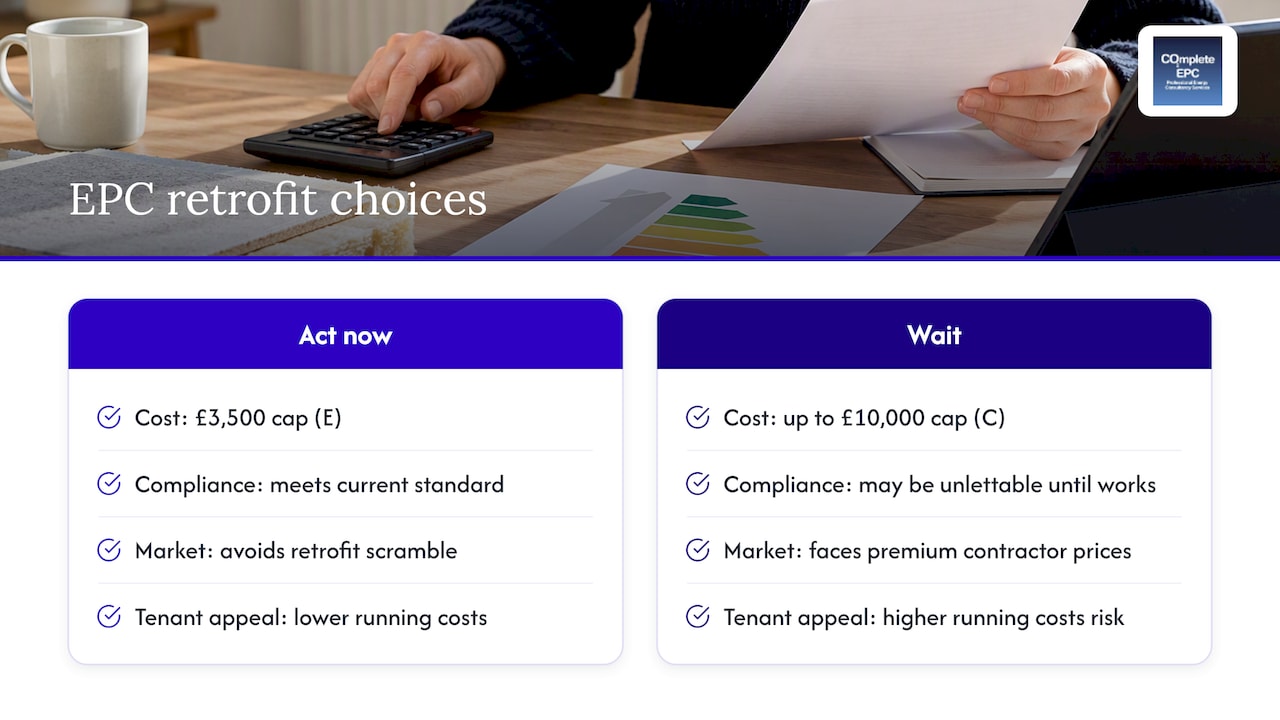
Buyers and tenants increasingly treat EPC bands as a proxy for running costs, so a property sitting at F or G can be harder to sell or let than one that reaches C or above. This matters more as MEES tightens: a domestic rental that falls short of the required band from 2030 risks being unlettable until works bring it up to standard, which puts a hard floor under its market value.
An improved rating also feeds directly into a tenant’s ongoing costs. Energy bills correlate with the fabric and heating condition an EPC records, so a better-insulated, better-heated property is cheaper to run month to month. That affordability argument increasingly shows up in rental listings, alongside bedroom count and location.
For landlords weighing whether to invest now or wait, the calculation is not purely about compliance. A property that already meets or exceeds the forthcoming standard avoids the scramble, and potentially the premium pricing, that will hit the market as the 2030 deadline approaches and demand for retrofit contractors rises. Acting early, while the current £3,500 cap still applies to the E standard, can also be cheaper than waiting for the £10,000 cap and the C target to take effect, as set out in the landlord guidance on minimum energy efficiency standards.
Common misconceptions and mistakes when reading an EPC report
The most common mistake is treating the EPC band as a legal obligation to carry out every recommended measure. There is no statutory requirement to complete every item on the recommendation report unless MEES specifically requires the property to reach a certain band, according to guidance on non-domestic EPCs. The recommendations are advisory, built around indicative payback periods, not a checklist you must clear in full.
A second mistake is assuming the EPC measures actual energy consumption. It models a property’s fabric and systems under standard assumptions, so two identical households can have very different real bills despite sharing the same certificate. The rating tells you about the building, not about how any particular occupant uses it.
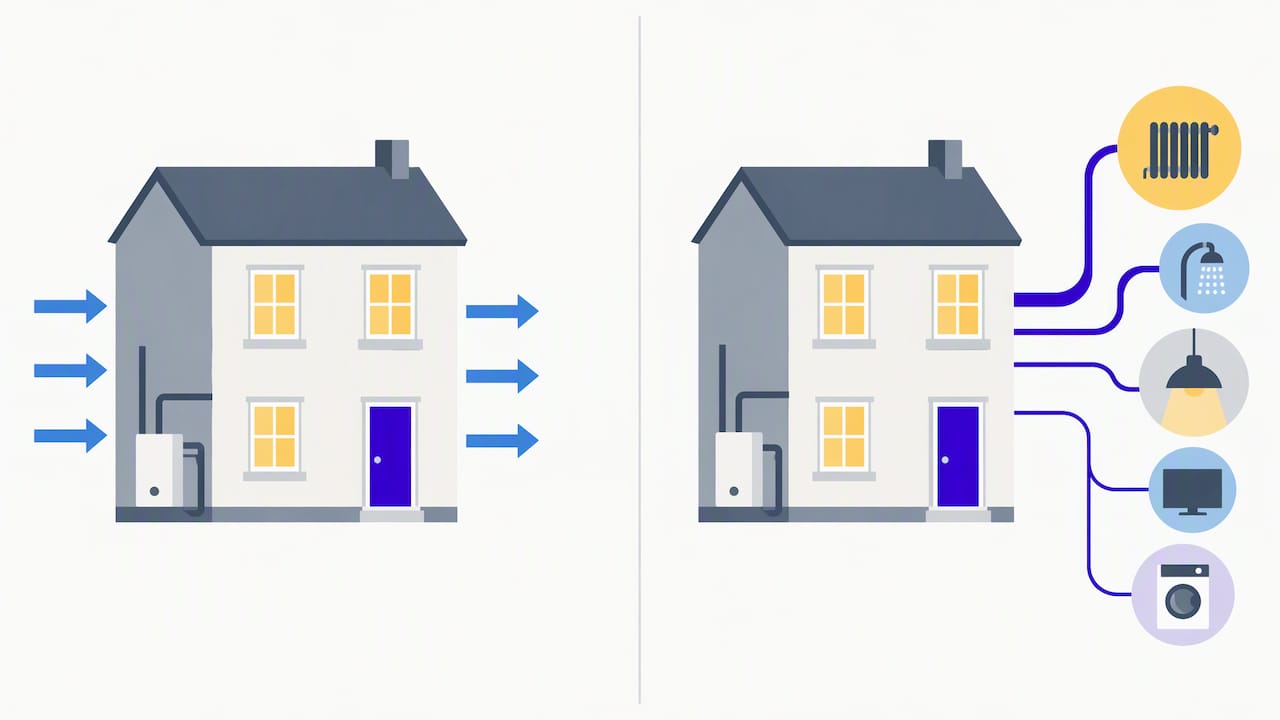
Landlords sometimes also assume an old EPC is still accurate because nothing has visibly changed. Ten years is a long validity window, and a boiler replacement, glazing upgrade or loft top-up carried out without a new assessment will not show up on the certificate on file, leaving the official record understating the property’s true performance.
Finally, some owners confuse the current E standard with the future target and assume they have more time than they do. The E standard applies now; the C-equivalent target and £10,000 cap apply from 1 October 2030, and transitional grandfathering only protects properties that already hold a C rating before their existing certificate expires.
How your EPC rating can affect mortgage approval and insurance
Some mortgage lenders now factor EPC bands into buy-to-let lending decisions or offer preferential rates for greener properties, reflecting a broader shift towards climate-linked lending criteria. A poor rating does not usually block a mortgage outright, but it can affect the terms offered or the lender’s risk assessment, particularly for portfolio landlords.
Insurers are moving in a similar direction. Underwriters increasingly look at a building’s fabric and systems when assessing risk, since better insulation and modern electrics can correlate with lower claims exposure. A property flagged for poor energy performance alongside other maintenance issues may attract closer scrutiny or less favourable terms.
None of this is uniform across lenders or insurers, and the detail varies by provider, so check directly with your mortgage lender or insurer about how they treat EPC bands before assuming a particular outcome. What is consistent is the direction: EPC data is becoming a standard input into both markets, which gives landlords another reason to treat compliance as groundwork for financing rather than a one-off paperwork exercise.
Government grants and incentives for energy efficiency upgrades
Various schemes exist to help offset the cost of insulation, heating upgrades and renewables, though eligibility and availability shift over time and by nation within the UK. Rather than listing scheme names that may change or close, the practical approach is to check current eligibility directly with your local authority or energy supplier before planning a budget around an assumed grant.
What is worth building into your plan is the fact that EPC assessment fees and some improvement costs can count towards the cost caps that apply under MEES, as covered earlier. That means a grant covering part of an insulation job, combined with cap-eligible spend, can reduce what you need to find from your own funds considerably. Always get costs and grant terms in writing before committing, since cap calculations rely on documented, reasonable costs rather than estimates.
For larger commercial retrofit projects, planning ahead with proper cost estimates and visual plans for major works, such as those covered in a commercial building rendering cost guide, can help you budget realistically before applying for any available incentive, since lenders and grant bodies often want to see a costed scope before releasing funds.
Treat your EPC as a strategic asset, not just a compliance box
The conventional approach treats EPCs as paperwork to clear before a letting deadline. That is a mistake: a property that reaches band C well ahead of 2030 holds its value better, costs less to run, and avoids competing for contractors in the rush before the deadline.
Prioritise fabric measures, insulation and draught-proofing, before heating swaps, unless a specific heating metric forces your hand. Early movers protect both margins and tenant affordability.
— Danny
Get help meeting your EPC obligations
We carry out Domestic Energy Performance Certificate and Commercial EPC assessments across London using accredited assessors, with rates we guarantee to be among the most competitive in the UK. Assessment fees can often count towards your MEES cost cap, so booking early costs you less overall. Get in touch to arrange an assessment and a recommendation report you can act on straight away.
FAQ
How does the EPC rating work?
An EPC rates a property from A (most efficient) to G (least efficient) based on its fabric, heating and lighting, assessed by a qualified energy assessor. Domestic certificates use the Energy Efficiency Rating, while non-domestic buildings use the Energy Index Rating, and both come with a recommendation report listing costed improvement measures.
Is energy rating E or F better?
E is better than F on the A to G scale, since lower letters represent greater energy efficiency and bands run from A at the top to G at the bottom. Private rented homes in England and Wales currently need to reach at least band E to be let legally, unless an exemption applies, according to landlord guidance.
How much does an EPC certificate cost?
We do not publish a fixed fee for domestic or commercial EPCs, since cost depends on property size and type, so get a quote directly through our domestic or commercial EPC pages. Assessment costs can often be counted towards the MEES cost cap when improvement works follow shortly afterwards.
How can I find the energy rating of my house?
Search the property address on the national EPC register to see any existing valid certificate and its recommendations. If no certificate exists or the one on file has expired, you will need to commission a new assessment from a qualified assessor.
Do I have to carry out every improvement listed on my EPC?
No, there is no general legal requirement to complete every recommended measure unless a specific regulation, such as MEES, requires your property to reach a certain band. The recommendations are advisory and ranked by indicative payback, giving you a starting point for prioritising work rather than a compliance checklist.