

TL;DR:
- An EPC rating E indicates an energy efficiency score of 39 to 54, representing the legal minimum for rental properties in England and Wales. Improving from E to C involves upgrades like loft insulation, boiler replacement, and cavity wall insulation, with government grants available for some measures. Landlords must plan early to meet the anticipated 2030 requirement of a band C rating to ensure legal compliance and reduce energy costs.
An EPC rating E is defined as an energy efficiency score of 39–54 on the Standard Assessment Procedure (SAP) scale, representing the minimum legal standard for rental properties in England and Wales. An energy performance certificate, or EPC, is the official document that records this score and is produced by an accredited energy assessor following a structured inspection. Understanding what an EPC rating E means is critical for landlords, buyers, and homeowners because it sits at the boundary of legality, cost, and future compliance. Around 19% of English homes carry this rating, making it one of the most common bands on the scale.
What is an EPC rating e and what causes it?
An EPC rating E places a property in the second-lowest tier of the A–G energy efficiency scale. The SAP score range of 39–54 reflects a property that loses heat faster than average and relies on older or less efficient systems to maintain comfortable temperatures. Properties in this band are not failing catastrophically, but they are consuming significantly more energy than they need to.
The most common physical cause is solid wall construction, typically found in homes built before 1930. Solid walls lose heat roughly twice as fast as insulated cavity walls. That single characteristic can anchor a property at band E regardless of other improvements made elsewhere in the building.
Other typical features of E-rated properties include:
- No loft insulation or inadequate loft insulation allowing heat to escape through the roof
- Single-glazed windows with poor thermal performance
- Older gas boilers operating below modern efficiency standards
- Uninsulated floors contributing to cold draughts and heat loss
- No cavity wall insulation in properties where cavities do exist
The EPC rating scale runs from A (most efficient, scoring 92 and above) down to G (least efficient, scoring 1–20). The table below shows how band E compares to neighbouring bands:
| EPC Band | SAP Score | Typical Annual Heating Cost | Common Property Type |
|---|---|---|---|
| C | 69–80 | £900–£1,400 | Post-1980 semi-detached |
| D | 55–68 | £1,200–£1,800 | 1960s–1980s terraced |
| E | 39–54 | £1,600–£2,500 | Pre-1930 solid-wall terraced |
| F | 21–38 | £2,500–£3,500 | Older rural cottage |
| G | 1–20 | £3,500+ | Unimproved historic building |
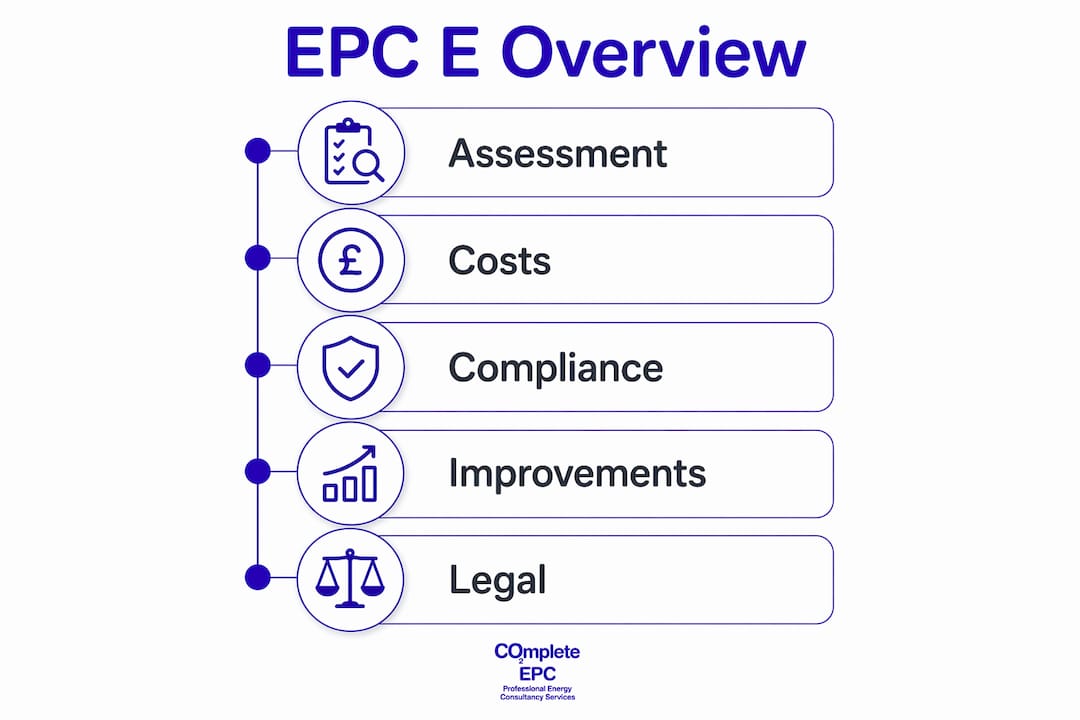
The EPC rating meaning goes beyond a letter grade. It reflects the building fabric, heating system, insulation levels, and glazing quality assessed together through the SAP model. You can explore the full EPC rating scale in detail to understand how each band is calculated.
How does an EPC rating e affect costs and legal compliance?
The financial impact of an E rating is direct and measurable. Heating costs for E-rated homes typically range between £1,600 and £2,500 annually. That figure is £500 to £1,000 more per year than a similarly sized property rated C. Over a five-year tenancy, that gap represents up to £5,000 in additional energy bills paid by the occupant.

For landlords, the legal position is equally clear. Since April 2020, it has been illegal to let properties in England and Wales with an EPC rating below E. Non-compliance carries fines of up to £5,000. A band E property currently sits at the legal minimum, which means it passes today but has no margin for error.
The regulatory picture is tightening. The government is expected to raise the minimum standard to band C for new tenancies by 2030. That change affects a significant portion of the rental market because around one third of privately rented homes currently fall below band C. Landlords with E-rated properties need to plan improvements now rather than wait for a compliance deadline.
Buyers and mortgage lenders are also paying closer attention to EPC ratings. Some lenders offer preferential rates for properties rated C or above, and buyers increasingly factor energy costs into their offers. An E-rated property can attract lower offers or longer sale times compared to equivalent C or D-rated homes. The role of EPCs in the property market has grown considerably as energy costs have risen.
Key compliance points for landlords to keep in mind:
- Band E is the current legal floor for all rental properties in England and Wales
- Fines reach £5,000 for letting a property below band E
- Band C is the anticipated 2030 target for new tenancies
- MEES regulations (Minimum Energy Efficiency Standards) govern these requirements
Which improvements best raise an EPC rating from e?
Improving an EPC rating from E to C or D is achievable for most properties, but the right measures depend on the building’s construction. The most cost-effective upgrades for typical E-rated homes are:
- Loft insulation: Costs of £250–£600 and can yield 3–12 SAP points. This is the single highest-return improvement for most properties.
- LED lighting throughout: Costs £100–£300 and delivers 2–5 SAP points. A straightforward change with immediate bill savings.
- Cavity wall insulation: Where cavities exist, this can add 4–8 SAP points and costs £400–£800 depending on property size.
- Boiler replacement: Upgrading from a G-rated to an A-rated condensing boiler can add 10–15 SAP points and is often the largest single improvement available.
- Double or triple glazing: Replacing single-glazed windows typically adds 2–6 SAP points and improves comfort significantly.
For solid-wall properties, the options are more limited and more expensive. External wall insulation costs £8,000–£20,000 for a typical terraced house. Internal wall insulation is cheaper but reduces floor space. Neither is a quick fix, which is why solid wall construction is the primary reason many pre-1930 homes remain stuck at band E.
Many E-rated properties qualify for government-funded schemes such as ECO4 (Energy Company Obligation), which can cover insulation and heating upgrades at no cost to eligible households. ECO4 targets low-income households and properties with poor energy ratings, so band E homes are frequently eligible. Checking eligibility before committing to private expenditure is a sensible first step.
Pro Tip: Before ordering any work, ask your assessor which specific improvements will move your SAP score across a band boundary. A 3-point gain that pushes you from 54 to 57 moves you from E to D. Targeting the boundary is more cost-effective than chasing the highest possible score.
How is the EPC assessment conducted and what do recommendations mean?
An EPC assessment is carried out by an accredited energy assessor who visits the property and records its physical characteristics. The assessor documents wall construction, roof type, floor insulation, window glazing, heating systems, and hot water provision. This data feeds into the SAP model, which produces the final score and band. EPC assessments generally cost between £60 and £120 depending on property size and location.
The SAP model is a standardised national calculation. It assumes standard occupancy patterns and average energy use rather than the actual behaviour of the people living in the property. This means two identical houses with different occupants will receive the same EPC score.
The recommendations printed on an EPC are generated automatically by the SAP software. They are a useful starting point, but they are not a substitute for a professional building survey. Following EPC recommendations without professional evaluation can create new problems such as damp or ventilation issues, particularly in older solid-wall properties where airtightness improvements can trap moisture.
Key points to understand about EPC recommendations:
- They reflect what the SAP model calculates, not what is physically practical for your specific building
- Older properties may need a retrofit survey before any insulation work begins
- The assessor’s visit is observational, not investigative. Hidden defects do not affect the score
- A new assessment is required after improvements. The original certificate does not update automatically to reflect changes
Pro Tip: Commission a retrofit assessment from a qualified retrofit coordinator (PAS 2035 standard) before undertaking major insulation work on a pre-1950 property. This prevents costly mistakes and satisfies grant scheme requirements.
The EPC assessment process involves more nuance than many property owners expect. Understanding what the assessor is measuring helps you prepare the property correctly and interpret the resulting recommendations with realistic expectations.
Key takeaways
An EPC rating E is the current legal minimum for rental properties in England and Wales, but rising to band C by 2030 is the target landlords must plan for now.
| Point | Details |
|---|---|
| EPC E definition | A SAP score of 39–54, representing the lowest legal band for rental properties in England and Wales. |
| Heating cost premium | E-rated homes cost £500–£1,000 more per year to heat than equivalent C-rated properties. |
| Legal compliance risk | Letting below band E carries fines up to £5,000; band C is the anticipated 2030 minimum. |
| Most effective improvement | Loft insulation offers the highest SAP point return at the lowest cost for most E-rated homes. |
| Reassessment required | A new EPC assessment must be commissioned after improvements; certificates do not update automatically. |
Why acting early on an e rating is the smartest move
I have worked with hundreds of E-rated properties across London, and the pattern I see most often is owners waiting too long. They assume the 2030 deadline is distant enough to ignore, then discover that solid-wall insulation requires planning permission, contractor availability, and months of lead time. The landlords who start now are the ones who avoid panic spending later.
The other misconception I encounter regularly is that swapping appliances will shift the rating. Replacing a washing machine or installing a smart thermostat does almost nothing to the SAP score. The score reflects the building fabric, not the contents. A new boiler helps considerably. New windows help moderately. But if the walls are solid and uninsulated, those improvements alone will rarely push a property from E to C.
What I always recommend is a proper retrofit assessment before spending a penny on insulation. I have seen well-meaning owners install internal wall insulation in a Victorian terrace, only to create a condensation problem that cost more to fix than the insulation itself. The EPC recommendations are a map, not a guarantee. Treat them as a starting point, then get professional advice specific to your building.
The properties I see achieve the best outcomes are those where the owner treats the EPC as a planning document rather than a compliance box to tick. Use it to sequence improvements, apply for ECO4 funding where eligible, and book a reassessment once the work is done. That approach turns an E rating into a genuine asset improvement rather than a regulatory headache.
— Danny
Get your EPC assessment right with Completeepc
If your property carries an E rating, the next step is a professional assessment that gives you accurate data and a clear improvement pathway. Completeepc provides domestic EPC certificates for properties across London, carried out by qualified assessors with extensive field experience. Whether you need a certificate for a sale, a letting, or to plan upgrades ahead of the 2030 compliance changes, Completeepc delivers accurate results at competitive rates. You can also explore the EPC compliance guide for landlords to understand exactly what your obligations are and how to meet them without overspending.
FAQ
What does an EPC rating e mean for a property?
An EPC rating E means the property scores between 39 and 54 on the SAP energy efficiency scale. It is the current legal minimum for rental properties in England and Wales.
Can i legally rent out a property with an EPC rating e?
Yes, band E is the current legal minimum for rental properties. Letting a property rated F or G is illegal and carries fines of up to £5,000.
How much does it cost to improve an EPC rating from e?
Costs vary by property type. Loft insulation costs £250–£600 and yields the highest SAP point return. Solid-wall insulation can cost £8,000–£20,000 but may be partially funded through ECO4 grants.
Do i need a new EPC after making improvements?
Yes. The original certificate does not update automatically. You must commission a new assessment from an accredited assessor to officially record the improved rating.
What is the 2030 EPC requirement for landlords?
The government is expected to require all new tenancies in England and Wales to meet a minimum band C rating by 2030. Landlords with E-rated properties should begin planning improvements now.