

The legal minimum EPC rating for letting a home in England and Wales is band E, and landlords who cannot show a valid certificate or exemption are already breaking the rules. The bigger date on the calendar is 1 October 2030, when government plans would raise that minimum to band C. Check your current EPC on the register now, then decide whether you need to book a new assessment or register an exemption.
TL;DR:
- Most properties will need an EPC rating of C or better by October 1, 2030, with transitional recognition if already rated C before October 2029.
- Upgrading fabric measures like insulation and glazing offers the largest improvements, while heating and smart technology have secondary benefits.
- A new dual-metric EPC will prioritize fabric performance and secondary heating or smart readiness, emphasizing insulation work.
- Landlords should conduct a new EPC assessment before major renovations and post-retrofit to document compliance, minimizing delays and higher costs later.
- Exemptions require proper documentation, including quotes and current EPCs, as enforcement penalties increase and reliance on old certificates is risky.
Table of Contents
- Current legal requirements now under MEES
- The move to EPC C: dates, transition and new metrics
- How to check your property’s EPC and confirm compliance
- Improving your EPC rating: what actually moves the band
- Costs, funding and the proposed cost cap
- Exemptions: evidence, registration and common mistakes
- Compliance and enforcement: what happens if you get it wrong
- How Complete EPC helps you meet these requirements
- Why waiting until 2029 is the costly option
- Book an EPC assessment before your next letting cycle
- Sources
- FAQ
Current legal requirements now under MEES
The Minimum Energy Efficiency Standard applies to most domestic properties let on relevant tenancies, including assured, regulated and some agricultural tenancies, across England and Wales. If you rent out a home under one of these tenancy types, MEES almost certainly covers you, and it is worth confirming this before assuming an older or unusual tenancy sits outside the rules.
Since 1 April 2020, landlords have not been permitted to let a property rated F or G unless a valid exemption is registered. In practice, that means EPC band E is the working minimum for both new lets and continuing tenancies: a property must reach at least an E, or the landlord must hold a registered exemption that covers the current tenancy.
An EPC lasts ten years, but relying on an old certificate is riskier than it sounds. You should commission a new one whenever:
- The current certificate has expired or is close to expiry.
- You have completed works that could improve the rating, such as insulation or a new heating system.
- A reform trigger applies, such as the property moving toward the new C-rated requirement ahead of 2030.
To check what is on file, use the official EPC register, which shows the current band, the assessment date and the recommendation report attached to the certificate.
The move to EPC C: dates, transition and new metrics
The government has set a single compliance date of 1 October 2030 for the new minimum standard. From that date, most tenancies falling under MEES will need an EPC rating of C or better, unless a registered exemption applies.
There is a transitional allowance built into the policy: if a property already holds a valid EPC rated C before 1 October 2029, that certificate will continue to be recognised until it expires, even after the new rules take effect. This gives landlords who act early a genuine head start rather than a race against the deadline.
One change worth flagging early: the reformed EPC is expected to move to a dual-metric approach, with fabric performance as the primary standard and a choice of heating efficiency or smart readiness as a secondary measure. That shift rewards insulation and building fabric work rather than treating a boiler swap as an easy shortcut to compliance.
Two points matter for scheduling:
- A new EPC will generally be required before major retrofit works begin, so you have a documented starting point.
- A further, post-retrofit EPC will be required in many cases to prove the property has actually reached the new standard, not just that work was carried out.
Landlords who leave this until the late 2020s risk competing for the same assessors and installers as everyone else on the same deadline, which tends to push both waiting times and prices up.
How to check your property’s EPC and confirm compliance
Before deciding on any works, confirm exactly where your property stands. This takes most landlords under 15 minutes.
- Search your address on the EPC register to find the most recent certificate.
- Note the current band, the numerical energy efficiency rating (EER), and the assessment date.
- Open the attached recommendation report, which lists specific improvement measures and their expected effect on the rating.
- Check the assessor’s contact details in case you need clarification or a follow-up visit.
- If the certificate is expired, close to expiry, or was issued before recent works, commission a new EPC rather than relying on the old one.
Keep a simple record of every certificate, invoice and quote relating to the property. Independent guidance from Oscar Onsite on checking EPC records is a useful reference point if you want a second explanation of what each field on the certificate means before you commission any work.
Improving your EPC rating: what actually moves the band
Most properties gain the most ground from fabric-first measures before anything else. Loft and cavity wall insulation, draught-proofing and improved glazing tend to deliver the biggest jump in rating because they reduce the amount of heat a property loses in the first place, rather than simply making the heating system work harder to compensate.
Heating and controls upgrades matter too, but they generally deliver less improvement on a poorly insulated property than the same spend on fabric measures. A new boiler in a draughty home still leaks heat through the walls and roof.
Smart and renewable measures, such as smart thermostats or solar panels, sit as secondary steps under the reformed dual-metric approach. They can help push a borderline property over the line, but they rarely substitute for fabric-first work on their own.
A realistic project sequence looks like this:
- Commission a fresh EPC and recommendation report to identify the specific gaps.
- Complete fabric measures first: insulation, draught-proofing, glazing.
- Address heating efficiency or smart readiness as the secondary metric.
- Commission a post-retrofit EPC to confirm the new band before advertising the property again.
Timescales vary by property, but a straightforward insulation project can often be completed within a few weeks, while whole-house retrofits involving multiple trades can run to several months once quotes, scheduling and follow-up inspections are factored in.
Pro Tip: Book your post-retrofit EPC as soon as works finish rather than waiting for the next tenancy change. A gap between completed works and a certificate that reflects them leaves you unable to prove compliance if you are asked.
Costs, funding and the proposed cost cap
Government modelling puts the average cost of reaching band C between £6,100 and £6,800 per property. Separately, the government has proposed a cost cap of up to £10,000, which sets a ceiling on how much a landlord can be required to spend before an exemption becomes available.
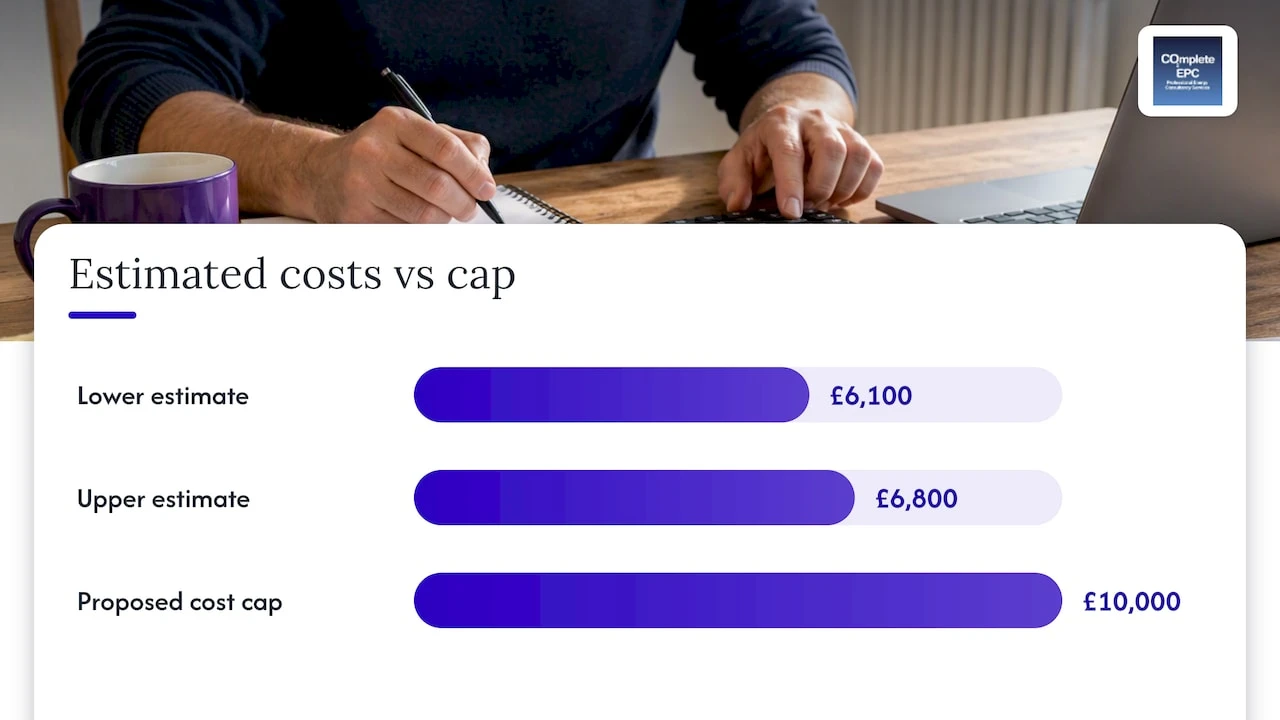
A meaningful detail for budgeting: reasonable EPC assessment costs can count toward that cap, and in specified cases, eligible works carried out after 1 October 2025 can also count retrospectively. That makes early, well-documented spending more useful than it might first appear.
To reduce the amount you spend out of pocket, it is worth checking:
- The Energy Company Obligation (ECO) scheme for insulation and heating support.
- Local council grants, which vary by area and household eligibility.
- The Boiler Upgrade Scheme for heat pump installation support.
Practical budgeting habits pay off here. Get at least three independent quotes for any significant works, phase projects where cash flow is tight, and keep every invoice and quote on file. These records double as evidence if you later need to demonstrate spend toward the cost cap or support an exemption application.
Exemptions: evidence, registration and common mistakes
Not every property can reach the required band affordably, and the rules recognise that through registered exemptions. The two most common categories are the high-cost exemption, where the required works exceed the cost cap, and the “all improvements made” exemption, where every relevant measure has already been installed but the property still falls short.
To register an exemption correctly:
- Obtain three independent quotes from installers for the required improvement works.
- Keep the reports and correspondence from each contractor as supporting evidence.
- Hold a current EPC that reflects the property’s actual condition, including any works already completed.
- Submit the evidence through the PRS Exemptions Register.
- Note the exemption’s expiry, commonly five years, and plan to review the property well before it lapses.
The most common mistake landlords make is failing to document quotes properly, or assuming an exemption is automatic once costs look high. An exemption only protects you once it is evidenced and formally registered, and the burden of proof sits with the landlord throughout.
Compliance and enforcement: what happens if you get it wrong
Local authorities enforce MEES directly and have the power to issue financial penalties and publish details of breaches. Enforcement guidance confirms that penalties are tiered according to the length and severity of the breach, and the government has signalled plans to raise the maximum penalties available under future legislation.
Digital cross-referencing between tenancy records and the EPC register makes non-compliance easier to spot than in previous years, so assuming an old certificate will simply go unnoticed is a poor strategy.
If you receive an enforcement notice:
- Gather every EPC, invoice and quote relating to the property immediately.
- Commission a new EPC if the existing one is out of date or inaccurate.
- Register a valid exemption if the property genuinely qualifies for one.
- Begin any outstanding works without delay rather than waiting for a follow-up notice.
Appeals are available where a landlord believes a penalty was wrongly issued, but they are far easier to argue successfully when your paperwork is already in order.
How Complete EPC helps you meet these requirements
A Domestic Energy Performance Certificate from Complete EPC gives you the assessment and recommendation report you need to establish your current band and plan improvements with confidence. Landlords with mixed-use or business premises can book a Commercial EPC for the same purpose.
Professional assessors carry out the on-site inspection, produce the recommendation report, and can support the evidence needed for an exemption application or a post-retrofit re-assessment once works are finished. To make the visit efficient:
- Have proof of any completed insulation, glazing or heating works ready to show.
- Locate your most recent EPC, if one exists, so the assessor can compare results.
- Note any known issues, such as difficult loft access, in advance.
Where government guidance permits, EPC assessment costs can count toward the proposed cost cap, which makes booking a professional assessment part of your compliance evidence rather than a separate expense.
Why waiting until 2029 is the costly option
Landlords who treat 2030 as a distant deadline tend to end up competing for the same assessors and installers as everyone else in the final year before the deadline, which usually means longer waits and higher quotes. Acting early spreads the cost and the hassle over several letting cycles instead of one rushed scramble.
There is also a tenant-facing benefit that gets overlooked. A property that reaches band C earlier is cheaper to heat, which supports rent stability and makes it easier to market compared with a property still sitting on an ageing E-rated certificate.
The sensible order rarely changes: get a proper survey, fix the fabric of the building first, then look at heating and smart measures. Chasing the secondary metrics before the fabric work is done usually wastes money.
— Danny
Book an EPC assessment before your next letting cycle
If you would rather have a qualified assessor confirm your rating than guess from an old certificate, booking is straightforward. Visit the Domestic Energy Performance Certificate page for residential lets, or the Commercial EPC page if you manage business premises, retail units or mixed-use buildings.
Alongside EPCs, Complete EPC also supports related compliance work landlords sometimes need at the same time, including SAP Calculations for new builds and conversions, and Electrical Installation Condition Reports and PAT testing for wider safety compliance.
- Book a domestic or commercial EPC assessment directly through the relevant service page.
- Request a quote in advance so you know the cost before the visit.
- Use the resulting recommendation report to plan fabric-first improvements ahead of the 2030 deadline.
Getting a current, accurate certificate now gives you the clearest possible picture of where your property stands, and how much runway you actually have before the rules change.
This article is general information, not a substitute for advice from a qualified lawyer. Consult a qualified legal professional about your own circumstances before acting on anything here.
FAQ
What EPC rating is acceptable to rent out a property?
The current legal minimum is band E, and since 1 April 2020 landlords have not been able to let a property rated F or G without a registered exemption. This applies to most tenancies covered by MEES in England and Wales.
How can I raise my EPC rating from D to C?
Fabric-first measures such as insulation, draught-proofing and improved glazing typically deliver the largest gains before you look at heating or smart upgrades. A recommendation report from a fresh EPC assessment will show exactly which measures apply to your property and their likely effect on the band.
What EPC changes are coming in 2026 for landlords?
The headline change remains the planned move to a minimum EPC band C, with a single compliance date of 1 October 2030 and transitional recognition for properties already rated C before 1 October 2029. Landlords should also expect the reformed EPC to introduce fabric performance as the primary metric alongside a secondary heating or smart readiness measure.
What is the 2% rule for renting?
If you have seen this term used elsewhere, it is worth checking the original source directly, since it does not correspond to any figure in current MEES or EPC reform guidance.