

TL;DR:
- An EPC rating measures a property’s energy efficiency from A to G, reflecting estimated costs and compliance. The scale is based on modelled fuel bills, with legal requirements rising to Band C by 2030 for rental properties. Upgrading key features and leveraging grants can improve ratings, reduce costs, and enhance property value.
An Energy Performance Certificate (EPC) rating is a standardised letter grade from A to G that measures a property’s energy efficiency, with A being the most efficient and G the least. The meaning of EPC rating goes beyond a simple letter: it reflects estimated annual fuel costs, legal compliance status, and the potential for improvement. Calculated using the Standard Assessment Procedure (SAP), the rating applies to residential and commercial properties alike. Whether you are buying, selling, renting, or renovating, your EPC rating determines what you owe legally, what you pay in bills, and what grants you can access.
What does the EPC rating scale actually mean?
The EPC rating scale runs from A to G, with each band corresponding to a numerical SAP score. Band A covers scores of 92–100, representing the most energy-efficient properties with the lowest estimated fuel costs. Band G covers scores of 1–20, indicating the least efficient buildings with the highest running costs. The EPC rating scale is not a measure of raw energy consumption. It is a cost proxy, calculated from modelled fuel bills and influenced heavily by the type of heating fuel used.

The full band breakdown
| Band | SAP Score | Meaning |
|---|---|---|
| A | 92–100 | Highest efficiency, lowest estimated fuel costs |
| B | 81–91 | Very efficient, well above average |
| C | 69–80 | Good efficiency, meets upcoming rental standards |
| D | 55–68 | Average efficiency, most common in England |
| E | 39–54 | Below average, current legal minimum for rentals |
| F | 21–38 | Poor efficiency, significant upgrade needed |
| G | 1–20 | Lowest efficiency, highest estimated running costs |
Around 35% of homes in England fall into Band D, with a typical SAP score of 60. That figure tells you the majority of English homes sit squarely in the middle of the scale, neither compliant with future targets nor catastrophically inefficient.
Current rating vs potential rating
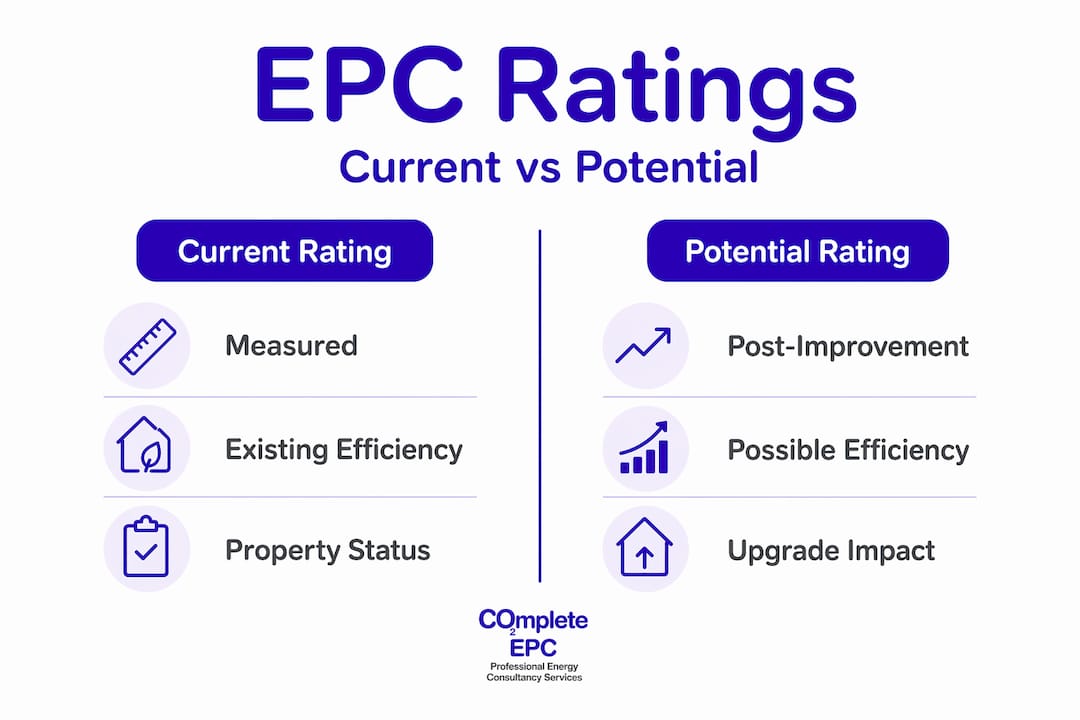
Every EPC shows two ratings: the current rating and the potential rating. The current rating reflects the property as it stands today. The potential rating assumes all recommendations are implemented simultaneously, making it a theoretical maximum rather than a guaranteed outcome. Practical constraints such as budget, planning restrictions, and listed building status often prevent full implementation. Treat the potential rating as a planning target, not a promise.
Pro Tip: If your current and potential ratings are far apart, focus on the two or three recommendations with the highest estimated savings first. You will close the gap faster and at lower cost.
The SAP method and its simplified version, RdSAP (Reduced Data SAP), are the two calculation routes used in England and Wales. RdSAP is used for existing homes and relies on surveyed data rather than full design specifications. Understanding SAP versus RdSAP helps you appreciate why two similar-looking properties can receive different ratings based on heating system type alone.
What are the legal requirements for EPC ratings?
EPC certification is mandatory in England and Wales whenever a property is sold, rented, or newly constructed. The legal framework sets minimum standards that landlords and sellers must meet, with financial penalties for non-compliance.
The current requirements for privately rented properties are:
- Minimum Band E is the legal threshold for all new and existing private rental tenancies in England and Wales.
- Fines up to £5,000 apply to landlords who let a property below Band E without a valid exemption registered on the official PRS Exemptions Register.
- A valid EPC must be provided to prospective tenants and buyers before marketing begins.
- New constructions require an EPC before the building is occupied, based on full SAP calculations from design specifications.
The regulatory picture is about to change significantly. By 1 October 2030, the minimum EPC rating for private rentals in England and Wales will rise to Band C (69–80). Fines for extreme non-compliance could reach £30,000. That is a substantial increase from the current £5,000 maximum, and it signals how seriously the government is treating energy efficiency in housing.
Landlords with Band D or E properties face the most urgent decisions. Moving from Band E to Band C typically requires a combination of loft insulation, cavity wall insulation, and a heating system upgrade. None of these are trivial investments, but the cost of inaction is rising. If you are unsure whether your property qualifies for an exemption, the EPC exemption register outlines the conditions and application process.
Pro Tip: Do not wait until 2029 to commission upgrades. Demand for qualified installers will spike as the 2030 deadline approaches, driving up costs and extending waiting times. Starting now gives you access to better pricing and more grant funding.
For commercial properties, the requirements differ by building type and use. Display Energy Certificates (DECs) apply to public buildings, while EPCs apply to commercial sales and lettings. The commercial EPC process follows different assessment protocols, but the compliance obligation is equally firm.
How does your EPC rating impact financial decisions?
The EPC rating has a direct and measurable effect on property finances. A lower rating means higher estimated fuel bills for occupants, which affects rental demand, sale price negotiations, and mortgage eligibility. Lenders including Halifax and Nationwide have begun factoring EPC ratings into green mortgage products, offering preferential rates for Band C and above.
The financial implications extend to grant eligibility. Properties rated Band D or E typically qualify for government energy efficiency grants such as ECO4 (Energy Company Obligation 4). ECO4 funds insulation, heating upgrades, and renewable installations for eligible households. This means a lower rating is not purely a liability. It can be the entry point to funded improvements that cost you little or nothing out of pocket.
Here is a practical upgrade pathway for a Band E property targeting Band C:
- Loft insulation (if absent or thin): typically the highest return on investment, often funded through ECO4 or the Great British Insulation Scheme.
- Cavity wall insulation: reduces heat loss significantly in properties built before 2000.
- Boiler replacement: upgrading from an old G-rated boiler to an A-rated condensing boiler can add several SAP points alone.
- Double or triple glazing: improves thermal performance and reduces draughts, contributing to both comfort and rating.
- Solar photovoltaic panels: can push a Band C property toward Band B, and may qualify for the Smart Export Guarantee (SEG) income.
The EPC recommendations list inside your certificate prioritises these improvements by estimated cost and saving. It is the most underused section of the document. Most property owners glance at the letter grade and ignore the detail. The recommendations list is where the financial planning actually happens.
Pro Tip: Cross-reference your EPC recommendations with current grant schemes before spending a penny. Measures listed on your certificate may be fully or partially funded, particularly if your household income is below the ECO4 threshold.
What practical steps should you take based on your EPC?
Interpreting your EPC correctly means looking beyond the letter grade. The document contains your current rating, your potential rating, estimated energy costs, and a prioritised list of improvements. Each of these elements serves a different purpose in your planning.
Key steps to take once you have your EPC:
- Compare current and potential ratings to understand the gap and what is realistically achievable.
- Read the recommendations section carefully. Each measure includes an estimated cost range and projected annual saving.
- Check grant eligibility using schemes like ECO4 or the Great British Insulation Scheme before commissioning any work.
- Prioritise measures with the highest saving-to-cost ratio, typically loft insulation and draught-proofing before more expensive interventions.
- Commission a new EPC after major works. An EPC remains valid for 10 years, but a boiler replacement, new insulation, or window upgrades will change your rating. An outdated certificate will not reflect your improvements and could cost you grant eligibility or rental compliance.
The EPC renewal process is straightforward when handled by a qualified assessor. The assessor surveys the property, inputs data into RdSAP software, and issues a new certificate registered on the national EPC register. The whole process typically takes under two hours for a standard domestic property.
For landlords managing multiple properties, a portfolio approach works best. Rank properties by current rating, identify those closest to Band C, and prioritise upgrades there first. Properties already at Band D with good insulation may need only a boiler upgrade to reach compliance. Properties at Band F or G require a more substantial investment plan.
Key takeaways
An EPC rating is a cost-based energy efficiency grade from A to G, calculated via SAP, that determines legal compliance, grant access, and estimated fuel costs for any property in England and Wales.
| Point | Details |
|---|---|
| EPC scale runs A to G | Band A (92–100) is most efficient; Band G (1–20) carries the highest estimated fuel costs. |
| Legal minimum is Band E now | Landlords renting below Band E face fines up to £5,000; the minimum rises to Band C by October 2030. |
| Rating measures estimated costs | EPC grades reflect modelled fuel bill costs, not raw energy consumption, influenced by heating fuel type. |
| Potential rating is a planning tool | The potential rating assumes all improvements are made at once and is a target, not a guarantee. |
| Upgrades can unlock grant funding | Band D and E properties often qualify for ECO4 grants covering insulation, heating, and renewables. |
Why the letter grade is only half the story
One thing I have noticed consistently, working in energy performance across London, is that most property owners fixate on the letter and ignore everything else on the certificate. That is understandable. The letter is prominent, easy to compare, and directly tied to compliance. But it is also the least useful part of the document for anyone trying to make a financial decision.
The EPC rating is, at its core, a cost-based energy metric, not a measure of how much energy a building actually uses. A property heated by mains gas will almost always score better than an identical property heated by oil or LPG, even if both consume the same amount of energy. That is not a flaw in the system. It reflects real-world running costs. But it does mean two Band D properties can feel very different to live in and cost very different amounts to run.
The other misconception I encounter regularly is around the potential rating. People see a potential Band B on their certificate and assume that is achievable with a modest investment. In reality, that figure assumes every single recommendation is implemented at once, including measures that may be physically impossible in a listed building or economically unviable in a leasehold flat. The potential rating is aspirational, not a contractor’s quote.
What I would encourage every property owner to do is treat the EPC as a planning document, not a compliance checkbox. The recommendations list, the estimated savings figures, and the gap between current and potential ratings together form a roadmap. Used properly, that roadmap can save you thousands in bills, unlock grant funding, and position your property well ahead of the 2030 regulatory shift.
— Danny
Get your EPC right with Completeepc
Completeepc provides professional EPC assessments for both residential and commercial properties across London, carried out by qualified assessors with deep knowledge of current regulations and upcoming 2030 compliance requirements. Whether you need a domestic EPC for a sale or rental, or a commercial certificate for a business premises, Completeepc delivers accurate, registered certificates at competitive rates. The team also advises on upgrade pathways and grant eligibility, so you leave the assessment with a clear picture of your compliance position and your options. Book your assessment today and take the uncertainty out of your EPC rating.
FAQ
What does an EPC rating of d mean?
Band D covers SAP scores of 55–68 and represents average energy efficiency. Around 35% of homes in England currently sit in this band, meaning they meet the current legal minimum for rentals but will fall short of the Band C requirement coming into force in October 2030.
How long is an EPC valid for?
An EPC is valid for 10 years from the date of issue. However, if you carry out major works such as a boiler replacement, new insulation, or window upgrades, you should commission a new assessment to reflect the improvements and update your compliance status.
Is an EPC required for all property transactions?
Yes. An EPC is legally required whenever a property in England and Wales is sold, rented, or newly constructed. Failure to provide a valid certificate can result in a £200 penalty for sellers and up to £5,000 for landlords.
Can i improve my EPC rating without spending a lot?
Yes. Measures such as loft insulation, draught-proofing, and upgrading to a smart thermostat are relatively low cost and can improve your SAP score meaningfully. Properties rated Band D or E may also qualify for ECO4 grants that fund larger improvements at little or no direct cost.
Does a better EPC rating increase property value?
A higher EPC rating reduces estimated running costs, which makes a property more attractive to buyers and tenants. Lenders such as Halifax and Nationwide offer preferential green mortgage rates for properties rated Band C and above, which can directly affect the price a buyer is willing to pay.