

An EPC rating is a government-standardised measure of a building’s energy efficiency, expressed as a letter from A to G and backed by a numeric score between 1 and 100. It models what a property should cost to heat, light, and supply with hot water under standard conditions, not what you actually pay. The rating matters because you cannot legally market a property for sale or let without one, and it now feeds directly into government policy on minimum energy standards.
TL;DR:
- Improving from a D to C rating generally requires significant upgrades like solar PV or a new heating system, which can be costly but yield notable points.
- The current legal minimum for landlords is an EPC F or G unless they secure a valid exemption, with stricter standards aimed at reaching at least a C by 2030.
- The potential EPC score reflects what could be achieved by implementing all recommended measures in sequence, emphasizing the importance of prioritizing cost-effective upgrades.
- The assessment methodologies differ for existing and new homes, relying on observable features or design specs, and can cause near-identical houses to score differently.
- Keep detailed records of retrofit costs and materials, as documented work is essential when challenging or claiming exemptions on EPC-related compliance.
Table of Contents
- Understanding the EPC rating scale: what the letters and numbers mean
- How is an EPC score actually calculated?
- What does a domestic EPC certificate actually show you?
- Which improvements move the needle on your EPC score?
- Legal implications: when you need an EPC and what’s changing
- Why practitioner judgement still matters alongside the model
- Book an assessment or plan your next improvement
- Where to check the official guidance
- Sources
- FAQ
Understanding the EPC rating scale: what the letters and numbers mean
The number behind every EPC is what assessors call the Energy Efficiency Rating, and it runs from 1 to 100 (occasionally above, for the most efficient new-builds). That figure then maps onto the familiar A to G bands you see on the certificate’s coloured chart. The score is a cost-based estimate of running costs per square metre, calculated under standard assumptions about heating patterns and occupancy, so two identical houses with different occupants will still score the same.
Typical band boundaries look like this, though exact cut-off points can shift slightly with methodology updates:
- A: 92 to 100 (rare outside new-builds with renewables)
- B: 81 to 91
- C: 69 to 80
- D: 55 to 68 (the most common band for existing UK housing stock)
- E: 39 to 54
- F: 21 to 38
- G: 1 to 20
A property sitting in band D typically means average running costs and a reasonable but improvable fabric. Drop into E, F, or G and you’re looking at higher heating bills, weaker insulation or an inefficient heating system, and, for landlords, potential compliance problems. The official bandings sit with government guidance, so treat any published table, including this one, as indicative rather than definitive.
How is an EPC score actually calculated?
Two methodologies produce that headline number, and which one applies depends entirely on the property’s status.
- RdSAP (Reduced Data Standard Assessment Procedure) is used for existing dwellings. An assessor visits, records what they can observe, and feeds it into government-approved software.
- SAP (Standard Assessment Procedure) applies to new builds, where design specifications rather than a site visit drive the model.
Both approaches rely on the same core inputs: wall and loft insulation, heating system and fuel type, glazing specification, floor area, hot water provision, ventilation, any renewables, and fixed lighting controls. The software then applies standardised assumptions, fixed internal temperatures, typical occupancy patterns, average usage hours, so no two assessments are skewed by whether the previous owner liked the heating on full blast.
This is precisely why two near-identical semis on the same street can score differently. Fuel type matters more than most owners expect. A gas-heated home usually scores better than an all-electric one with the same insulation, simply because of how the model weights fuel costs. Floor area normalisation also plays a part, and hidden fabric differences, an uninsulated cavity nobody’s ever opened up, can quietly drag a score down without anyone noticing until an assessor flags it.
What does a domestic EPC certificate actually show you?
The certificate itself carries far more detail than the headline letter. Once you know where to look, it becomes a genuinely useful diagnostic document rather than a compliance formality.
- A coloured bar chart showing your current rating and your potential rating side by side.
- A breakdown of individual features, walls, roof, windows, heating, hot water, each rated separately.
- A recommendations table listing specific improvement measures.
- Indicative costs for each measure alongside typical three-year savings estimates.
The potential rating is not a fantasy figure. It’s what your score would reach if you installed every recommended measure in the order listed, which matters because tackling them out of sequence can produce smaller gains than the certificate implies. If you’re planning improvements on a budget, the smart approach is working through the recommendation list and prioritising whichever measures deliver the most points per pound spent, rather than starting with whatever feels most obvious.
Which improvements move the needle on your EPC score?
Not every upgrade earns equal points, and cost doesn’t always track with impact. Some interventions are cheap and surprisingly effective; others are expensive and only move the score modestly.
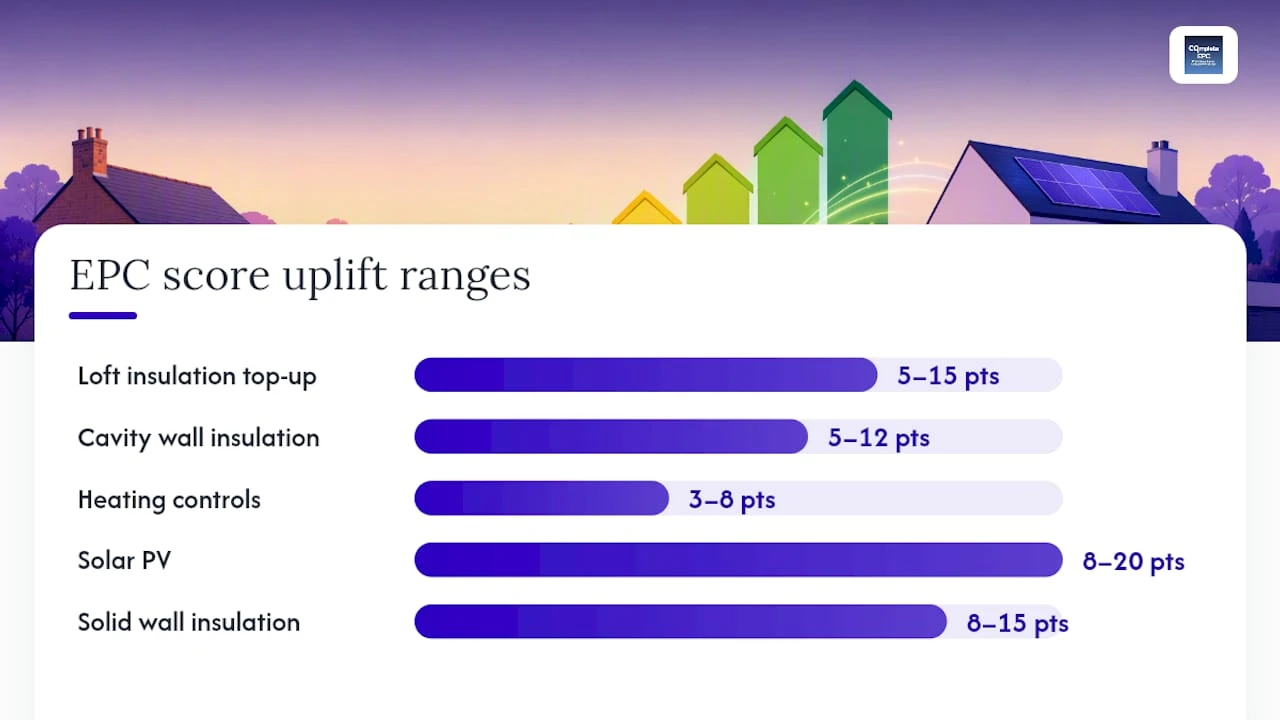
- Loft insulation top-up: roughly 5 to 15 points, low cost, high value for older homes with thin existing insulation.
- Cavity wall insulation: roughly 5 to 12 points, moderate cost, strong return where walls were never filled.
- Heating controls (thermostatic radiator valves, programmers): roughly 3 to 8 points, low cost, often the cheapest points available.
- New condensing boiler: roughly 5 to 10 points, moderate to high cost depending on the existing system.
- Solar PV: roughly 8 to 20 points, higher upfront cost but a substantial score lift.
- Solid wall insulation: roughly 8 to 15 points, the most expensive common measure, usually reserved for period properties with no cavity option.
These figures are ballpark ranges rather than guarantees, since the actual gain depends on your starting fabric and what’s already in place. Measures also compound. A loft top-up plus better heating controls might tip a D into a C, where either alone wouldn’t cross the threshold.
Pro Tip: Keep every invoice and product spec sheet from retrofit work. If you later need to claim a cost-cap exemption or challenge an assessment, that paperwork is often the difference between a successful appeal and a rejected one.
Once major works are finished, commission a fresh assessment. The certificate remains valid at its old rating until a new one is lodged, regardless of what you’ve installed since.
Legal implications: when you need an EPC and what’s changing
An EPC is valid for ten years and is legally required when you sell a property, let it out, or complete a new build, with limited exemptions for certain listed or short-let buildings. For landlords, the current minimum standard under MEES generally rules out letting a property rated F or G without a registered exemption, and the evidential bar for those exemptions is high. Landlords who claim a cost-cap exemption without robust supporting documentation frequently lose at appeal.
Bigger change is coming. Government proposals point towards new-form domestic EPCs carrying multiple headline metrics, covering fabric performance, heating, smart readiness, and running cost separately, alongside a confirmed direction towards an EPC C standard for privately rented homes by 2030, with transitional arrangements still being finalised.
- Check your current rating and note how far you sit from band C.
- Document every improvement’s cost and evidence as you go.
- Commission a new EPC promptly after any significant retrofit work.
Why practitioner judgement still matters alongside the model
Danny
Software models are only as good as what an assessor actually observes on site. A visual survey can’t see inside every cavity wall, so RdSAP defaults to standard assumptions when the fabric is uncertain. Qualified assessors handle both domestic and commercial certificates across London, and on-site judgement, not just the software output, is what turns a certificate into recommendations you can actually act on.
— Danny
Book an assessment or plan your next improvement
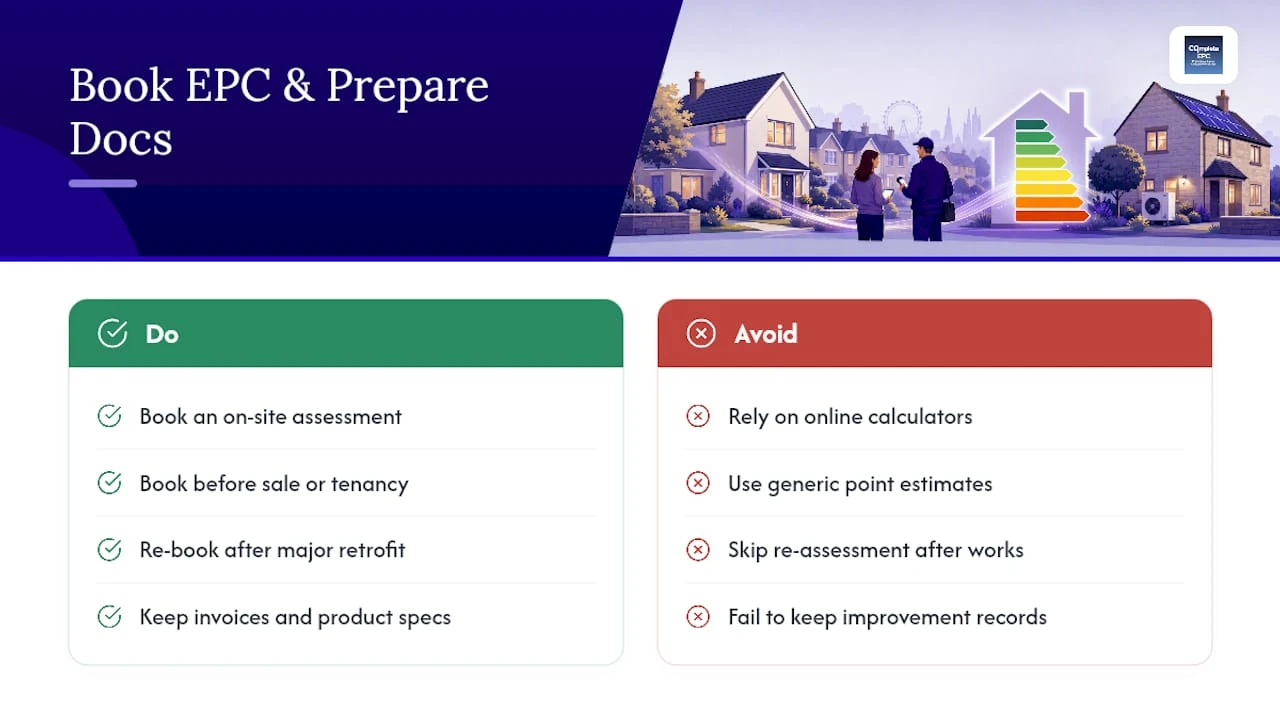
This is a practical route to a valid, accurate certificate rather than a guessing game with online calculators. Every assessment can include an on-site visit from a qualified assessor, a full certificate lodged to the register, and a recommendations report you can actually use to plan improvements in the right order, rather than working from generic point estimates.
Book before you market a sale or a new tenancy, and book again after major retrofit work so your certificate reflects what you’ve actually installed. Homeowners and landlords needing a residential assessment can start with the domestic EPC service, while businesses and commercial landlords should look at the commercial EPC service for compliance covering offices, retail units, and mixed-use buildings. Keep your invoices and product specs from any improvement work; they’ll matter if you need to demonstrate compliance or claim an exemption later.
Where to check the official guidance
For the legal detail behind any of this, consult GOV.UK’s EPC guidance, the technical annex on what EPCs measure, and Energy Saving Trust’s homeowner advice.
Sources
- Gov
- Sample EPC and guidance (certificate sample) – GOV.UK
- EPC reforms and MEES for private-rented property confirmed – Pinsent Masons
FAQ
How do I understand my EPC rating?
Look at the letter band first (A to G), then check the numeric score behind it and compare your current rating against the potential rating shown on the certificate. The recommendations table tells you exactly which measures would close that gap.
How can I improve my EPC rating from C to B?
Moving from C to B usually means tackling higher-cost measures like solar PV or upgrading an ageing heating system, since the cheaper wins (loft top-ups, heating controls) are typically already reflected in a C rating. Check your certificate’s recommendation table for property-specific options, as the exact gap depends on what’s already installed.
Is an EPC rating of D good or bad?
D is neither excellent nor poor. It’s the most common band across UK housing stock, representing average efficiency and running costs, with clear room for improvement through fabric or heating upgrades.
What is the best EPC score for a house?
A is the top band and represents the most efficient properties, typically new-builds with renewables like solar PV. For most existing homes, reaching C is a realistic and increasingly important target given the proposed 2030 minimum standard for rented properties.