

TL;DR:
- Many London landlords wrongly assume a single EPC letter fully explains a property’s energy efficiency. EPC ratings are based on detailed scores influenced by observable improvements; documentation is crucial for accurate assessment. Upcoming reforms in October 2026 will separate performance metrics, providing clearer insights and incentivizing genuine upgrades.
Many London landlords assume that a single letter on an EPC tells the whole story. In reality, EPC ratings from A to G also carry a numerical score from 1 to 100, calculated through a detailed energy model that assesses insulation, heating systems, glazing, and more. That single letter is shaped by dozens of variables, many of which you can influence before an assessment takes place. This guide breaks down exactly how EPC ratings work, what each band means in practical terms, how the October 2026 reforms will change what appears on your certificate, and what steps you can take right now to improve your score and protect your investment.
Table of Contents
- What is an EPC and why does it matter?
- How EPC ratings are calculated: The SAP and RdSAP model explained
- The EPC A–G scale: What each band means for your property
- October 2026 reforms: Four new EPC metrics and what they mean for London owners
- How to improve your EPC rating: Actionable steps for London properties
- A property expert’s view: Why one-size EPC ratings often miss the mark
- Take the next step in EPC compliance and property value
- Frequently asked questions
Key Takeaways
| Point | Details |
|---|---|
| EPC is legal necessity | A valid EPC is required by law to sell or let property in London. |
| Calculation uses assumptions | EPC scores are often based on observed evidence and standard defaults, so providing documentation can improve outcomes. |
| Reforms bring four metrics | From October 2026, EPCs in London will display new separate fabric, heating, cost, and smart metrics. |
| Upgrades improve value | Practical improvements and documentation can boost ratings, reduce costs, and enhance property value. |
What is an EPC and why does it matter?
An Energy Performance Certificate, or EPC, is a government-mandated document that rates the energy efficiency of a residential or commercial property on a scale from A to G. Band A is the most efficient, band G the least. Every property offered for sale or rent in England and Wales must have a valid EPC in place before it can be marketed.
For landlords, the stakes are particularly high. EPC compliance is a legal requirement for marketing any rental property, and certificates produced by accredited assessors remain valid for 10 years, unless major works alter the property’s energy profile and require reassessment. Letting a property without a current EPC is not just poor practice; it exposes you to financial penalties.
London’s property market has seen a notable surge in EPC activity. New EPC lodgements rose sharply in Q1 2026 compared to Q1 2025 across the capital, reflecting rising transaction volumes and growing landlord awareness of compliance obligations. In a competitive London rental market, a strong EPC band also signals lower running costs to prospective tenants, making it a genuine marketing asset.
Key reasons why an EPC matters for London property owners:
- Legal compliance: Without a valid EPC, you cannot legally market a property for rent or sale.
- Minimum energy efficiency standards (MEES): Rental properties must currently meet at least band E. Stricter targets are expected in coming years.
- Tenant attraction: Energy-conscious renters actively compare EPC bands when choosing properties.
- Property value: Buyers and mortgage lenders increasingly factor in EPC ratings when assessing long-term value.
- Running costs: Higher-rated properties cost significantly less to heat and power, benefiting both landlords and occupants.
Having set the stage with why understanding EPC is mission-critical, let’s break down precisely how ratings are calculated and what influences your score.
How EPC ratings are calculated: The SAP and RdSAP model explained
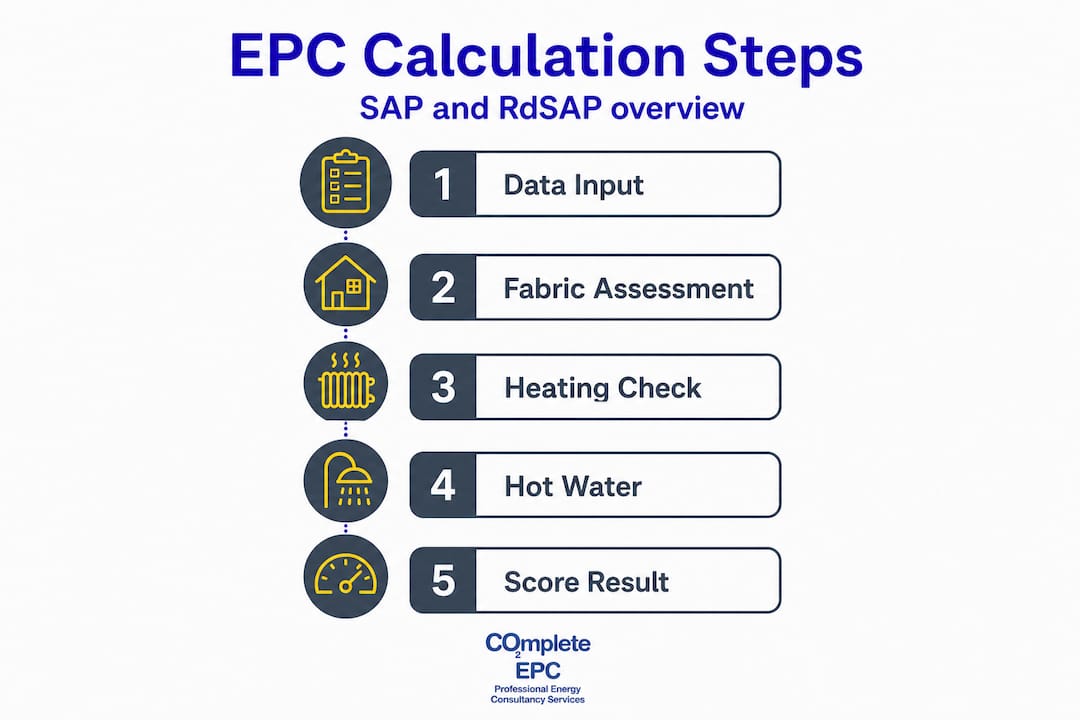
The engine behind every domestic EPC is the Standard Assessment Procedure, known as SAP. This is the official government-approved methodology for calculating a home’s energy performance. For most existing homes, assessors use a simplified version called Reduced Data SAP, or RdSAP, which relies on a reduced set of inputs and applies standardised assumptions when certain details cannot be directly observed or evidenced.
This matters enormously for older London properties. If an assessor cannot confirm the specification of cavity wall insulation installed 15 years ago, RdSAP defaults to a conservative assumption that may understate your property’s actual thermal performance. The same applies to boiler efficiency, loft insulation thickness, and window glazing types.
The government’s approved SAP methodology is periodically updated through formal notices of approval, with the most recent update published in June 2025. Any EPC issued after that date reflects the revised calculation framework.
Here is a summary of the key inputs that shape your EPC score:
| Input category | Examples | Impact on score |
|---|---|---|
| Building fabric | Wall type, insulation, floor, roof | High |
| Glazing | Single, double, triple glazing | Moderate |
| Heating system | Boiler type, heat pump, controls | High |
| Hot water system | Cylinder insulation, solar thermal | Moderate |
| Lighting | LED vs standard bulbs | Low to moderate |
| Renewables | Solar PV, wind turbines | High if present |
Pro Tip: Before your EPC assessment, gather every installation certificate, warranty document, and receipt for energy-related upgrades. Insulation guarantees, boiler commissioning sheets, and glazing specifications can all prevent an assessor from defaulting to worst-case assumptions.
Now that you understand the rating’s importance, let’s explore how the methods behind the rating can impact your property and what you can do to influence the outcome.
The EPC A–G scale: What each band means for your property
Understanding what each letter band actually represents helps you set realistic targets and judge whether your current rating is a compliance risk or a competitive advantage. EPC ratings run from A to G, and each band corresponds to a numerical range on the 1 to 100 SAP scale.
| EPC band | SAP score range | Typical property type |
|---|---|---|
| A | 92 to 100 | New-build, Passivhaus, heavily retrofitted |
| B | 81 to 91 | Recent new-builds, well-insulated refurbishments |
| C | 69 to 80 | Compliance target for many landlords |
| D | 55 to 68 | Average UK stock, some older properties |
| E | 39 to 54 | Current minimum for rentals |
| F | 21 to 38 | Below minimum; cannot be legally let without exemption |
| G | 1 to 20 | Serious legal and financial risk |
A note on band C: Government proposals have long targeted band C as the future minimum for rental properties. Although the exact timetable has shifted, the direction of travel is clear. Landlords who invest in reaching band C now are positioning themselves ahead of regulation rather than reacting to it.
What does this mean in practice?
- Band A or B properties attract premium tenants, face lower running cost complaints, and are increasingly favoured by green mortgage lenders offering preferential rates.
- Band C or D properties sit in a manageable position but may need targeted improvements to future-proof against tightening regulations.
- Band E is the current minimum for rentals. Any property at E should be treated as a short-term position, not a resting point.
- Band F or G properties cannot legally be let without a registered exemption. If your property sits here, action is not optional.
Both the letter and the number matter. A property at 68 (band D) is far closer to band C than one at 55, yet both display the same letter. When planning improvements, always ask your assessor for the numerical score so you can target upgrades efficiently.
With a grasp of calculation mechanics, the real question for most is whether your rating is good, bad, or a deal-breaker. Now let’s look at what is about to change.
October 2026 reforms: Four new EPC metrics and what they mean for London owners
The single A to G headline rating has served as the main currency of energy compliance for years. But EPC reforms moving toward four separate metrics represent a significant shift in how property energy performance will be reported and assessed from October 2026 onwards.
Instead of one number driving a letter grade, future EPCs will present four distinct scores covering:
- Fabric performance: How well your walls, roof, floors, and windows retain heat. This directly reflects the quality of insulation and construction.
- Heating and hot water: The efficiency and type of heating system installed, including boiler ratings, heat pump coefficients, and controls.
- Estimated energy costs: A projected annual running cost based on standardised occupancy assumptions, giving tenants a clearer picture of what they will actually pay.
- Smart readiness: How well the property is equipped to integrate with smart energy technologies, including smart meters, demand response systems, and EV charging infrastructure.
Pro Tip: Start thinking about each of these four areas now rather than waiting until October 2026. If your next EPC renewal falls after the reform date, you will be assessed against the new framework. Properties that already perform well across all four metrics will face fewer surprises.
For London landlords, the smart readiness metric is worth particular attention. Older London housing stock was not built with smart technology in mind, yet demand for smart meters and EV charging points is growing fast. Simple upgrades such as installing a smart thermostat or ensuring your property is compatible with smart meter installation can contribute positively to this metric.
The four-metric approach also makes it harder to mask a weak area with a strong one. A property with excellent insulation but an old gas boiler will no longer score well overall, because heating efficiency will be reported separately. This gives you a clearer picture of where to focus investment.
How to improve your EPC rating: Actionable steps for London properties
With regulatory and calculation knowledge in hand, this final body section arms you with practical steps to boost your property’s efficiency score.

EPC outcomes depend heavily on what assessors can evidence through observation or documentation. If an improvement cannot be confirmed, it will not benefit your score. That means preparation is as important as the physical work itself.
Key actions to improve your EPC rating:
- Upgrade loft insulation to at least 270mm. This is one of the highest-impact, lowest-cost improvements available and is easily evidenced with a dated receipt or guarantee.
- Install cavity wall or solid wall insulation. For older London terraces with solid walls, external or internal insulation can make a material difference to both fabric performance and your EPC score.
- Replace single-glazed windows with double or triple glazing. Always retain the installation certificate issued by the glazing company.
- Upgrade to a high-efficiency condensing boiler or heat pump. Boiler efficiency is one of the biggest drivers of your heating score. A modern A-rated boiler or an air source heat pump can lift a D-rated property into band C.
- Fit smart heating controls. Programmable thermostats and zone controls demonstrate heating system efficiency to assessors and will count favourably under the October 2026 smart readiness metric.
- Switch to LED lighting throughout. While the impact on your overall SAP score is modest, it costs very little and combines with other measures to nudge scores upward.
- Install solar photovoltaic panels. In properties where roof access is suitable, solar PV can deliver a significant score boost, particularly under the new cost metric.
Before booking an assessment, use a property energy audit checklist to ensure you have identified every possible improvement opportunity and gathered supporting documentation.
Pro Tip: For heritage or listed properties in London, standard improvement routes such as cavity wall insulation or replacement windows may not be permitted. In these cases, focus on heating controls, draught-proofing, secondary glazing, and specialist solid wall insulation solutions that are approved for use in conservation areas.
A property expert’s view: Why one-size EPC ratings often miss the mark
There is a persistent frustration among owners of older London properties who have spent considerable sums on energy improvements, only to receive an EPC score that seems to ignore half of what they have done. This is not an accident of the system; it is a direct consequence of how RdSAP works.
RdSAP’s default assumptions are based on age bands, meaning a Victorian terrace built in 1890 may be assessed using assumptions about a typical 1890s home, even if it has been thoroughly upgraded. Without certificates proving that insulation has been installed to a modern specification, the model will assume the worst. This is not the assessor being difficult; it is simply how the methodology is designed.
The practical implication is that documentation is not an optional extra. It is the difference between your improvements being counted and being invisible to the EPC. We have seen properties jump a full band simply because the owner provided installation records that allowed the assessor to record actual specifications rather than age-band defaults.
The October 2026 reforms should help in one important respect. By separating fabric performance, heating, and other metrics, the new framework makes it much harder for a weak area to hide behind a strong overall average. That transparency benefits owners who have genuinely invested in their properties, because the fabric score will reflect quality insulation independently of heating system age.
If your current EPC feels lower than expected, our strong advice is this: do not immediately rush into costly works. First, review the assumptions the assessor used. Request the full report and look at the default values applied. In some cases, providing evidence of existing improvements is all that is needed. Work with an assessor who has direct experience with older London property types and who understands the nuances of RdSAP defaults.
Take the next step in EPC compliance and property value
Understanding EPC ratings is one thing. Acting on that knowledge with the right professional support is what protects your property’s legal standing and long-term value. At Complete EPC, our qualified assessors work with London landlords and property owners every day, providing accurate assessments, clear improvement recommendations, and fully accredited certificates at the UK’s most competitive rates. Whether you need a straightforward domestic EPC for a rental property, are preparing for the October 2026 reforms, or want to understand how targeted upgrades can move your property up a band, we are here to help. Contact us today to book an assessment and take the guesswork out of energy compliance.
Frequently asked questions
How long is an EPC valid for a London property?
An EPC is valid for 10 years from the date of issue, unless major works are carried out that materially change the property’s energy performance and require reassessment.
What happens if my property does not meet the minimum EPC band?
If your rental property falls below the legally required minimum EPC band, you cannot legally let it until you have made sufficient improvements or registered a valid exemption with the relevant authority.
What evidence should I provide to improve my EPC outcome?
Provide installation certificates, dated receipts, and clear survey access so your assessor can record actual improvements rather than applying conservative defaults based on your property’s build date.
How will EPCs change after October 2026?
From October 2026, EPCs will include four separate performance metrics covering fabric, heating and hot water, estimated energy costs, and smart readiness, replacing the single headline rating as the primary compliance measure.
Are older London properties unfairly penalised by EPC ratings?
Older and heritage homes can receive lower scores than their actual performance warrants because RdSAP applies age-band defaults when specific details cannot be observed. Providing documentation and using experienced assessors familiar with older stock can significantly reduce this effect.