

TL;DR:
- EPC compliance involves continuous management, not just a one-time certification.
- Improving EPC ratings can significantly boost property value and attract tenants.
- Landlords should proactively monitor and upgrade their properties to meet evolving standards.
Treating an Energy Performance Certificate as mere paperwork is one of the most expensive mistakes a London landlord can make. Since April 2020, properties rated F or G cannot legally be let in England and Wales without a registered exemption, yet enforcement is tightening and proposed reforms are set to raise the bar further. Getting EPC compliance right does far more than keep you on the right side of the law. It protects your rental income, reduces void periods, and can meaningfully increase your asset’s market value. This guide covers everything you need to know, from legal definitions and current standards to the assessment process, upcoming regulatory changes, and the hard financial case for acting now.
Table of Contents
- What does EPC renting really mean?
- Minimum energy standards: EPC bands and MEES explained
- How EPC assessments work: process, metrics, and upcoming changes
- The business case: how EPC ratings affect property value
- Our perspective: why EPC compliance is ongoing risk management, not a one-off task
- Need EPC support? Make compliance easy and boost your property’s value
- Frequently asked questions
Key Takeaways
| Point | Details |
|---|---|
| EPC renting defined | It means commissioning a valid EPC for letting, not simply holding a document. |
| Legal standards matter | London properties for rent must have EPC band E or better, unless exempt. |
| Assessments are changing | The Home Energy Model will soon alter EPC calculations and required evidence. |
| Value boost possible | Raising your EPC band can typically add 1–3% to sale or rental value. |
| Ongoing compliance is vital | Treat EPCs as an active risk management tool, not a one-off task. |
What does EPC renting really mean?
With the stakes established, it is critical to define precisely what EPC renting means and dispel common misconceptions.
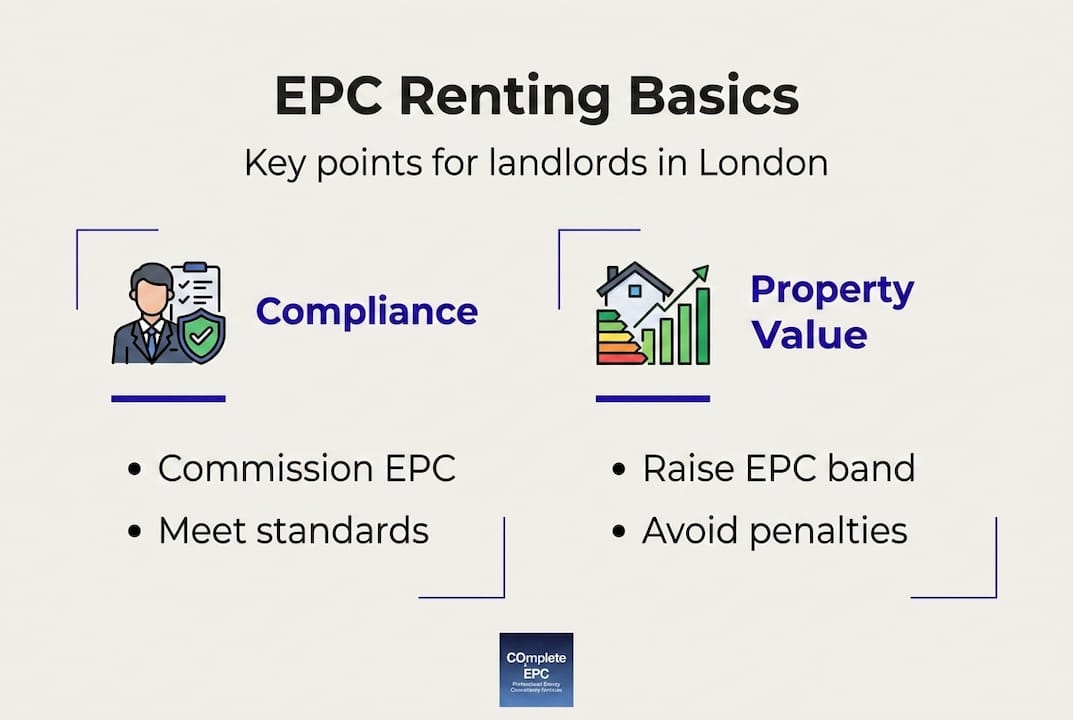
“EPC renting” is not about renting out a document or certificate. It refers to the legal obligation to commission and maintain a valid Energy Performance Certificate before letting a residential property. An EPC is a formal legal document, produced by an accredited assessor, that rates a property’s energy efficiency on a scale from A (most efficient) to G (least efficient). It also provides estimated energy costs and a list of recommended improvements.
Many landlords assume that having any EPC on file is sufficient. That assumption carries real financial risk. MEES compliance requires more than simply filing a certificate: since April 2020, the prohibition on letting F or G rated properties applies to all covered tenancies, including those that are ongoing, not just new lets. In other words, if your existing tenant’s property sits at band F, you are potentially in breach right now.
Here is what EPC renting actually involves in practical terms:
- Commissioning an assessment from an accredited domestic energy assessor registered with a government-approved scheme
- Verifying the rating meets the minimum legal standard (band E or above) before any tenancy begins or continues
- Providing the certificate to prospective tenants as part of the letting process
- Keeping evidence of any improvements made, especially if you have registered an exemption
- Renewing the EPC when it expires (every 10 years) or after major works that affect energy performance
“MEES compliance is not a one-off exercise. It applies continuously, covering both new and continuing tenancies, and demands that landlords actively monitor their portfolio’s energy ratings.”
The practical reality is that London’s diverse housing stock, ranging from Victorian terraced houses to modern purpose-built flats, presents highly variable EPC outcomes. A flat with solid wall construction and no insulation can easily land at band F or below without targeted improvements. Getting the certificate is step one. Understanding what it means for your letting obligations is where most landlords need to focus.
Minimum energy standards: EPC bands and MEES explained
With definitions in place, we can break down the specifics of the minimum energy standards, band cut-offs, and the practical impact on London property lets.

The Minimum Energy Efficiency Standards (MEES) were introduced under the Energy Efficiency (Private Rented Property) (England and Wales) Regulations 2015. They set a legal floor on the energy rating that a landlord can let. The minimum letting standard for domestic private rented properties is EPC band E. Any property rated F or G cannot be let legally unless a valid exemption has been registered on the national PRS Exemptions Register.
Here is how each band translates into practical landlord obligations:
| EPC band | SAP score range | Lettable? | Landlord action required |
|---|---|---|---|
| A | 92 to 100 | Yes | No action needed |
| B | 81 to 91 | Yes | No action needed |
| C | 69 to 80 | Yes | No action needed |
| D | 55 to 68 | Yes | No action needed |
| E | 39 to 54 | Yes | Minimum compliance met |
| F | 21 to 38 | No | Improve or register exemption |
| G | 1 to 20 | No | Improve or register exemption |
Common exemption scenarios that allow an F or G property to be let without upgrading include:
- All relevant energy efficiency improvements have been made, but the property still cannot reach band E
- The cost of works exceeds the regulatory cost cap (currently £3,500 including VAT per property)
- A third party such as a freeholder or mortgage lender refuses consent to carry out works
- The property is newly acquired and you require time to make improvements (a temporary six-month exemption applies)
- Expert evidence confirms that improvements would devalue the property by more than 5%
Exemptions are not automatic. They must be formally registered with evidence, and they last for five years, not indefinitely. After that period, you must either re-register or bring the property up to standard.
It is also worth noting that the government has signalled its intention to raise the minimum standard to band C for new tenancies in the coming years, though the exact timeline remains subject to consultation. London landlords with portfolio properties at band D or E today would do well to begin planning improvements now rather than facing a rushed and costly upgrade cycle later.
How EPC assessments work: process, metrics, and upcoming changes
With an understanding of current standards, let us examine how EPC assessments actually work and what is changing soon for landlords.
Currently, domestic EPC assessments use the SAP (Standard Assessment Procedure) methodology, or its simplified version RdSAP (Reduced Data SAP) for existing dwellings. An accredited assessor visits the property, collects data on construction, insulation, heating systems, glazing, and lighting, and then runs those inputs through the SAP calculation engine to generate the rating and energy cost estimates.
The assessment process follows these steps:
- Book an accredited assessor registered with a government-approved accreditation scheme such as Stroma, Elmhurst Energy, or ECMK
- Prepare the property by giving the assessor access to the loft, boiler, meter cupboards, and any relevant documentation such as installation certificates for insulation or heating upgrades
- The assessor surveys the property, recording dimensions, construction type, insulation levels, heating and hot water systems, and fixed lighting
- Data is entered into the SAP/RdSAP software, which calculates the energy efficiency rating and environmental impact rating
- The certificate is lodged on the national EPC register (managed by the Ministry of Housing, Communities and Local Government) and becomes publicly accessible
- You receive your certificate, typically within 24 to 48 hours of the assessment
However, the methodology is changing. Government consultation materials confirm a move to a Home Energy Model (HEM)-based calculation for reformed domestic EPCs. HEM is designed to be more accurate and granular than RdSAP, using improved modelling of heat loss, occupancy patterns, and renewable energy contributions.
The reformed EPC is expected to report on multiple headline metrics rather than a single rating:
| Metric | What it measures | Why it matters |
|---|---|---|
| Energy cost | Estimated annual running costs | Directly relevant to tenant affordability |
| Fabric performance | Insulation, windows, and structural heat loss | Identifies improvement priorities |
| Heating system | Type, efficiency, and carbon output | Relevant for low-carbon heating upgrades |
| Smart readiness | Ability to integrate smart controls and renewables | Future-proofing for technology adoption |
Pro Tip: Start keeping records of every energy-related improvement you make now, including contractor invoices and installation certificates. When HEM replaces RdSAP, documented improvements may be submitted as evidence and could influence your new rating positively. Assessors working with the updated methodology will need reliable data.
Landlords should monitor government announcements closely. The transition timeline for HEM has not been finalised, but properties requiring new EPCs after the reform launch will be assessed under the new rules. A property that sits comfortably at band D today could be recalculated differently once HEM is in use.
The business case: how EPC ratings affect property value
Beyond ticking regulatory boxes, improving your EPC carries major practical and financial benefits that are often underestimated.
The evidence for a financial premium linked to higher EPC ratings is compelling. Research confirms a market premium for more energy-efficient homes, often quantified at around 1% to 3% per EPC band in the academic literature. For a London property valued at £500,000, moving from band D to band C could therefore represent a value increase of up to £15,000. That is a significant return on the cost of typical insulation and heating upgrades.
“There is an evidence-backed market premium for more energy-efficient homes (higher EPC bands), often quantified around 1% to 3% per band in the research literature.”
The benefits extend well beyond headline sale prices. Here is how a higher EPC rating adds practical value across your rental portfolio:
- Stronger tenant demand: Eco-conscious renters, particularly younger professionals in London, actively filter properties by energy efficiency. A band C or above can set your listing apart in a competitive market.
- Lower void periods: Properties with lower running costs are more attractive and easier to let quickly, reducing the income loss from empty periods between tenancies.
- Reduced maintenance risk: Improved insulation and modern heating systems tend to generate fewer tenant complaints and maintenance call-outs, lowering your ongoing management costs.
- Compliance confidence: A solid EPC rating well above the minimum means you are insulated from future regulatory tightening. If the minimum moves to band C, you are already there.
- Mortgage and financing advantages: Some lenders now offer preferential rates on buy-to-let mortgages for higher-rated properties, giving you a financing edge as green finance products grow in the London market.
Pro Tip: If you are planning to future-proof your rental portfolio, target band C or above as your benchmark rather than the current legal minimum of band E. The cost difference between reaching E and reaching C is often modest when works are planned strategically, but the long-term benefits in value, marketability, and regulatory security are substantial.
Common improvement measures that help climb the bands include loft insulation, cavity or external wall insulation, upgrading to a modern condensing boiler, installing smart thermostats, and replacing single glazing with double or triple glazing. An accredited assessor can identify which combination of measures will be most cost-effective for your specific property type.
Our perspective: why EPC compliance is ongoing risk management, not a one-off task
Most landlords and letting agents view EPC compliance as a tick-box exercise. Get the certificate, file it, move on. That approach is increasingly dangerous, and frankly, it leaves money on the table.
We see this pattern regularly: a landlord gets an EPC at the start of a tenancy, assumes it covers them indefinitely, and then discovers years later that MEES compliance requires active, continuous management rather than a static document. Regulations evolve. Calculation methodologies shift. The property may have changed. What was compliant three years ago may not be compliant under the new metrics being introduced through the HEM reform.
Our view is straightforward. Treat your EPC status the same way you treat buildings insurance or gas safety certificates: as a live obligation that needs scheduled review, not a historic record. Practically, this means building an annual compliance check into your property management calendar. Review each certificate’s expiry date. Note which properties are sitting close to the band E threshold. Identify where a single improvement could make a meaningful difference.
Enforcement is also becoming sharper. Local authorities have existing powers to issue civil penalty notices of up to £5,000 per breach, and as the government moves toward tighter standards, the political will to enforce them is only growing. The landlords who will face the least disruption are those who are already ahead of the minimum, not scrambling to meet it.
One further point that rarely gets discussed: exemptions are not a long-term strategy. They expire, they must be re-registered with fresh evidence, and they signal to prospective tenants and lenders that a property is below standard. If your business model relies on exemptions to keep properties in the market, the risk profile of that portfolio is higher than it needs to be.
The smarter approach is to treat EPC improvement as capital investment with measurable returns in value, tenant retention, and regulatory security.
Need EPC support? Make compliance easy and boost your property’s value
Understanding the regulations is one thing. Acting on them quickly and correctly is another. At Complete EPC, we work with London landlords, letting agents, and property owners to make the whole process straightforward. Our qualified assessors cover all property types across London, providing accurate certificates at the UK’s most competitive rates.
Whether you need to understand the full EPC assessment process for your rental property or want to better understand the EPC rating impact on your asset’s value and marketability, we have the guidance and expertise to help. Avoid costly fines, reduce void periods, and position your property ahead of incoming regulatory changes. Get in touch with Complete EPC today and let us handle the compliance so you can focus on your portfolio.
Frequently asked questions
Do I need a new EPC every time I let my property?
You need a valid EPC that is no more than 10 years old when letting a property. A new assessment is only required if the previous certificate has expired or if significant works have been carried out that affect the property’s energy performance.
What are the penalties for renting out a property with an EPC rating below E?
Fines can reach up to £5,000 per breach for letting sub-standard properties rated F or G without a registered exemption, as domestic private rented properties covered by MEES cannot legally be let below band E.
Will the Home Energy Model (HEM) affect existing EPCs?
The HEM will apply to new or replacement EPCs issued after the reform launches, potentially changing both ratings and the metrics reported compared to current SAP/RdSAP calculations. Existing certificates remain valid until they expire.
What improvements can help raise my EPC band?
Typical improvements include adding loft or wall insulation, upgrading to a modern condensing boiler, fitting double glazing, and installing smart heating controls. An accredited assessor can specify which measures will be most effective for your particular property.
Is there a property value premium for higher EPC bands?
Yes. Research confirms a premium of approximately 1% to 3% per EPC band improvement, meaning that raising a London property from band D to band C can add thousands of pounds to its sale or rental value.