

TL;DR:
- Stricter MEES regulations now prevent landlords from leasing properties with EPC F or G ratings without exemptions, risking fines and market value loss.
- Proactively improving EPC ratings aligns with future regulation trends, enhances tenant appeal, and increases property investment value.
- Understanding and strategically managing exemptions and upgrades will position landlords to meet evolving standards and maximize their portfolio’s performance.
Many commercial landlords in London treat an Energy Performance Certificate (EPC) as just another piece of paperwork to secure before a letting or sale. That assumption is costly. Since April 2023, stricter legal standards under MEES (Minimum Energy Efficiency Standards) mean that holding a substandard EPC rating can legally prevent you from leasing your property, expose you to significant fines, and quietly erode its market value. This guide cuts through the confusion, explains exactly what your obligations are, clarifies which exemptions apply to your situation, and shows you how a proactive approach to energy performance translates into measurable financial returns across your commercial portfolio.
Table of Contents
- What is an EPC and why do commercial properties need one?
- Understanding MEES: The legal standards and upcoming changes
- EPC exemptions: Who is affected and when do they apply?
- How EPCs enhance commercial property value and tenant appeal
- What most guides miss about EPC strategy for landlords
- Take the next step: Seamless EPC compliance and value upgrades
- Frequently asked questions
Key Takeaways
| Point | Details |
|---|---|
| Legal compliance is crucial | Letting or selling commercial property without a valid EPC risks fines and lost revenue. |
| Minimum EPC standards apply | From April 2023, most commercial lets in London need at least an EPC E rating or a registered exemption. |
| Exemptions exist but require proof | Some buildings and tenancies qualify for exemptions, but you must document and register them correctly. |
| EPC upgrades boost value | Proactively improving EPC ratings increases market value, attracts better tenants, and mitigates future risks. |
| Stay ahead of regulation changes | Future MEES rules may set tougher EPC targets, so planning improvements early protects your investments. |
What is an EPC and why do commercial properties need one?
An Energy Performance Certificate is an official document that rates a building’s energy efficiency on a scale from A (most efficient) to G (least efficient). For commercial properties, this rating is produced by an accredited assessor who evaluates heating systems, insulation, lighting, and building fabric. The result is a score expressed in kWh per square metre per year, accompanied by recommendations for improvement.
Commercial landlords need an EPC for legal, financial, and practical reasons. Legally, you must have a valid EPC in place before marketing a property for sale or rent. Practically, lenders, insurers, and increasingly sophisticated tenants will scrutinise the certificate before committing to any transaction. As a landlord, the certificate is your evidence that you are operating within the law.
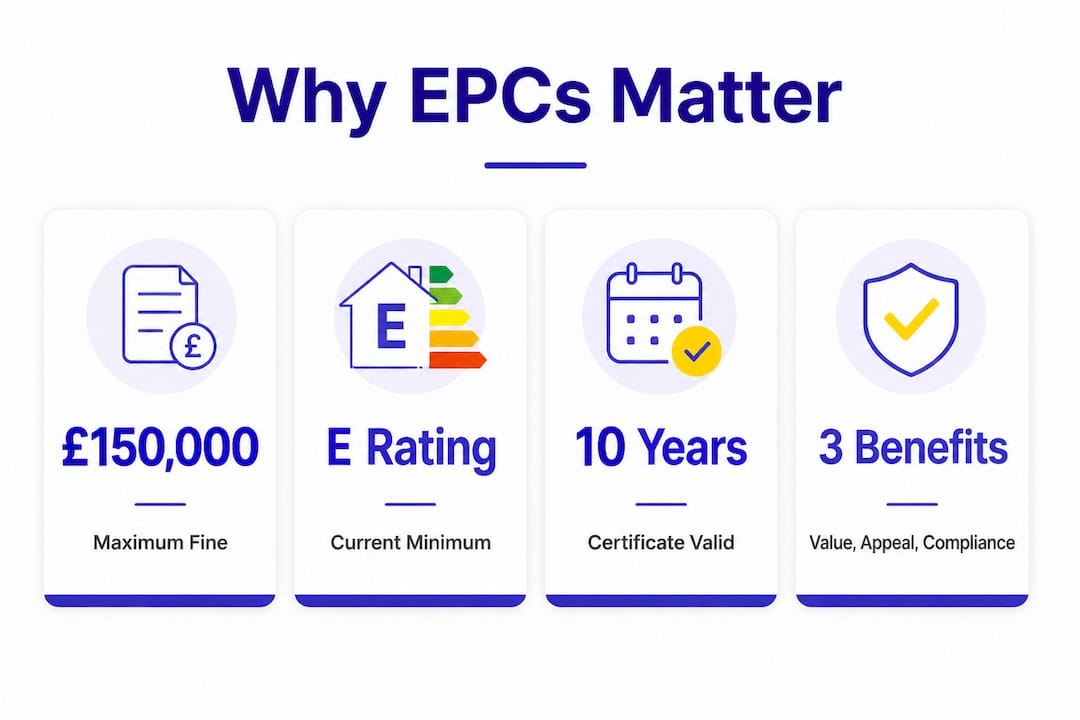
Since April 2023, MEES set EPC E as the minimum standard for privately rented commercial buildings, unless a valid exemption applies. This means you cannot lawfully grant or continue a lease on a commercial property that holds an F or G rating without registering an exemption on the official PRS (Private Rented Sector) Exemptions Register.
Main circumstances that trigger an EPC requirement for commercial property:
- Selling a commercial building or part of a building
- Letting or re-letting a commercial unit to a new tenant
- Constructing a new commercial building
- Modifying a building in a way that affects its energy performance
- Renewing or extending an existing commercial lease after April 2023
- Seeking certain types of commercial finance where lenders request an EPC
Failing to meet these obligations is not a theoretical risk. Local authorities have enforcement powers, and fines for non-compliance with MEES can reach up to £150,000 for larger commercial properties. Beyond fines, an unlawful letting could be challenged, potentially disrupting your rental income entirely.
Statutory minimum EPC rating: From 1 April 2023, the minimum EPC rating for a privately rented commercial property in England and Wales is E. Any landlord continuing to let premises rated F or G without a registered exemption is in breach of MEES regulations.
Understanding MEES: The legal standards and upcoming changes
MEES stands for Minimum Energy Efficiency Standards, and they represent the UK government’s primary mechanism for raising the energy performance of rented buildings. For commercial landlords, the standards are set out in the Energy Efficiency (Private Rented Property) (England and Wales) Regulations 2015, which have been progressively tightened over time.
The current threshold, confirmed from April 2023, requires all privately rented non-domestic (commercial) properties to achieve at least EPC E before letting. This applies to existing leases as well as new ones, meaning you cannot sit on a legacy tenancy and assume you are shielded from compliance obligations.
Looking ahead, the regulatory landscape is likely to become more demanding. Discussions within government have raised the prospect of requiring EPC C by 2027 and EPC B by 2030 for commercial properties. However, as legal commentary notes, there remains genuine uncertainty around whether these exact timelines will be confirmed, especially following various consultation rounds. The direction of travel is clear even if the precise dates are not yet locked in.
The practical implication for you as a landlord is significant. A building that comfortably meets EPC E today may fall below a future minimum threshold without any physical deterioration. The rating you hold now could become non-compliant simply because the bar has been raised.
Comparison of past, current, and proposed future minimum EPC ratings for commercial lets:
| Period | Minimum EPC rating | Key change |
|---|---|---|
| Pre-April 2018 | No minimum (new lets) | MEES introduced for new leases |
| April 2018 to March 2023 | E (new leases only) | Existing leases excluded |
| From April 2023 | E (all leases) | Existing leases brought into scope |
| Proposed 2027 (unconfirmed) | C | Significant uplift required |
| Proposed 2030 (unconfirmed) | B | Near top-tier performance expected |
Industry estimates suggest that a substantial proportion of existing commercial stock in England and Wales currently falls below an EPC C rating. This means a large number of landlords will face mandatory improvement works if and when the proposed 2027 threshold is introduced. Starting the planning process now, rather than scrambling in response to a confirmed deadline, puts you in a far stronger position.
Pro Tip: Commission an EPC assessment now if your current certificate is more than three years old. Understanding your building’s current position gives you time to budget for upgrades and avoid reactive, rushed spending when regulation tightens.
EPC exemptions: Who is affected and when do they apply?
Not every commercial property falls neatly within MEES requirements. Understanding the exemption framework is just as important as knowing the rules themselves, because a valid exemption can protect you from enforcement action even where your property cannot realistically achieve the minimum standard.
Exemptions under MEES broadly cover situations where improvement works are impractical, legally obstructed, or economically unjustifiable. There are three primary categories:
Main exemption categories:
| Exemption type | Criteria | Registration process |
|---|---|---|
| Golden Rule exemption | All relevant improvements would cost more than they save within a 7-year payback period | Register on PRS Exemptions Register with supporting evidence |
| Third Party Consent exemption | Landlord cannot obtain required consent from tenant, superior landlord, or planning authority | Register with written evidence of refusal |
| Devaluation exemption | A surveyor confirms that making improvements would reduce the property’s market value by more than 5% | Register with a report from an independent RICS-qualified surveyor |
Beyond these three categories, certain building types and tenancy arrangements fall entirely outside the scope of MEES. In these cases, no EPC is required, and MEES regulations simply do not apply.
Buildings and tenancies commonly outside the scope of MEES:
- Places of worship and buildings used for religious activities
- Temporary structures planned for use of two years or less
- Standalone buildings with a total useful floor area of less than 50 square metres
- Buildings that are due to be demolished, with planning permission confirmed
- Leases of six months or less, or leases of 99 years or more
- Holiday accommodation let for fewer than four months a year
Pro Tip: Exemptions are not automatic. You must actively register them on the PRS Exemptions Register, keep supporting documentation, and be aware that most exemptions last for five years before requiring review. An unregistered exemption offers no legal protection.
If you believe your property or lease structure may qualify for an exemption, it is worth obtaining professional advice before assuming you are outside MEES scope. Incorrectly claiming an exemption leaves you exposed to enforcement action just as much as ignoring the rules entirely.
How EPCs enhance commercial property value and tenant appeal
Compliance is the baseline. But a strong EPC rating delivers benefits that go well beyond avoiding enforcement action. In London’s competitive commercial property market, energy efficiency has moved from a nice-to-have feature to a genuine factor in occupier decisions and investment appraisals.

Tenants, particularly larger corporates and public sector bodies, are increasingly bound by their own sustainability commitments. They actively seek premises with strong EPC ratings because the building’s performance directly affects their reported carbon footprint and operational costs. A well-rated commercial property is, quite simply, easier to let and commands stronger rents.
From a finance and insurance perspective, lenders are beginning to factor EPC ratings into lending decisions. Some major banks now offer preferential rates for energy-efficient commercial stock, while insurers may price risk differently for properties with poor energy credentials. A higher EPC rating broadens your refinancing options and reduces your exposure to stranded asset risk, which is the risk that your property becomes difficult to finance or sell as regulations tighten.
The ‘Golden Rule’ under MEES states that landlords are only required to install improvements that can be funded within a seven-year payback period based on projected energy savings. Any improvement that fails this test may qualify for an exemption, but improvements that pass it represent genuine long-term financial value to the building.
Understanding which upgrades offer the best return is essential. Informed renovations for boosting renter interest go beyond decoration or fixtures and focus on the fabric and systems that assessors measure directly.
Practical ways to improve your commercial building’s EPC rating:
- Upgrade lighting to LED throughout, including emergency and external lighting
- Install or improve insulation in walls, roofs, and around pipework
- Replace or upgrade heating and cooling systems with higher-efficiency models
- Add controls such as occupancy sensors, thermostats, and building management systems (BMS)
- Install double or triple-glazed windows where building fabric allows
- Consider on-site renewable energy such as solar photovoltaic (PV) panels
- Improve air tightness through draught-proofing and better sealing of service penetrations
Each of these measures is evaluated during the EPC assessment, and the recommendations section of your existing EPC report is a practical starting point for identifying where investment will have the greatest impact on your rating.
What most guides miss about EPC strategy for landlords
Most guidance on EPCs focuses on meeting the current minimum. That is understandable, but it is also short-sighted. Here is the view we hold having worked with commercial landlords across London: the landlords who will thrive over the next decade are those who treat EPC ratings as a strategic asset, not a compliance hurdle.
Consider the uncertainty around future MEES thresholds. As legal commentary confirms, whilst ratings of C by 2027 and B by 2030 have been discussed, the government has not definitively confirmed these timelines. Some landlords read that uncertainty as a reason to wait. We would argue the opposite. Uncertainty about when the change arrives is not uncertainty about whether it arrives. The trend is unmistakable.
A landlord who upgrades to EPC C today, even though the current minimum is E, does several things simultaneously. They future-proof their asset against at least one anticipated regulatory step. They improve their lettability and rental income now. They spread the cost of compliance over time rather than facing a large capital outlay against a hard deadline. And they reduce the risk of a void period caused by an inability to let while works are carried out under time pressure.
The strategic mistake we see most often is landlords treating exemptions as a long-term solution rather than a temporary measure. An exemption may protect you for five years, but it does not improve your building, attract quality tenants, or add to your asset’s value. It simply delays the decision. Using that five-year window productively, by planning and phasing improvement works, is a far more effective use of the time.
Pro Tip: Build a simple scenario plan for your portfolio. Map each property’s current EPC rating against the proposed future thresholds. Identify which properties require the most work, estimate costs against the Golden Rule, and sequence upgrades to manage cash flow. Doing this now, with a trusted assessor, costs very little and can save a great deal.
The landlords who treat EPC assessments as routine check-ins rather than annual strategic reviews are the ones most likely to be caught off-guard. We recommend booking a reassessment any time you make improvements, change tenants, or when your certificate nears its 10-year expiry.
Take the next step: Seamless EPC compliance and value upgrades
If you want to stay ahead of MEES obligations and turn your building’s energy performance into a genuine commercial advantage, expert support makes the process straightforward. At Complete EPC, our qualified assessors work with commercial landlords across London to deliver accurate, competitively priced EPC assessments with detailed improvement recommendations.
Whether you need to obtain a fresh EPC, understand whether registering EPC exemptions is the right step for your property, or want a clear picture of how enhancing property value with EPCs can strengthen your portfolio, we are here to help. Our assessors have deep knowledge of the London commercial market and can advise on the most cost-effective route to compliance and beyond. Book an assessment today and take control of your energy performance obligations with confidence.
Frequently asked questions
When do I legally need an EPC for a commercial property in London?
You need an EPC before letting, selling, or constructing most commercial buildings in London, and since April 2023 the minimum EPC standard for all privately rented commercial properties is EPC E unless a valid exemption applies.
What are the penalties for not having a valid EPC?
Failing to comply with MEES regulations can result in financial penalties reaching up to £150,000 for larger commercial properties, and may prevent you from lawfully continuing or granting a lease.
How do I know if my property qualifies for an exemption?
Exemptions apply if improvement costs fail the Golden Rule seven-year payback test, if third-party consent for works is refused, or if a surveyor confirms that improvements would reduce the property’s market value by more than 5%.
Can future MEES regulations change the minimum EPC requirement?
Yes, future government proposals have discussed raising the minimum to C by 2027 and B by 2030, though these exact timelines have not yet been officially confirmed and landlords should plan accordingly rather than wait.