

TL;DR:
- An energy performance certificate is a legal document rating a property’s energy efficiency from A to G in England. Only accredited Domestic Energy Assessors can produce a valid EPC, which must be obtained before marketing a property for sale or rent. Maintaining a current EPC, meeting minimum ratings, and registering exemptions when necessary are essential for compliance and can enhance property value and marketability.
An energy efficiency certificate, formally known as an Energy Performance Certificate (EPC), is an official document rating your property’s energy performance on a scale from A to G. It is a legal requirement before you sell or rent any property in England, including London. Only a qualified, accredited Domestic Energy Assessor (DEA) can produce a valid EPC. This guide covers who can issue one, what the law requires, and how to get yours without delays or compliance problems.
How do I get an energy efficiency certificate: who can issue one?
Only accredited Domestic Energy Assessors can produce a legally valid EPC in England. This means the person assessing your property must hold current membership with an approved accreditation scheme recognised by the government. An unaccredited assessor, or any online self-assessment tool, produces a certificate that carries no legal weight.

Finding a legitimate assessor is straightforward. GOV.UK maintains a searchable register of accredited DEAs, which you can filter by postcode. This is the most reliable way to confirm an assessor’s credentials before you book. Always check the register rather than relying solely on a business’s own claims.
Estate agents often arrange EPC bookings on behalf of sellers and landlords as part of the property marketing process. This is convenient, but you should still verify the assessor’s accreditation yourself. The responsibility for holding a valid EPC sits with you as the property owner or landlord, not with your agent.
Key accreditation points to check:
- The assessor holds current membership with a government-approved scheme
- Their registration is active and not lapsed
- They cover your area of London
- They can provide their membership number for you to verify on GOV.UK
Pro Tip: Always ask for the assessor’s membership number before booking and cross-check it on the GOV.UK register. A legitimate assessor will share this without hesitation.
What are the legal requirements for an EPC in London?
The law is clear. An EPC must be commissioned before you market a property for sale or rent. You cannot wait until a buyer or tenant is found. The certificate must be available to prospective buyers or tenants at the point of marketing.
For landlords, the rules go further. Rented properties must achieve an EPC rating of E or above to comply with the Minimum Energy Efficiency Standards (MEES) in England and Wales. MEES applies to new tenancies and renewals. A property rated F or G cannot legally be let without a registered exemption.
Exemptions do exist, but they require formal registration. MEES exemptions must be registered in advance on the government’s official register. Intending to apply for one is not enough. Landlords who let a property without a valid EPC or a registered exemption face financial penalties.
The steps for legal compliance are:
- Commission an EPC from an accredited DEA before marketing the property
- Confirm the rating meets the E or above threshold for rental properties
- If the rating is F or G, carry out improvements or register a valid exemption
- Keep the EPC available for prospective tenants or buyers throughout marketing
- Renew the EPC when it expires or after significant energy improvements
An EPC remains valid for 10 years from the date of issue. That means a certificate issued in 2016 expired in 2026. Check the issue date on any existing EPC before assuming it is still current.
MEES compliance note: The GOV.UK exemption register is searchable by postcode and landlord name. Prospective tenants and local authorities can check it. Registering an exemption is not a loophole. It is a formal process with specific qualifying criteria.
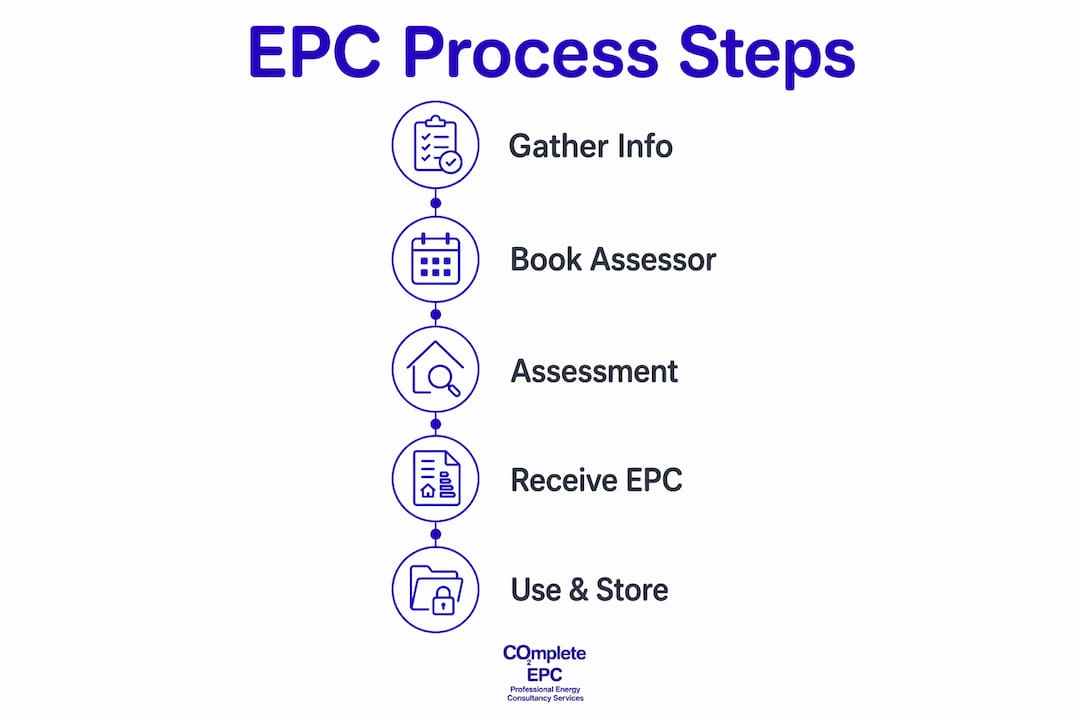
Step-by-step guide to getting an EPC for your London property
Getting an EPC follows a clear sequence. Knowing each stage in advance prevents delays and avoids the cost of repeat visits.
Step 1: Gather property information
Before the assessor arrives, locate documents that describe your property’s construction, insulation, and heating systems. Boiler installation certificates, window guarantees, and loft insulation records all support a more accurate assessment. Missing documents can result in a lower rating because the assessor must make conservative assumptions.
Step 2: Book an accredited assessor
Use the GOV.UK register to find a DEA in your London borough. Compare availability and pricing. Completeepc employs accredited assessors across London and offers competitive rates for both domestic and commercial properties.
Step 3: The assessment visit
The assessor visits your property and collects data on its construction, heating, hot water systems, lighting, and insulation. Assessors calculate SAP or rdSAP scores on a scale from 1 to 100, which then converts into the familiar A to G energy efficiency band. The visit typically takes between 45 minutes and 2 hours depending on property size and complexity.
Step 4: Receive and review the certificate
The EPC is issued digitally and lodged on the national EPC register. You receive a copy, usually within 24–48 hours of the visit. The certificate includes your rating, an estimated energy cost, and a list of recommended improvements with potential rating gains.
Step 5: Use and store the EPC correctly
Provide a copy to prospective buyers or tenants. Keep a copy for your own records. If you carry out energy improvements, commission a new EPC to reflect the updated performance. For more detail on the full EPC assessment process, Completeepc provides a dedicated guide for London properties.
| Stage | What happens | Typical timeframe |
|---|---|---|
| Preparation | Gather property documents | Before booking |
| Booking | Find and confirm accredited DEA | 1–3 days |
| Assessment visit | On-site data collection | 45 mins–2 hours |
| Certificate issued | EPC lodged on national register | 24–48 hours |
| Compliance check | Confirm rating meets MEES threshold | Same day as receipt |
Pro Tip: If you have recently installed insulation, a new boiler, or double glazing, book the EPC after the work is complete. The certificate will reflect the improvements and may achieve a higher band.
Common pitfalls that cause delays or invalid EPCs
The most expensive mistake a landlord can make is using an unaccredited assessor. Certificates from unaccredited sources are not legally valid and must be replaced at full cost. This also delays your marketing timeline and can put you in breach of legal requirements.
Other pitfalls to avoid:
- Providing inaccurate property information. If you tell the assessor your loft has 270mm of insulation but cannot evidence it, the assessor must record a lower figure. Gather certificates and receipts before the visit.
- Leaving EPC commissioning too late. An EPC must exist before you list the property. Booking an assessor the day you instruct an estate agent is too late if the assessor cannot attend for a week.
- Assuming an old EPC is still valid. Check the issue date. A certificate more than 10 years old is expired and cannot be used for compliance.
- Failing to register exemptions before letting. If your property genuinely cannot reach an E rating, register the exemption on the PRS exemption register before the tenancy begins.
- Commissioning an EPC before planned energy upgrades. If you intend to install insulation or a new heating system, wait until the work is finished. Timing EPC commissioning after improvements ensures the certificate reflects the property’s actual current performance.
“The EPC register is public. Tenants, buyers, and local authorities can all check whether your property has a valid certificate. There is no benefit to cutting corners.”
How does an EPC benefit landlords beyond legal compliance?
An EPC is more than a compliance document. The recommendations section lists specific improvements, such as cavity wall insulation, solar panels, or heat pump installation, with estimated costs and projected rating gains. Acting on these recommendations reduces energy bills for tenants and lowers the property’s carbon footprint.
A higher EPC rating makes a property more attractive to prospective tenants. Energy costs are a significant factor in rental decisions, particularly in London where bills are high. A property rated B or C commands attention in a competitive market. The benefits of an EPC for London properties extend well beyond satisfying a legal checkbox.
Higher-rated properties may also qualify for government grants or green finance products aimed at supporting energy upgrades. Schemes such as the Great British Insulation Scheme and ECO4 use EPC ratings as eligibility criteria. Landlords who invest in improvements can access funding that reduces the upfront cost significantly.
Additional benefits include:
- Reduced void periods, as energy-efficient properties let faster
- Lower maintenance costs from modern, efficient heating systems
- Stronger position when refinancing, as lenders increasingly consider EPC ratings
- Demonstrated commitment to environmental responsibility, which matters to an increasing number of tenants
Key takeaways
Obtaining a valid EPC requires an accredited Domestic Energy Assessor, must happen before marketing, and must meet the MEES E-rating threshold for rented properties in London.
| Point | Details |
|---|---|
| Use an accredited DEA | Only government-accredited assessors produce legally valid EPCs in England. |
| Commission before marketing | The EPC must exist before you list a property for sale or rent. |
| Meet the MEES E threshold | Rented properties rated F or G cannot be let without a registered exemption. |
| Check the 10-year validity | EPCs expire after 10 years; always verify the issue date on any existing certificate. |
| Time commissioning wisely | Book the EPC after energy improvements to capture the best possible rating. |
What I have learned from working with London landlords on EPCs
The most common misconception I encounter is that an EPC is a one-off administrative task. Landlords often treat it as a box to tick and then forget about it. The reality is that an EPC is a live document that should inform your property management decisions.
I have seen landlords lose weeks of rental income because they booked an assessor the same day they instructed an agent, only to find the assessor could not attend for ten days. Planning the EPC at least two weeks before your intended marketing date removes that risk entirely.
Choosing an accredited assessor is not just about legal validity. A good assessor explains the recommendations clearly and helps you understand which improvements offer the best return. That conversation can save you thousands of pounds over a tenancy. For HMO landlords in particular, the EPC compliance requirements carry additional complexity that a qualified assessor can help you manage.
My honest view is that landlords who treat the EPC as an investment tool rather than a legal burden get far more value from the process. The certificate tells you exactly where your property loses energy and what it would cost to fix it. That is genuinely useful information.
— Danny
How Completeepc helps London landlords get valid EPCs
Completeepc provides accredited Domestic Energy Assessors for properties across London, covering both residential and commercial buildings. The booking process is straightforward, with assessors available at competitive rates and flexible scheduling to fit around tenancy timelines.
Every assessment is carried out by a qualified DEA registered with an approved accreditation scheme, so the certificate you receive is legally valid and lodged on the national register. Completeepc also supports landlords navigating MEES compliance, including guidance on improvement recommendations and exemption eligibility.
For landlords managing residential properties, the domestic EPC service covers the full process from booking through to certificate delivery. For those with commercial premises, Completeepc’s commercial EPC service provides the same accredited, compliant assessment.
FAQ
Who can legally issue an EPC in England?
Only accredited Domestic Energy Assessors registered with a government-approved scheme can issue a legally valid EPC in England. Certificates from unaccredited sources or online self-assessments do not satisfy legal requirements.
How long does an EPC last?
An EPC is valid for 10 years from the date of issue. If you carry out significant energy improvements before the 10 years are up, commissioning a new EPC will reflect the updated rating.
What EPC rating do I need to rent my property in London?
Rented properties in England must achieve an EPC rating of E or above to comply with MEES regulations. Properties rated F or G require a registered exemption on the government’s PRS exemption register before they can be legally let.
How long does an EPC assessment take?
A typical domestic EPC assessment takes between 45 minutes and 2 hours, depending on the size and complexity of the property. The certificate is usually issued within 24–48 hours of the visit.
Can I use an existing EPC when selling or renting my property?
You can use an existing EPC if it was issued within the last 10 years and remains valid. Check the issue date on the certificate before marketing your property to confirm it has not expired.