

Energy compliance means holding the right certificates and calculations for what you are doing with a building, and meeting the minimum standard that applies to it. For a landlord in England, that starts with a valid EPC rated at least E. For a developer in London, it goes further: a SAP or SBEM calculation and a planning energy assessment. This guide sets out which rules apply to you, in what order to act, and where people most often get caught out.
TL;DR
- Work out which rule applies: a rented home (MEES), a sale or new let (EPC), a new build or extension (SAP or SBEM), or a major London development (energy assessment).
- Privately rented homes in England need an EPC of at least E unless a valid exemption is registered.
- The government has confirmed a standard equivalent to EPC C for all private tenancies by 1 October 2030, so plan upgrades now.
- Start with the recommendations on your current EPC and fix the building fabric before buying new heating technology.
- Treat compliance as an ongoing routine with renewal dates, not a one-off certificate.
Table of Contents
- Start by identifying which rules apply to you
- Step 1: Check your EPC and its recommendations
- Step 2: Meet the minimum standard if you let property
- Step 3: Plan for EPC C by 2030
- Step 4: Get the calculations right for new builds and extensions
- Step 5: Planning and London energy assessments
- Step 6: Use local support and keep compliance going
- Our view: compliance is cheaper when it is planned
- How Complete EPC can help
- FAQ
- Sources
Start by identifying which rules apply to you
“Energy compliance” covers several separate obligations. Mixing them up is the commonest reason people pay for the wrong report or miss a deadline.
| Your situation | What you need | Why |
|---|---|---|
| Renting out a home in England | A valid EPC, rated E or above (or a registered exemption) | Minimum energy efficiency standard (MEES) |
| Selling or letting a home | A domestic EPC | Legal requirement at marketing |
| Selling or letting commercial space | A commercial EPC | Legal requirement at marketing |
| Building a new home, conversion or extension | A SAP calculation | Building regulations, Part L |
| Building new commercial space | An SBEM calculation | Building regulations, Part L |
| Operating air conditioning above the size threshold | A TM44 inspection | Air conditioning inspection requirements |
| Major development in London | A detailed energy assessment at planning stage | London Plan policy |
The rest of this guide follows that order: existing rented property first, then new building work and planning.
Step 1: Check your EPC and its recommendations
Find your current certificate, check the rating and the expiry date, and read the recommended measures page. Energy Saving Trust advice is to look past the letter grade at the specific recommended measures, because they work as a low-cost roadmap for staged improvements rather than a reaction to a deadline.
A useful way to read the report:
- Note the current rating and the potential rating.
- List every recommended measure with its estimated cost and saving.
- Sort them into cheap and quick (draught-proofing, loft insulation, heating controls, lighting) and larger projects (wall insulation, new heating).
- Check whether the cheap group alone moves you over the line you need.
If the certificate is out of date, or the property has changed since it was produced (a new boiler, insulation, an extension), a fresh assessment can show a better rating than the old one. Our qualified assessors produce domestic EPCs and commercial EPCs across London, with a full report on the improvements available.
Step 2: Meet the minimum standard if you let property
Under the MEES regulations, a privately rented home in England needs an EPC rating of E or better. The GOV.UK landlord guidance is the authoritative reference. A landlord who cannot show a valid rating, or a valid registered exemption, risks being unable to let or keep letting the property legally.
How the cost cap works
The guidance says you are not currently required to spend more than £3,500 including VAT on improvements. In practice:
- If the property can reach E for less than the cap, that is all you need to spend.
- If it would cost more, install all the recommended measures that fit within the cap, then register an exemption.
- Improvements made since 1 October 2017 count towards the cap.
Exemptions are narrower than many landlords expect
A high-cost exemption needs evidence, including three independent quotes. The exemptions guidance is specific about what must be shown, and a high total bill alone is not enough: the paperwork has to show that even the cheapest recommended measure exceeds the cap. Exemptions also run out, typically after five years, and you then have to try again.
If you are unsure whether your tenancy type or property falls under the regulations, check the guidance above or ask your local authority, which enforces them.
Step 3: Plan for EPC C by 2030
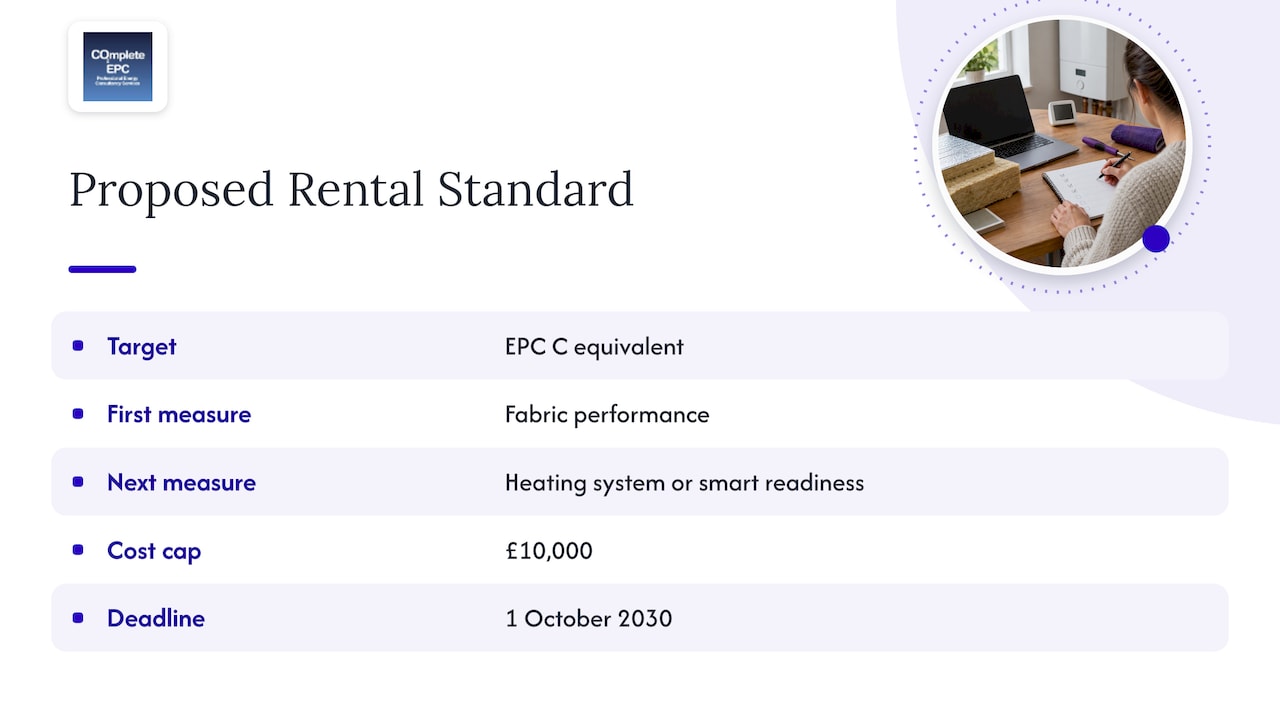
The government’s response to its 2025 consultation confirms that privately rented homes in England and Wales will have to meet a standard equivalent to EPC C by 1 October 2030. The response describes a standard that looks first at fabric performance, then at either a heating system or smart readiness measure, supported by a higher cost cap of £10,000.
There is also a transitional point worth knowing. Homes that reach C on the existing Energy Efficiency Rating before 1 October 2029 will be treated as compliant until that EPC expires. For a landlord with several properties, that argues for acting on the cheapest-to-improve homes first and getting fresh certificates on file. Check the response itself for the full detail, as the policy is still moving into regulation.
Work in stages, fabric first
A common mistake is to start with solar panels or a heat pump. Energy advisers favour a fabric-first approach: insulation and draught-proofing reduce the demand that any heating system has to meet. Energy Saving Trust notes that in an uninsulated home, around a third of heat loss is through the walls. That is why wall, loft and floor measures usually come before new heating.
A sensible sequence for a typical rented home:
- Draught-proofing and loft insulation.
- Heating controls, thermostatic valves and efficient lighting.
- Wall insulation where the construction allows it.
- Heating system upgrades once demand has fallen.
For wider ideas on keeping the process organised, a practical guide to eco-friendly construction shows how a compliance roadmap can be tracked as part of a wider project. The principle carries over to property management: record each measure, keep the evidence, and review the plan every time a certificate is renewed.
Step 4: Get the calculations right for new builds and extensions
An EPC describes an existing building. New dwellings, conversions and extensions need a design-stage calculation to show they meet Part L. That calculation uses the Standard Assessment Procedure, and GOV.UK explains the current status of SAP and the Home Energy Model, which is intended to replace it in future. Until a change takes effect, the method named in your building control or planning conditions is the one to use.
The usual route:
- Commission a SAP calculation from the drawings and specification, before construction details are fixed.
- Adjust insulation, glazing, ventilation or heating if the design fails.
- Submit the design-stage result to building control.
- After completion, provide as-built information so the final result and the EPC reflect what was actually built.
For new commercial space the equivalent is an SBEM calculation. Large or glazed buildings may also need dynamic simulation modelling, and residential schemes with overheating risk may need a TM59 and TM52 assessment.
The cheapest time to find a problem is before the drawings are final. Changing a specification on paper costs far less than changing it on site.
Step 5: Planning and London energy assessments
In London, building regulations are only part of the picture. The London Plan requires each major development to submit a detailed energy assessment showing how it meets the net zero-carbon target. Where the on-site reduction falls short, the shortfall can be paid as a cash-in-lieu contribution to the local authority’s carbon offset fund.
The Mayor’s Energy Assessment Guidance explains that the assessment must show the proposal complies with London Plan energy policies, including the energy hierarchy. In short, you reduce demand first, then supply energy efficiently, then use renewables.
To avoid delay:
- Appoint your energy consultant before the planning application is prepared, not after.
- Make sure the modelling method matches the current guidance.
- Keep the design intent and the as-built performance aligned, since the guidance expects follow-up reporting after construction.
- Treat the assessment as part of the application, not a separate task.
Our energy statements for planning service covers this stage for London schemes.
Step 6: Use local support and keep compliance going
Compliance is a continuing job. EPCs expire, standards tighten, and tenancies change. Energy Saving Trust points owners and businesses to local authorities and regional bodies as sources of guidance, and sometimes funding, so contact your borough early and ask what is available before you commit to a big spend.
A simple routine for a landlord or small property business:
- Keep a register of every property, its EPC rating, expiry date and recommended measures.
- Diarise renewals at least three months ahead.
- Keep invoices and photographs for every improvement, as evidence for the cost cap or an exemption.
- Review the register each autumn against the latest government position.
- Remember the other certificates that sit alongside EPCs: electrical safety (EICR) and portable appliance testing (PAT) are available through us as well.
Our view: compliance is cheaper when it is planned
We see the same pattern again and again across London. A landlord gets a certificate only when a tenant moves out, finds a D or an F, and then has days to fix it. A developer commissions a calculation after the specification has been ordered. Both pay more than they needed to.
Our advice is plain. Treat the EPC as a survey, not a bill. Read the recommendations, rank them by cost and effect, and spread the work over the years you have. For new builds, bring the assessor in while the design can still change. A good assessor does not just produce a number: they tell you which change moves the number furthest for the least money.
We would also say this about the 2030 C standard: do not wait for the final regulations to start. Fabric measures help whatever metric is finally used, and they cut your tenants’ bills in the meantime.
— Danny
How Complete EPC can help
We provide energy performance certificates for homes and commercial buildings across London, along with SAP and SBEM calculations, TM44 inspections, overheating assessments, energy statements for planning, and EICR and PAT testing. Landlords, owners, agents and solicitors can book through the Complete EPC website, or go straight to the domestic EPC page to arrange an assessment. Every report includes recommendations you can act on.
FAQ
What is the minimum EPC rating to rent out a property in England?
The current minimum is E for privately rented homes, unless a valid exemption is registered, as set out in the GOV.UK landlord guidance. The government has confirmed a move to an equivalent of C by 1 October 2030. Check the guidance for how it applies to your tenancy.
How much do I have to spend on improvements?
The current guidance sets a cost cap of £3,500 including VAT. If you can reach E for less, that is all you must spend. If not, you install what fits within the cap and register an exemption. The cap proposed for the 2030 standard is £10,000.
Does a new build need an EPC as well as a SAP calculation?
Yes, they do different jobs. The SAP calculation demonstrates compliance at design stage and again as built, while the EPC is the certificate issued for the finished dwelling. Both rely on accurate specification details, so keep your product data and site records.
Do I need a planning energy assessment in London?
The London Plan requires one for every major development proposal, according to the Greater London Authority. Smaller schemes may have different requirements, so check with your borough’s planning team early.
Where should I begin if I own several properties?
Build a register of EPC ratings and expiry dates, then rank properties by how far they sit below C. Start with those where the cheap measures can close the gap, and book new assessments once the work is done.
Sources
- Domestic private rented property: minimum energy efficiency standard, landlord guidance (GOV.UK)
- Improving the energy performance of privately rented homes: government response (GOV.UK)
- Guidance on PRS exemptions and Exemptions Register evidence requirements (GOV.UK)
- Standard Assessment Procedure (GOV.UK)
- Energy Planning Guidance (Greater London Authority)
- Energy Assessment Guidance (Greater London Authority)
- Energy saving house viewing tips (Energy Saving Trust)
- Solid wall insulation (Energy Saving Trust)
- Energy Saving Trust