
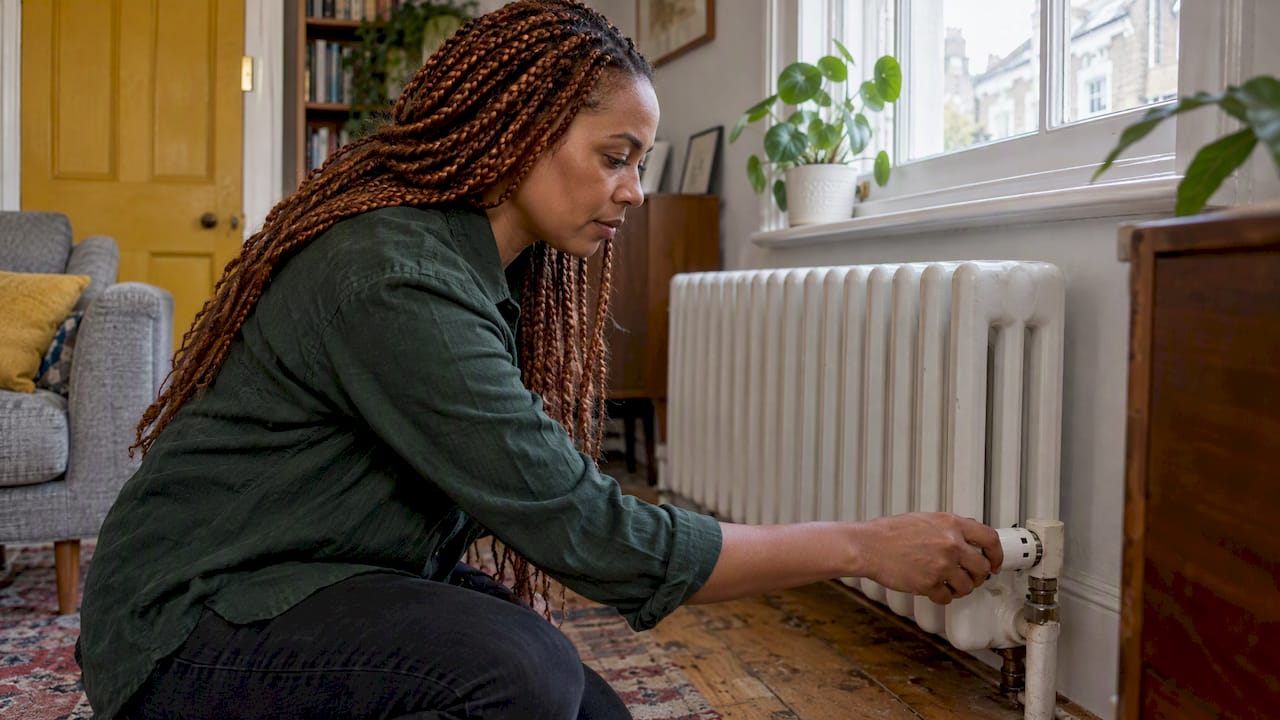
The quickest way to cut energy bills is to work in order: stop obvious waste first (heating settings, hot water, standby, lighting), then seal draughts, then look at insulation, heating upgrades and grants. Each step costs more than the last, so start with the free ones and let your energy performance certificate (EPC) tell you which bigger jobs are worth the money. This guide covers what to do in a home, a rented flat and a small business, with the savings figures we can source.
TL;DR
- Start with free changes: lower the thermostat, shorten showers, cut standby use and line-dry washing. Together they add up to real money each year.
- Draught-proofing is one of the cheapest fixes, and a lower thermostat setting then feels comfortable.
- Your EPC lists the improvements that suit your property and the savings they could bring, so use it to rank bigger jobs.
- Landlords and businesses should check minimum efficiency rules and grant eligibility before spending on upgrades.
- Savings vary with the size of your home, your tariff and how you live. Treat every figure here as a guide, not a promise.
Table of Contents
- Where the money actually goes
- Free and low-cost habits that save money straight away
- Draught-proofing: the cheap job that pays back
- Bigger improvements: insulation and heating
- What your EPC can do for you
- Renting? What tenants and landlords can each do
- Cutting energy costs in a business
- New builds, extensions and conversions
- Grants, support and tariffs
- Our perspective
- FAQ
- Sources
Where the money actually goes
Before changing anything, find out what you spend most on. In most UK homes that is heating, followed by hot water, then appliances and lighting. Official US guidance makes the same point: heating can account for almost half of an average family’s winter energy bill, and water heating for 14% to 25% of household energy use. Those are American averages, and British homes differ, but the order of priorities is a useful starting assumption.
A simple way to check your own pattern:
- Gather 12 months of gas and electricity statements, or read your smart meter history.
- Separate electricity from gas (or oil, LPG or other fuel).
- Compare winter and summer months. A big winter jump points to heating and heat loss. A flat, high base load points to appliances, always-on devices or a hot water cylinder.
- Aim your effort at the biggest block first.
The US Department of Energy recommends the same method: an energy audit, collecting your bills and separating electricity from fuel costs to find the largest user.
Free and low-cost habits that save money straight away
These need no tradesperson and no permission from a landlord.
Heating controls
Turning your thermostat down by one degree is the classic quick win. Citing the Energy Saving Trust, one UK home-advice site puts the saving at around £90 a year for a single degree. Your result depends on the size of your home and your fuel prices.
Set heating times to match when you are actually in. A programmable thermostat or smart controls help here. In the US, an ENERGY STAR certified smart thermostat is credited with cutting heating and cooling bills by more than 8%. That is a US figure, so treat it as indicative rather than a UK forecast.
Hot water
Hot water is a steady drain you can shrink without losing comfort. The Energy Saving Trust’s quick tips include spending less time in the shower, swapping baths for showers, fitting a tap aerator, not overfilling the kettle, and topping up your hot water cylinder insulation if you have one. A cylinder jacket is cheap, and an old thin one is worth replacing.
Laundry and drying
The same Energy Saving Trust page says that avoiding the tumble dryer, and drying on a line or an indoor rack instead, can save around £50 a year in Great Britain. Fewer, fuller, colder washes help too. Dry clothes in a room with a window open slightly, or use a dehumidifier sparingly, to avoid damp.
Lighting and standby
LED bulbs are the simplest upgrade you can make. Ofgem reports the Energy Saving Trust’s figure that swapping old bulbs for LEDs can save up to £4 per bulb per year. In a house with 20 bulbs in regular use, that adds up quickly. Start with the lights you use longest: kitchen, living room, hallway.
Turn off lights in empty rooms, and switch appliances off standby at the socket, particularly TVs, consoles and chargers. A power strip with a switch makes this a one-click habit.
Draught-proofing: the cheap job that pays back
Draughts let heated air out and cold air in, so your boiler works harder to hold the same temperature. Draught-proofing is among the most cost-effective jobs a homeowner or tenant can do.
According to the Energy Saving Trust, as quoted by Ideal Home, draught-proofing around doors, windows and floors could save around £85 a year, with another £60 for an open chimney (when it is not in use). Overseas government guidance agrees on the direction: the US Department of Energy says that sealing uncontrolled air leaks can reduce heating and cooling bills by 10% to 20%. Again, those are US homes, so expect your own saving to differ.
Where to look:
- Gaps around window frames and external doors
- Letterboxes and keyholes
- Gaps between skirting boards and floors
- Loft hatches
- Pipework entering walls, for example under sinks
- Unused chimneys (use a removable cap or balloon, never block a flue that serves a working appliance)
Do not seal up the ventilation your home needs. Trickle vents, extractor fans and air bricks supplying fuel-burning appliances must stay clear. Damp and condensation follow if a home cannot breathe, and fuel-burning appliances need air supply to run safely. If you are unsure, ask a Gas Safe registered engineer about gas appliances before you seal anything near them.
Bigger improvements: insulation and heating
Once habits and draughts are dealt with, the larger savings come from the building itself.
Insulation
Loft insulation, cavity wall insulation (where suitable) and floor insulation reduce heat loss at the source. The US Department of Energy advises owners to prioritise sealing and insulation after an energy audit so the money goes where heat loss is greatest. In the UK, the equivalent of that audit is the recommendations list on your EPC.
Not every wall is suited to cavity fill, and older solid-wall homes need a different approach, so get a survey before you commit. Many London homes are Victorian or Edwardian terraces and flats with solid walls, where options and costs differ from 1960s cavity-wall houses.
Heating system
An annual boiler service keeps efficiency up and catches faults early. For older systems, upgrading controls (a room thermostat, thermostatic radiator valves, a smart thermostat) is often the best first step before replacing the boiler itself. Heat pumps can lower running costs in a well-insulated home, and the government has supported them through grants, covered below.
Windows
Double or secondary glazing reduces heat loss and noise, but it is usually among the slowest of all upgrades to repay its cost. If budget is tight, curtains, thick lined blinds and draught strips on existing frames give a partial gain for much less money.
What your EPC can do for you
An EPC is more than a document for selling or renting. Ofgem describes it plainly: it shows how energy efficient your home is, what you can do to improve it, and how much money this could save you. The recommendations section is the practical part: a ranked list of measures with estimated costs and savings, so you do not have to guess whether loft insulation or a new boiler should come first.
If your certificate is old, or you have since added insulation, a new boiler or double glazing, a fresh assessment can show the real rating. That helps when you plan further work, apply for support or market the property.
Promo: get an EPC assessment in London
We carry out domestic EPC assessments across London and commercial EPCs for offices, shops and mixed-use buildings. Our assessors are qualified, and the report sets out improvement measures you can act on. We also state a lowest-rate guarantee on our pricing. For a quote or to book, start from our main site.
Renting? What tenants and landlords can each do
Tenants cannot usually change the structure, but plenty is still in reach. Government guidance for renters in Australia makes a point that applies equally here: renters can lower bills significantly through daily habits and minor low-cost measures such as draught stoppers. In the UK that means:
- Draught excluders, removable seals and thermal curtains (ask first before fixing anything to frames or walls)
- Moving furniture away from radiators
- Using a radiator reflector panel behind radiators on external walls
- Running appliances efficiently and drying laundry on racks
- Reading the EPC for the property before signing a tenancy, to see its likely running costs
Landlords have a stronger incentive than many realise. A better EPC rating makes a property easier to let, and minimum energy efficiency standards (MEES) apply to rented homes and commercial lettings, so low-rated properties may need improvement before they can be let. Rules are changing, so check current government guidance before planning works. Our guide on thermal efficiency and its effect on EPC ratings explains how the main measures feed into a rating.
Cutting energy costs in a business
Offices, shops and workshops waste energy in different places from homes: lighting left on, equipment idling, over-cooled or over-heated spaces and unmonitored use.
The US Department of Energy’s office guidance suggests that a business perform an energy audit, install meters to track energy use, enable power-management features and use occupancy sensors. The ENERGY STAR checklist adds a figure for sensors: occupancy sensors in low-traffic areas such as storage rooms can save 15% to 30% on lighting costs. Both are US sources, so treat the percentages as examples of scale.
A practical checklist for a UK business:
- Check meter readings monthly, not only when the bill arrives.
- Switch to LED lighting with sensors or timers in storerooms, corridors and toilets.
- Set heating and cooling schedules, with a dead band so they do not fight each other.
- Shut down computers and monitors at the end of the day.
- If you have air conditioning, get it inspected. Larger systems must have regular inspections, and our TM44 inspection service covers this.
- Review your commercial EPC recommendations and rank them by payback.
If you are planning a refurbishment or new commercial build, energy modelling at design stage can avoid expensive fixes later. Our SBEM calculations and dynamic simulation modelling support that work.
New builds, extensions and conversions
If you are building, extending or converting, the cheapest time to cut future bills is at design stage. SAP calculations assess a dwelling’s energy performance for building regulations, and the results show whether fabric, heating and ventilation choices meet the standard. In dense urban projects, overheating can matter as much as heat loss, which is why an overheating assessment under TM52 and TM59 is often needed alongside it. Getting these right early avoids retrofit costs and gives the occupants lower bills from day one.
Grants, support and tariffs
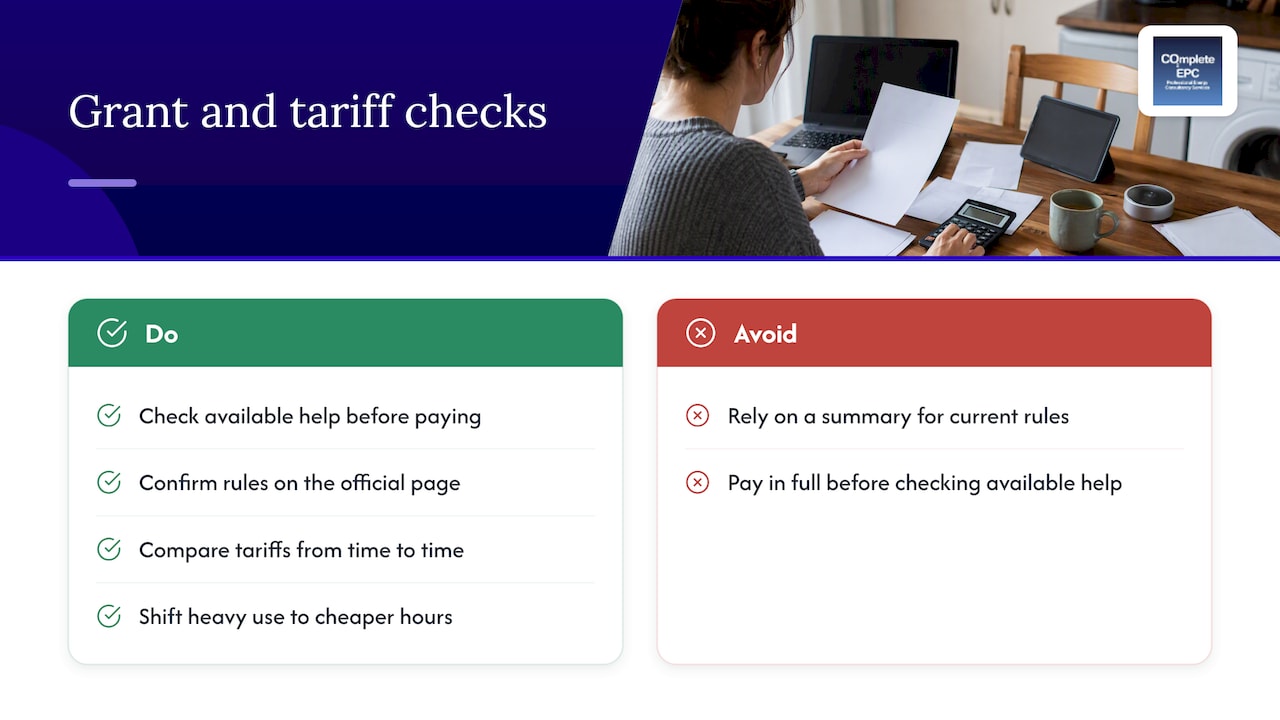
Before paying in full for upgrades, check what help exists. Ofgem lists the main routes: the Boiler Upgrade Scheme, Warm Homes: Local Grant in England, the Warm Homes Discount and the Energy Company Obligation. Suppliers may also offer grants, funding or green tariffs, and eligibility can depend on location, finances, business size or sector.
Schemes open, close and change criteria often, so confirm the current rules on the official page rather than relying on a summary. Also compare tariffs from time to time. The unit price you pay matters as much as how much you use, and the regulator’s price cap is reset on a regular cycle, so your rate can change between quarters. Where you have a smart meter, a time-of-use tariff can reward you for shifting heavy use, such as laundry or electric vehicle charging, to cheaper hours.
Our perspective
Most people who contact us want one thing: lower bills without wasting money on the wrong upgrade. What we see in London homes and commercial buildings is that people often spend on the visible job (new windows, a new boiler) while the loft is thinly insulated and the doors let in a draught. The EPC recommendations are valuable because they put the measures in order, using the actual construction of the property rather than a generic checklist.
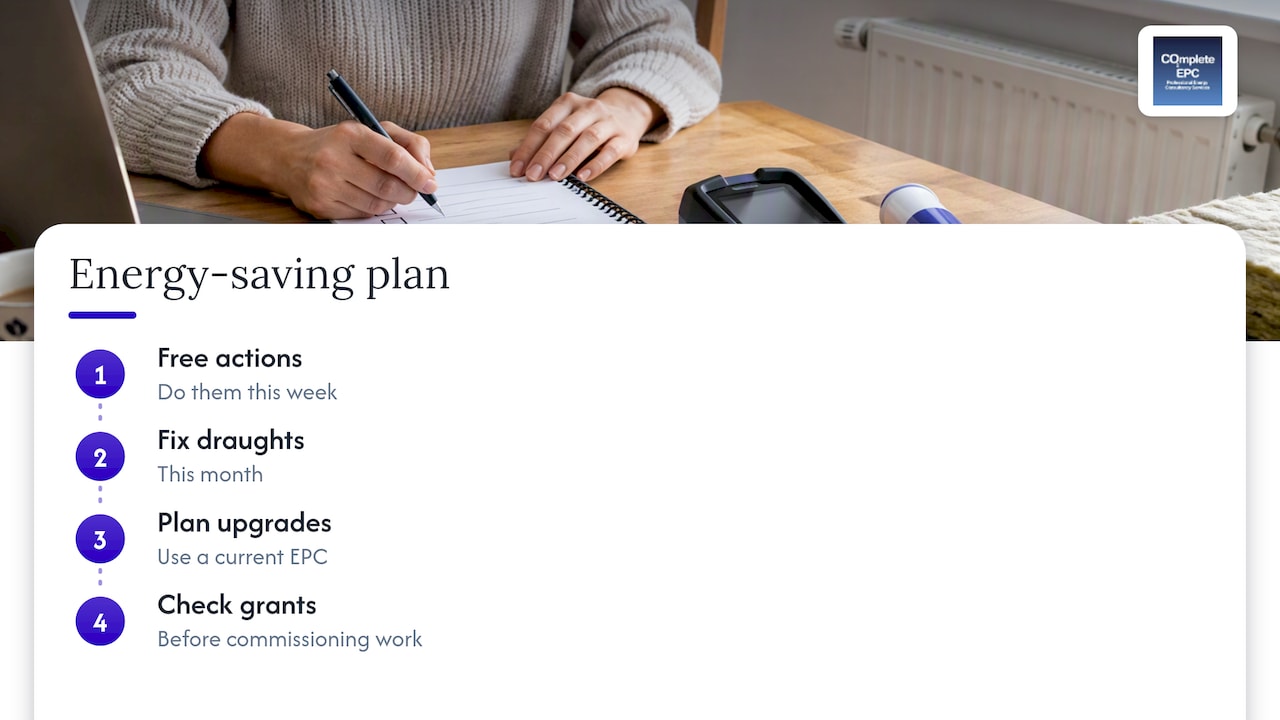
Our advice is simple. Do the free things this week. Fix draughts this month. Use a current EPC to plan insulation and heating work, and check grant eligibility before you commission anything. Landlords and businesses should treat efficiency as part of asset planning, because ratings affect who can let a property and on what terms.
We would rather you book a survey and take the right action than buy a product that does not suit your building.
— Danny
FAQ
What is the fastest way to cut my energy bill?
Lower your thermostat by a degree, shorten showers, line-dry laundry and switch off standby. These cost nothing and the Energy Saving Trust figures quoted above show they can add up to tens of pounds each per year. Draught-proofing is the next cheapest step.
Does an EPC help me reduce bills?
Yes, because it lists the improvements suited to your property, with estimated costs and savings. Ofgem describes the certificate as showing how efficient your home is and what could save you money. Use the recommendations to decide which job comes first.
Are there grants to help pay for energy efficiency work?
Possibly. Schemes include the Boiler Upgrade Scheme, Warm Homes: Local Grant in England, Warm Homes Discount and the Energy Company Obligation, with eligibility based on factors such as location and finances. Check the official Ofgem page for current criteria before you buy anything.
Can tenants cut their energy bills?
Yes. Draught excluders, thermal curtains, efficient appliance use and lower heating settings all work without altering the building. Ask your landlord before fitting seals or film to frames, and ask them about the property’s EPC and any planned improvements.
How can a small business reduce energy costs?
Start by tracking usage monthly, then fit LED lighting with sensors, set heating and cooling schedules and switch off equipment out of hours. A commercial EPC and, where relevant, a TM44 air conditioning inspection will show where the larger savings sit.
Sources
- Quick tips to save energy at home, Energy Saving Trust
- Draught-proofing savings, Ideal Home citing the Energy Saving Trust
- Save money on your energy bill, Ofgem
- Get energy efficiency help for your home or business, Ofgem
- Home Energy Checklist, US Department of Energy
- Energy Saver guide 2022, US Department of Energy
- Office Energy Checklist, US Department of Energy
- Low- to No-Cost Tips for Saving Energy at Home, ENERGY STAR
- Checklist of common energy-saving measures, ENERGY STAR
- Renters, energy.gov.au