

Commission an accredited assessor for an RdSAP or SAP assessment as your first move, then follow their cost-effective recommendations within the investment cap that applies to your property type. Government policy requires private rented domestic homes to reach EPC band C by 1 October 2030, with a cost cap of £10,000 per property. Once works are done, commission a post-works EPC and lodge it as your legal evidence of compliance.
TL;DR:
- Conduct a detailed assessment with an accredited assessor and obtain at least three quotes for major measures before starting work.
- Prioritize fabric insulation and heating upgrades, especially those with short payback periods, to maximize cost-effectiveness within the £10,000 cap.
- Prepare comprehensive documentation, including building plans, warranty certificates, and detailed invoices, to ensure accurate assessments and smooth re-certification.
- Use full SAP or DSM assessments for properties with advanced measures or unusual construction to better reflect genuine improvements.
- Keep thorough records of quotes, invoices, and assessments to support exemption claims and prevent compliance issues before the 2030 deadline.
Table of Contents
- Step-by-step checklist to raise your property’s official energy rating
- How to prepare for the assessor so your rating is accurate
- Which official method applies: RdSAP, SAP, SBEM or DSM?
- MEES and the regulatory checklist landlords need to follow
- Exemptions and evidence: when you can register one
- Post-works actions: re-certification, lodgement and disputes
- What an EPC is and how the A to G bands work
- How to commission an assessor and where accountability sits
- Recommendation reports are advisory, not a works order
- Retrofit measures that most reliably improve an EPC rating
- Grants, incentives and financing options to offset the cost
- How to prioritise retrofit actions by cost and expected gain
- What documentation EPC reassessment after retrofit requires
- Common pitfalls that stall EPC improvement, and how to avoid them
- Assessor tips and common practical pitfalls
- How we help with EPCs, SAP calculations and re-certification
- FAQ
- Sources
Step-by-step checklist to raise your property’s official energy rating
Raising an EPC rating is a sequence, not a single job. Miss a step and you risk paying for works that do not count towards compliance or do not show up in the final certificate.
- Order a pre-works survey with an accredited assessor and confirm whether RdSAP or full SAP applies to your property.
- Request an itemised set of recommendations with indicative paybacks, not just a generic list.
- Get at least three quotes for major measures, particularly where exemption thresholds or cost-effectiveness tests might apply.
- Prioritise fabric and heating measures with the shortest paybacks first, then schedule contractors.
- Keep every invoice, date and lodged certificate reference as evidence of spend against the £10,000 cap.
- Commission a post-works EPC once the works are complete to confirm and lodge the new rating.
Landlords managing several units often underestimate how much paperwork this generates. A simple spreadsheet tracking quotes, invoice dates and certificate numbers against each property saves considerable time when a sale, letting or exemption renewal comes around.
Pro Tip: Book your pre-works and post-works assessments with the same assessor where possible, since they will already understand the property’s construction and won’t need to repeat conservative default assumptions.
How to prepare for the assessor so your rating is accurate
An assessor working from limited information has to fall back on default assumptions, and those defaults are usually conservative. Giving them proper documentation before the visit protects your rating from guesswork.
- Gather building plans, specifications and any manufacturer data sheets for insulation, glazing or renewable installations.
- Pull together boiler and heating plant paperwork, including service records and efficiency ratings.
- Provide clear access to loft spaces, plant rooms and meter cupboards so nothing has to be assumed from the exterior.
- If the property has advanced or unusual measures installed, flag this before the visit so a full SAP or Dynamic Simulation Modelling assessment can be considered instead of standard RdSAP.
- Have warranties and commissioning certificates ready to show installed performance rather than assumed performance.
This preparation matters most for older properties with retrofitted measures, where RdSAP’s standard assumptions can understate what has actually been installed.
Which official method applies: RdSAP, SAP, SBEM or DSM?
The method used to generate your EPC changes what gets measured and how generously it credits your improvements. Getting this wrong before works start can mean paying for upgrades that the standard methodology barely reflects.
- RdSAP is the government-approved methodology for existing dwellings and is used for the vast majority of EPCs issued on marketed homes.
- Full SAP is the methodology for new builds and can also be applied to heavily refurbished dwellings to capture measures more precisely.
- Non-domestic buildings use SBEM, or a Dynamic Simulation Modelling approach for more complex buildings where SBEM’s simplified assumptions fall short.
- Approved calculation methodologies specify SAP and RdSAP for dwellings and SBEM or DSM for non-dwellings, with approved software required for official certificates.
A more detailed assessment can mean a materially better rating. Where detailed refurbishments or advanced measures are present, full SAP or a DSM assessment can capture improvements that RdSAP’s standard assumptions would otherwise miss or under-credit.
Choosing the more rigorous method costs more in assessor time and data gathering, but for a property with unusual construction or advanced retrofit measures, it is often the only way to see those measures reflected properly in the final certificate.
MEES and the regulatory checklist landlords need to follow
The Minimum Energy Efficiency Standard sets the floor for what a rented property’s EPC rating must be, and that floor is rising.
- The current domestic private rented sector minimum is EPC band E.
- Government policy requires private rented homes to reach band C by 1 October 2030, with a maximum investment cost cap of £10,000 per property.
- Non-domestic private rented proposals target higher standards for larger buildings, with payback and cost-effectiveness tests remaining part of the flexibility mechanisms.
- Commission EPCs both before and after works so eligible spend is properly evidenced against the cap.
- Build an internal checklist: pre-works EPC, quotes, invoices, post-works EPC and lodgement reference, stored together for each property.
The reformed EPCs are also set to report on multiple headline metrics, including fabric performance, heating system, smart readiness and energy cost, rather than a single blended score. Targeting fabric performance measures first is likely to be the most direct route to improving that primary metric, since fabric work tends to show up clearly across the newer reporting structure. The government also intends to retain a ten-year validity period for reformed EPCs, recognising the cost and administrative burden that more frequent certification would place on owners.
Exemptions and evidence: when you can register one
Not every property can reach band C by the deadline at a reasonable cost, and the exemptions framework exists for exactly that situation.
- High-cost or cost-cap exemptions require documented quotes from multiple installers and calculations showing the measures exceed the relevant threshold.
- All-improvements-made and negative impact exemptions require a supporting report from an assessor or qualified expert, which should stay on file indefinitely.
- Exemptions are time-limited, so plan a re-assessment well before the exemption expires rather than waiting for a reminder.
- Keep copies of every EPC, assessor report, invoice and lodgement reference in one place, since the PRS exemptions register sets out specific evidence requirements for each exemption type.
A missed renewal date is one of the most common reasons landlords find themselves unexpectedly non-compliant, usually because the exemption had already lapsed before anyone noticed.
Post-works actions: re-certification, lodgement and disputes
Once works are finished, the job is not done until the new rating is lodged.
- Commission an accredited assessor to produce and lodge the post-works EPC. The lodged certificate, not the contractor’s invoice, is the legal record of your new rating.
- Share every invoice and completion date with the assessor so the works are properly linked to spend counted against any cost cap.
- If you dispute a rating, raise it with the assessor first. If that does not resolve matters, escalate to the assessor’s accreditation scheme, which oversees complaints and accountability.
- Set a calendar reminder well ahead of certificate expiry or exemption renewal so the next assessment is never a last-minute scramble.
What an EPC is and how the A to G bands work
An EPC states how energy efficient a building is and gives it a band from A, the most efficient, down to G, the least. The certificate is a legal requirement when a property is built, sold or let, and it carries both a current rating and a potential rating that shows what could be achieved with recommended improvements.
Each band corresponds to a score range generated by the approved calculation methodology, whether that is RdSAP for an existing home or SBEM for a non-domestic building. The rating reflects the building’s fabric, heating system and fixed lighting rather than how the current occupants actually use energy, which is why two identical properties with different glazing or boiler types can land in different bands even with similar running costs.
Buildings account for close to 40% of the UK’s energy consumption and carbon emissions, which is the underlying reason EPCs exist: making building performance visible and giving owners a documented route to improve it. For a landlord or seller, the band is not just a compliance figure. It is one of the first things a prospective tenant or buyer will check, and a low band can affect both marketability and the price a property commands.
How to commission an assessor and where accountability sits
Only a Domestic or Non-Domestic Energy Assessor registered with an accreditation scheme can legally produce an EPC, and the certificate is only valid once lodged on the official register. Booking one is straightforward: provide the property address, confirm whether it is domestic or commercial, and arrange access for the physical inspection the assessment requires.
Our Domestic Energy Performance Certificate service and Commercial EPC service both use accredited assessors who carry professional responsibility for the data they lodge.
Accountability does not disappear once the certificate is issued. Assessors are bound by a duty of care to their accreditation scheme, and the scheme is the formal route for resolving any dispute about a rating. The government’s guidance on getting a new energy certificate sets out that complaints should go to the assessor first, with escalation to the accreditation scheme if the issue is not resolved. This matters practically: if you believe a rating is wrong, you have a documented process to challenge it rather than simply accepting the figure on the certificate.
Recommendation reports are advisory, not a works order
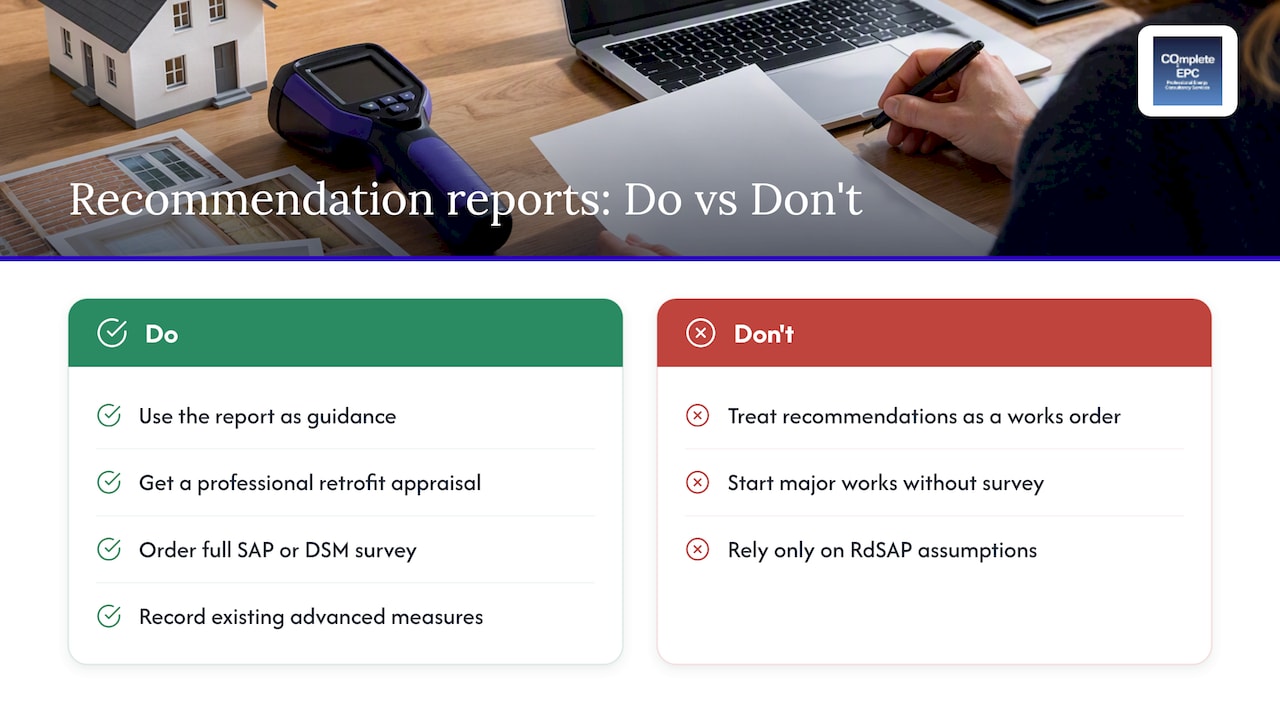
The recommendation report attached to an EPC lists measures that could improve the rating, but nothing in it is mandatory. It is built on standardised RdSAP assumptions designed to apply broadly across housing stock, which means it can miss the nuance of your specific property.
Treating that list as a ready-made works schedule is a common and costly mistake. A measure that looks cost-effective on paper may not be viable for a listed building, a flat with shared systems, or a property with structural constraints the standard assessment did not capture. Before committing to major works, it is worth getting a professional retrofit appraisal that tests the recommendations against the building’s actual condition and your budget.
This is also where the choice of methodology matters again. Gaining an accurate view of a property’s genuine potential rating often requires the more rigorous data capture of full SAP or a DSM assessment, backed by documented proof of any advanced measures already installed. Skipping that step and acting purely on the standard recommendation report risks spending on works that do not move the rating as far as expected, simply because the underlying assessment never captured the full picture in the first place.
Retrofit measures that most reliably improve an EPC rating
Some measures move the needle on an EPC far more reliably than others, and the gap can be substantial.
- Loft and cavity wall insulation typically offer some of the shortest paybacks and the most consistent rating improvements for properties that currently lack them.
- Heating system upgrades, particularly replacing an old, inefficient boiler with a modern condensing model, usually produce a noticeable shift in the heating metric.
- Glazing improvements, such as moving from single to double glazing, help but tend to deliver smaller gains per pound spent than fabric insulation.
- Renewable installations, including solar PV, can lift a rating further still, though they generally represent a larger upfront cost relative to the improvement achieved.
- Heating controls, such as thermostatic radiator valves and programmable room thermostats, are inexpensive and often improve the rating without any structural work at all.
Fabric measures tend to outperform renewables on a cost-per-band basis, which is part of why starting with insulation and heating controls before considering solar or heat pumps is generally the more cost-effective sequence for most properties working towards the C standard.
Grants, incentives and financing options to offset the cost
Several schemes exist across the UK to help property owners fund efficiency works, and checking eligibility before committing your own budget is worth the time. Local authorities often administer grant schemes aimed at specific measures such as insulation or heating upgrades, and eligibility criteria vary by region and household circumstances.
Energy suppliers also run obligation schemes that can fund or subsidise certain measures for eligible households, typically targeted at lower-income or vulnerable occupiers. Separately, some lenders offer green mortgages or further advance products with preferential terms for properties meeting higher EPC bands, which can be relevant for landlords refinancing a portfolio.
Because scheme availability and criteria change, checking current eligibility directly with your local authority or energy supplier before starting works is the safest way to confirm what you can actually claim. Factoring potential grant funding into your sequencing decisions can also shift which measures make sense to do first, particularly where a subsidy covers a measure that would otherwise sit low on a cost-effectiveness ranking.
How to prioritise retrofit actions by cost and expected gain
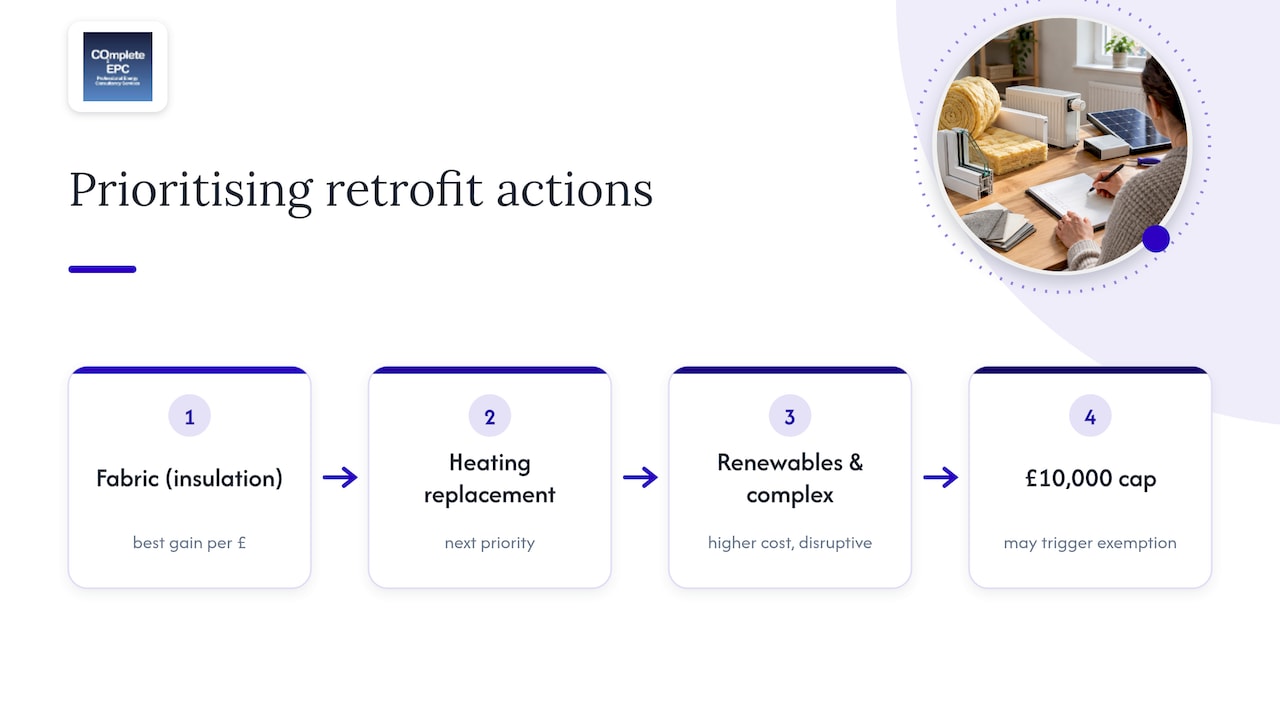
Not every recommended measure deserves equal priority, and treating them as a flat list is where many property owners waste money. The better approach ranks measures by expected rating improvement per pound spent, not simply by what is cheapest or what a contractor suggests first.
Start with measures that affect the fabric metric directly, such as insulation, since these tend to produce the most predictable gains for modest cost. Heating system replacement usually sits next, particularly where an existing boiler is old or oversized for the property. Renewable installations and more complex fabric work, such as solid wall insulation, typically come later in the sequence because the cost per band gained is higher and the installation is more disruptive.
Where the £10,000 cost cap applies, this ordering becomes more than a nice-to-have. If a landlord reaches the cap before hitting band C, the exemptions framework allows registration of a high-cost exemption, but only with documented quotes showing the threshold has genuinely been exceeded. Spending the cap on low-impact measures first, then discovering a high-impact measure was never reached, is an avoidable and expensive sequencing error.
What documentation EPC reassessment after retrofit requires
A post-works EPC is only as strong as the evidence behind it. Assessors need proof that works were actually carried out to specification, not just a verbal confirmation that something was done.
Keep installation invoices showing dates, the measure installed and the installer’s details. Manufacturer certificates and warranties for items such as boilers, insulation materials or solar panels help the assessor record accurate specifications rather than generic defaults. Where relevant, building control sign-off or compliance certificates for works that required them should also be available.
Assembling this evidence before the post-works visit, rather than searching for it afterwards, keeps the reassessment efficient and ensures the lodged certificate properly reflects what you paid for.
Common pitfalls that stall EPC improvement, and how to avoid them
A handful of mistakes account for most of the frustration property owners experience when trying to raise a rating. Relying solely on the standard recommendation report without checking feasibility against the property’s actual condition is one of the most frequent, often leading to wasted spend on measures that cannot be properly installed.
Another common issue is poor record keeping: invoices misplaced, dates not matched to measures, or quotes never retained for exemption purposes. When the time comes to evidence spend against the £10,000 cap or register an exemption, missing paperwork can undo months of genuine improvement work.
Choosing the wrong assessment method is a third pitfall. Using standard RdSAP on a property with advanced or unusual retrofit measures can under-credit genuine improvements, leaving owners with a lower rating than the works actually justify. Finally, leaving the post-works EPC until the last minute, rather than booking it as soon as works complete, creates unnecessary pressure against compliance deadlines. Building a simple checklist from the outset, covering assessment method, quotes, invoices and lodgement, avoids nearly all of these issues before they become costly.
Assessor tips and common practical pitfalls
Document everything before the assessor arrives. Fabric fixes and heating controls tend to deliver the most reliable band improvement per pound spent, more consistently than renewables. Where advanced measures are already installed, push for full SAP or a DSM rather than accepting standard RdSAP defaults.
— Danny
How we help with EPCs, SAP calculations and re-certification
Getting the method, the documentation and the timing right across a portfolio takes real coordination, and that is where we come in. We provide Domestic Energy Performance Certificate and Commercial EPC assessments, SAP Calculations for new builds and refurbishments, and the post-works re-certification that turns your retrofit spend into a lodged, compliant rating.
- Accredited assessors handling both domestic and commercial properties.
- Recommendation reports that flag genuinely cost-effective measures.
- Full EPC lodgement and compliance advice built into every assessment.
Book a Domestic EPC or get in touch about SAP Calculations for your next project.
FAQ
What is the deadline for private rented homes to reach EPC band C?
Government policy sets 1 October 2030 as the deadline for private rented domestic properties to reach EPC band C. A maximum investment cost cap of £10,000 per property applies within this policy.
What is the difference between RdSAP and full SAP?
RdSAP is the government-approved method for assessing existing dwellings and is used for most EPCs on marketed homes. Full SAP applies to new builds and can also be used for heavily refurbished dwellings where more detailed data capture is needed to reflect advanced measures accurately.
Are the measures listed in my EPC recommendation report compulsory?
No, recommendation reports are advisory rather than mandatory. They are built on standardised assumptions, so a professional retrofit appraisal is worth getting before committing to major works, particularly for properties with unusual construction.
How long is an EPC valid for?
The government intends to keep a ten-year validity period for reformed EPCs, recognising the cost and administrative burden that more frequent certification would place on property owners. A new EPC should still be commissioned after retrofit works to prove compliance.
What evidence do I need to register an EPC exemption?
High-cost exemptions require multiple installer quotes and supporting calculations showing the relevant threshold has been exceeded. Other exemption types, such as all-improvements-made, require a supporting report from an assessor or expert, and all exemptions are time-limited.