

TL;DR:
- Improving a property’s EPC rating involves targeting cost-effective measures like insulation, heating upgrades, and solar panels. Landlords should prioritize low-cost, high-impact upgrades such as loft insulation and LED lighting first, planning larger investments later. Digital tools and regular assessments help maintain energy efficiency and ensure compliance with evolving standards.
An Energy Performance Certificate (EPC) is the official measure of a property’s energy efficiency, rated on a scale from A (most efficient) to G (least efficient). Knowing how to improve EPC performance is no longer optional for UK landlords. Under the Minimum Energy Efficiency Standards (MEES), rented properties must meet a minimum rating of E, with the government proposing a raise to C for new tenancies. A stronger rating reduces energy bills, raises property value, and protects you from legal risk. This guide gives you the practical strategies to act now.
What are the primary factors affecting EPC performance?
Your EPC rating is calculated using a Standard Assessment Procedure (SAP), which weighs up several physical characteristics of your property. Understanding which factors carry the most weight lets you target upgrades where they count.
The six biggest influences on your rating are:
- Insulation quality. Loft, wall, and floor insulation are the single largest contributors to heat loss. A poorly insulated Victorian terrace can lose up to 35% of its heat through the walls alone. Cavity wall insulation and loft insulation are typically the most cost-effective starting points.
- Heating system efficiency. Upgrading old boilers to modern condensing models or air source heat pumps significantly improves EPC ratings and cuts fuel costs. A boiler installed before 2005 is likely operating at under 70% efficiency compared to over 90% for a modern A-rated condensing unit.
- Windows and glazing. Single-glazed windows are a major source of heat loss. Replacing them with double or triple glazing improves both the thermal envelope and the SAP score.
- Lighting. Switching all fixed lighting to LED reduces energy consumption by up to 80% per fitting. Assessors record the proportion of low-energy fittings, so a full LED upgrade has a measurable impact on your score.
- Renewable energy. Solar photovoltaic panels generate on-site electricity, which the SAP model credits directly. Solar panels for homes can push a property from a D to a C rating in many cases.
- Property age and construction type. Pre-1919 solid-wall properties are harder and more expensive to improve than post-1990 cavity-wall builds. Your EPC report will reflect the construction type and suggest measures accordingly.
Each of these factors interacts with the others. Improving insulation without addressing heating, for example, delivers less benefit than tackling both together.
How do you prioritise EPC improvements by budget?
The most common mistake landlords make is starting with the most visible upgrade rather than the most impactful one. Your existing EPC report is the correct starting point. It lists recommended measures ranked by cost and potential rating improvement.
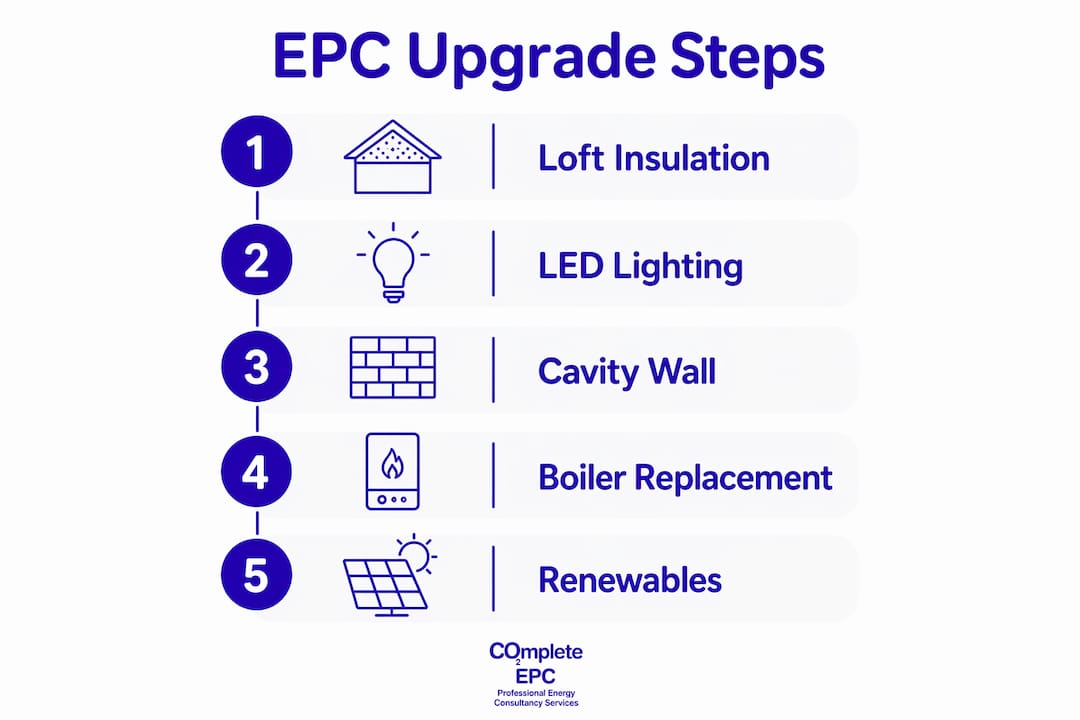
| Upgrade | Typical Cost | EPC Impact | Approx. Payback Period |
|---|---|---|---|
| Loft insulation (top-up) | £300–£500 | High | 2–3 years |
| Cavity wall insulation | £500–£1,500 | High | 3–5 years |
| LED lighting (full property) | £100–£300 | Medium | Under 1 year |
| Condensing boiler replacement | £2,000–£3,500 | High | 7–10 years |
| Double glazing (full property) | £4,000–£8,000 | Medium | 10–15 years |
| Solar PV panels | £5,000–£9,000 | High | 8–12 years |
Start with loft insulation and LED lighting. These deliver strong rating improvements at low cost and minimal disruption. Cavity wall insulation follows closely. Reserve boiler replacements and glazing for the second phase, once you have confirmed your compliance position under MEES.
If your property currently sits at an F or G rating, compliance is the immediate priority. The EPC exemption register exists for cases where improvements are not technically feasible or would exceed a cost cap, but exemptions are time-limited and must be renewed.
Pro Tip: Request a copy of your existing EPC report before booking any contractors. The recommendations section lists specific measures with estimated costs and rating gains. Use this as your brief when getting quotes, not a contractor’s sales pitch.
Landlords with larger portfolios benefit from a professional energy audit. A qualified assessor can identify measures across multiple properties and help you batch upgrades to reduce per-unit costs.
Step-by-step: how to execute EPC improvements effectively
A clear workflow prevents wasted spending and avoids the common pitfall of over-investing in upgrades that deliver minimal rating gains. Follow this sequence:
- Obtain your current EPC report. If your certificate is more than ten years old, commission a new EPC assessment before planning any works. Ratings can change as the SAP methodology is updated.
- Identify your target rating. For most landlords, the target is C. Work backwards from that goal to identify which combination of measures achieves it at lowest cost.
- Schedule works around tenancy agreements. Notify tenants in writing before any works begin. For occupied properties, plan disruptive works such as boiler replacements during warmer months to minimise inconvenience.
- Hire accredited tradespeople. Boiler installations must be carried out by Gas Safe registered engineers. Insulation installers should hold Trustmark or PAS 2030 certification, which is required if you are accessing government grant schemes such as the Great British Insulation Scheme.
- Check planning permissions. External wall insulation and solar panels may require permitted development approval or listed building consent. Confirm with your local planning authority before works commence.
- Update heating controls and install smart meters. Smart thermostats such as those from Hive or Nest allow precise temperature control and reduce energy waste. Smart meters provide accurate consumption data, which supports future EPC reassessments.
- Commission a reassessment. Once works are complete, book a new EPC assessment. Keep all installation certificates and warranties as evidence for the assessor.
- Avoid over-investing in low-impact measures. Replacing a functional double-glazed window with triple glazing rarely justifies the cost in rating terms. Focus spending where the SAP model rewards it most.
Solid planning in energy projects is proven to reduce cost overruns significantly. Applying the same discipline to domestic upgrades, by defining scope clearly before engaging contractors, prevents budget creep.
Pro Tip: Keep a property improvement log with dates, costs, and contractor details for every upgrade. This record speeds up future EPC reassessments and supports any exemption applications if needed.

One frequently overlooked issue is ventilation. Sealing a property tightly to improve insulation without providing adequate ventilation can cause condensation and damp. Mechanical ventilation with heat recovery (MVHR) or trickle vents in replacement windows address this directly.
How does technology improve EPC performance management?
Digital tools are changing how landlords monitor and maintain energy performance between formal assessments. The benefits go beyond convenience.
- Energy management systems (EMS). Platforms such as those built on Schneider Electric’s EcoStruxure or Siemens Desigo CC allow landlords managing multiple properties to track consumption in real time. Anomalies, such as a sudden spike in gas use, flag potential boiler faults before they become costly.
- Live dashboards. Data-driven monitoring with live dashboards has demonstrated the ability to accelerate project phases by months in industrial settings. The same principle applies at property level: knowing your consumption data in real time lets you act before inefficiencies compound.
- IoT sensors and smart meters. IoT-enabled infrastructure improves decision-making and reduces waste across building systems. Temperature sensors, occupancy detectors, and smart plugs generate the data needed to identify where energy is being lost.
- Predictive analytics. AI-powered analytics are now used for predictive maintenance and optimising energy use in properties under EPC assessment. For landlords, this means identifying when a boiler is likely to fail before it does, avoiding emergency replacement costs.
- Digital twins. A digital twin is a virtual model of a property’s energy systems. Standardised data tools such as CFIHOS enable digital twins to become operational immediately upon project completion, avoiding costly data cleanup. Applied to residential property, this approach supports long-term performance tracking.
| Technology | Primary Benefit | Suitable For |
|---|---|---|
| Smart meters | Real-time consumption data | All property types |
| IoT sensors | Fault detection and monitoring | Larger or HMO properties |
| EMS platforms | Portfolio-wide energy tracking | Landlords with 5+ properties |
| Predictive analytics tools | Maintenance planning | All property types |
The direction of travel is clear. Digital transformation in EPC management delivers measurable efficiency gains for those who adopt it early. Landlords who rely solely on annual meter readings are working with incomplete information.
Key takeaways
Improving EPC performance requires targeting the highest-impact upgrades first, planning works systematically, and using digital tools to maintain efficiency between formal assessments.
| Point | Details |
|---|---|
| Start with your EPC report | Use the existing recommendations section to identify the highest-impact, lowest-cost measures first. |
| Insulation and heating deliver most | Loft insulation, cavity wall insulation, and boiler upgrades produce the strongest rating gains per pound spent. |
| Plan works around compliance deadlines | MEES requires a minimum E rating now; a C rating is the proposed target for new tenancies from 2028. |
| Use accredited contractors | Gas Safe, Trustmark, and PAS 2030 certification are required for grant eligibility and assessor verification. |
| Monitor performance digitally | Smart meters and IoT sensors identify inefficiencies between formal EPC assessments, preventing costly surprises. |
What i have learned from working with landlords on EPC improvements
The landlords who get the best results are not the ones who spend the most. They are the ones who read their EPC report carefully before spending anything.
The most common error I see is a landlord replacing windows because they look dated, when the report clearly shows that loft insulation is the measure that would push the rating from a D to a C. Windows might cost £6,000 and move the needle by two points. Loft insulation costs £400 and does the same job.
The shift toward digital monitoring is real and worth taking seriously. Landlords managing even two or three properties benefit from smart meters and basic consumption tracking. The data tells you things a once-a-decade EPC assessment cannot. It shows you when a heating system is working harder than it should, which is often the first sign of a fault.
My honest advice: treat your EPC report as a project brief, not a compliance tick-box. The energy rating improvement steps outlined in a good assessment give you a prioritised list of works with estimated costs. That is more useful than most surveys you will pay for. Work through it methodically, use accredited contractors, and reassess once the major works are done. The rating will follow.
— Danny
How Completeepc can help you improve your EPC rating
Completeepc provides professional EPC assessments for domestic and commercial properties across London, carried out by qualified and experienced assessors. If you are unsure where your property currently stands or what improvements would have the greatest impact, a fresh assessment gives you the accurate baseline you need. Completeepc’s reports include clear recommendations ranked by cost and impact, so you leave with a practical plan rather than a certificate alone. Book your domestic EPC assessment directly through the website, or explore the commercial EPC service if you manage non-residential or mixed-use properties. Completeepc also offers guidance on energy efficiency upgrades to support compliance and long-term value.
FAQ
What is the minimum EPC rating required for rented properties?
The current legal minimum under MEES is an E rating for privately rented properties in England and Wales. The government has proposed raising this to C for new tenancies from 2028.
How long does an EPC assessment take?
A domestic EPC assessment typically takes between 45 minutes and one hour, depending on the size and complexity of the property. The certificate is usually issued within 24 hours of the visit.
Which upgrades improve an EPC rating the most?
Loft insulation, cavity wall insulation, and boiler replacement consistently deliver the largest rating improvements relative to cost. Solar PV panels also have a strong positive impact on the SAP score.
How often does an EPC need to be renewed?
An EPC is valid for ten years. You should commission a new assessment after completing significant energy efficiency works, as the certificate will not automatically reflect improvements made after it was issued.
Can a landlord be fined for a low EPC rating?
Yes. Letting a property that does not meet the minimum E rating without a valid exemption can result in a civil penalty of up to £30,000 per property under current MEES enforcement rules.