

TL;DR:
- Owning or letting property in England or Wales now requires compliance with EPC regulations, including achieving a minimum C rating by 2030. Improving your EPC involves understanding current ratings, prioritizing low-cost measures like LED lighting, insulation, and heating upgrades, and planning major works for the most impact. Regular assessment, maintenance, and early action are essential to meet legal deadlines and optimize property value.
If you own or let property in England or Wales, knowing how to improve your EPC rating has gone from a good idea to a legal obligation. Rental properties must achieve a minimum ‘C’ rating by October 2030, and fines for non-compliance can reach £30,000. With regulatory requirements tightening and a new multi-metric rating system taking shape, the time to act is now. This guide walks you through every practical step, from reading your current report to commissioning upgrades and verifying the results.
Table of Contents
- Key takeaways
- How to improve your EPC rating: start with your current report
- Practical steps to boost your EPC score
- Common pitfalls and how to avoid them
- Verifying and maintaining your EPC rating
- My take on EPC improvements in 2026
- How Completeepc can help you meet your EPC obligations
- FAQ
Key takeaways
| Point | Details |
|---|---|
| Legal deadline approaching | Rental properties must meet EPC ‘C’ by October 2030 or face fines up to £30,000. |
| New multi-metric system | From 2026, EPCs assess fabric performance, heating efficiency, smart readiness, and energy costs separately. |
| Quick wins exist | LED lighting, smart thermostats, and loft insulation can each add measurable points at relatively low cost. |
| Combine fabric and heating upgrades | Meeting the new standards requires improvements to both insulation and heating systems together. |
| Act early | Contractors are in high demand; acting now secures better pricing and avoids last-minute compliance pressure. |
How to improve your EPC rating: start with your current report
Before you spend a penny on upgrades, you need to understand where your property stands. Your current EPC report is publicly available on the government’s EPC register and shows your rating on a scale from A (most efficient) to G (least efficient). It also lists recommended improvements alongside estimated costs and potential savings.
Reading that report critically is the first real step. Each recommendation is generated by a national modelling system, not by a surveyor who has examined your specific property in detail. The EPC recommendations are model-based, which means they may not account for your property’s particular construction, existing issues, or local planning constraints. Use them as a starting point, not a definitive instruction manual.
The regulatory context is also changing. The UK is transitioning to a multi-metric EPC system by 2029, which assesses properties across four separate categories:
- Fabric performance: The thermal quality of walls, roof, and windows
- Heating system efficiency: The type and age of your boiler or heat pump
- Smart readiness: Whether the property supports smart controls and metering
- Energy costs: Projected running costs based on the above metrics
This shift matters because a property that scores well on one metric may still fail another. Portfolio landlords in particular need to plan across all four categories for every property they own.
You should also check whether any government funding applies to your situation. The Great British Insulation Scheme and ECO4 programme offer grants for lower-income households and certain property types. Checking eligibility before commissioning any work could significantly reduce your outlay.
Pro Tip: Before booking any contractor, obtain a copy of your EPC report and cross-reference its recommendations with a qualified retrofit assessor. This one step can prevent costly mistakes, particularly in older properties where poor ventilation or existing damp may make certain upgrades counterproductive.
Practical steps to boost your EPC score
Not all improvements carry the same weight on your rating. Understanding the return on each measure lets you prioritise spend and sequence your works sensibly.

Quick wins with low investment
Start with measures that cost little but deliver real points:
- Replace all bulbs with LED lighting. This adds 1 to 2 EPC points and costs under £100 for a typical property.
- Install a smart or programmable thermostat. A smart thermostat is worth approximately 2.4 EPC points and improves the smart readiness metric under the new system.
- Insulate the hot water cylinder. If your property has a tank rather than a combi boiler, an insulating jacket costs around £20 and is one of the fastest improvements available.
- Add draught-proofing to doors and windows. Simple, inexpensive, and it reduces heat loss without requiring planning approval.
Medium-level improvements
Once quick wins are in place, move to moderate investment measures:
- Top up loft insulation to 270 mm. This single measure can add up to 4.9 points to your EPC rating. Many older properties have some insulation but not at current recommended depths.
- Install cavity wall insulation. Where your property has an unfilled cavity, this is one of the most cost-effective fabric improvements available and works directly towards the fabric performance metric.
- Upgrade heating controls. Adding thermostatic radiator valves and a zone controller gives you better control and recognition on the EPC assessment.
Major upgrades
For properties still sitting at D or below, larger investments may be unavoidable:
- Replace an old boiler with an A-rated condensing boiler or heat pump. Boiler replacement can add up to 40 EPC points, making it the single most impactful measure for many properties.
- Upgrade single-glazed windows to double or triple glazing. Replacing single glazing reduces heat loss significantly, improves tenant comfort, and addresses damp caused by cold surfaces. A-rated glazing reduces heat loss by up to 25%.
- Consider external or internal wall insulation for solid-wall properties. This is more expensive but may be the only option for pre-1919 terraced housing.
Pro Tip: Plan major works between tenancies wherever possible. Vacant periods are the most cost-effective time to tackle disruptive jobs like cavity wall insulation or boiler replacements. You avoid tenant disruption, speed up the work, and often negotiate better rates with contractors.
Common pitfalls and how to avoid them
Improving your EPC rating sounds straightforward. In practice, several common mistakes can waste money or create new problems.
-
Treating EPC recommendations as guaranteed outcomes. The standard EPC report uses modelling assumptions that may not reflect your property’s actual fabric or systems. A recommendation to install cavity wall insulation, for example, could be wrong for a property with existing moisture ingress. Always get a specialist survey before committing to fabric works.
-
Creating ventilation problems through poorly planned insulation. Sealing a building too tightly without adequate ventilation can cause condensation and mould. The risk of damp or airflow problems increases sharply if insulation and draught-proofing are added without a whole-house assessment. This matters particularly for tenant health and your obligations under Awaab’s Law.
-
Underestimating the challenges in older and heritage properties. The upcoming EPC reforms remove heritage exemptions, meaning listed buildings must now comply. However, heritage-compatible retrofits cost 30 to 60% more than standard works, and planning constraints may rule out options like external insulation or cavity fill entirely. If you own a listed or pre-1919 building, get specialist retrofit advice early.
-
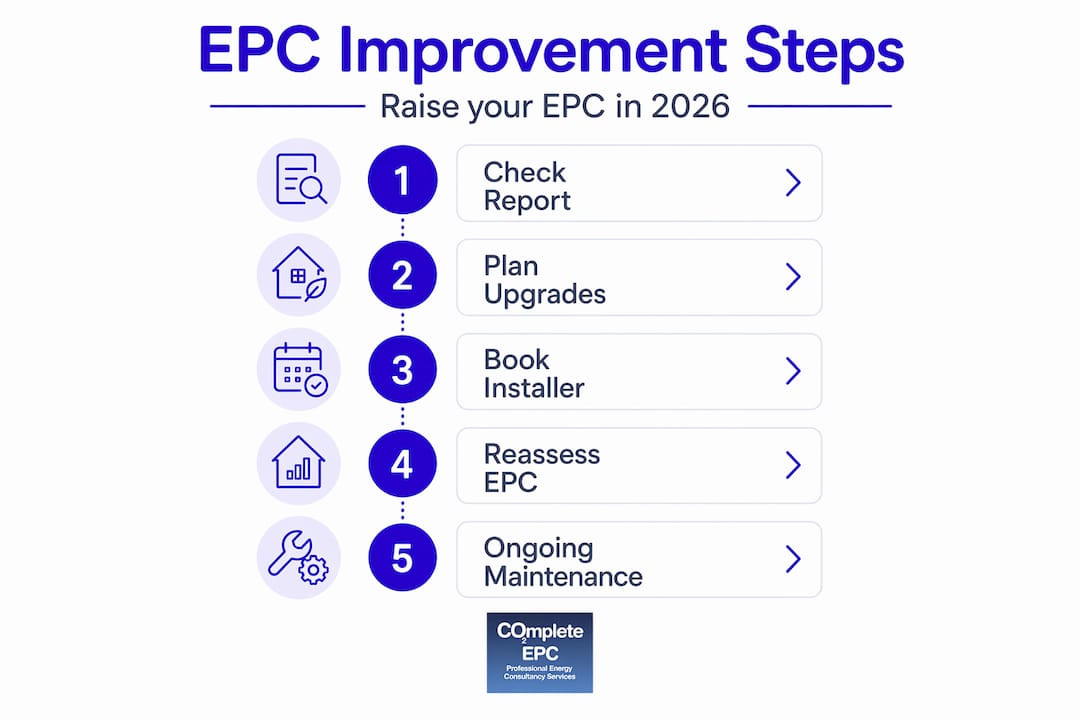
Forgetting to commission a new EPC after works are complete. Improvements only count towards compliance once they are recorded on a new, valid EPC. Many landlords complete works and assume their rating has been updated. It has not until a qualified assessor has reassessed the property and lodged the new certificate.
-
Leaving everything until the deadline. 62% of landlords are unaware that EPC compliance is a legal requirement. That knowledge gap creates a bottleneck as the 2030 deadline approaches. Contractors will be oversubscribed, prices will rise, and installation slots will be scarce. Acting now protects both your budget and your compliance position.
Verifying and maintaining your EPC rating
Completing works is not the finish line. You need to confirm those improvements are correctly reflected in your rating and then keep the property performing at that level.
| Action | When to take it | Why it matters |
|---|---|---|
| Commission a new EPC | Immediately after significant works | Only a new lodged certificate updates your legal compliance record |
| Maintain boiler and heating | Annual service | Unserviced boilers lose efficiency and may affect future assessments |
| Check insulation integrity | Every 5 years | Settled or damp insulation underperforms and can cause structural issues |
| Review EPC register | Before any sale or new tenancy | Buyers and lenders now scrutinise EPC ratings as part of valuations |
| Plan for 2030 requirements | Now | A phased upgrade plan avoids rushed spending and contractor shortages |
The point about buyers and lenders is worth expanding. Lenders increasingly use EPC ratings in their loan risk modelling. A low-rated property can attract less favourable mortgage terms or reduce the pool of buyers prepared to offer asking price. Properties rated C or above are easier to let, sell, and finance. Maintaining a high property energy rating is increasingly a financial asset, not just a regulatory box to tick.
Ongoing maintenance matters too. A boiler installed in 2024 that has not been serviced will perform less efficiently by 2028. Insulation that has settled or become damp provides less thermal resistance than when installed. These factors can affect your rating at the next assessment, so build routine checks into your property management schedule.
My take on EPC improvements in 2026
I have worked with dozens of landlords on EPC compliance, and the pattern I see most often is the same: people know the deadline is coming, but underestimate how much preparation the new system requires.
The biggest misconception I come across is that EPC improvement is a single project with a clear endpoint. Under the new multi-metric framework, it is more accurate to say it is an ongoing performance standard. You cannot simply replace a boiler and call it done. The new 2026 system requires meeting fabric and heating standards concurrently, which means a property with excellent insulation but an outdated heating system may still fail.
What I have found actually works is treating the EPC report as a starting document, not an instruction sheet. Get a retrofit assessor to walk the property with you. Cross-reference their findings with your current report. Then build a phased plan that addresses both the fabric and the heating system together, with works timed for void periods where possible.
Early movers genuinely benefit here. Landlords who act early secure better pricing and less disruption. Those who wait until 2029 will face a contractor market that cannot serve everyone at once.
— Danny
How Completeepc can help you meet your EPC obligations
If you are managing a property in London and need a current, accurate EPC, Completeepc provides professional assessments carried out by qualified assessors with extensive experience across both domestic and commercial properties. Whether you are preparing for a new tenancy, planning upgrades, or verifying that recent works have improved your rating, getting an up-to-date certificate is the right first step.
Completeepc’s reports are fully compliant with current regulations and include clear improvement recommendations you can use to plan your next steps. You can start with the EPC assessment process guide to understand exactly what to expect, or explore the EPC renewal guide if you need to update an existing certificate after completing works. With the 2030 deadline approaching and the regulatory landscape shifting, now is the time to get your ratings in order.
FAQ
What is the minimum EPC rating required for rented properties?
From October 2030, all privately rented properties in England and Wales must achieve a minimum EPC rating of C. Properties that fail to comply face fines of up to £30,000.
How many EPC points does a new boiler add?
Replacing an old, inefficient boiler with a modern A-rated condensing boiler can add up to 40 EPC points, making it one of the highest-impact single upgrades available.
Do I need a new EPC after making improvements?
Yes. Your EPC rating is only updated when a qualified assessor reassesses the property and lodges a new certificate. Completed works alone do not automatically change your rating on the register.
Can I improve my EPC rating without major building work?
Yes. Measures such as LED lighting, a smart thermostat, hot water cylinder insulation, and draught-proofing can each add points at low cost. However, properties rated D or below will likely need medium to major works to reach a C.
Are heritage or listed buildings exempt from EPC requirements?
No. The upcoming EPC reforms remove heritage exemptions, so listed buildings must comply. However, heritage-compatible works cost significantly more and require specialist advice due to planning constraints.