

TL;DR:
- Improving an EPC rating primarily involves fabric-first upgrades like insulation and airtightness, which offer the greatest cost-effective energy efficiency gains.
- Additional improvements include LED lighting, heating controls, and boiler upgrades, which can significantly boost SAP scores at predictable costs.
- Planning these measures early and combining fabric, technology, and ventilation upgrades helps property owners meet the 2029 regulation deadline efficiently and cost-effectively.
An Energy Performance Certificate (EPC) rating is a measure of a property’s energy efficiency, expressed on a scale from A (most efficient) to G (least efficient) and calculated using the Standard Assessment Procedure (SAP). If you are asking how do I improve my EPC rating, the answer starts with understanding that fabric-first improvements deliver the greatest gains at the lowest cost. By 1 October 2029, all privately rented homes must reach EPC grade C or above, with a £10,000 investment cap per property. Acting now means lower costs, access to grants, and far less disruption to your tenants.
How do I improve my EPC rating through building fabric upgrades?
Building fabric improvements are the single most cost-effective way to raise your EPC score. They reduce heat loss permanently, which means every heating upgrade you add afterwards works harder and costs less to run.
The most impactful fabric measures include:
- Loft insulation to 270mm. Loft insulation top-up is the best insulation upgrade for most D-rated properties, costing £300–£600 and delivering 3–8 SAP points. That gain alone can shift a borderline D property into C territory.
- Cavity wall insulation. Injected cavity wall insulation costs roughly £400–£800 for a typical semi-detached home and delivers comparable SAP gains to loft insulation. Solid wall properties require external or internal wall insulation, which costs more but delivers greater thermal improvement.
- Draught-proofing. Sealing gaps around windows, doors, and letterboxes reduces heat loss with minimal outlay. A professional draught-proofing service typically costs under £200 and adds measurable SAP points.
- Floor insulation. Suspended timber floors lose significant heat. Insulating beneath the floorboards costs £500–£1,500 and is worth considering once loft and walls are addressed.
Improving airtightness without adequate ventilation causes condensation and damp. Retrofit experts warn that the principle of “build tight, ventilate right” must guide every fabric upgrade. Sealing a property without planning ventilation is a common and costly mistake.
Pro Tip: Schedule fabric upgrades during tenancy void periods. Loft and cavity wall work typically takes one to two days, so a planned void between tenancies is the least disruptive window to complete multiple measures at once.

How can heating and lighting upgrades improve your EPC rating?
Once the building fabric is addressed, heating and lighting upgrades deliver the next tier of SAP gains. These measures are well understood, widely available, and carry predictable costs.
-
Switch all bulbs to LED. Replacing existing bulbs with LED lighting typically costs under £50 for a whole property and adds 1–4 SAP points. This is the cheapest single upgrade available and should always be the first step.
-
Install heating controls. Thermostats, programmers, and thermostatic radiator valves (TRVs) cost £200–£500 combined and can add 3–8 SAP points. They also reduce energy bills directly, which makes them attractive to tenants and supports your compliance case.
-
Upgrade to an A-rated condensing boiler. Replacing an old boiler with a modern A-rated condensing model adds 10–20 SAP points but requires a capital investment of £2,000–£4,000. This is the highest-impact single heating measure for gas-heated properties.
-
Consider a heat pump. Air source heat pumps score well in SAP calculations and suit properties with good fabric insulation already in place. Installation costs are higher than a boiler replacement, but government grant support through the Boiler Upgrade Scheme reduces the net outlay.
The combined effect of low-cost fabric-first measures such as LED lighting, loft insulation, and heating controls can deliver 10–25 SAP points for under £1,500 in a typical three-bedroom semi-detached house. That figure puts many D-rated properties within reach of a C rating before any major capital spend.
Pro Tip: Always check your current EPC’s recommendation report before booking any heating work. The report lists the specific measures that will gain the most SAP points for your property type, saving you from spending on upgrades with limited impact.
What role do renewable technologies play in boosting your EPC score?
Renewable technologies and advanced ventilation systems sit at the top of the upgrade hierarchy. They deliver real SAP gains but require larger investment and work best after fabric and heating improvements are complete.
Key advanced measures to consider:
- Solar photovoltaic (PV) panels. Solar PV adds 5–15 SAP points and costs £4,000–£8,000, with a payback period of 8–12 years. The SAP gain is significant, but the financial case depends on the property’s orientation, roof condition, and existing energy use.
- Smart heating controls. Systems with weather compensation, load compensation, and remote monitoring add SAP points under the current methodology and future-proof the property against tightening regulations.
- Mechanical extract ventilation (MEV). MEV systems extract stale air from wet rooms continuously, maintaining air quality in tightly sealed properties. They are a cost-effective step up from passive ventilation.
- Balanced mechanical ventilation with heat recovery (MVHR). MVHR recovers heat from extracted air and supplies fresh, pre-warmed air throughout the property. It is the gold standard for energy recovery in well-insulated homes and scores well in SAP assessments.
The table below summarises the advanced measures by cost and SAP impact:
| Measure | Approximate cost | SAP points gained | Best suited to |
|---|---|---|---|
| Solar PV panels | £4,000–£8,000 | 5–15 | South-facing roofs, post-fabric upgrade |
| Smart heating controls | £300–£800 | 2–5 | All gas-heated properties |
| MEV system | £400–£900 | 1–3 | Flats, tightly sealed homes |
| MVHR system | £2,000–£5,000 | 3–8 | New builds, deep retrofits |
Without PAS 2035-compliant ventilation, tightly sealed buildings risk moisture buildup leading to interstitial condensation and structural damage. Ventilation must be planned alongside insulation, not added as an afterthought.
How to plan and prioritise EPC improvements efficiently
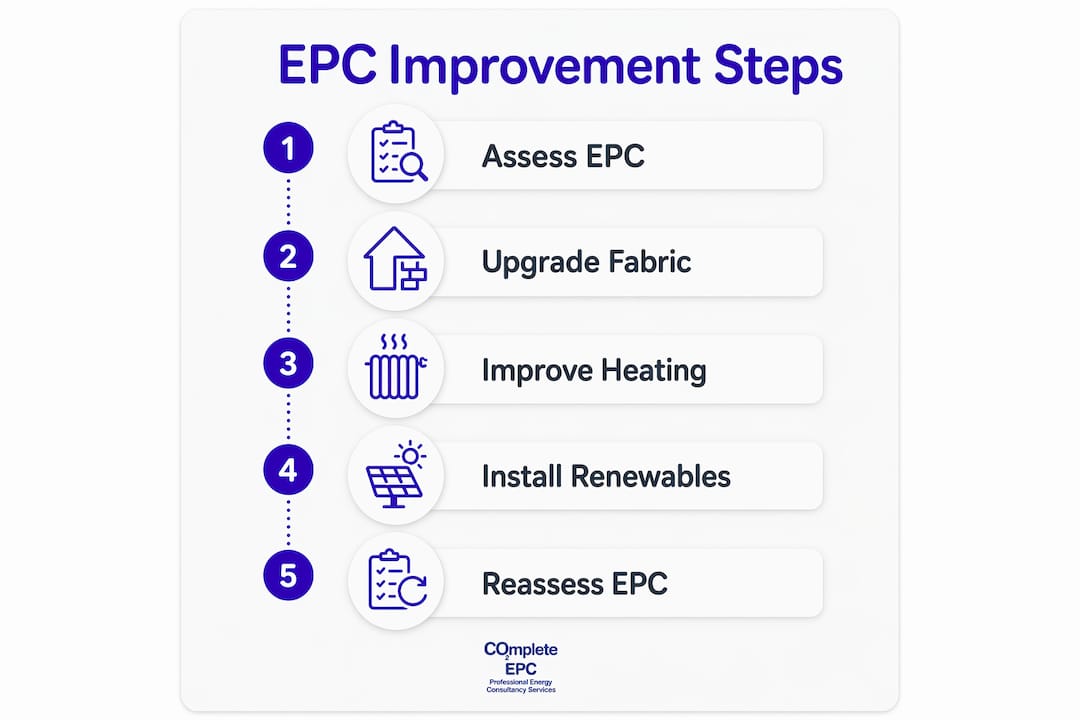
A clear plan prevents wasted spend and avoids the common pitfall of treating EPC improvement as a points race rather than a genuine building upgrade. Follow this sequence:
-
Commission a retrofit assessment. A thorough assessment covers structural condition, damp, ventilation, and current SAP score. Comprehensive retrofit assessments identify water ingress and structural defects before any upgrade work begins. Skipping this step risks installing insulation into a damp building, which accelerates decay.
-
Review your current EPC and SAP score. Your existing EPC lists recommended measures ranked by cost-effectiveness. Use it as your starting checklist and cross-reference it with the retrofit assessment findings.
-
Prioritise low-cost, high-impact measures first. LED lighting, heating controls, and loft insulation deliver the best return per pound spent. Complete these before committing to boiler replacements or renewables.
-
Keep full documentation. Retain invoices, installation certificates, and photographs for every measure completed. This evidence supports compliance checks and exemption applications if required. The EPC exemption register is available for properties where the £10,000 cap is reached before grade C is achieved.
-
Apply for available grants. The Warm Homes Local Grant and other government schemes reduce the net cost of insulation and heating upgrades. Starting retrofit upgrades early allows landlords to access grants and plan around void periods, reducing both cost and disruption.
Delaying EPC improvement until close to the 2029 deadline risks higher costs and project delays. Demand for qualified assessors and installers will rise sharply as the deadline approaches, pushing up prices and extending lead times. Acting in 2026 or 2027 gives you access to competitive quotes, grant funding, and the flexibility to phase work across multiple void periods.
Key takeaways
The most effective way to improve your EPC rating is to follow a fabric-first sequence: insulation and draught-proofing first, then heating controls and boiler upgrades, then renewables and advanced ventilation.
| Point | Details |
|---|---|
| Fabric first | Loft insulation to 270mm and cavity wall insulation deliver the highest SAP gains per pound spent. |
| Heating controls pay quickly | Thermostats and TRVs cost £200–£500 and add 3–8 SAP points with no structural work required. |
| LED lighting is the easiest win | Replacing all bulbs costs under £50 and adds 1–4 SAP points immediately. |
| Ventilation is non-negotiable | Every airtightness improvement must be paired with adequate ventilation to prevent damp and condensation. |
| Plan early for 2029 | Acting now secures grant funding, competitive installer quotes, and avoids deadline-driven cost spikes. |
A fabric-first approach: what I have learned from working with landlords
Most landlords I speak to want a number. They ask which single measure will push them from D to C. The honest answer is that chasing one measure rarely works. Properties that achieve lasting EPC improvements do so because the landlord addressed the building fabric thoroughly before spending on technology.
The risk of skipping fabric work is real. I have seen properties where cavity wall insulation was installed into walls with existing damp. The result was accelerated decay behind the insulation, a worse damp problem, and an EPC score that still did not reach C. The money was spent twice: once to install the insulation, and again to remediate the damage.
Independent technical monitoring throughout a retrofit project catches these failures before they become expensive. Relying solely on installer certification is not enough. A qualified retrofit coordinator, working to PAS 2035 standards, provides the oversight that protects your investment.
The other point landlords underestimate is resident education. A property upgraded to EPC C will underperform if tenants do not understand how to use the heating controls or ventilation system correctly. A brief handover guide, covering thermostat settings and ventilation operation, costs nothing and protects the gains you have paid for. Understanding home upgrades that genuinely deliver versus those that sound good on paper is the difference between a property that performs and one that merely looks compliant on paper.
— Danny
Completeepc: professional EPC assessments for landlords
Completeepc provides domestic EPC assessments carried out by qualified assessors with extensive experience across London’s property stock. Whether you need a baseline assessment before planning retrofit work or a post-improvement certificate to confirm compliance, Completeepc delivers accurate, reliable results at competitive rates. The team understands the 2029 regulatory requirements and can advise on which measures your specific property needs to reach grade C. Completeepc also supports landlords with documentation guidance and compliance evidence, making the process straightforward from assessment to certification. Contact Completeepc to book your assessment and take the first step towards a compliant, energy-efficient property.
FAQ
What is a good EPC rating for a rental property?
EPC grade C or above is the legal requirement for privately rented homes from 1 October 2029. Grade B or A indicates a highly efficient property with lower running costs and stronger tenant appeal.
How many SAP points do I need to move from D to C?
The SAP score range for grade D is 55–68, and grade C starts at 69. The exact number of points required depends on your current score, but most D-rated properties need 5–15 additional SAP points to cross the threshold.
What is the cheapest way to improve my EPC rating?
Replacing all bulbs with LED costs under £50 and adds 1–4 SAP points immediately. Loft insulation top-up to 270mm costs £300–£600 and is the next most cost-effective measure for most properties.
Can I claim an exemption if I cannot reach EPC grade C?
Yes. If you have spent up to the £10,000 investment cap and the property still cannot reach grade C, you can register an exemption on the EPC exemption register. The exemption must be supported by evidence of the work completed and costs incurred.
How long does an EPC assessment take?
A domestic EPC assessment typically takes 45 minutes to one hour for a standard property. The assessor inspects insulation, heating systems, glazing, and lighting before producing the certificate and recommendation report.