

TL;DR:
- Failing to comply with energy audit requirements in London can lead to hefty fines and decreased property value. Proper preparation and understanding of the process enable property owners to identify cost-effective improvements and ensure compliance. Acting on audit findings, especially operational changes, maximizes energy savings and legal benefits.
Failing to comply with energy audit requirements in London can cost property owners far more than the audit itself. Fines for non-compliance under the Energy Savings Opportunity Scheme (ESOS) can reach tens of thousands of pounds, and a poor Energy Performance Certificate (EPC) rating can actively deter tenants and reduce your property’s market value. Understanding the full audit process, from what triggers the requirement to how you act on the findings, puts you in control of both your legal obligations and your running costs. This guide walks you through every stage.
Table of Contents
- Understanding the energy audit process and legal requirements
- What to prepare: documentation, data and site requirements
- Step-by-step: how a typical energy audit is conducted
- After the audit: interpreting recommendations and common pitfalls
- A fresh perspective on energy audits: operational value over box ticking
- How Complete EPC helps streamline your energy audit journey
- Frequently asked questions
Key Takeaways
| Point | Details |
|---|---|
| Legal compliance is essential | Failing to meet ESOS and EPC rules risks large fines for London properties. |
| Prepare documents in advance | Gather 12 months of energy data and building access for a smooth audit process. |
| Professional audits yield real savings | Go beyond DIY for accurate reporting and actionable improvement plans. |
| Act on audit recommendations | Implement operational changes, not just asset upgrades, for best efficiency. |
| Expert support simplifies compliance | Using a qualified assessor ensures accurate audits and timely regulatory submissions. |
Understanding the energy audit process and legal requirements
An energy audit is a structured assessment of how much energy a building or organisation uses, and where efficiency can be improved. For property owners and landlords in London, two regulatory frameworks matter most: the EPC system and ESOS.
An EPC rates a building’s energy efficiency on a scale from A (most efficient) to G (least efficient). It must be produced before a property is sold or let. ESOS goes further, applying to large organisations. Under ESOS, audits are required every four years, covering at least 90 to 95 per cent of an organisation’s total energy use across buildings, industrial processes, and transport. Phase 4 runs to December 2027. Each audit must be carried out by a qualified lead assessor who conducts site visits, gathers 12 months of energy data, and submits a formal report to the Environment Agency.
Who must comply?
- Organisations with more than 250 employees
- Organisations with an annual turnover above £44 million and a balance sheet above £38 million
- UK subsidiaries of overseas companies that meet these thresholds
ESOS operates on a “one-in, all-in” group basis. If one part of a corporate group qualifies, the entire group must participate. Non-compliance carries financial penalties that can exceed £50,000, with additional daily fines for continued failure to act.
| Regulation | Who it applies to | Frequency | Penalty for non-compliance |
|---|---|---|---|
| EPC | All sold/let properties | On transaction | Up to £5,000 per property |
| ESOS | Large organisations | Every 4 years | Up to £50,000+ |
| MEES | Landlords (residential/commercial) | Ongoing | Up to £150,000 |
It is worth noting the edge cases within ESOS: listed buildings and properties where improvement costs exceed £3,500 may qualify for EPC exemptions. From 2026 onwards, the Home Energy Model (HEM) is replacing RdSAP as the calculation method for domestic EPCs, which will alter ratings for many properties. If your property sits close to a rating boundary, this change could affect its compliance status. Staying informed about these shifts is essential, particularly when it comes to reducing electricity costs through planned improvements before new methods take effect.
What to prepare: documentation, data and site requirements
Once you know the rules and whether an audit applies to you, preparation is the next priority. Getting this right before you book an assessor will save you time, reduce costs, and help produce a more accurate report.
Documentation and data checklist:
- Energy bills covering the last 12 months (electricity, gas, oil, or other fuel types)
- Site plans and floor plans, including any recent alterations
- Building management system (BMS) settings and control schedules
- Occupancy information: hours of use, typical occupant numbers, and any remote or hybrid working patterns
- Details of existing energy-saving measures already in place
- Maintenance records for heating, ventilation, and air conditioning (HVAC) systems
- Meter readings and any smart meter data available
The ESOS requirement for 12 months of data exists because energy use varies significantly across seasons. Summer air conditioning loads and winter heating demands paint a very different picture from a single month’s snapshot. Providing complete data upfront avoids delays and ensures the assessor’s recommendations are grounded in your building’s real performance.
Comparison: DIY audit vs. professional audit
| Feature | DIY audit | Professional audit |
|---|---|---|
| Cost | Low or free | Moderate to high |
| Covers regulatory compliance | No | Yes (EPC, ESOS) |
| Identifies quantitative savings | Limited | Full analysis |
| Uses approved methodology | No | Yes |
| Valid for legal purposes | No | Yes |
| Covers transport and processes | No | Yes (for ESOS) |
Physical site access is just as important as paperwork. Your assessor will need to inspect meter locations, plant rooms, roof spaces, and any areas that are let to separate tenants. If units are occupied by third parties, arrange access in advance.

Pro Tip: Walk through your own property before the assessor arrives. Note any areas with restricted access, recent changes to heating systems, or spaces added since the last floor plan was drawn. Addressing these details before the visit prevents costly delays on the day.
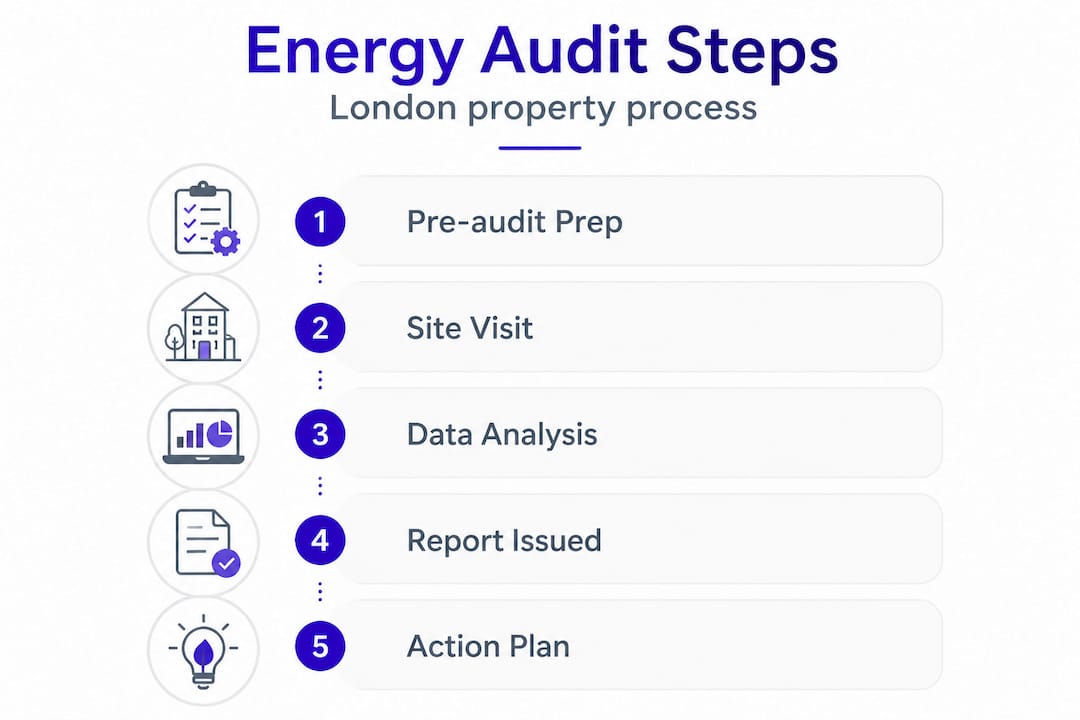
Step-by-step: how a typical energy audit is conducted
Now that you are prepared, here is exactly what to expect from booking through to receiving your final report.
-
Initial booking and scoping. You contact a qualified assessor or consultancy. They confirm which type of audit you need (EPC, ESOS, or both), agree on the scope, and request your documentation list in advance.
-
Pre-visit data review. The assessor reviews your energy bills, floor plans, and occupancy data before arriving on site. This allows them to identify areas of focus and potential anomalies worth investigating during the visit.
-
Site assessment. The assessor visits the property in person. They inspect insulation, glazing, heating and cooling systems, lighting, controls, and the building envelope (the physical barrier between interior and exterior). For ESOS, they also consider transport data if applicable. Interviews with building managers or facilities staff often reveal operating patterns that are not visible in data alone.
-
Measurement and data gathering. Where needed, portable monitoring equipment may be used to measure actual energy consumption in specific areas. This is particularly relevant in larger commercial properties where sub-metering may be limited.
-
Analysis. The assessor processes all gathered information against approved methodologies. They calculate current energy use intensity (EUI), identify inefficiencies, and model the potential savings from specific interventions.
-
Report preparation and delivery. You receive a formal report detailing current performance, recommended actions, estimated savings, and payback periods for each measure. For ESOS, this report is submitted to the Environment Agency.
It is important to flag any changes in building use or occupancy before the site visit. Assessors who work without accurate occupant behaviour data may produce recommendations that look strong on paper but miss the real operational losses happening day to day.
While DIY energy-saving steps have their place in routine property management, a professional audit provides the quantitative rigour that EPC and ESOS compliance demands. An EPC produces an asset rating: it tells you how efficient the building could be under standard conditions. An operational audit tells you how efficient it actually is, based on how you use it. The gap between those two figures is often where the real savings sit.
After the audit: interpreting recommendations and common pitfalls
With your audit complete, you now have a report in hand. The real work begins here. Translating findings into action is where many property owners fall short.
Your report will typically separate recommendations into two categories. Asset-based recommendations relate to physical improvements: upgrading insulation, replacing boilers, installing LED lighting, or improving glazing. These require capital investment but deliver lasting improvements to your EPC rating. Operational recommendations address how the building is used: adjusting heating schedules, fixing controls that run equipment unnecessarily, or changing occupant behaviour. These often cost very little to implement but can deliver significant savings within months.
Common pitfalls to avoid:
- Treating the report as a compliance document only, filing it away without acting on the quick wins
- Ignoring operational recommendations in favour of expensive capital projects
- Failing to involve tenants or building users, whose daily habits directly affect energy use
- Overlooking small but persistent energy drains such as equipment left on standby or poorly calibrated controls
- Missing the documentation requirements introduced under ESOS Phase 4
Standard audits can miss the real operational losses that occur because of behavioural patterns or poorly configured controls. Phase 4 of ESOS now mandates not just the audit itself but also a documented action plan showing how identified savings will be achieved. Simply completing the audit and submitting it is no longer sufficient for large organisations.
For ongoing management, keep your audit report as a live reference document. Track which measures you have implemented and when, and record the energy savings achieved. This creates a clear evidence trail for future compliance reviews and strengthens your position if your property is inspected.
Pro Tip: Set a calendar reminder 18 months before your next audit is due. This gives you time to gather the required 12 months of energy data, address any building changes, and ensure that previously recommended measures have been implemented and documented.
A fresh perspective on energy audits: operational value over box ticking
Here is something that rarely gets said directly: most energy audits are completed, filed, and then forgotten. The regulatory obligation has been met, the certificate has been issued, and the property owner moves on. This is understandable given the pressures of managing London property, but it leaves a significant amount of money on the table.
The real value of an energy audit is not the report. It is what changes as a result of the report. A building with a C-rated EPC can still waste enormous amounts of energy if heating systems run outside occupied hours, if tenants leave equipment on overnight, or if building controls have never been properly commissioned. Asset ratings and operational use can tell very different stories about the same building. We have seen properties where the asset rating looks respectable but the actual energy bills tell a story of consistent waste driven entirely by controllable behaviour and system settings.
The properties that see the best return from audits are those where the building manager or landlord treats the report as a starting point, not a destination. They prioritise the no-cost and low-cost operational changes first, building momentum and demonstrable savings before committing capital to larger upgrades. This approach also builds credibility with tenants, who increasingly ask questions about energy costs and sustainability credentials before signing leases.
What concerns us is that standard commercial audits frequently overlook these operational losses because assessors are working from data rather than from deep engagement with how a building actually operates day to day. If your assessor does not ask about occupancy patterns, shift work, or seasonal variations in use, the recommendations they produce may be technically correct but practically incomplete.
The audit process is evolving in the right direction. ESOS Phase 4’s mandatory action plans are a step forward, because they force organisations to think beyond the compliance certificate. But the mindset shift needs to come from property owners and landlords, not just regulators. The best investment you can make after an audit is in the time spent actually reading and acting on the findings, particularly the operational changes that cost very little but deliver measurable results quickly.
How Complete EPC helps streamline your energy audit journey
Knowing the process is one thing. Having the right team to carry it out is another. At Complete EPC, we work with property owners, landlords, and estate agents across London to deliver accurate, compliant energy assessments at competitive rates. Whether you need an EPC for a residential letting, a commercial property transaction, or support with ESOS obligations, our qualified assessors manage the process from initial booking through to final report. We make compliance straightforward, offering clear guidance on what you need to prepare, transparent pricing, and fast turnaround times. If you are unsure where your property stands or what your next audit requires, speak with our team for straightforward advice and a quote.
Frequently asked questions
Who must have an energy audit under UK law?
Large organisations qualifying under ESOS thresholds, specifically those with over 250 employees or above £44 million turnover and £38 million balance sheet, must complete audits every four years. All landlords must hold a valid EPC before selling or letting any property.
Can I do a DIY energy audit?
DIY audits are useful for identifying obvious inefficiencies at no cost, but only professional audits satisfy the requirements for ESOS and EPC compliance. They also lack the quantitative analysis needed to support planning decisions or legal documentation.
What is the difference between an EPC and an energy audit?
An EPC provides a standardised asset rating for efficiency based on the building’s physical characteristics, while an energy audit examines real operational use, identifies specific losses, and recommends targeted improvements. Both serve different but complementary purposes.
Are any buildings exempt from audits?
Listed buildings and properties where the cost of required improvements exceeds £3,500 may be exempt from EPC requirements, but ESOS obligations for qualifying organisations still apply regardless of building type in most cases.
How often do I need a new energy audit for compliance?
ESOS audits are required every four years for qualifying organisations, with Phase 4 running to December 2027. EPC validity is ten years, but a new certificate is required whenever a property is sold or re-let after significant changes have been made.