

A landlord in England typically needs a valid Energy Performance Certificate (EPC), an Electrical Installation Condition Report (EICR), a gas safety certificate where there is gas, and working smoke and carbon monoxide alarms. Each has its own renewal cycle and its own deadline for handing it to tenants. For London landlords, we cover the EPC and EICR side at Complete EPC, so those two can be sorted in one booking rather than chased separately.
This guide sets out what each certificate is, when it applies, how long it lasts and what to do with it. It also covers commercial lettings and selling a property.
TL;DR
- Rented homes in England need a valid EPC, an EICR at least every five years, a gas safety certificate each year (if there is gas) and working alarms.
- Rented homes rated F or G cannot be let unless an exemption applies, and the government has confirmed a move to EPC C for all tenancies by 2030.
- Give tenants the EICR within 28 days (existing tenants) or before they move in (new tenants), and the gas record within 28 days of each check.
- Commercial premises need an EPC when sold, rented or newly built, and a missing EPC can bring a penalty of £500 to £5,000.
- A seller or landlord must commission an EPC before marketing a property if there is no valid one.
Table of Contents
- The certificates a landlord may need
- Energy Performance Certificates for rented homes
- EICR: the electrical safety report
- Gas safety and alarms
- Commercial property compliance certificates
- Selling a property: the certificates buyers expect
- New builds, conversions and extensions
- A simple compliance routine for landlords
- Why use one provider for the energy and electrical reports
- Our view
- FAQ
- Sources
The certificates a landlord may need
GOV.UK’s landlord responsibilities page sets the general duty: keep the property safe and free from health hazards, maintain gas and electrical equipment safely, provide an EPC and meet the fire-alarm duties. In practice that turns into a short list of documents.
| Document | Applies to | How often | Who issues it |
|---|---|---|---|
| EPC | Every let or sold property | Valid for 10 years | Accredited energy assessor |
| EICR | Rented homes with electrics | At least every five years | Qualified electrical inspector |
| Gas safety certificate | Rented homes with gas appliances | Every 12 months | Gas Safe registered engineer |
| Smoke and CO alarms | Rented homes | Working on day one of each tenancy | Landlord checks and installs |
The EPC and the EICR are the two where London landlords most often need an outside specialist and a clear paper trail. The gas certificate must come from a Gas Safe engineer by law, so that one is a separate trade.
Energy Performance Certificates for rented homes
An EPC rates a property from A (most efficient) to G (least efficient) and lists the improvements that would raise the rating. It is produced by an accredited assessor who surveys the property.
GOV.UK’s How to rent a safe home guide says that in England a landlord must give interested renters a valid EPC at the earliest opportunity, give it to the eventual tenant, and show the home’s energy rating when advertising. The same guide says rented homes rated F or G cannot be let unless an exemption applies. This is the Minimum Energy Efficiency Standard, known as MEES.
What is changing for EPC ratings
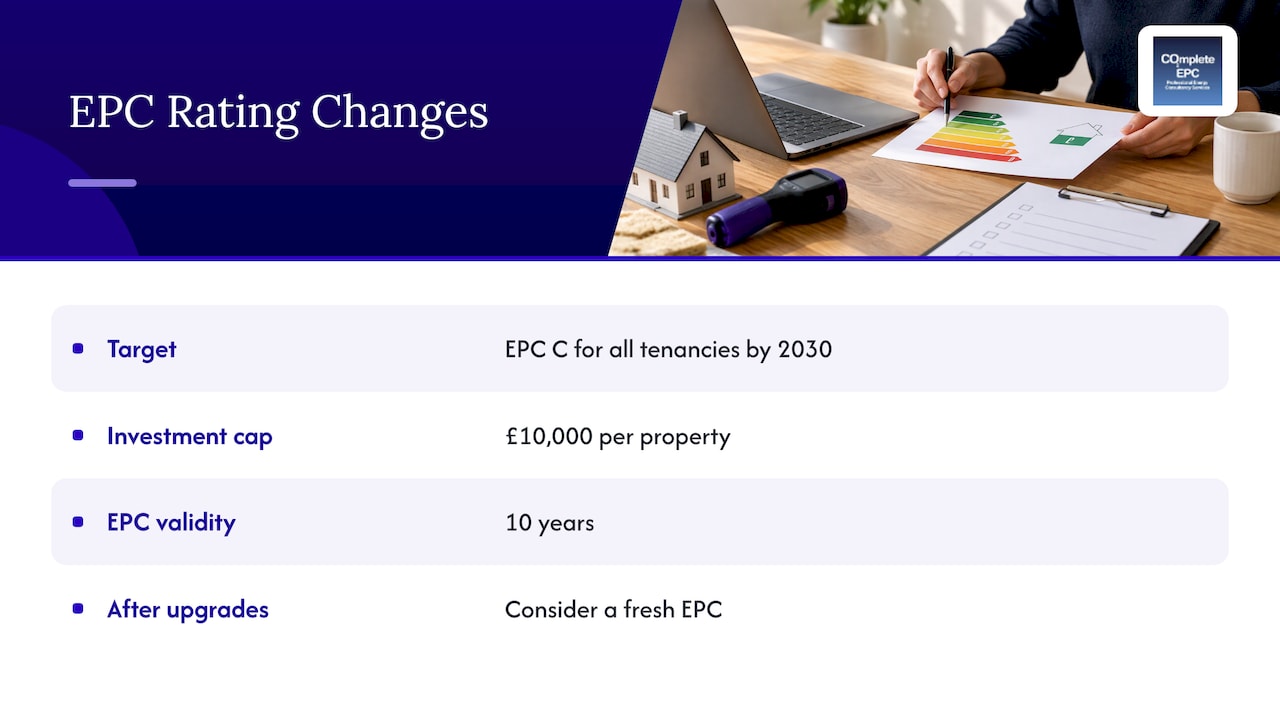
The government’s response to its consultation on privately rented homes confirms a target of EPC C for all tenancies by 2030, using new EPCs. It also sets a maximum landlord investment of £10,000 per property on improvements. For a landlord with an older London conversion or Victorian terrace, the sensible move is to know the current band now and plan upgrades such as loft insulation, glazing or heating controls over several years, rather than in a rush near the deadline.
An EPC lasts 10 years, but it is worth thinking about a fresh one after upgrades, because the recommendations on an old certificate may no longer reflect the property.
Worked example
A landlord owns a two-bedroom flat in Walthamstow with an EPC from eight years ago. The certificate is still valid, so there is no legal need to renew it for a new tenancy. If they then insulate the loft and replace the boiler, a new assessment would capture those changes and show the true rating before the 2030 standard applies. Our domestic EPC service covers exactly this kind of booking.
EICR: the electrical safety report
An EICR is a report on the fixed electrical installation: the wiring, consumer unit and sockets. It records faults and rates them by urgency. It does not cover plug-in appliances.
The 1 November 2025 GOV.UK guidance for England says landlords covered by the regulations must have the installation inspected and tested by a qualified person at least every five years, and obtain a report, usually an EICR.
Who must receive the report, and when
The same guidance gives the delivery deadlines for tenancies covered by the regulations:
- Existing tenants: within 28 days of the inspection.
- New tenants: before they occupy the property.
- Prospective tenants: within 28 days of a written request.
- The local authority: within seven days of its request.
Keep a dated copy and a record of when and how you sent it. A London borough can ask for it, and seven days passes quickly if the report sits with a previous agent.
What to do if the report finds problems
If the EICR lists faults that need work, the remedial work must be done and confirmed in writing; the GOV.UK guidance sets out the timescales. Book the inspection well before a tenancy ends, so there is time to repair anything it finds without leaving a void period.
We provide EICRs alongside EPCs, which means a landlord can arrange both reports through one London provider.
Gas safety and alarms
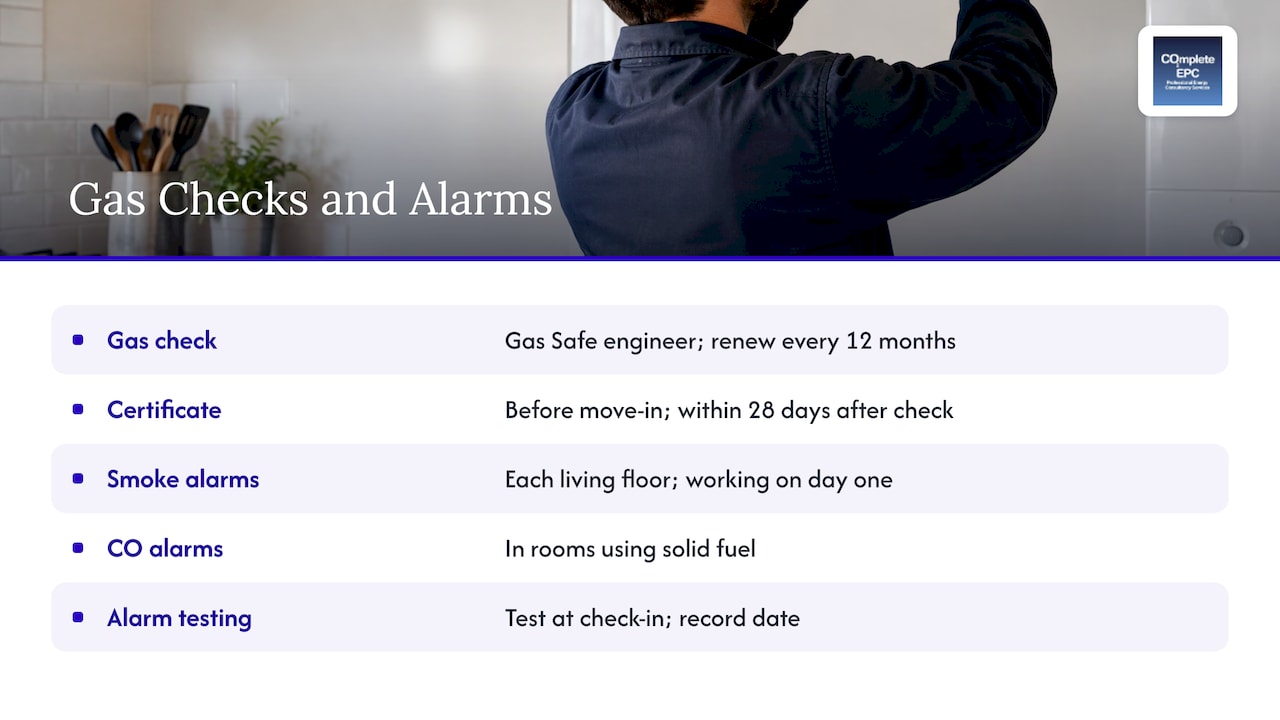
The How to rent a safe home guide says a landlord with gas installations must use a Gas Safe registered engineer. The tenant must receive the gas safety certificate before moving in, and within 28 days of each annual check. Put the 12-month renewal in your diary the day the certificate is issued.
The same guide requires a working smoke alarm on each floor used as living accommodation, and a carbon monoxide alarm in any room using solid fuel. Alarms must work on the first day of the tenancy. Test them at every check-in and note the date.
Fire duties go further in larger or multi-occupancy buildings. For a wider picture of what property managers are expected to understand about fire doors, alarms and inspections, these fire safety terms for property managers are a handy reference list.
Commercial property compliance certificates
If you let or sell shops, offices or other business premises, the main certificate is again the EPC, but the triggers differ. GOV.UK’s commercial EPC guide says an EPC is needed when:
- the premises are sold or rented;
- a building’s construction is completed; or
- specified changes are made to separately occupied parts that involve fixed heating, air-conditioning or mechanical ventilation.
Commercial EPCs are valid for 10 years. The guide adds that failing to make an EPC available to a prospective buyer or tenant can attract a penalty of £500 to £5,000, depending on rateable value.
Depending on the building, other reports can apply. Where a building has air-conditioning, an inspection report under TM44 may be needed, and we offer TM44 inspections. For new commercial buildings, energy calculations under SBEM are part of the compliance route, and we provide SBEM calculations. Our commercial EPC service covers premises across London.
Selling a property: the certificates buyers expect
For a sale, the EPC is the certificate that matters first. GOV.UK’s guide to EPCs for marketing, sale and let says that in England and Wales a seller or landlord must commission an EPC before marketing if there is no valid one, and the agent must be satisfied it has been commissioned before marketing begins.
In practice, order it before you instruct an agent. Solicitors and buyers will also ask for electrical and gas paperwork on a property that has been let, so a recent EICR and gas record save time during conveyancing. Landlords selling a tenanted flat should have those documents ready in a single folder.
New builds, conversions and extensions
Certificates are not only for existing lettings. If you are building, converting or extending, building regulations require energy calculations. We prepare SAP calculations for new dwellings, conversions and extensions, and can advise on related items such as water calculations and overheating assessments (TM52 and TM59). Planning applications may also need an energy statement.
A simple compliance routine for landlords
- Before marketing: confirm the EPC is valid and the rating is not F or G.
- Before the tenancy starts: hold a current gas certificate, EICR and EPC; test the alarms; give the tenant the documents.
- Every 12 months: renew the gas safety certificate and give the new copy within 28 days.
- Every five years: renew the EICR and share the new report within the deadlines above.
- Every 10 years, or after major upgrades: renew the EPC.
- Keep records: date, issuer, and how each document was delivered.
A spreadsheet with renewal dates for each property and a reminder two months ahead is enough for most small portfolios.
Why use one provider for the energy and electrical reports
Separate certificates from separate firms mean separate bookings, access arrangements and invoices. Our description of the service is simple: qualified assessors, practical energy-saving advice and fast, reliable service at competitive prices, backed by a UK lowest-rate guarantee. Landlords, agents and businesses across London can book an EPC and an EICR in one conversation, which shortens the time between a tenancy ending and the next one starting.
If you manage several flats, tell us how many and where, and we will arrange the visits together. Use the Complete EPC site to start.
Our view
Most compliance problems we hear about from landlords are not about the rules being hard. They are about paperwork arriving late: an EPC nobody can find, an EICR that expired while the flat was empty, a certificate sent to the wrong person.
Our advice is to treat the EPC as a planning document, not just a legal box. The recommendations on it show which upgrades move a property up a band, and with EPC C expected for all tenancies by 2030, early planning spreads the cost.
We deliver EPCs, SAP calculations, EICRs and PAT testing across London, so that a landlord or agent can keep the energy and electrical side in one place, with clear reports and a straight answer on what each one means.
Danny
FAQ
Do landlords have to provide an Energy Performance Certificate?
Yes. In England a landlord must give interested renters a valid EPC at the earliest opportunity and give it to the eventual tenant. The energy rating must also appear in the advert. Rented homes rated F or G cannot be let unless an exemption applies.
How often does an EICR need renewing?
At least every five years for tenancies covered by the regulations in England, or sooner if the previous report recommends it. The report must go to existing tenants within 28 days and to new tenants before they move in.
Is a landlord compliance certificate one single document?
No. Landlords usually mean a set of separate documents: the EPC, EICR, gas safety certificate and alarm checks. Each has its own issuer, validity period and deadline for giving it to the tenant.
What certificate do I need to sell a rental property?
A valid EPC must be in place before marketing begins. Buyers’ solicitors often also ask for the EICR and gas safety record, so having them to hand avoids delays.
Sources
- Renting out your property: landlord responsibilities, GOV.UK
- Electrical safety standards in the private and social rented sectors, GOV.UK
- How to rent a safe home, GOV.UK
- Improving the energy performance of privately rented homes: government response
- Energy Performance Certificates for your business premises, GOV.UK
- A guide to Energy Performance Certificates for the marketing, sale and let of dwellings, GOV.UK