

Every private landlord in England and Wales must hold a valid Energy Performance Certificate (EPC) rated at least E for any rented property, and must plan to reach EPC band C by 1 October 2030 or register a valid exemption. An EPC is valid for 10 years; check the register now, start a compliance file, and commission a new assessment if your certificate is below C or nearing expiry.
Your immediate obligations at a glance:
- Hold a current EPC (rated E or above) for every let property — this is the law today under the Minimum Energy Efficiency Standards (MEES).
- Provide a copy of the EPC to every prospective tenant and display the energy rating in any property advertisement.
- Plan your route to EPC C by 1 October 2030, or register an exemption on the PRS MEES Exemptions Register.
- Keep a compliance file per property: EPC, invoices, installer certificates, and any exemption registrations.
Pro Tip: Pull your current EPC from the GOV.UK energy certificate register today. If it is rated D or below, or expires before 2030, commission a new assessment before spending anything on works — the assessment cost counts toward your £10,000 cap.
Table of Contents
- How do you commission an EPC and what must you provide?
- How do you improve an EPC rating and manage the £10,000 cost cap?
- Who enforces EPC rules and what are the penalties?
- Your landlord compliance checklist: what to keep in each property file
- How Completeepc can help you meet compliance quickly
- Key takeaways
- The part of EPC planning most landlords get wrong
- Useful official sources and further reading
- FAQ
How do you commission an EPC and what must you provide?
Only a government-accredited domestic energy assessor (DEA) can produce a valid domestic EPC. You can find accredited assessors through the GOV.UK energy certificate register, which also lets you retrieve any existing certificate for your property.
When you must commission a new EPC:
- Before letting a property for the first time, or when an existing certificate expires.
- After completing significant works that materially affect the property’s energy performance (new insulation, a replacement heating system, window upgrades).
- After retrofit works, to demonstrate compliance under the 2030 standard — a post-works EPC is the primary evidence that the property has reached band C.
- Before major works begin, once the new Home Energy Model (HEM) methodology is in use, because recommendations under HEM may differ materially from older RdSAP assessments.
Practical steps to prepare for an assessor visit:
- Notify tenants in advance and arrange access to all rooms, the loft, and the boiler/heating controls.
- Gather any existing documentation: previous EPCs, boiler service records, insulation installation certificates, and window energy ratings.
- Have meter readings and fuel type details to hand.
- Ask the assessor to walk you through the recommendations — these directly inform your route to band C.
The new EPC methodology, the Home Energy Model, will split the certificate into multiple metrics: fabric performance, heating system, smart readiness, and energy cost. Installer quality requirements under this framework require work to be carried out by TrustMark-registered contractors following PAS 2035 standards — so choosing the right installer from the start protects both your rating and your evidence file.
Pro Tip: Commission a pre-retrofit EPC before starting any works. It establishes your baseline, informs which measures will move the needle most, and the assessment fee counts as qualifying spend toward the £10,000 cap.
How do you improve an EPC rating and manage the £10,000 cost cap?
The new EPC framework uses a dual-metric approach: you must first meet a fabric performance standard, then satisfy either a heating system metric or a smart readiness metric. Choosing between those two secondary metrics is one of the most consequential decisions you will make as a landlord planning for 2030.
Fabric-first measures
Fabric improvements are the foundation. They tend to be lower cost, less disruptive, and they reduce heat loss regardless of which secondary metric you pursue. Common measures include:
- Loft insulation (top-up or first-time installation)
- Cavity wall insulation
- Draught-proofing (doors, windows, floorboards)
- Double or triple glazing upgrades
- Solid wall insulation (internal or external, where structurally feasible)
Which? notes that these measures also reduce tenant energy bills and improve comfort — a practical letting advantage as well as a compliance step.
Choosing your secondary metric
| Measure | Likely metric impact | Rough spend band | Notes |
|---|---|---|---|
| Loft insulation | Fabric | Low | High impact per £ spent |
| Cavity wall insulation | Fabric | Low–medium | Requires cavity survey first |
| Solid wall insulation | Fabric | High | May qualify for grant funding |
| Double glazing upgrade | Fabric | Medium | Check existing window ratings |
| Air source heat pump | Heating metric | High | Eligible for Boiler Upgrade Scheme |
| Solar PV panels | Smart readiness metric | Medium–high | Roof access and orientation matter |
| Battery storage | Smart readiness metric | Medium | Often paired with solar PV |
The heating route suits properties where a heat pump is feasible and grant funding (such as the Boiler Upgrade Scheme or ECO scheme) is available. The smart readiness route may suit properties where roof access for solar PV is straightforward and tenant disruption from a heating replacement is a concern. Neither route is universally cheaper — model both before committing.
The £10,000 cost cap in practice
The government’s response confirms that qualifying spend is backdated to 1 October 2025 and counts toward the £10,000 ceiling. That includes assessment costs, so every invoice from that date should be retained and itemised. For properties valued below £100,000, required spend is capped at 10% of the property’s value rather than the flat £10,000 figure.
If you reach the cap without achieving band C, you can register a cost-cap exemption on the PRS MEES Exemptions Register — but you must have evidence of every penny spent.
Pro Tip: Do fabric measures before committing to a heat pump or solar installation. Fabric work is almost always cheaper per rating point gained, and it reduces the size of the heating or smart system you need — which in turn reduces the cost of the secondary measure.
How to register an exemption
- Gather your evidence: itemised invoices, installer certificates, written quotes from at least three installers (for high-cost exemptions), RICS valuation report (for devaluation), or written refusal correspondence.
- Log in to the PRS MEES Exemptions Register via GOV.UK.
- Submit the exemption with all supporting documents. Local authorities can inspect entries and the evidence behind them.
- Note the duration: most exemptions last five years, after which you must reassess whether compliance is achievable.
False or misleading entries on the register are treated as a breach of the regulations. If circumstances change — a tenant moves out, a grant becomes available, a lender reverses a refusal — the exemption should be reviewed and, if appropriate, removed.
Who enforces EPC rules and what are the penalties?
Local housing authorities are responsible for enforcing the MEES Regulations. Their primary tools are the PRS Database, the Energy Performance of Buildings Register, and the PRS MEES Exemptions Register — all of which they can check without visiting your property.
What enforcement teams will look for:
- A valid EPC on the register, rated at least E (current standard) or C (from 2030).
- Evidence that qualifying works have been carried out: itemised invoices, installer certificates, and confirmation that installers are TrustMark-registered and PAS 2035-compliant.
- A valid exemption registration where the property cannot meet the standard, with supporting documentation.
- Accurate records — discrepancies between registered exemptions and actual circumstances are a red flag.
When a local authority suspects a breach, it can issue a compliance notice requiring you to provide information. If the breach is confirmed, a penalty notice follows. Under the current 2015 Regulations, maximum penalties are lower than the government’s stated ambition. Under the new PRS Regulations (expected around 2027), the government intends to allow fines of up to £30,000 per property.
Policy note: The £30,000 maximum fine is the government’s stated intention under the forthcoming PRS Regulations, not yet enacted law. Current maximum penalties under the 2015 Regulations are set out in the Energy Efficiency (Private Rented Property) (England and Wales) Regulations 2015. Landlords who receive a penalty notice have the right to request a review and, if unsatisfied, appeal to the First-tier Tribunal.
Good records are your first line of defence. A landlord who can produce a current EPC, itemised invoices, and installer certificates at short notice is far less likely to face a penalty notice than one who cannot.
Your landlord compliance checklist: what to keep in each property file
Government guidance recommends keeping a property-level compliance file that you can produce quickly if a local authority contacts you. Here is what that file should contain.
Documents to keep per property:
- Current EPC (certificate number, rating, expiry date)
- All previous EPCs for the property
- Itemised invoices for every qualifying energy-efficiency measure installed from 1 October 2025 onwards
- Installer certificates confirming TrustMark registration and PAS 2035 compliance
- Any exemption registration confirmation and supporting evidence (quotes, RICS report, correspondence)
- Grant or loan paperwork (ECO, Warm Homes grant, Boiler Upgrade Scheme)
- Correspondence with tenants regarding works, access, or refusals
- Pre-retrofit and post-retrofit EPCs (once the new methodology is in use)
Keep both a physical copy and a digital copy of every document, with clear date stamps. Retention periods under the regulations are at least five years from the date of the relevant action, but keeping records for the life of your ownership of the property is prudent.
When presenting your file to an enforcement officer, organise documents chronologically per property. A well-ordered file signals that you take compliance seriously and can significantly reduce the time an inspection takes.
Pro Tip: Use a simple folder structure — one folder per property, sub-folders for EPCs, invoices, installer certs, and exemptions. A landlord property inspection checklist can help you build a consistent template across your portfolio.
How Completeepc can help you meet compliance quickly
Completeepc provides domestic energy performance certificates for residential landlords across London, carried out by accredited assessors with direct experience of PRS evidence requirements. If your property is below band C, or your certificate is expiring, Completeepc can produce both pre-retrofit and post-retrofit EPCs — giving you the baseline assessment you need to model your route to band C and the post-works certificate that proves you have got there.
Beyond the certificate itself, Completeepc’s assessors can advise on which secondary metric (heating or smart readiness) is likely to be more cost-effective for your property type, and can help you compile the documentation that local authorities expect to see. For landlords with mixed portfolios, commercial EPC assessments are also available.
Get a quote or book an assessment directly at completeepc.co.uk — straightforward, competitively priced, and with the accreditation your compliance file requires.
Key takeaways
Landlord EPC compliance in England and Wales requires a valid EPC rated at least E today, a clear plan to reach band C by 1 October 2030, and a property-level compliance file containing EPCs, invoices, installer certificates, and any exemption registrations.
| Point | Details |
|---|---|
| Current minimum standard | All let properties must hold a valid EPC rated at least E; F and G lettings are already a breach. |
| EPC C deadline | Every privately rented home must reach band C by 1 October 2030, or hold a registered exemption. |
| £10,000 cost cap | Required spend is capped at £10,000 per property (including VAT); qualifying spend counts from 1 October 2025. Properties valued below £100,000 are subject to a reduced cap set at 10% of the property value. |
| Grandfathering rule | A property achieving band C before 1 October 2029 under the current EER is treated as compliant until that certificate expires. |
| Completeepc | Completeepc provides accredited domestic EPCs across London, including pre/post-retrofit assessments and compliance documentation support. |
The part of EPC planning most landlords get wrong
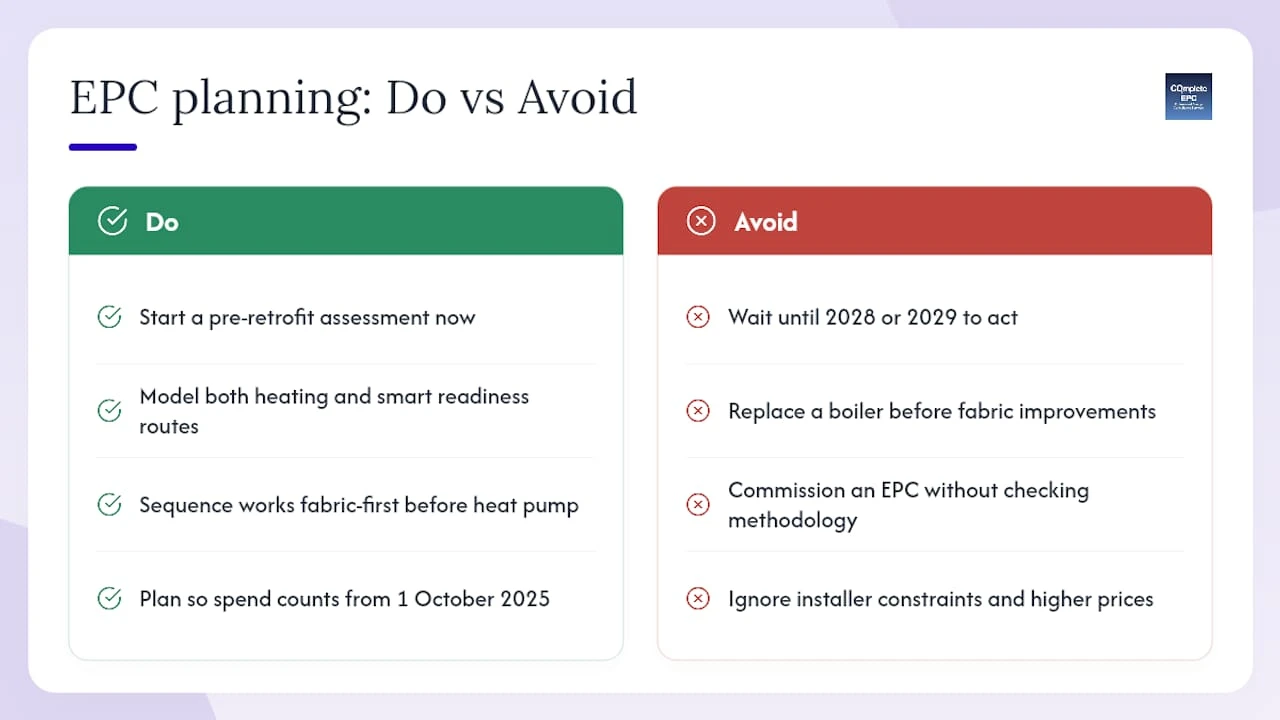
The most common mistake is treating the 2030 deadline as a 2029 problem. Landlords who wait until 2028 or 2029 to commission assessments and arrange works will face a constrained market for accredited installers, higher prices, and less time to register exemptions properly if works prove impractical.
The second mistake is sequencing. Replacing a boiler with a heat pump before addressing loft insulation and cavity walls is expensive and often counterproductive — the heat pump has to work harder in a poorly insulated building, which affects both the heating metric score and the running costs your tenant pays. Fabric first is not just a government slogan; it is the cheaper path to compliance.
There is also a subtler trap in the grandfathering rule. A property that achieves band C before 1 October 2029 under the current EER methodology is protected until that certificate expires. But if you commission a new EPC after the Home Energy Model replaces the current methodology, you will be assessed against the new dual-metric standard. Timing your assessment carefully — and understanding which methodology will apply when you commission it — can make a material difference to your compliance position and your spend.
The landlords who will navigate this most smoothly are those who start with a proper pre-retrofit assessment now, use it to model both the heating and smart readiness routes, and then sequence works to count every pound toward the cap from 1 October 2025 onwards. That is not complicated. It just requires acting before the deadline pressure arrives.
Useful official sources and further reading
The following sources are the authoritative references for landlord EPC compliance in England and Wales. Bookmark them and check for updates as the PRS Regulations move toward enactment.
- Warm Homes Plan (HTML) – GOV.UK
- Improving the energy performance of privately rented homes: government response – GOV.UK
- Domestic private rented property: minimum energy efficiency standard – landlord guidance – GOV.UK
- Warm Homes: Local Grant policy guidance – July 2026 (PDF)
- Find an energy certificate – GOV.UK
- Landlords: how to make your property more energy efficient – Which?
- EPC Changes for Landlords 2026: What’s Confirmed and What’s Coming | LettingsLedger
- Energy Efficiency (Private Rented Property) (England and Wales) Regulations 2015 – legislation.gov.uk
Check GOV.UK for regulation enactment updates in 2027. The PRS Exemptions Register and the Energy Performance of Buildings Register are both accessible via GOV.UK and should be checked regularly to confirm your entries are current and accurate.
This article provides general information about EPC regulations and is not legal or professional advice. Confirm current rules with GOV.UK or a qualified adviser before making compliance decisions.
FAQ
What are the EPC rules for landlords in England and Wales?
Landlords must hold a valid EPC rated at least E for every let property under the current MEES Regulations, provide a copy to prospective tenants, and display the rating in advertisements. From 1 October 2030, the minimum standard rises to band C under the Warm Homes Plan.
How often does a landlord need to renew an EPC?
An EPC is valid for 10 years. You must commission a new one before it expires, and also after significant works that change the property’s energy performance — particularly after retrofit works needed to demonstrate compliance with the 2030 standard.
Can a landlord be fined for not having an EPC?
Yes. Local housing authorities can issue penalty notices under the Energy Efficiency (Private Rented Property) (England and Wales) Regulations 2015. The government intends to allow fines of up to £30,000 per property under the forthcoming PRS Regulations, though that figure is stated policy and not yet enacted law.
What are the new EPC rules for landlords coming in 2030?
All privately rented homes in England and Wales must reach at least EPC band C by 1 October 2030. The new framework uses a dual-metric approach: a fabric performance standard plus either a heating system metric or a smart readiness metric. Required landlord spend is capped at £10,000 per property (including VAT), with qualifying spend counting from 1 October 2025. For properties valued below £100,000, required spend is capped at 10% of the property’s value.
Does a C-rated EPC obtained now count toward the 2030 standard?
Yes, under the grandfathering rule. A property that achieves band C under the current Energy Efficiency Rating before 1 October 2029 is treated as compliant with the 2030 standard until that certificate expires — making early action a practical planning advantage.