

If you let property in the UK you must provide a valid EPC when letting and, where the Minimum Energy Efficiency Standards (MEES) apply, ensure the property meets the minimum rating, currently E, or register a valid exemption on the PRS Exemptions Register. These duties sit alongside a bigger shift: reforms will raise the bar to EPC band C by 2030, and we can help you prepare for both.
TL;DR:
- A valid EPC lasts 10 years unless a newer certificate replaces it, and landlords must give it to prospective tenants free when marketing begins.
- The current MEES floor is band E, and costs above the £3,500 including VAT cap may qualify for exemption with at least three quotes.
- Most registered exemptions last five years, but new landlord exemptions last six months; landlords must upload evidence for the chosen category rather than rely on undocumented claims.
- By October 1, 2030, covered homes in England and Wales must reach band C under fabric and heating or smart readiness measures, with a £10,000 cap.
- Record qualifying spending from October 1, 2025, toward the future cap; an old metric band C certificate issued before October 1, 2029, remains valid until expiry.
Table of Contents
- Who the rules apply to and when an EPC is required
- EPC validity, renewal triggers and accredited assessors
- MEES today: minimum E rating and the current cost cap
- Exemptions: qualifying and registering on the PRS Exemptions Register
- Enforcement: how councils check compliance and the penalties involved
- What changes by 2030: EPC band C, new metrics and grandparenting
- Practical compliance checklist and suggested timeline for landlords
- Why work with an accredited EPC provider
- Why acting before 2030 beats waiting for the final rules
- Get your EPC sorted with Complete EPC
- FAQ
- Sources
Who the rules apply to and when an EPC is required
The duty to provide an EPC falls on the “relevant person”, usually the landlord or the person marketing a property for sale or rent. An EPC becomes necessary at three points: when a property is marketed for sale, when it is marketed to let, and at the point a tenancy begins. If you are letting a flat, house or commercial unit, a valid certificate must be available to prospective tenants free of charge, at the earliest opportunity, under government guidance on EPCs for the marketing, sale and let of dwellings.
MEES has its own history of triggers. The minimum E rating applied to new tenancies from April 2018, then extended to all existing tenancies from April 2020, creating what is often called the 2020 backstop. Since then, domestic landlords have not been able to continue letting an F or G rated home without a registered exemption.
Not every property needs an EPC. Common exclusions include:
- Listed buildings where upgrades would unacceptably alter their character.
- Buildings used as places of worship.
- Temporary structures intended for use of less than two years.
- Industrial sites and workshops with low energy demand.
- Residential buildings intended for use less than four months a year.
Checking whether your property falls inside or outside these categories is the first step before assuming MEES applies at all.
EPC validity, renewal triggers and accredited assessors
An EPC remains valid for 10 years from the date of assessment, or until a newer certificate is produced for the same building, whichever comes first, according to government guidance on EPCs for dwellings. You do not need a fresh certificate every time a tenancy renews, but several situations call for a new assessment sooner:
- Material changes to the building, such as new insulation, glazing or a heating system upgrade.
- A need to confirm the post-works rating after improvements, particularly where this supports an exemption claim.
- Marketing a property where the existing EPC has expired or is close to expiry.
When marketing a home for sale or let, guidance expects a certificate to be commissioned within a reasonable window, generally interpreted as seven days from the start of marketing, with a further 21 days allowed to produce it in cases where this proves genuinely difficult.
Only an accredited domestic or non-domestic energy assessor can legally produce an EPC, and their accreditation should be checked before booking, since the Energy Performance of Buildings Regulations set data standards that only registered assessors can meet. Our Domestic Energy Performance Certificate service and Commercial EPC service are both carried out by accredited assessors working to these standards.
MEES today: minimum E rating and the current cost cap
Since 1 April 2020, landlords have not been able to let or continue letting a domestic private rented property covered by MEES if its EPC rating falls below E, unless a valid exemption is registered, as confirmed in government MEES guidance. This single rule underpins almost every enforcement action taken against landlords in the private rented sector.
“Relevant energy efficiency improvements” are the measures that would raise a property above an F or G rating, things like loft insulation, cavity wall insulation or glazing upgrades. Under the present rules, you are only required to spend up to a cost cap of £3,500 including VAT on these measures. If quotes for the improvements needed to reach band E come in above that cap, you can register a high-cost exemption rather than carry out works that exceed it.
- Keep every quote, invoice and survey report that relates to improvement works.
- Note the date each quote was obtained, since the cap calculation depends on genuine market quotes, not estimates.
- Retain evidence even after an exemption is granted, since authorities can request it during a compliance check.
Pro Tip: Get at least three independent quotes for any improvement works before assuming a property qualifies for the high-cost exemption; a single quote is rarely accepted as sufficient evidence.
Recordkeeping matters because the cost cap calculation, and any future exemption claim, depends on being able to show what was spent and when. A folder of invoices is far more persuasive to a local authority than a verbal account of works carried out.
Exemptions: qualifying and registering on the PRS Exemptions Register
Several exemption categories exist for landlords who cannot reasonably bring a property up to band E, each requiring its own evidence:
- High cost exemption: applies when the cost of all relevant improvements exceeds the current £3,500 cap, evidenced by at least three quotes.
- All relevant improvements made: applies where every applicable measure has already been installed but the property remains below E, evidenced by invoices and a post-works survey.
- Third-party consent: applies where a tenant, freeholder or planning authority refuses consent for works, evidenced by written correspondence showing the refusal.
- Devaluation exemption: applies where an independent surveyor confirms that the improvements would reduce the property’s market value by more than 5%.
- New landlord exemption: a temporary exemption of six months for landlords who have recently become responsible for a property, such as through inheritance or a new letting.
Under current guidance from gov.uk on MEES, most exemptions last five years, though the new landlord exemption is far shorter. Reforms under discussion may extend these durations, so it is worth checking the register before assuming an old exemption has lapsed.
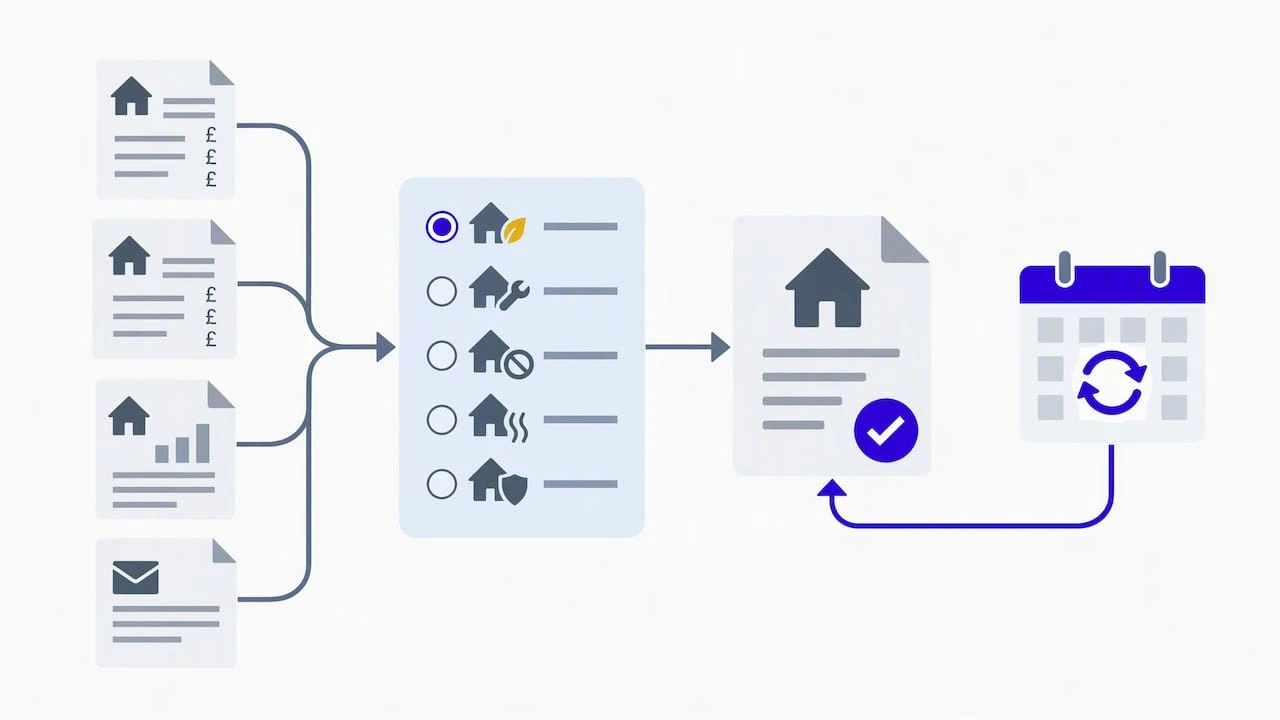
To register, landlords log in to the PRS Exemptions Register, select the relevant exemption type, and upload the supporting evidence, whether that is quotes, survey reports or correspondence. Common mistakes include registering the wrong exemption category, submitting quotes that are not independent, or failing to renew before the exemption expires. Government guidance on PRS exemptions and evidence requirements is clear that self-certifying without registering, or relying on undocumented claims, leaves landlords exposed to penalties.
Enforcement: how councils check compliance and the penalties involved
Local authorities hold the enforcement powers for MEES, and they can act on complaints, routine checks or data matching against the EPC register. Their first step is usually an information request, asking a landlord to confirm the property’s rating and exemption status.
- A compliance notice may follow if the information suggests a breach, requiring the landlord to respond with evidence within a set period.
- Confirmed breaches can lead to financial penalties, and landlord guidance on minimum standards confirms that details of the breach may also be published on the PRS Exemptions Register.
- Publication itself carries reputational weight, since letting agents and prospective tenants can see a landlord’s compliance history.
If you receive a compliance notice, the practical response is to gather every document relevant to the property’s rating: the current EPC, any quotes obtained, invoices for completed works and the exemption registration if one exists. Responding promptly with organised evidence is usually the difference between a resolved query and an escalated penalty.
What changes by 2030: EPC band C, new metrics and grandparenting
The direction of travel is clear: private rented homes in England and Wales will need to reach EPC band C by a single deadline of 1 October 2030, according to the government’s response on PRS homes energy performance. Alongside the new rating threshold comes a higher cost cap of £10,000 per property, more than double today’s £3,500 limit under current MEES rules, reflecting the scale of works some properties will need.
The assessment method is changing too. Instead of a single EPC score, the reformed approach uses a dual-metric structure: a fabric primary standard covering insulation and building performance, paired with a secondary standard that lets landlords choose between upgrading the heating system or investing in smart readiness measures. Analysis of the reforms notes that this discretion allows more tailored, and potentially lower cost, routes to compliance than a single fixed checklist.
- A C-rated EPC obtained under the outgoing Energy Efficiency Rating before 1 October 2029 is treated as compliant until that certificate expires, a mechanism known as grandparenting.
- Expenditure on relevant measures from 1 October 2025 counts towards the future £10,000 cap, so early spending is not wasted.
- The compressed runway between now and 2030 is expected to squeeze assessor and contractor availability as the deadline approaches, according to legal analysis of the reforms.
For landlords planning fabric improvements such as insulation or glazing, timing matters as much as the works themselves: measures completed now still count later, but capacity for installers may not stay this available.
Practical compliance checklist and suggested timeline for landlords
A structured approach now avoids a scramble closer to 2030.
- Audit every EPC across your portfolio and flag certificates nearing their expiry or sitting at F or G.
- Commission reformed-format EPCs where a property is due for reassessment, since these will reflect the new fabric and heating metrics earlier.
- Collect quotes for improvement works, prioritising fabric measures like insulation and glazing before secondary measures like heating upgrades.
- Log every pound spent on relevant improvements from 1 October 2025, since this expenditure counts toward the future cost cap.
- Register exemptions promptly on the PRS Exemptions Register wherever a property genuinely cannot reach the required standard yet.
- Review your portfolio annually against both the current E minimum and the approaching C target, rather than treating 2030 as a single cliff edge.
Pro Tip: Start with the properties furthest from compliance. Properties rated very poorly need attention well before those closer to compliance, and leaving the hardest cases until last is how landlords end up facing the 2030 deadline with the least time to act.
Keep a single file per property containing the current EPC, all quotes and invoices, any exemption registration, and a note of works completed since October 2025. This recordkeeping habit does more to protect you from enforcement action than any single compliance step on its own.
Why work with an accredited EPC provider
A legally valid certificate only comes from an accredited assessor working to the standards set out in the Energy Performance of Buildings Regulations. Beyond the certificate itself, a good assessment gives you recommendations that map directly onto MEES thresholds and the coming fabric and heating metrics, so you know which improvements actually move your rating rather than guessing.
- A properly produced EPC gives you evidence that holds up if a local authority ever queries your compliance status.
- Clear, prioritised recommendations help you sequence spending between now and 2030 rather than reacting to each deadline separately.
- Survey-backed evidence supports exemption claims, since quotes and reports from an accredited assessor carry more weight than informal estimates.
Our assessors produce both Domestic Energy Performance Certificates and Commercial EPCs, and we support the wider compliance picture with SAP Calculations for new builds and conversions, TM59 Overheating Assessment & TM52 Thermal Comfort Analysis, and electrical safety checks including EICR and PAT testing. Each service is designed to give you the documentation MEES and the 2030 reforms expect.
Why acting before 2030 beats waiting for the final rules
Most landlords will wait for secondary legislation to settle before spending a pound, and that instinct is understandable but costly. Expenditure on relevant measures from 1 October 2025 already counts toward the future cap, so every improvement made now is banked against what you will owe later, not lost to a rule change.
Waiting also means competing for assessors and contractors in the final years before the deadline, when demand will be at its highest. Staging investment early, starting with the properties furthest from band C, is the more practical route.
— Danny
Get your EPC sorted with Complete EPC
Meeting your current MEES duties and preparing for the 2030 reforms both start with an accurate, accredited assessment. Our Domestic Energy Performance Certificate service gives you a legally valid certificate plus the recommendations you need to support an exemption claim or plan fabric improvements that count toward the future cost cap. Where fabric upgrades involve new structural space, our construction partner’s insulated garden rooms from £18,000 are worth a look if you are weighing wider refurbishment alongside compliance works.
Book an assessment through our Domestic EPC page or get in touch for a quick quote on your portfolio.
FAQ
What are the new EPC rules for landlords?
New rules will require private rented homes in England and Wales to reach EPC band C by 1 October 2030, with a £10,000 per-property cost cap and a dual-metric assessment covering fabric performance and a choice between heating upgrades or smart readiness measures. Expenditure on relevant measures from 1 October 2025 counts toward that future cap.
Does a landlord have to provide an EPC?
Yes, a landlord must provide a valid EPC free of charge to prospective tenants at the earliest opportunity when marketing a property to let, as set out in government EPC guidance. The certificate remains valid for 10 years unless a newer one is produced first.
What are the new responsibilities of a landlord in 2026?
In 2026, landlords remain bound by the current MEES minimum of band E, with exemptions registered where genuinely needed, while the reformed EPC C requirement for 2030 is being finalised. The practical responsibility now is to audit certificates, gather quotes and start logging expenditure from 1 October 2025, since this spending will count toward the future £10,000 cap.
Is a landlord liable for a tenant’s electricity bill?
Energy performance obligations relate to the property’s EPC rating and MEES compliance, not to who pays ongoing utility bills, which is governed separately by the tenancy agreement. A well-rated property can reduce the running costs a tenant faces, but billing responsibility itself sits outside EPC and MEES rules.