

Most listed buildings in England still need an Energy Performance Certificate (EPC) when they are sold or let. The heritage exemption is narrow: it applies only where meeting minimum energy standards would unacceptably alter the building’s character or appearance, and the owner has to be able to justify that view. For London owners and landlords, the safest route is a proper assessment by a qualified assessor, because the certificate either keeps you compliant or becomes the evidence behind a well-documented exemption decision. Our domestic EPC service covers properties across London, listed ones included.
TL;DR
- A listed building is not automatically exempt. GOV.UK says an EPC is generally required when you sell or rent a property.
- The exemption applies only where compliance with minimum energy performance requirements would unacceptably alter character or appearance. The owner forms that view and keeps a record of it.
- An EPC survey of a historic building follows the standard method, so its recommendations need careful reading before any work is planned.
- The government has said it intends to remove the heritage exemption, but as of November 2026 that is policy, not law.
- The rules differ in Scotland and Northern Ireland. This guide is written for England, where our London service operates.
Table of Contents
- Do listed buildings need an EPC?
- When the listed-building exemption applies
- What an EPC assessment of a listed building involves
- What is changing: reform is policy, not yet law
- Beyond England
- Commercial listed buildings
- Promo: EPCs for listed London properties
- Preparing for the assessment
- FAQ
- Sources
Do listed buildings need an EPC?
The starting point is the Energy Performance of Buildings (England and Wales) Regulations 2012. Under them, an existing building needs an EPC when it is to be sold or rented out, and the certificate is valid for 10 years or until a newer one is produced.
Listing does not change that starting point. A professional landlords’ handbook states that listed properties and buildings in conservation areas are not necessarily exempt, that it is up to the owner to decide whether the property needs a certificate, and that if you plan to market without a valid EPC you must commission one before marketing begins.
What that means in practice:
- Selling a listed home: you need an EPC before you market it, unless the exemption genuinely applies.
- Letting a listed property: you need an EPC before the first viewing and you must give it to the tenant. Let buildings also fall under the Minimum Energy Efficiency Standards (MEES), which set a minimum E rating.
- Living in it yourself: an EPC is only compulsory if you decide to sell or market the property. Nobody has to act on the recommendations.
Listings matter too. Propertymark notes that a valid EPC rating must appear in any property listing produced by the seller, landlord or agent unless the building has a valid exemption, with a potential fine of £200 per advertisement for non-compliance.
When the listed-building exemption applies
The regulations exclude buildings protected as part of a designated environment, or for their special architectural or historical merit, insofar as compliance with minimum energy performance requirements would unacceptably alter their character or appearance. Two words carry the weight: “insofar” and “unacceptably”. The exemption is not a label that comes with the listing. It depends on what the improvements would actually do to your building.
The guidance says owners take a view and may ask the local authority’s conservation officer if in doubt. In London that means your borough’s conservation team.
How the test works in practice
The CLA, which represents rural and heritage landowners, describes a sequence that makes the position clear:
- Obtain an EPC.
- Carry out the recommendations that would not damage the building’s heritage significance.
- Obtain a second EPC.
- If the new certificate contains only recommendations that would damage heritage significance, the building is exempt and outside MEES scope.
The same article stresses that decisions should be documented carefully, and that an opinion from a chartered surveyor or accredited heritage consultant can be important supporting evidence. It also warns against treating the exemption as a way out of every improvement: works that do not harm the building still have to be done.
MEES exemptions for let property
Landlords have a separate route. Historic England explains that the domestic MEES regulations set a minimum E rating for all tenancies from April 2020, and that showing improvements would negatively impact a listed or conservation-area building is one available exemption. It is registered with supporting papers such as planning decision notices and listed building consent correspondence.
In some cases a council may ask for a written statement from the local planning authority, which can be available through its paid pre-application service. Check what your own borough offers before relying on it.
A worked example
A landlord in a Grade II listed Georgian terrace in north London wants to let the top two floors. The first EPC comes back at F. Its recommendations include internal wall insulation, replacing the sash windows with double glazing and loft insulation.
The landlord asks the conservation officer. Replacing original sashes and lining historic plaster walls would need listed building consent and would harm the fabric. Loft insulation, draught-proofing and a heating controls upgrade would not. The landlord does the three harmless measures, books a second EPC and keeps the correspondence. If only the harmful measures remain, the building falls outside the requirement. If the rating reaches E, there is nothing to exempt. Either way, the paper trail starts with an accurate first certificate.

What an EPC assessment of a listed building involves
For existing buildings, the Reduced Data Standard Assessment Procedure (RdSAP) is generally the method used. An accredited assessor physically surveys the rooms, the boiler and the loft where it is safe to do so, and features that cannot be seen are assumed from the building’s age.
That last point is where older properties are different:
- Age bands: the BRE specification sets out age bands for England and Wales, with band A being before 1900. Many listed London properties sit in the oldest band, and later extensions can fall into a newer one.
- Default U-values: U-values measure how quickly heat passes through a wall, roof or floor. The specification requires the existing values to be the default “as built” ones, and they cannot be overwritten without specific documentary evidence of the materials’ thermal conductivity.
What the assessor needs from you is simple: access to every room, the loft and the boiler, and any paperwork on past works such as insulation, new windows or a replacement boiler. Good records mean fewer assumptions in the model.
Reading the results sensibly
Histic England points out that EPC modelling can significantly underestimate the thermal performance of traditionally built homes, and that its recommendations are fabric-first and do not consider how the building is used. So treat the recommendation list as a menu to discuss, not a work order. Historic England also advises giving careful consideration to each measure, since some may be inappropriate for the character and fabric of the building.
A sensible order of work for a listed property:
- Get the EPC and note which recommendations are low-impact (draught-proofing, loft insulation, controls, lighting).
- Take anything involving windows, walls, floors or visible alterations to the conservation officer before you commit.
- Apply for listed building consent where the work needs it.
- Keep every email, decision notice and invoice.
What is changing: reform is policy, not yet law
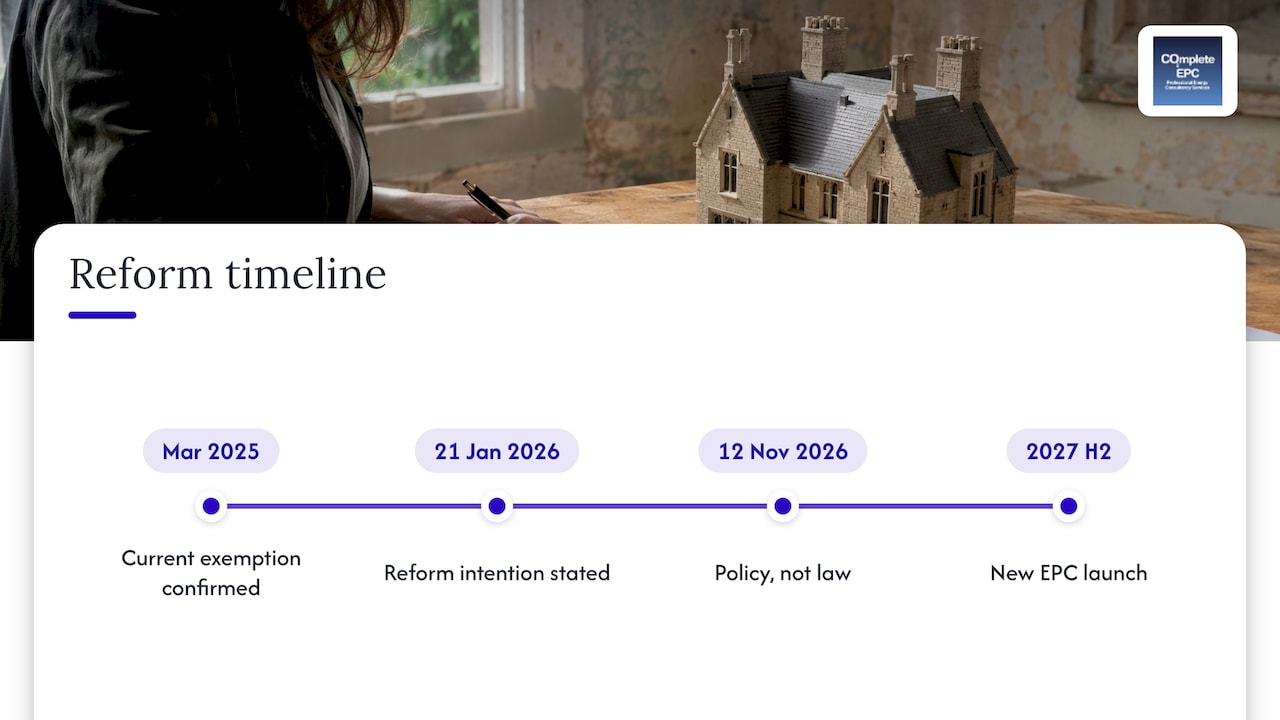
The government’s partial response of 21 January 2026 states an intention to remove the heritage exemption and to move the EPC trigger to the point of marketing. According to UKSRS’s analysis of the reform, the launch of new EPCs has moved to the second half of 2027. As of 12 November 2026 the reforms are policy rather than law, and today’s duties remain those in the 2012 Regulations.
A parliamentary written answer from March 2025 confirmed that protected buildings are currently exempt insofar as compliance would unacceptably alter their character, and that the government is proposing all heritage buildings be required to have an EPC. Under that proposal, MEES exemptions would remain available if consent cannot be obtained, or if recommendations would devalue the property by more than 5%.
For an owner, the practical reading is plain. Plan on the assumption that a certificate will be expected in future, and keep your reasoning on file today. A valid certificate now lasts 10 years, so one commissioned for a current sale or let is not wasted if the rules tighten.
Beyond England
The rules are not the same across the UK. In Scotland, places of worship and historic buildings are not subject to a general EPC exemption unless they fall into another listed exception. In Northern Ireland a landlord needs a valid EPC to market and let, but there is no minimum rating requirement. If you own property outside England, check the rules for that nation before acting on anything here.
Commercial listed buildings
Shops, offices and other commercial premises in listed buildings sit in the same legal framework in England, and the same test applies: the exemption covers only what compliance would unacceptably alter. If you own a listed commercial unit in London that you plan to sell or let, a commercial EPC is where to begin. If air conditioning is fitted, a TM44 inspection may also be relevant.
Promo: EPCs for listed London properties
Complete EPC provides domestic and commercial EPCs across London, with qualified assessors and practical energy-saving advice in every report. We also stand behind a UK lowest-rate guarantee. If you are selling or letting a listed home, our domestic EPC service gives you the certificate you need to market the property, and the starting point for any exemption decision.
If you are converting or extending a listed building, we also carry out SAP calculations and prepare energy statements for planning.
Our view on listed building EPCs
Owners of listed properties often tell us they assume the building is exempt and so never look into it. We think that is the costlier route. The exemption is conditional, it rests on your own judgement, and that judgement is much stronger when it is built on a real certificate and a clear list of what could and could not be done.
Our approach is to treat the EPC as a working document. Our qualified assessors survey the property, and the report’s practical advice shows you which improvements are low-impact and which need a conversation with the conservation officer. That separates the sensible measures from the ones that would harm a period home.
We would also not wait for the rules to change. The government has said it wants heritage buildings to need an EPC, and a certificate lasts 10 years. A listed property that already has one, with a file showing why certain measures were not pursued, is ready for either outcome.
Danny
Preparing for the assessment
A few steps make the visit quicker and the result more accurate:
- Clear access to every room, the loft hatch and the boiler.
- Documents for any insulation, glazing, boiler or heating control upgrades, with dates.
- Details of extensions and when they were built.
- Any listed building consent decisions already on file.
If you manage several London properties, this routine is worth repeating across the portfolio. Keep each certificate’s date and recommendations in one place so a sale or new tenancy is never delayed.
FAQ
Are listed buildings exempt from EPCs?
Not automatically. In England and Wales the exclusion applies only insofar as meeting minimum energy performance requirements would unacceptably alter the building’s character or appearance. The owner forms that view, and the conservation officer can advise if you are unsure. Keep notes of your reasoning.
Do I need an EPC to sell a listed house?
Generally yes. GOV.UK says an EPC is required when you sell or rent a property, and the exemption is limited to cases where the required work would unacceptably alter the building. A certificate must be commissioned before marketing begins, so the rating can appear in the listing.
Can I rent out a listed building rated F or G?
Let buildings fall under MEES, which require a minimum E rating. Landlords can register an exemption where improvements would negatively impact a listed or conservation-area building, supported by documents such as listed building consent correspondence. Speak to the conservation officer in your borough about what is possible.
How long does a listed building EPC last?
The certificate is valid for 10 years or until a newer one is produced. If you carry out improvements, a new assessment records the better rating.
Will the EPC suggest changes I cannot make to a listed building?
It may. The assessment uses a standard method that can recommend measures unsuited to period fabric, so consider each one carefully and discuss anything visible or structural with the conservation officer before you commit.
Sources
- Selling a home: Energy Performance Certificates, GOV.UK
- A guide to Energy Performance Certificates for the marketing, sale and let of dwellings, GOV.UK
- Energy Performance Certificates (EPC), Landlords’ Guild of England
- EPCs must feature in property listings, Propertymark
- In Focus: Energy performance certificates (EPCs) and listed buildings, CLA
- EPCs, Minimum Energy Efficiency Standards and Old Houses, Historic England
- Energy Performance Certificates, Historic England
- Energy efficiency and historic buildings, Mid Suffolk Council
- RdSAP10 Specification, BRE
- EPC Reform: What Is Decided and What Is Law, UKSRS
- Written question HL5696, UK Parliament
- Exceptions, Energy Performance Certificates guide, gov.scot
- EPC, NI Landlord Hub