
Many London property owners feel uncertain when tackling energy efficiency for the first time. Understanding the Passive House standard is key to creating homes that stay warm with minimal heating and meet rising performance expectations. With over 30,000 buildings worldwide proving its success, this method combines airtight design, advanced insulation, and smart ventilation to keep interiors comfortable and energy bills low. Discover how Passive House principles could improve sustainability and help your property move closer to strong EPC compliance.
Table of Contents
- What Defines A Passive House?
- Essential Design Principles And Standards
- Types Of Passive Houses In The UK
- Benefits For London Property Owners
- Costs, EPC Implications, And Common Pitfalls
Key Takeaways
| Point | Details |
|---|---|
| Passive House Standards | Achieving Passive House certification involves meeting rigorous energy performance criteria, promoting sustainability and comfort in buildings. |
| Diverse Applications | The Passive House approach can be applied to both new builds and retrofitting existing buildings, demonstrating its versatility across various architectural contexts. |
| Financial Benefits | Property owners can experience significant energy cost reductions and increased property value, making Passive House standards a smart investment. |
| Expert Collaboration | Engaging a certified Passive House consultant early in the design process is crucial for ensuring compliance with standards and optimising building performance. |
What Defines A Passive House?
Passive House is an internationally recognised building standard focused on extraordinary energy efficiency and thermal comfort. Originating in Germany, this design approach represents a radical reimagining of architectural performance, where buildings can maintain optimal indoor temperatures with minimal external heating or cooling systems.
The core principles of Passive House revolve around five fundamental criteria that transform traditional construction methods:
- Ultra-high insulation that minimises thermal bridging
- Airtight building envelope preventing uncontrolled air leakage
- High-performance windows with exceptional thermal characteristics
- Mechanical ventilation with heat recovery systems
- Solar orientation maximising natural heat gain
The Passivhaus Trust highlights that this approach is not merely theoretical but a proven method, with over 30,000 buildings worldwide demonstrating its effectiveness. Unlike conventional buildings, Passive Houses maintain interior comfort through intelligent design rather than energy-intensive mechanical systems.
To achieve certification, buildings must meet stringent performance standards. These include maintaining maximum space heating demand below 15 kilowatt-hours per square metre annually, ensuring total primary energy demand remains under 120 kilowatt-hours per square metre, and achieving exceptional airtightness measured through pressurisation tests.
Passive House represents a transformative approach to building design, prioritising human comfort and environmental sustainability simultaneously.
Pro tip: Consider consulting a Passive House specialist during early design stages to integrate these principles most effectively into your London property.
Essential Design Principles And Standards
The Passive House design approach is underpinned by a comprehensive set of rigorous principles that transform traditional building construction. Passivhaus principles establish a systematic framework ensuring exceptional energy performance and occupant comfort through precise architectural and engineering strategies.
Eight foundational principles guide Passive House design, with five critical building components forming the core technical approach:
- High-performance insulation creating thermal resistance
- Continuous airtight layer preventing uncontrolled air infiltration
- Thermal bridge minimisation reducing heat transfer points
- Advanced window technologies with superior thermal characteristics
- Mechanical ventilation incorporating heat recovery systems
The certification process demands meticulous attention to detail, utilising sophisticated computational modelling through the Passivhaus Planning Package (PHPP). This specialised software enables architects and engineers to simulate building performance with unprecedented accuracy, predicting energy consumption and thermal dynamics before construction begins.
United Kingdom regulatory frameworks are increasingly recognising these standards, with future building regulations likely to incorporate Passive House performance criteria. UK Building Regulations are moving towards mandating fabric-first approaches and quality assurance systems that align closely with Passive House methodology.
Passive House standards represent a transformative approach to architectural design, prioritising energy efficiency and human comfort simultaneously.
Pro tip: Engage a certified Passive House consultant early in your project to ensure optimal design integration and compliance with emerging UK building performance standards.
Types Of Passive Houses In The UK
Passive House design in the United Kingdom has evolved to encompass diverse building types, addressing both new construction and existing building retrofit challenges. Social housing projects have become particularly significant in demonstrating the practical applications of this energy-efficient standard across different architectural contexts.
The primary categories of Passive House implementations in the UK include:
- New Build Homes designed from ground up to meet Passive House standards
- Retrofit Dwellings utilising EnerPHit certification for existing buildings
- Multi-Unit Residential Developments
- Social Housing Complexes
- Commercial and Public Buildings
Notable examples showcase the versatility of Passive House standards across urban landscapes. Norwich’s Goldsmith Street represents a landmark development featuring over 100 certified homes, while Camden’s Agar Grove Estate demonstrates successful large-scale retrofit strategies. These projects highlight the adaptability of Passive House principles to various architectural contexts, from dense urban environments to suburban settings.
Urban passive housing projects are increasingly prevalent in London and Scotland, reflecting a strategic approach to addressing climate goals and mitigating fuel poverty. The designs consistently incorporate advanced technologies such as super insulation, airtight construction, triple-glazed windows, and mechanical ventilation with heat recovery (MVHR) systems.
The table below contrasts key aspects of Passive House new builds versus retrofits in the UK:
| Aspect | New Build Passive House | Retrofit (EnerPHit) |
|---|---|---|
| Design Freedom | Full architectural flexibility | Constrained by existing structure |
| Certification Target | Certified Passive House | EnerPHit (retrofit standard) |
| Typical Cost Impact | 8-9% above standard new build | Variable, often higher due to complex detailing |
| Main Challenge | Meeting tight performance targets | Addressing thermal bridges, airtightness |
| Example Project | Goldsmith Street, Norwich | Agar Grove Estate, Camden |
Passive House standards represent a flexible architectural approach, capable of transforming both new and existing buildings across diverse UK environments.
Pro tip: Consult local Passive House specialists to understand which certification type best suits your specific property and location in the UK.
Benefits For London Property Owners
Passive House standards offer London property owners a comprehensive suite of advantages that extend far beyond traditional energy efficiency strategies. Significant financial benefits transform these properties into smart, sustainable investments that deliver long-term value and comfort.
The primary benefits for London property owners include:
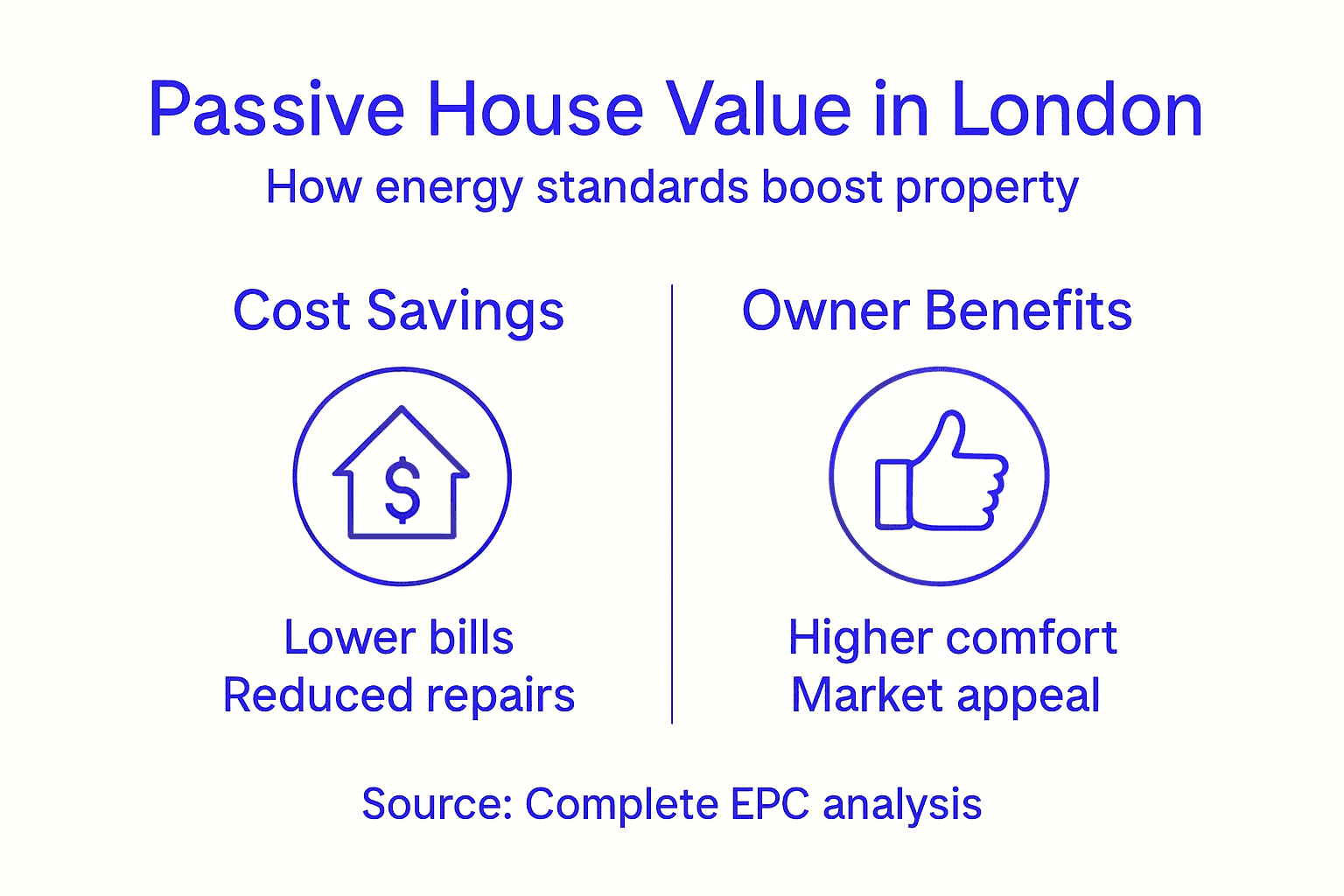
- Dramatic Energy Cost Reduction with potential savings up to 90% on heating expenses
- Enhanced Property Value through superior construction quality
- Improved Indoor Environmental Quality
- Reduced Carbon Footprint
- Protection Against Future Energy Price Fluctuations
London’s unique urban landscape makes Passive House principles particularly attractive. These properties maintain consistent internal temperatures, providing exceptional thermal comfort through advanced insulation and airtight design. The triple-glazed windows not only improve energy efficiency but also significantly reduce external noise, creating a peaceful living environment in bustling city settings.
Energy efficiency trends suggest that London’s property market is increasingly valuing high-performance buildings. Passive House certification signals a property’s commitment to sustainability, potentially attracting environmentally conscious buyers and commanding premium prices in competitive real estate markets.
The following table offers a condensed summary of primary benefits for London property owners considering Passive House standards:
| Benefit Area | Immediate Impact | Long-Term Value |
|---|---|---|
| Energy Costs | Substantial heating savings | Resilience against rising prices |
| Comfort | Consistent indoor temperatures | Improved health and wellbeing |
| Noise Insulation | Reduced outside noise | Attractive in urban locations |
| Property Value | High-performance quality | Market premium for sustainability |
| Environmental Impact | Lower carbon footprint | Contribution to city climate goals |
Passive House represents more than an energy standard; it’s a comprehensive approach to creating healthier, more comfortable living spaces.
Pro tip: Consult an energy performance specialist to understand how Passive House certification could specifically enhance your London property’s market value.
Costs, EPC Implications, And Common Pitfalls
Investing in a Passive House standard requires careful financial planning and understanding of potential challenges. Passivhaus Trust research.pdf) indicates that initial construction costs typically run 8-9% higher than conventional building projects, a crucial consideration for London property owners.
Key financial and technical considerations include:
- Initial Construction Premium typically 8-9% above standard builds
- Long-term Energy Cost Savings offsetting initial investment
- Potential EPC Rating Improvements
- Complex Certification Requirements
- Specialised Design and Construction Expertise Needed
Common pitfalls in Passive House implementation often stem from inadequate early planning and lack of specialist knowledge. Contractors unfamiliar with the stringent standards can introduce design inefficiencies that compromise the building’s performance, potentially negating the expected energy savings and certification potential.
The Energy Performance Certificate (EPC) implications are significant, with Passive House standards potentially elevating a property’s rating dramatically. Careful design integration, early engagement with certification experts, and commitment to precise construction techniques are essential for successfully navigating the complex landscape of high-performance building standards.
Successful Passive House implementation requires a holistic approach, balancing technical precision with strategic financial planning.
Pro tip: Engage a certified Passive House consultant during initial design stages to minimise unexpected costs and maximise performance potential.
Elevate Your London Property with Expert Energy Performance Certification
Understanding Passive House principles reveals the critical need for precise energy efficiency evaluation to maximise property value and reduce long-term costs. The article highlights challenges such as meeting stringent airtightness standards, optimising insulation, and enhancing EPC ratings. For London property owners committed to sustainable investment and comfort, addressing these issues early is essential.
Complete EPC specialises in providing comprehensive Energy Performance Certificates that align with Passive House ambitions and emerging UK building regulations. Our qualified assessors deliver detailed reports identifying improvements that can significantly boost your property’s appeal and market value. With our competitive pricing and expertise, we help you navigate complexities around EPC upgrades and compliance efficiently.
Ready to transform your property with proven energy strategies? Visit Complete EPC now and secure a tailored assessment that supports your Passive House goals and adds measurable value to your London investment.
Frequently Asked Questions
What is a Passive House?
A Passive House is a building designed to achieve high energy efficiency and comfort, using minimal external heating or cooling systems while maintaining optimal indoor temperatures.
How does a Passive House increase property value?
A Passive House increases property value through superior construction quality, substantial energy cost reduction, and enhanced indoor environmental quality, making it more attractive to environmentally conscious buyers.
What are the main benefits of investing in a Passive House?
Investing in a Passive House can lead to dramatic energy cost savings, improved indoor comfort, reduced carbon footprint, and protection against future energy price fluctuations.
What are the common pitfalls in building a Passive House?
Common pitfalls include inadequate early planning, lack of specialist knowledge, and design inefficiencies due to unfamiliarity with Passive House standards, which can compromise energy savings and certification potential.
Recommended
- Energy Efficiency Barriers – Overcoming Obstacles in London
- Energy Efficiency Steps for London Properties Made Simple
- London’s Guide to EPC: What You Need to Know to Boost Property Value – Complete EPC
- Thermal Efficiency: Impact on EPC Ratings and Costs
- Thermal Waterproofing: Complete Guide for Property Owners