

London landlords face mounting pressure as legal standards for property energy efficiency tighten every year. Staying compliant is not just about avoiding fines but also about protecting your investment in one of the world’s most competitive property markets. EPC recommendation reports offer clear guidance on practical improvements that cut energy costs and boost property value, helping you prioritise upgrades that make the biggest difference for both compliance and long-term returns.
Table of Contents
- Defining Recommendation Reports In EPCs
- Types Of Energy Efficiency Recommendations
- How Recommendation Reports Are Created
- Legal Role In Landlord Compliance
- Maximising Property Value With Recommendations
Key Takeaways
| Point | Details |
|---|---|
| Recommendation Reports Are Essential | These reports provide strategic insights for property owners to enhance energy efficiency and understand potential upgrades. |
| Legal Compliance Is Crucial | Landlords must adhere to the Domestic Minimum Energy Efficiency Standard (MEES) to avoid penalties and ensure properties meet required energy ratings. |
| Targeted Improvements Maximise Value | Implementing recommended upgrades can significantly increase property marketability and potentially enhance resale value while reducing energy consumption. |
| Professional Guidance Is Advisable | Consulting with qualified energy assessors is recommended to develop tailored improvement strategies for optimal energy performance and property value enhancement. |
Defining Recommendation Reports in EPCs
A recommendation report in an Energy Performance Certificate (EPC) is a detailed document that provides targeted insights into improving a property’s energy efficiency. These reports are designed to help property owners and landlords understand potential upgrades that can reduce energy consumption and enhance the building’s overall performance.
EPC recommendation reports typically focus on a comprehensive fabric-first approach to energy improvements, which means prioritising improvements to the building’s core structure and systems before considering additional technological solutions.
Key features of recommendation reports include:
- Detailed assessment of current energy performance
- Specific suggested upgrades for improving efficiency
- Estimated costs and potential energy savings
- Prioritised list of recommended improvements
- Carbon emission reduction strategies
These reports are not merely suggestions but strategic roadmaps for property owners seeking to enhance their building’s energy performance. They provide a structured approach to understanding potential upgrades, their financial implications, and long-term benefits.
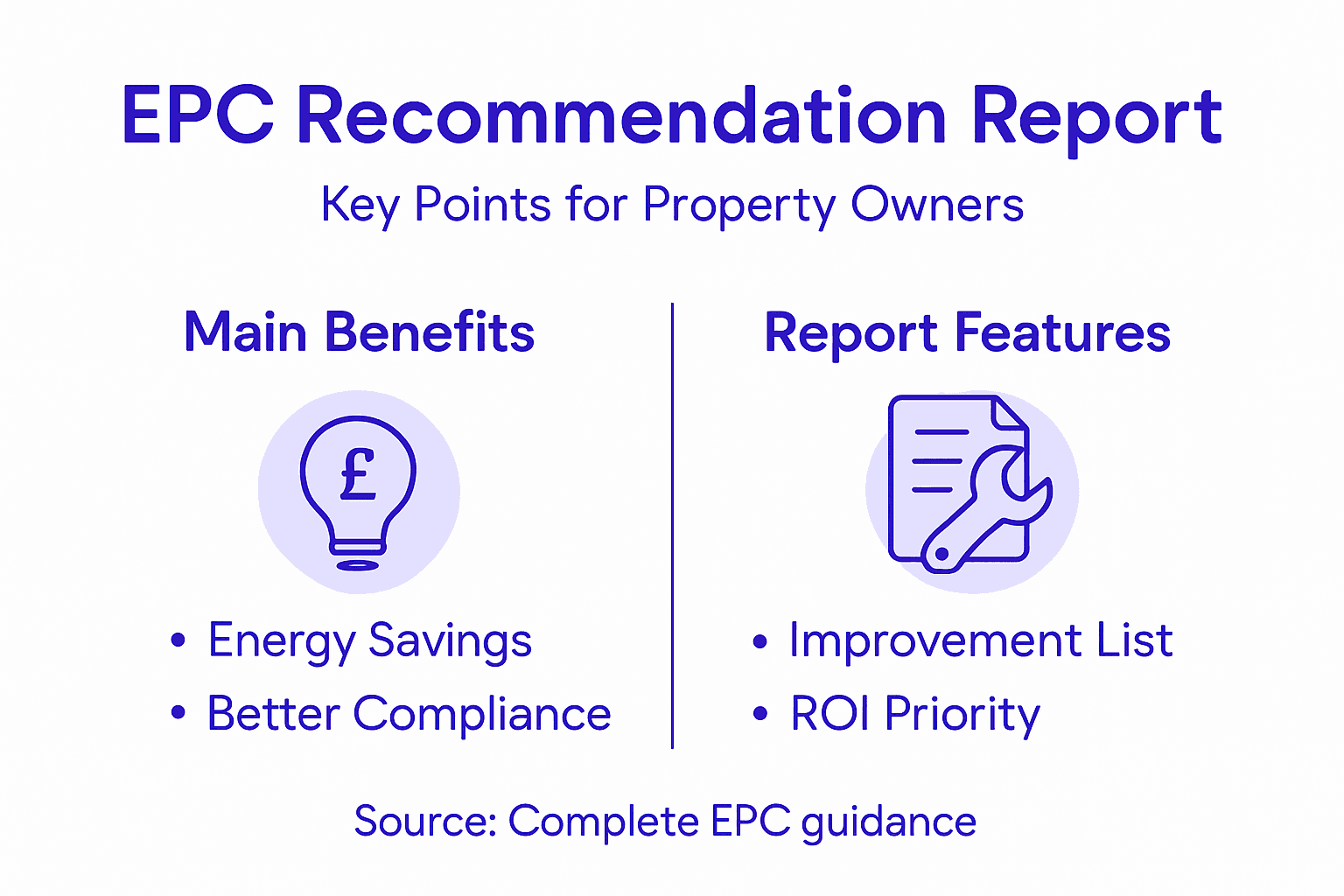
Pro tip: Review your EPC recommendation report carefully and prioritise improvements with the highest potential return on investment and energy savings.
Types of Energy Efficiency Recommendations
EPC recommendation reports offer a comprehensive range of energy efficiency improvements categorised by complexity and potential impact. These recommendations are strategically designed to help property owners progressively enhance their building’s energy performance through targeted upgrades.
The recommendations typically span multiple categories, ranging from simple, low-cost interventions to more substantial structural improvements. Energy efficiency recommendations can be broadly classified into several key types:
-
Lighting Upgrades
- Switching to LED bulbs
- Installing motion sensors
- Maximising natural lighting
-
Insulation Improvements
- Cavity wall insulation
- Loft insulation
- Floor insulation
- Draught-proofing windows and doors
-
Heating System Enhancements
- Upgrading to high-efficiency boilers
- Installing smart heating controls
- Implementing zoned heating systems
- Adding thermostatic radiator valves
-
Renewable Energy Solutions
- Solar panel installations
- Heat pump systems
- Solar water heating
Property owners should understand that these recommendations are typically prioritised based on potential energy savings, cost-effectiveness, and ease of implementation. Some improvements require minimal investment and can be completed quickly, while others represent more significant long-term infrastructure investments.
Pro tip: Prioritise energy efficiency recommendations that offer the fastest return on investment and align with your property’s specific structural characteristics.
How Recommendation Reports Are Created
Creating an Energy Performance Certificate (EPC) recommendation report is a meticulous process that involves comprehensive property assessment and sophisticated energy analysis. Qualified assessors conduct a systematic evaluation of a building’s energy performance, examining multiple critical aspects of its construction and operational characteristics.
The assessment process begins with a detailed on-site inspection, where assessors collect specific data about the property’s physical attributes. EPC methodology changes are continually refining this process to improve accuracy and relevance. During the inspection, assessors typically document and analyse:
-
Structural Elements
- Wall construction and insulation
- Roof and loft characteristics
- Window and door specifications
- Floor construction
-
Heating Systems
- Boiler type and efficiency
- Heating controls
- Radiator configurations
- Hot water systems
-
Additional Energy Features
- Lighting installations
- Renewable energy systems
- Ventilation mechanisms
- Thermal bridging points
After collecting comprehensive data, assessors use specialised software to model the property’s energy performance. This computational analysis generates a detailed report that not only provides an energy efficiency rating but also recommends specific improvements tailored to the property’s unique characteristics.
The recommendation report transforms raw data into actionable insights, helping property owners make informed decisions about energy efficiency upgrades.
The final recommendation report ranks suggested improvements based on potential energy savings, cost-effectiveness, and implementation complexity. This strategic approach ensures property owners receive practical, prioritised guidance for enhancing their building’s energy performance.

Pro tip: Request a comprehensive walkthrough of your EPC recommendation report to fully understand each suggested improvement and its potential impact.
Legal Role in Landlord Compliance
Landlords in the United Kingdom face increasingly stringent legal obligations regarding energy performance and property efficiency. The Domestic Minimum Energy Efficiency Standard (MEES) establishes clear regulatory requirements that directly impact rental property management and compliance.
Minimum Energy Efficiency Standards impose critical legal responsibilities on landlords, with specific requirements that must be carefully navigated. These standards establish key legal obligations:
-
Certificate Requirements
- Obtain valid Energy Performance Certificate (EPC)
- Display EPC at property marketing stage
- Provide EPC to prospective tenants
- Ensure EPC rating meets minimum standards
-
Compliance Thresholds
- Current minimum EPC rating: Band E
- Projected minimum rating: Band C by 2030
- Mandatory for all new tenancies
- Applies to existing tenancy agreements
-
Potential Legal Consequences
- Fines up to £5,000 for non-compliance
- Prohibition from legally letting property
- Invalidation of section 21 notices
- Potential legal disputes with tenants
The legal framework surrounding EPCs is designed to progressively improve the energy efficiency of rental properties, creating a structured pathway for landlords to upgrade and maintain their buildings. Landlords must proactively manage their properties to meet these evolving standards, understanding that compliance is not just a legal requirement but also a significant factor in property value and tenant satisfaction.
Legal compliance with energy efficiency standards is no longer optional but a fundamental requirement for responsible property management.
Understanding and implementing these requirements requires careful planning and strategic investment in property improvements. Landlords must view EPC recommendations not as a burden, but as a roadmap to enhancing their property’s performance and market attractiveness.
This table compares key legal requirements for landlords under the MEES regulations:
| Requirement | Current Standard | Future Changes (by 2030) | Penalty for Non-Compliance |
|---|---|---|---|
| Minimum EPC Rating | Band E | Band C | Up to £5,000 fine |
| Applies To | New & existing tenancies | All new & existing tenancies | Letting prohibited, legal risks |
| Certificate Provision | At marketing and let | Ongoing, stricter enforcement | Section 21 invalidation |
Pro tip: Consult with an energy assessment professional annually to stay ahead of changing regulatory requirements and potential compliance issues.
Maximising Property Value with Recommendations
EPC recommendation reports are powerful tools for property owners seeking to enhance their real estate’s market value and attractiveness. By strategically implementing suggested energy efficiency improvements, landlords and homeowners can transform their properties into more desirable, cost-effective assets.
Energy efficiency upgrades offer multiple pathways to increasing property value. These recommendations provide a structured approach to property enhancement that appeals to environmentally conscious buyers and tenants.
Key strategies for maximising property value include:
-
Quick Win Improvements
- LED lighting installations
- Draught-proofing windows and doors
- Smart thermostat implementation
- Loft insulation top-ups
-
Substantial Value-Adding Upgrades
- Cavity wall insulation
- High-efficiency boiler replacement
- Double or triple glazing
- Solar panel installations
- Heat pump systems
-
Market Perception Benefits
- Lower running costs
- Enhanced energy performance rating
- Reduced carbon footprint
- Increased tenant/buyer appeal
- Potential rental income premium
Implementing these recommendations demonstrates a proactive approach to property management. Potential buyers and tenants increasingly value energy-efficient properties, recognising the long-term financial and environmental benefits.
Here’s a summary of how different EPC upgrades impact both energy savings and property value:
| Upgrade Type | Typical Energy Saving | Impact on Property Value | Implementation Complexity |
|---|---|---|---|
| LED lighting | 5–10% | Low, but improves appeal | Simple, quick to install |
| Loft insulation | Up to 15% | Moderate, attracts buyers | Moderate, quick to implement |
| High-efficiency boiler | 10–20% | High, long-term cost reduction | More involved, some disruption |
| Cavity wall insulation | Up to 15% | High, boosts EPC rating | Moderate, some disruption |
| Solar panels | Up to 20% | High, offers long-term savings | Complex, higher upfront cost |
Strategic energy efficiency improvements can significantly increase a property’s marketability and potential resale value.
While implementing recommendations, property owners should carefully balance cost-effectiveness with potential returns. Not all upgrades will yield identical value increases, so prioritising improvements based on potential impact is crucial.
Pro tip: Consult with a professional energy assessor to develop a tailored improvement strategy that maximises both your property’s value and energy performance.
Unlock the Full Potential of Your EPC Recommendation Report
Understanding a recommendation report for EPCs can feel overwhelming when faced with complex details about improving energy efficiency and legal compliance. Property owners and landlords often struggle with prioritising upgrades that offer the best return on investment while ensuring their properties meet current and future legal standards like the Domestic Minimum Energy Efficiency Standard (MEES). It is common to feel uncertain about which improvements to implement first and how to navigate the legal landscape effectively.
At Complete EPC, we specialise in turning these challenges into clear, actionable plans. Our team of qualified assessors provides detailed EPC assessments coupled with personalised recommendation reports tailored to your property’s unique characteristics. We help you identify cost-effective upgrades such as insulation improvements or heating system enhancements that maximise energy savings and property value. Benefit from professional guidance that aligns with your compliance obligations and supports long-term sustainability goals.
Take control of your property’s energy future today with expert advice from Complete EPC. Visit our website to book your comprehensive energy performance assessment and receive a strategic recommendation report that empowers you to make informed decisions. Don’t wait until regulatory deadlines approach—act now to enhance efficiency, comply confidently, and increase your property’s market appeal.
Frequently Asked Questions
What is a recommendation report in an Energy Performance Certificate (EPC)?
A recommendation report in an EPC is a detailed document outlining specific insights and strategies for improving a property’s energy efficiency, including suggested upgrades and estimated costs.
How are recommendation reports created for EPCs?
Recommendation reports are created through a thorough on-site inspection of the property by qualified assessors. They collect data on structural elements and energy systems, followed by computational analysis using specialised software to generate tailored recommendations.
What types of improvements are typically suggested in EPC recommendation reports?
Improvements suggested in EPC recommendation reports usually include upgrades in lighting, insulation, heating systems, and renewable energy solutions, all prioritised based on potential energy savings and cost-effectiveness.
Why are EPC recommendation reports important for landlords?
EPC recommendation reports are crucial for landlords as they provide a roadmap for compliance with energy efficiency regulations, ensuring properties meet legal standards while enhancing marketability and tenant appeal.