

Every property owner in Greater London faces the challenge of meeting strict energy regulations while striving to reduce running costs. As the foundation of energy performance assessments, the Standard Assessment Procedure, or SAP, shapes how landlords prove compliance with British EPC requirements. Understanding the difference between a SAP score and actual energy bills is essential, as the score reflects expected energy efficiency under standardised conditions rather than personal usage or monthly costs. This guide brings clarity to common misconceptions and gives you the practical insights needed to maximise your property’s energy rating.
Table of Contents
- Defining SAP Scores And Common Misconceptions
- SAP Score Calculation For UK Homes
- SAP Vs EPC Bands: Key Distinctions
- Legal Requirements For SAP In London
- Practical Steps For Improving SAP Ratings
Key Takeaways
| Point | Details |
|---|---|
| Understanding SAP Scores | SAP scores range from 1 to 100, indicating a property’s energy performance, with higher scores reflecting better efficiency. |
| Common Misconceptions | Many property owners mistakenly believe SAP scores predict exact energy bills or guarantee lower costs; they instead reflect estimated efficiency under standard conditions. |
| SAP vs EPC Bands | SAP scores offer detailed technical insights, whereas EPC bands simplify this data into an easy-to-understand letter grade, with ‘A’ being the best rating. |
| Improving SAP Ratings | Property owners can enhance SAP ratings by upgrading insulation, installing efficient heating systems, and integrating renewable energy sources. |
Defining SAP Scores and Common Misconceptions
The Standard Assessment Procedure (SAP) is the cornerstone of energy performance evaluation for residential properties in the United Kingdom. Developed as a comprehensive method to assess dwelling energy efficiency, SAP scores provide a standardised approach to understanding how buildings consume and retain energy.
At its core, the SAP score is a numerical rating system that ranges from 1 to 100, with higher numbers indicating superior energy performance. SAP performance database calculations consider multiple critical factors, including:
- Building fabric insulation quality
- Heating system efficiency
- Lighting installations
- Renewable energy technologies
- Thermal characteristics of construction materials
Many property owners misunderstand SAP scores, believing they directly represent monthly energy bills or guarantee specific performance levels. In reality, these scores reflect expected energy efficiency under standardised conditions, not personalised consumption patterns.
SAP scores are designed to provide an objective, comparable assessment of a property’s energy performance, not predict exact utility costs.
Energy performance calculations involve complex modelling that assumes standard occupancy and usage scenarios. This means the actual energy consumption can vary significantly based on individual household behaviours, number of occupants, and specific usage patterns.
Key misconceptions about SAP scores include:
- Believing they are exact utility bill predictors
- Assuming higher scores guarantee lower energy costs
- Thinking SAP ratings remain constant indefinitely
- Misunderstanding the difference between SAP scores and EPC ratings
Pro-tip: When interpreting SAP scores, always consider them as a relative indicator of energy efficiency rather than a precise financial forecast.
SAP Score Calculation for UK Homes
The Standard Assessment Procedure (SAP) represents a sophisticated methodology for evaluating residential energy performance across the United Kingdom. Home energy models provide comprehensive frameworks for assessing dwelling efficiency through intricate computational processes that consider multiple technical parameters.
SAP calculations involve a complex evaluation of several critical building characteristics:
- Thermal insulation quality
- Heating system configuration
- Ventilation characteristics
- Renewable energy integration
- Construction material thermal properties
- Windows and doors energy performance
- Overall building envelope efficiency
The numerical scoring system ranges from 1 to 100, with higher numbers indicating superior energy efficiency. Each point represents a nuanced assessment of how effectively a property conserves and utilises energy resources.
SAP calculations provide an objective, standardised approach to understanding residential energy performance beyond simple consumption metrics.
Professional energy assessors employ detailed computational techniques to generate these scores, considering factors that extend well beyond basic utility consumption. The methodology accounts for variations in building design, technological installations, and potential energy-saving interventions.
Key components influencing SAP score calculations include:
- Precise building fabric measurements
- Comprehensive heating system analysis
- Detailed assessment of thermal bridging
- Evaluation of potential heat loss points
- Analysis of renewable energy potential
Pro-tip: Engage a qualified energy assessor who understands the intricate nuances of SAP calculations to obtain the most accurate and comprehensive property assessment.

SAP vs EPC Bands: Key Distinctions
Understanding the relationship between Standard Assessment Procedure (SAP) scores and Energy Performance Certificate (EPC) bands is crucial for property owners and energy assessors. EPC assessment methodologies reveal the nuanced distinctions between these two interconnected yet distinctly different evaluation systems.
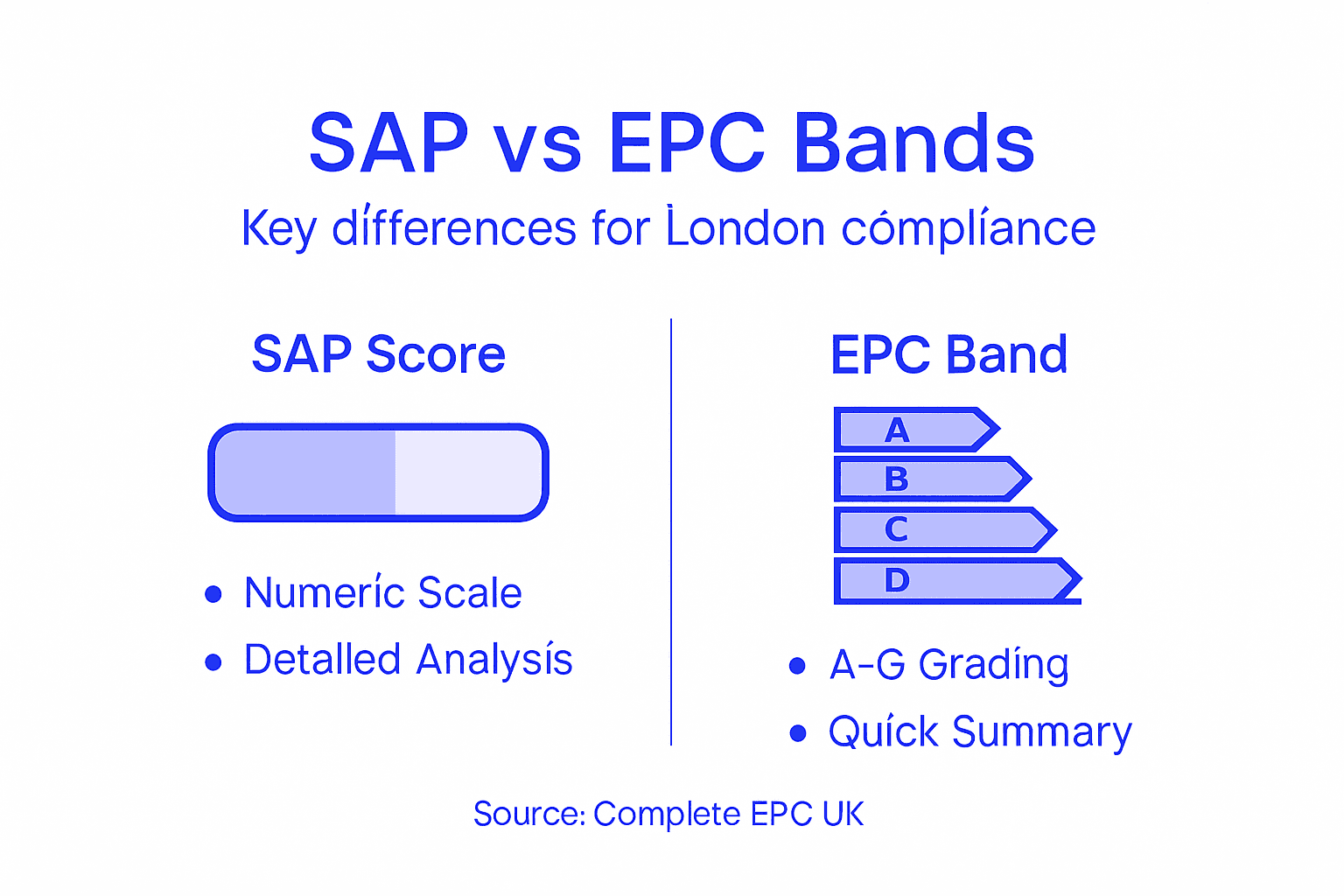
The fundamental differences between SAP scores and EPC bands include:
- SAP provides a detailed numerical score (1-100)
- EPC bands offer a simplified letter-grade representation (A-G)
- SAP scores enable precise technical analysis
- EPC bands serve as a consumer-friendly communication tool
- SAP calculations include more comprehensive technical parameters
Numeric SAP scores are transformed into EPC bands through a standardised conversion process. A score of 92-100 typically corresponds to an ‘A’ rating, while scores below 20 result in an ‘G’ rating, representing the least energy-efficient properties.
EPC bands distill complex energy performance data into an easily comprehensible format for property owners and potential buyers.
While SAP scores offer granular insights into a property’s energy characteristics, EPC bands provide a quick visual representation of overall efficiency. Professional energy assessors use SAP calculations to generate the precise numeric foundation that ultimately determines the broader EPC classification.
Here is a concise comparison of SAP scores and EPC bands to clarify their distinct roles:
| Aspect | SAP Score (1-100) | EPC Band (A-G) |
|---|---|---|
| Format | Detailed numeric rating | Alphabetical letter grade |
| Primary Purpose | Technical efficiency assessment | Broad consumer communication |
| Typical Users | Energy assessors, professionals | Homebuyers, renters |
| Influence on Valuation | Provides exact figures | Offers quick efficiency check |
| Conversion Process | Calculated from numerous inputs | Derived from SAP score |
Key comparative aspects of SAP scores and EPC bands include:
- Technical depth of SAP numerical analysis
- Simplified communication of EPC letter grades
- Regulatory compliance requirements
- Property valuation implications
- Energy improvement potential assessment
Pro-tip: Request a detailed breakdown of your SAP score alongside your EPC rating to gain comprehensive insights into your property’s energy performance.
Legal Requirements for SAP in London
The legal landscape surrounding Standard Assessment Procedure (SAP) compliance in London represents a critical framework for property owners and landlords. Energy efficiency regulations mandate stringent standards for residential and commercial properties across the city.
Key legal requirements for SAP in London encompass several crucial aspects:
- Mandatory EPC ratings for all rented properties
- Minimum energy efficiency standards
- Compliance requirements for residential and non-domestic buildings
- Regular energy performance assessments
- Penalties for non-compliance
- Exemption registration processes
From 2023 onwards, London landlords must ensure their properties meet specific energy performance criteria. Non-domestic private rented properties are required to achieve a minimum EPC rating of E or above, with potential financial penalties for properties failing to meet these standards.
Landlords must proactively manage their properties’ energy performance to avoid legal complications and potential financial sanctions.
The legal framework governing energy performance standards includes comprehensive regulations that impact property transactions, rentals, and modifications. These regulations apply to various property types, including:
- Residential dwellings
- Commercial buildings
- Newly constructed properties
- Properties undergoing significant renovations
- Buildings being sold or rented
Pro-tip: Conduct a pre-emptive SAP assessment to identify potential energy efficiency improvements and ensure compliance before legal deadlines.
Practical Steps for Improving SAP Ratings
Improving Standard Assessment Procedure (SAP) ratings requires a strategic and comprehensive approach to enhancing a property’s energy performance. Building energy efficiency techniques offer multiple pathways for property owners to systematically elevate their energy ratings.
A comprehensive strategy for improving SAP ratings involves addressing multiple key areas:
- Upgrading building fabric insulation
- Installing high-efficiency heating systems
- Implementing advanced window and door technologies
- Integrating renewable energy sources
- Enhancing overall thermal performance
- Reducing air leakage and heat transmission
The ‘fabric first’ approach remains fundamental to achieving substantial SAP rating improvements. This methodology prioritises fundamental structural enhancements that minimise heat loss and improve overall thermal efficiency before considering technological interventions.
Systematic, methodical improvements yield more reliable and cost-effective SAP rating enhancements compared to piecemeal modifications.
Energy performance optimisation involves a detailed assessment of current property characteristics. Property owners should consider implementing:
The following summary highlights practical strategies and expected impact on SAP ratings:
| Improvement Area | Typical Actions | Impact on SAP Rating |
|---|---|---|
| Insulation Upgrades | Install loft or wall insulation | Significant improvement |
| Heating System Efficiency | Fit high-efficiency boiler | Moderate to high |
| Window & Door Upgrades | Use double or triple glazing | Moderate increase |
| Renewable Integration | Add solar panels or heat pumps | Noticeable improvement |
| Air Leakage Reduction | Draught proofing, seal gaps | Incremental boost |
- Enhanced roof and wall insulation
- Modern condensing boiler installations
- Double or triple-glazed window replacements
- Draught-proofing measures
- Solar panel or heat pump technologies
Pro-tip: Engage a certified energy assessor to conduct a comprehensive property evaluation before implementing any energy efficiency improvements.
Ensure Your SAP Score Supports EPC Compliance in London Today
Navigating the complexities of SAP scores and their impact on Energy Performance Certificate compliance can be challenging for London property owners, landlords, and estate agents. This article highlights critical issues including legal requirements for minimum EPC ratings and the nuanced differences between SAP calculations and EPC bands. Achieving and maintaining the right energy performance standards is essential to avoid penalties and to enhance your property’s market value.
At Complete EPC, our professional consultancy specialises in providing accurate and reliable EPC assessments tailored to your property’s unique energy profile. Our expert assessors understand the detailed SAP methodology and deliver comprehensive reports with clear recommendations to improve your rating. Take control of your property’s energy efficiency with confidence and benefit from competitive pricing guaranteed to be the lowest in the UK.
Don’t risk non-compliance or costly delays. Visit Complete EPC now for a seamless service designed to help you meet London’s energy regulations effectively. Explore our expert guidance on energy performance certificates and start improving your SAP score today with trusted advice from specialists committed to your success.
Frequently Asked Questions
What is a SAP score and how does it relate to EPC compliance?
A SAP score is a numerical rating system that assesses the energy efficiency of residential properties. It influences the Energy Performance Certificate (EPC) compliance, as properties must meet minimum energy efficiency standards to obtain an EPC rating.
How can I improve my SAP score to meet EPC requirements?
Improving your SAP score can involve upgrading insulation, enhancing heating systems, installing energy-efficient windows and doors, and integrating renewable energy sources. These changes help in meeting minimum EPC rating standards.
What are the legal requirements for SAP compliance in rented properties?
In rented properties, landlords must ensure their properties meet certain energy performance criteria as mandated by law, including a minimum EPC rating of E or above to avoid penalties and legal complications.
Is there a difference between SAP scores and EPC ratings?
Yes, SAP scores are a detailed numerical assessment of energy performance, while EPC ratings are simplified letter bands (A-G) that communicate a property’s overall energy efficiency to consumers.
Recommended
- SAP Assessment – Impact on London Properties
- The Basics of SAP Calculations for London Properties – Complete EPC
- Understanding SAP Calculations for London Homes – Complete EPC
- Accessing SAP Calculation Online: London’s Solution for Energy Compliance – Complete EPC
- Urban Planning Software with Environmental Impact Assessment
- 7 Key Steps for a Building Compliance Checklist Success