
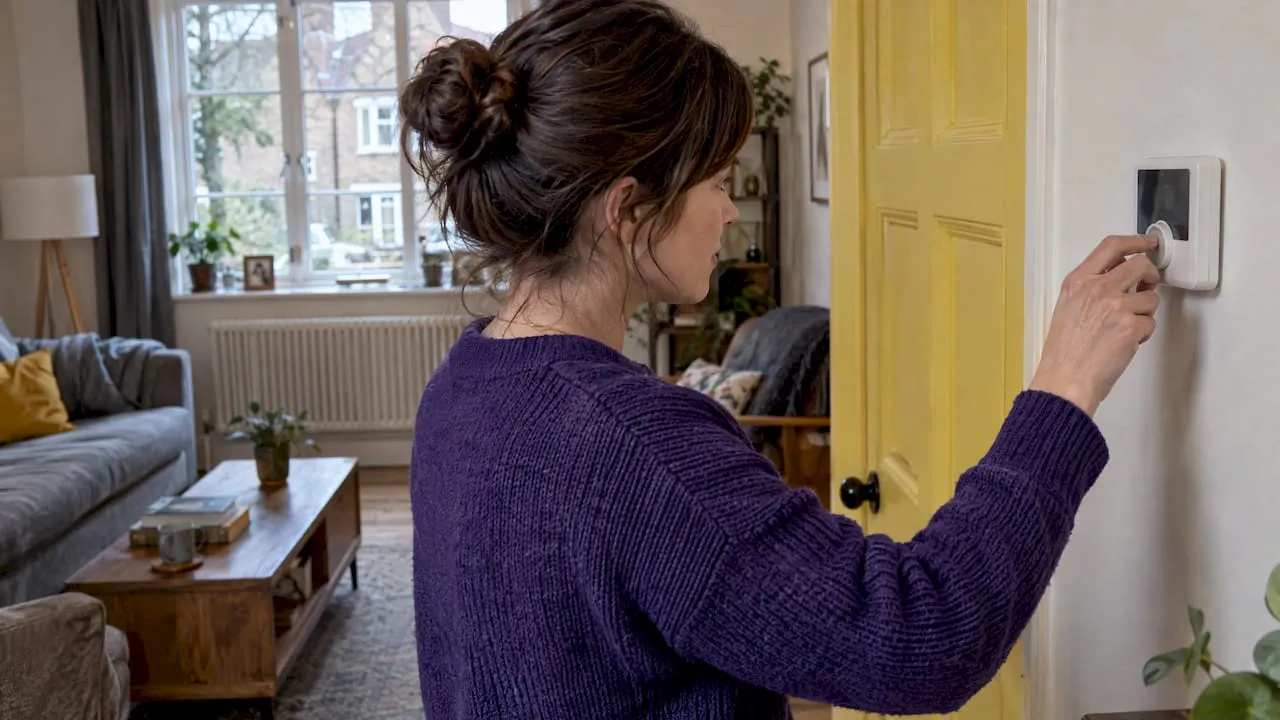
Saving energy means using less energy to get what you need, whether that is heat, light, hot water or power. You can do it in two ways: by changing what you do (conservation) or by upgrading what you use (efficiency). For a home or a commercial building, the best results usually come from doing both.
This guide explains the term in plain words, shows how it differs from related phrases, and turns it into practical steps for landlords, homeowners and businesses in London.
TL;DR
- Saving energy means reducing the amount of energy you consume, either by changing behaviour or by using better technology.
- Energy conservation is about what you do, such as switching lights off. Energy efficiency is about what you use, such as LED bulbs or insulation.
- Saving energy lowers bills and cuts emissions, and it also makes energy supply more secure.
- In buildings, an energy performance certificate (EPC) is a sensible starting point because it shows where a property loses energy and what to improve first.
- Check the effect of each upgrade before you spend, and match the measure to the building.
Table of Contents
- What saving energy actually means
- Energy conservation and energy efficiency: the difference
- Saving energy, conserving energy and saving electricity
- Why saving energy matters
- What saving energy looks like in a building
- Before you spend: how to choose the right improvements
- Our perspective
- Get your property assessed
- FAQ
- Sources
What saving energy actually means
In everyday English, “saving energy” is any action or change that lowers the amount of gas, electricity or other fuel you use. It does not have to mean going without. Often it means getting the same warmth, light or hot water for less.
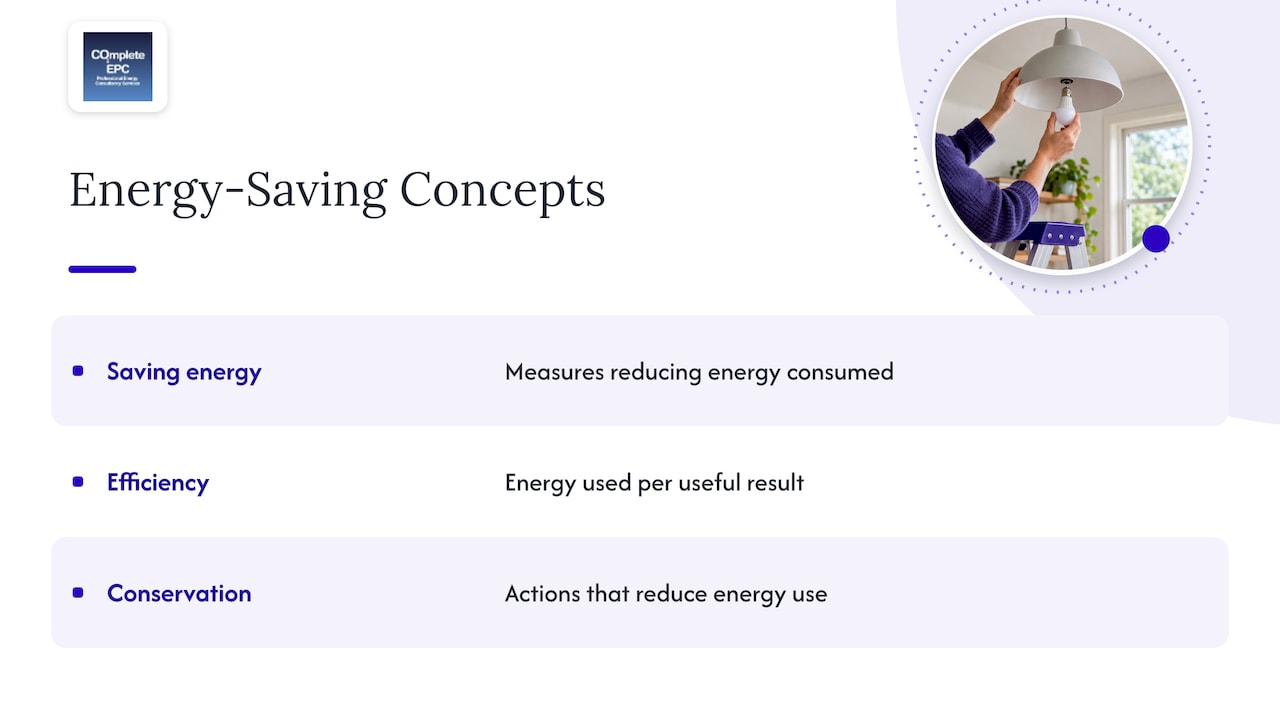
Official bodies describe it in two linked ways. The US Energy Information Administration explains that energy efficiency and energy conservation are two ways to avoid or reduce energy consumption. Efficiency relates to the technical performance of devices that use or convert energy. Conservation involves actions that reduce the energy you use, such as turning lights off when they are not needed.
A UNDP textbook for climate education puts it in a slightly different way. It describes energy saving as all the measures taken to reduce the amount of energy consumed, and energy efficiency as the ratio between the energy consumed and the useful result obtained. So “saving energy” is the broad umbrella, and efficiency and conservation sit underneath it.
The short version
If you want one sentence to remember, use this: saving energy is getting the result you want from less energy. Whether you reach that by behaving differently or by installing better equipment is the next question.
Energy conservation and energy efficiency: the difference
These two phrases are often mixed up, and search results for the topic show the confusion. A dictionary will describe conservation as using as little power as possible, while another page may treat “energy saving” and “conservation” as the same thing. In practice they are close relatives, but they work differently.
Stanford’s Understand Energy Learning Hub gives a clear example. Turning down the thermostat in winter is conservation, because the house gets colder, whereas insulating the house is efficiency, because it stays warm and the furnace needs less energy.
Natural Resources Canada makes the same point and adds the practical conclusion: building owners get the best results by combining both approaches. Better heating and insulation let you keep a comfortable temperature without using more energy, and sensible habits then add to the saving.
| Energy conservation | Energy efficiency | |
|---|---|---|
| What changes | Your behaviour | Your equipment or building |
| Typical example | Turning lights off when you leave a room | Fitting LED bulbs |
| Heating example | Turning the thermostat down | Adding insulation so the same temperature needs less fuel |
| Cost | Usually free | Usually needs an upfront outlay |
| Comfort effect | Can mean doing with less | Same or better comfort |
| Lasts as long as | You keep up the habit | The upgrade stays in place |
The City of Glasgow’s guidance uses everyday examples that map onto the table. It says efficiency is generally concerned with technology, such as an efficient fridge, while conservation relates to behaviour, such as unplugging at the wall.
One academic note is worth knowing. A chapter published by the Pacific Northwest National Laboratory observes that the degree of confusion between these meanings varies by individual, culture, historic period and language. If you see the two used interchangeably, that is normal. What matters is whether a measure cuts energy use, and how.
Saving energy, conserving energy and saving electricity
The other searches people make around this topic sit in the same family:
- Saving energy covers every fuel: gas, electricity, oil, and heat from any source.
- Conserving energy usually points to the behavioural side, using less of a service.
- Saving electricity is narrower. It covers only power drawn from the grid or generated on site, such as lighting, appliances and electric heating.
The difference matters in a London property because many homes heat with gas but run everything else on electricity. A switch to LED lighting saves electricity. Loft insulation mainly saves gas. Both are saving energy, but they show up on different lines of your bill.
Why saving energy matters
Lower bills
The most direct benefit is financial. The European Commission has stated that saving energy directly reduces energy bills and makes the economy more resilient, and that over the medium to long term it contributes to lower energy prices. The same document notes that high energy prices push vulnerable households and small businesses into uncomfortable choices about doing without energy.
A cleaner environment
The International Energy Agency reports that, since 2010, efficiency measures have avoided energy-related CO₂ emissions equal to nearly 20% of the 2023 global total. That is more than the entire energy-related emissions of India and the European Union combined. The agency adds that efficiency also improves air quality by lowering local pollutants such as fine particulate matter.
Stanford’s learning hub explains why. Energy you never use is sometimes called a “negawatt”, and unlike generated electricity, negawatts emit no greenhouse gases and require no power plants.
Security and economic benefit
The World Bank reports that two-thirds of the world’s energy is wasted, and that scaling up efficiency can return 3 to 5 dollars for every dollar invested. It also notes that in 2022 efficiency was the biggest source of jobs across the energy sector.
UK-based research by Tina Fawcett at Oxford argues that cutting energy demand serves energy security, energy equity and environmental sustainability at once, because a smaller energy system is more secure and has less impact on the natural environment.
What saving energy looks like in a building
For a property owner, the phrase becomes a list of concrete actions. Some cost nothing, some need a small purchase, and some are building works.
Habits that cost nothing
The City of Glasgow’s guidance lists many of these: turning off lights when you leave a room, switching off standby appliances, turning the heating down, washing clothes at a lower temperature and cooking with the lid on pans, and defrosting your fridge and freezer regularly.
The IEA gives numbers for heating. Lowering your thermostat by just 1°C saves around 7% of your heating energy, which it puts at €50 to €70 off an average annual bill. Those figures are in euros and are an average, so your own saving will depend on your home and tariff. The same page says that a programmable thermostat set to 15°C while you sleep and 10°C when the home is empty can cut up to 10% a year off heating bills.
Small purchases
- LED bulbs. The IEA says replacing old bulbs with LEDs saves around €10 a year per bulb.
- Boiler hot water temperature. The same page says lowering it saves 8% of heating energy.
- Draught-proofing. The US Department of Energy states that sealing air leaks around seams, cracks and openings can save 10% to 20% on heating and cooling bills. That figure comes from US homes, so treat it as a guide rather than a promise for a London flat.
- Radiator care. Bleeding radiators regularly is on the Glasgow list of simple actions.
Bigger upgrades
Insulation, double glazing, efficient appliances, heat pumps and on-site generation cost more up front but cut energy use for years. The IEA’s guidance names improving insulation and generating your own electricity among the biggest long-term savers, alongside efficient appliances.
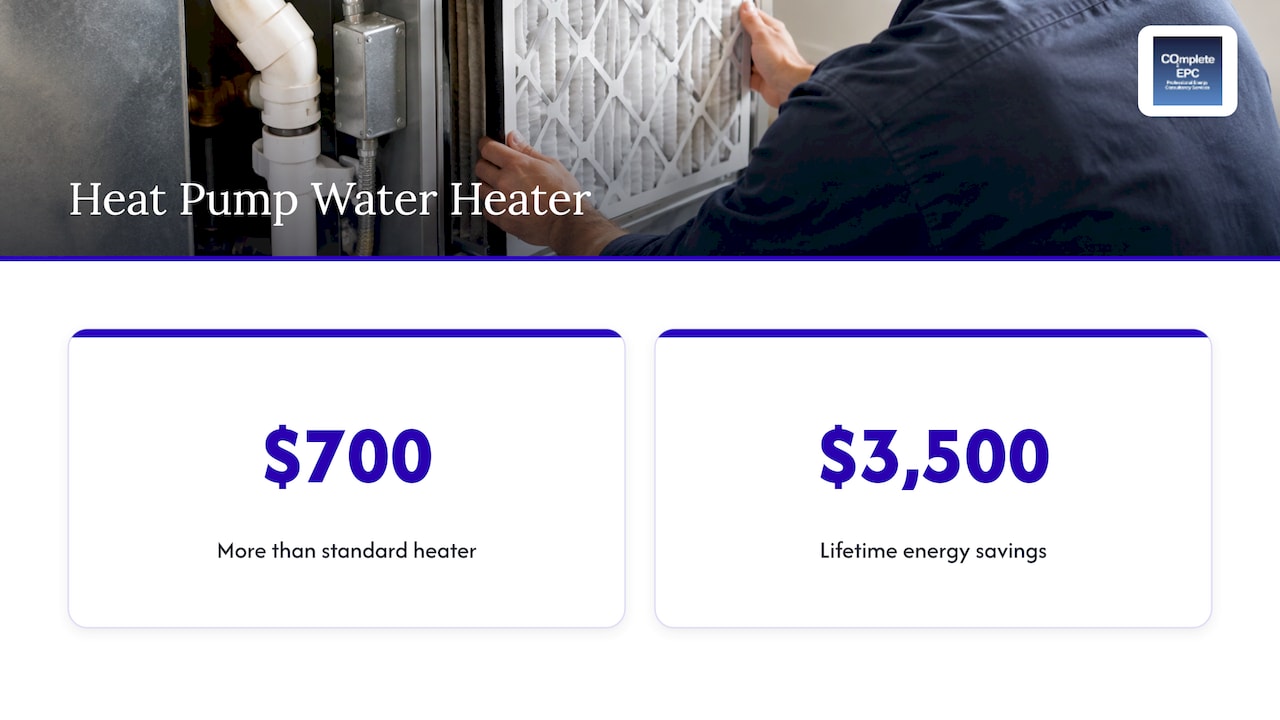
ENERGY STAR gives a worked example from the United States. A heat pump water heater could cost about $700 more than a standard electric one, but the energy savings typically add up to $3,500 over the life of the equipment. Prices and energy costs differ in the UK, but the pattern holds: a higher purchase price can be repaid through lower running costs.
Before you spend: how to choose the right improvements
Not every measure suits every building. A few questions help you decide in the right order.
- What does the building lose energy through? Walls, roof, windows, floors, ventilation and the heating system all play a part. Start with the biggest source.
- What is the cheapest saving first? Habits and draught-proofing cost little and pay back quickly. Do them before major works.
- Is the building ventilated properly? The IEA notes that retrofitting poorly insulated houses can reduce indoor air pollutants only as long as the building has adequate ventilation. Make ventilation part of any insulation plan.
- Will the upgrade pay for itself? Compare the purchase cost with the saving over its lifetime, as in the heat pump example above.
- Does the work need compliance paperwork? New builds, conversions and extensions may need calculations to show they meet energy standards, and rented properties have their own energy rules.
A professional assessment answers the first question with evidence rather than guesswork. An EPC rates a property’s energy efficiency and lists recommended improvements, so it works as a ready-made action list.
For landlords and businesses
If you let a property or run commercial premises, saving energy is also a compliance matter. Landlords need to know their property’s EPC position, and businesses with air conditioning or large premises may need further assessments. Poor thermal comfort in summer is also a growing concern in dense city buildings, which is why overheating analysis is now a regular part of design work in London.
Our perspective
We see the same pattern every week. Owners ask what “saving energy” means because they have been told to do it, by a tenant, a buyer, a solicitor or a planning officer, and nobody has shown them where to begin.
Our advice is to start with measurement. Habits matter, but a property is a system, and you cannot improve it sensibly until you know how it performs. A domestic or commercial EPC gives you that baseline and a list of improvements, and it is a legal requirement for many sales and lettings anyway. So the first step is useful twice over.
For new builds, conversions and extensions, the same thinking applies at design stage. SAP calculations for homes and SBEM calculations for commercial buildings show how a design performs before it is built, when changes are cheapest. Overheating analysis (TM52 and TM59) checks that an energy-efficient, well-sealed building stays comfortable in summer too.
Our assessors are qualified and experienced, and our aim is to give you a clear report, a fair price (we back it with a lowest-rate guarantee) and recommendations you can act on. Saving energy should feel practical, not abstract.
Danny
Get your property assessed
If you want to turn the idea into a plan, we can help. A domestic EPC shows how efficient your home is and what to improve first. For offices, shops and other premises, a commercial EPC does the same job. If you are building, converting or extending, our SAP calculations cover the energy compliance side, and our overheating assessments look at summer comfort. You can see everything we offer on the Complete EPC site.
FAQ
What does saving energy mean?
Saving energy means reducing the amount of energy you use, such as gas, electricity or fuel, while still getting the result you need. You can do it by changing habits, like switching off lights, or by using better technology, like LED bulbs and insulation. Official bodies treat both as part of the same goal.
What is the difference between energy conservation and energy efficiency?
Conservation is about behaviour: using less of a service, for example by turning the thermostat down. Efficiency is about technology: getting the same service from less energy, for example by insulating a house. The US Energy Information Administration’s explanation gives the LED bulb as a typical efficiency example and turning lights off as a typical conservation example.
Why is it important to save energy?
It lowers energy bills, reduces carbon emissions and air pollution, and makes energy supply more secure. The IEA, the World Bank and the European Commission all describe efficiency as one of the most cost-effective ways to do this. For a property owner, it also means a more comfortable building that costs less to run.
Is saving electricity the same as saving energy?
Not quite. Saving electricity covers only power use, such as lighting and appliances. Saving energy is wider and includes gas for heating and any other fuel. A home can save a lot of energy through insulation without changing its electricity use at all.
Where should a landlord or homeowner start?
Start with a clear picture of how the property performs. An EPC rates the building and lists recommended improvements, so you can tackle the cheapest and most effective ones first. Then add simple habits, such as sensible thermostat settings, on top of any upgrades.
Sources
- Energy efficiency and conservation, U.S. Energy Information Administration
- Saving energy, Energy Kids, U.S. Energy Information Administration
- 3.2. Energy efficiency and energy saving, UNDP Klimatski paket
- Energy Efficiency, Understand Energy Learning Hub, Stanford
- Energy efficiency basics, Natural Resources Canada
- REDUCE: tips on saving energy and being energy efficient, Glasgow City Council
- Energy Conservation vs. Energy Efficiency, Pacific Northwest National Laboratory
- Communication from the Commission, European Commission (2022)
- Emission reductions, International Energy Agency
- Energy Efficiency: Fast-Tracking Affordable Energy and Jobs, World Bank (2025)
- Energy demand reduction: its importance in meeting climate goals, University of Oxford
- Saving Energy, International Energy Agency
- Energy Saver guide 2022, U.S. Department of Energy
- Energy Efficiency, ENERGY STAR