
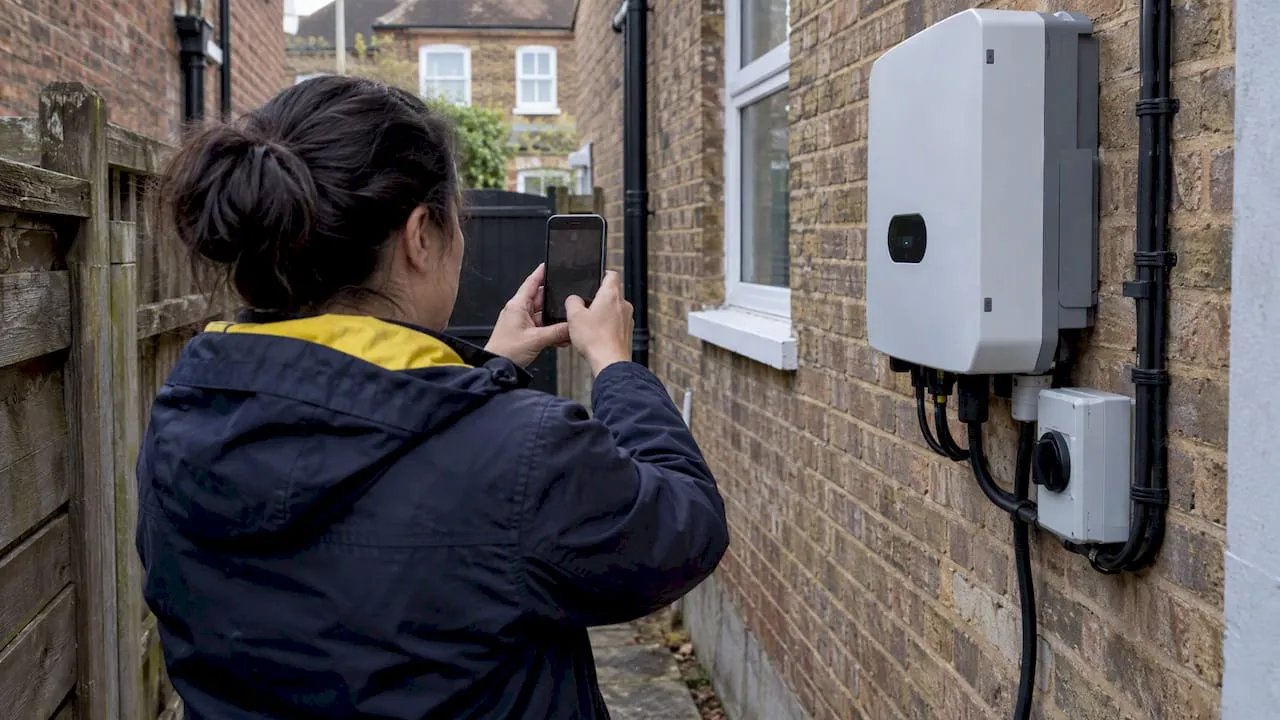
Yes, correctly sized and evidenced solar PV commonly improves a property’s EPC by lowering modelled energy costs and contributing to smart readiness. The size of the uplift depends heavily on system sizing, orientation and how much of the generated electricity you actually use. It will not appear automatically either: you need to commission a new EPC and supply installer evidence once the panels are in.
TL;DR:
- A shaded terrace with a 1 to 2 kWp array often gains fewer EPC points than a well oriented, south facing 3 to 4 kWp system.
- Using more generated electricity at home lowers modeled energy costs, while batteries or hot water diverters can raise self consumption compared with exporting surplus power.
- Commission a new EPC after panels are commissioned, and provide the MCS certificate, MID registration, dated invoices, and annual yield estimate.
- For landlords, the government modeled a 1 kWp solar system as a proxy for smart readiness when assessing possible upgrade routes for rental standards.
Table of Contents
- How EPCs are calculated and where solar PV fits in
- How much improvement to expect from solar PV
- What controls the size of the EPC change
- Making sure panels actually appear on a new EPC
- What EPC improvements mean for bills, resale and compliance
- Practical checklist before, during and after installation
- An assessor’s view on common evidence gaps
- How we help you get solar PV properly recorded on your EPC
- FAQ
- Sources
How EPCs are calculated and where solar PV fits in
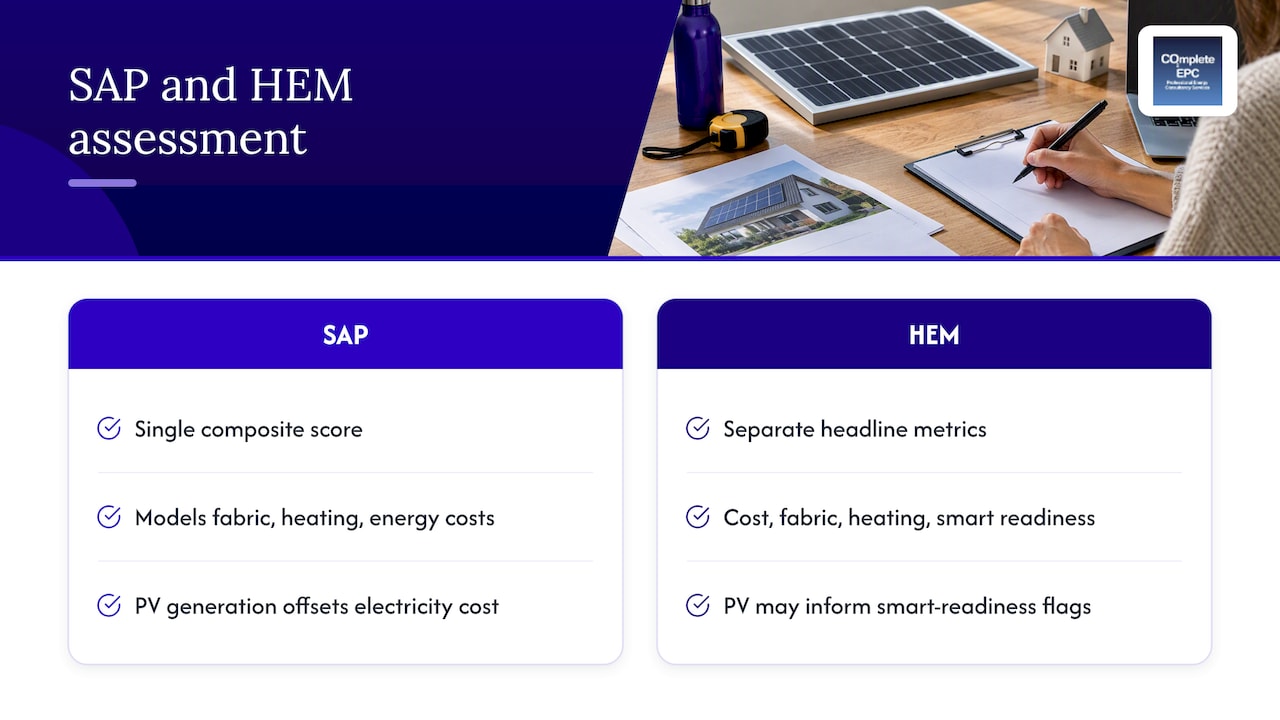
An EPC rating comes from a standardised assessment (SAP in England, Wales and Northern Ireland) that models a property’s fabric, heating system and energy costs rather than measuring actual bills. Reforms are now moving towards the Home Energy Model (HEM), which introduces several headline metrics covering energy cost, fabric performance, heating system and smart readiness rather than a single composite score, according to the technical annex on what EPCs measure.
When PV is present, several inputs change. The software models expected generation, offsets a portion of your electricity cost and, under the emerging framework, can feed into smart readiness flags that sit alongside the traditional efficiency score. These flags are being trialled specifically so that generation and storage technologies are recognised more explicitly than under the current SAP methodology.
The scale of the benefit is not fixed, though. Modelled electricity prices and regional solar yield assumptions both shift the calculation, so two identical systems in different postcodes, or assessed under different price assumptions, will not necessarily produce the same point gain. This is why installers and assessors increasingly rely on standardised yield estimates rather than rough rule-of-thumb figures when working out what a given array is likely to contribute.
How much improvement to expect from solar PV
Expect a range rather than a single number. Evidence varies by baseline rating and system specification, with some well-sized installations shifting a property by multiple bands in favourable cases, while others produce a more modest point change against the same starting position.
- A small terrace with a 1 to 2 kWp array on a partially shaded roof typically sees a modest point gain, since limited capacity and shading cap the modelled generation.
- A detached or semi-detached home with 3 to 4 kWp and good south-facing orientation tends to see a larger shift, particularly when self-consumption is high.
- A property that starts from a low band often has more room to move than one already sitting in a high band, simply because there is more inefficiency for PV to offset.
The honest caveat is that your baseline EPC, your heating system and how much of the generated electricity you use on-site all interact with each other, so no two installations behave identically even with comparable kWp ratings.
What controls the size of the EPC change
A handful of factors decide whether PV moves your rating by a little or a lot, and most of them are worth discussing with your installer before you commit to a system.
- System capacity, orientation, pitch and shading: assessors and installers rely on standardised yield estimation to project annual output in kWh per kWp, so a well-oriented, unshaded roof outperforms a compromised one of the same size, as set out in the MCS performance estimate methodology.
- Self-consumption rate: electricity you use as it is generated offsets grid costs directly, and adding battery storage or a hot water diverter can raise the proportion you actually use rather than export.
- Property fabric and heating system: poor insulation or an inefficient heating system can mean fabric upgrades deliver a bigger EPC gain than PV alone, so PV sometimes works best alongside other measures rather than instead of them.
- Local weather and postcode: yield assumptions are regionally adjusted, so the same array specified in different parts of the country will be modelled with different expected output.
Pro Tip: Ask your installer for a postcode-specific performance estimate before installation, since this figure, not a generic brochure number, is what assessors and EPC software will ultimately rely on.
Making sure panels actually appear on a new EPC
An existing EPC remains valid for its full term regardless of what you do to the property afterwards. It is not updated automatically, which means a certificate issued before installation will never reflect your new panels, no matter how long is left on it. The only way to capture the improvement is to commission a fresh assessment once the system is commissioned and registered.
Assessors need documentary proof before they can enter PV data into the EPC software rather than falling back on conservative default assumptions. In practice, that means:
- An MCS certificate confirming the system meets the required installation standard.
- MID (MCS Installation Database) registration showing the installation is formally recorded.
- Dated invoices and commissioning paperwork from the installer.
- A performance estimate showing expected annual yield, calculated to MCS methodology.
Without this evidence, an assessor working from a site visit alone may not be able to credit the system at all, which is why planned-but-not-yet-installed PV can never appear on a pre-installation certificate.
What EPC improvements mean for bills, resale and compliance
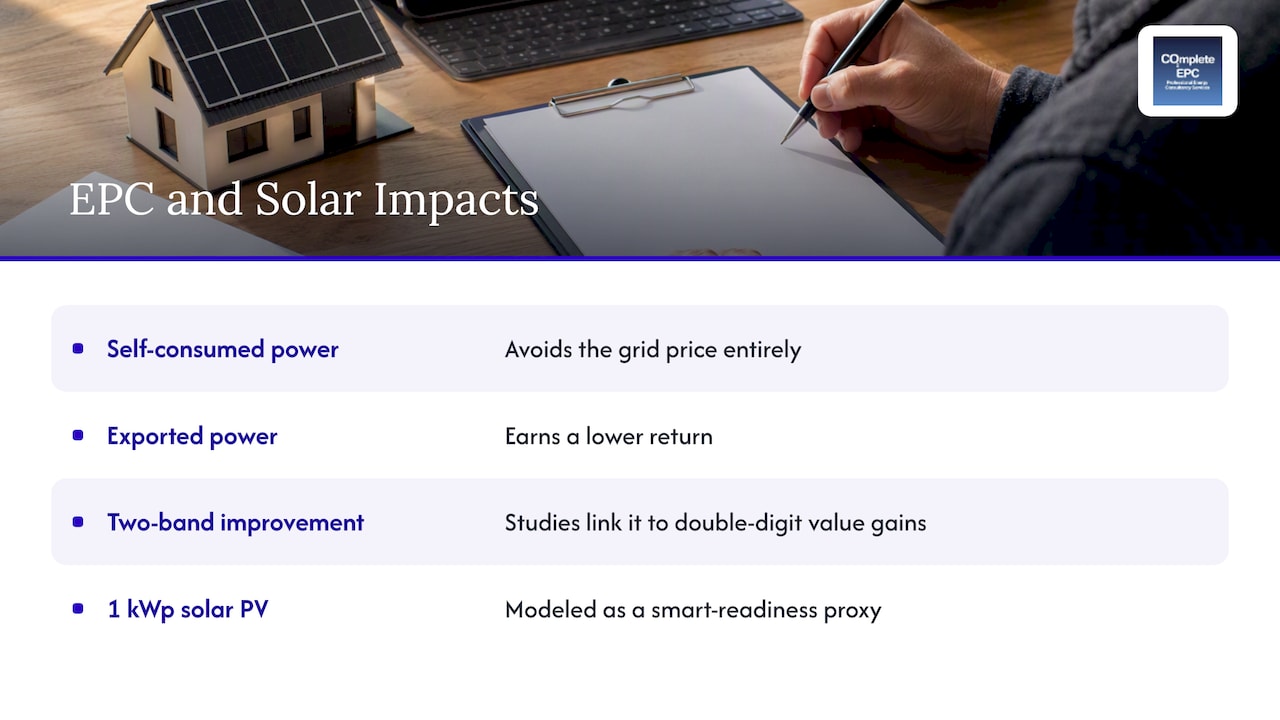
A better-modelled energy cost figure should translate into lower real bills, though the scale depends heavily on how much of your generation you consume rather than export, since self-consumed electricity avoids the grid price entirely while exported electricity earns a lower return. Valuation research has linked multi-band EPC improvements with measurable value and marketability effects: some studies associate a two-band improvement with a meaningful, double-digit percentage increase in property value, according to RICS valuation research on green premiums.
For landlords, the picture has a compliance dimension too. The government’s own impact assessment for privately rented homes modelled a 1 kWp solar PV system as a proxy for smart readiness when weighing up landlord upgrade routes, according to the PRS MEES impact assessment. That makes even a modest PV system potentially relevant to future MEES compliance strategy, alongside its effect on the conventional EPC score.
Practical checklist before, during and after installation
A methodical approach gives you the best chance that your system is both correctly sized and properly recorded.
- Before installation: get an MCS-standard performance estimate for your specific roof, confirm the realistic kWp your roof supports, and discuss self-consumption options such as battery storage or a diverter with your installer.
- During installation: confirm your installer will register the system on MID, and keep dated photographs of the array, inverter and meter alongside every invoice.
- After installation: commission a new Domestic Energy Performance Certificate or Commercial EPC assessment, hand over the MCS certificate and invoices to your assessor, and keep copies in your sale or letting pack for future reference.
Getting this sequence right the first time avoids a second assessment visit purely to supply evidence you could have gathered at the point of installation.
An assessor’s view on common evidence gaps
Assessors work from what can be seen or verified, not from what a homeowner tells them in passing. A missing MCS entry or an invoice that never turns up forces a conservative default, even when the system is clearly fitted and working well on the roof. That gap between an installation’s real performance and what the paperwork can prove is the single most common reason a property underperforms its potential rating.
When you are selling or renting, paying for an updated EPC after installation usually pays for itself through improved saleability or smoother compliance, rather than being a cost with no return.
— Danny
How we help you get solar PV properly recorded on your EPC
Once your panels are commissioned, getting them correctly reflected on paper matters as much as the installation itself. We carry out Domestic Energy Performance Certificate assessments for homeowners and landlords, and Commercial EPC assessments for business premises, working from the evidence your installer provides rather than guesswork.
Before booking, have your MCS certificate, dated invoices and any commissioning photographs ready. Our assessors use that paperwork to ensure your system is credited properly rather than defaulted to a conservative estimate. If you are weighing up how an EPC uplift fits alongside other home improvements, this ROI guide to value-adding renovations is a useful companion read.
Get in touch to arrange your updated assessment, or browse our full range of compliance services, including SAP Calculations for new builds and conversions.
FAQ
What is a solar EPC contract?
This is not a standard industry term, and definitions vary depending on who uses it. In most contexts it refers loosely to the paperwork and agreements covering a solar installation, which is distinct from the EPC assessment itself that rates your property’s energy performance.
What are the drawbacks to weigh up with solar panels and EPC ratings?
The main practical limitation is that an EPC does not update automatically once panels are fitted, so the improvement only counts once you commission a new assessment with proper evidence. The size of any uplift also depends on factors like orientation, shading and self-consumption, so results vary from property to property.
What are the limitations of an EPC?
An EPC models likely energy performance using standardised assumptions rather than measuring your actual bills or behaviour, so it can differ from real-world running costs. It also relies on visible or documented evidence, meaning genuine improvements can go unrecorded if paperwork such as an MCS certificate or invoices is missing.
What is the average efficiency of solar panels in the UK?
Panel output in the UK depends on postcode, orientation, pitch and shading rather than a single national average, which is why MCS methodology uses location-specific yield estimates measured in kWh per kWp, according to MCS performance estimate guidance. An installer can provide a site-specific figure rather than a generic UK-wide estimate.