
The quickest way to lower your energy bills is to work in order: stop wasting energy for free, fix the gaps where heat escapes, then upgrade heating and appliances once you know where the money is going. Most households can start today at no cost. Bigger savings come from insulation and better heating controls, and an energy performance certificate (EPC) shows which upgrades suit your particular property.
This guide sets out the steps in that order, with figures from UK sources where they exist. It also covers what landlords and small businesses should do differently.
TL;DR
- Start with free changes: switch off standby, use heating controls properly and cut hot water waste.
- Draught-proof and insulate next. Loft and cavity wall insulation cut heat loss the most.
- Replace bulbs with LEDs and measure your use with a smart meter or energy monitor.
- Landlords and businesses should check their EPC rating, because it lists the upgrades that matter for their building.
- Work through the steps in order, from cheapest to most expensive.
Table of Contents
- Step 1: Find out where your energy actually goes
- Step 2: Make the free changes first
- Step 3: Stop heat leaking out
- Step 4: Insulate the loft, walls and hot water
- Step 5: Take control of your heating
- Step 6: Switch to efficient lighting and appliances
- Step 7: Check your tariff and the support available
- Step 8: Use an EPC to choose upgrades that fit your property
- For landlords: lower bills and stay compliant
- For small businesses and commercial landlords
- Perspective
- Get a clear starting point with Complete EPC
- A simple order of action
- FAQ
- Sources
Step 1: Find out where your energy actually goes
You cannot cut what you have not measured. Before you change anything, spend a week looking at your usage.
- Read your meter. Take a reading on the same day each week, at the same time. Note gas and electricity separately.
- Check your bills. Look at the unit rate and the standing charge. The standing charge is a daily fee you pay however much you use, so only the unit rate falls when you use less.
- Find the big users. In most UK homes, heating and hot water make up the largest share of the bill. Appliances, lighting and cooking make up the rest.
- Use a smart meter or monitor if you can. Seeing real-time use makes it obvious when the kettle, oven or an old fridge-freezer is pulling more than you expected.
This first step costs nothing and stops you spending money on upgrades that will barely move your bill.
Step 2: Make the free changes first
These changes need no tools and no outlay. They are worth doing before anything else, and they add up.
Heating habits
- Heat the rooms you use. Close doors to unused rooms and turn their radiators down rather than fully off if the room is prone to damp.
- Do not block radiators. Furniture and long curtains in front of a radiator trap the heat instead of letting it circulate.
- Set the thermostat sensibly. Lowering it by a degree is a small comfort change for many households. Test it for a week before deciding.
- Use your timer. Set heating to come on shortly before you wake or get home, and to switch off before you go to bed or leave.
- Check your boiler flow temperature. On many modern combi boilers you can adjust the temperature of the water sent to the radiators. Check your boiler manual or ask a Gas Safe registered engineer before changing it, and never alter settings you are unsure about.
Hot water
- Take shorter showers.
- Wash clothes at 30 degrees and run full loads.
- Only boil as much water as you need in the kettle.
Standby and idle devices
Devices left on standby draw power all day. Smart Energy GB suggests checking the sockets around your home and switching off at the wall anything that does not need constant power, such as phone chargers, lamps and kettles. Some digital recorders need to stay powered so they can keep scheduled recordings, so check the instructions first.
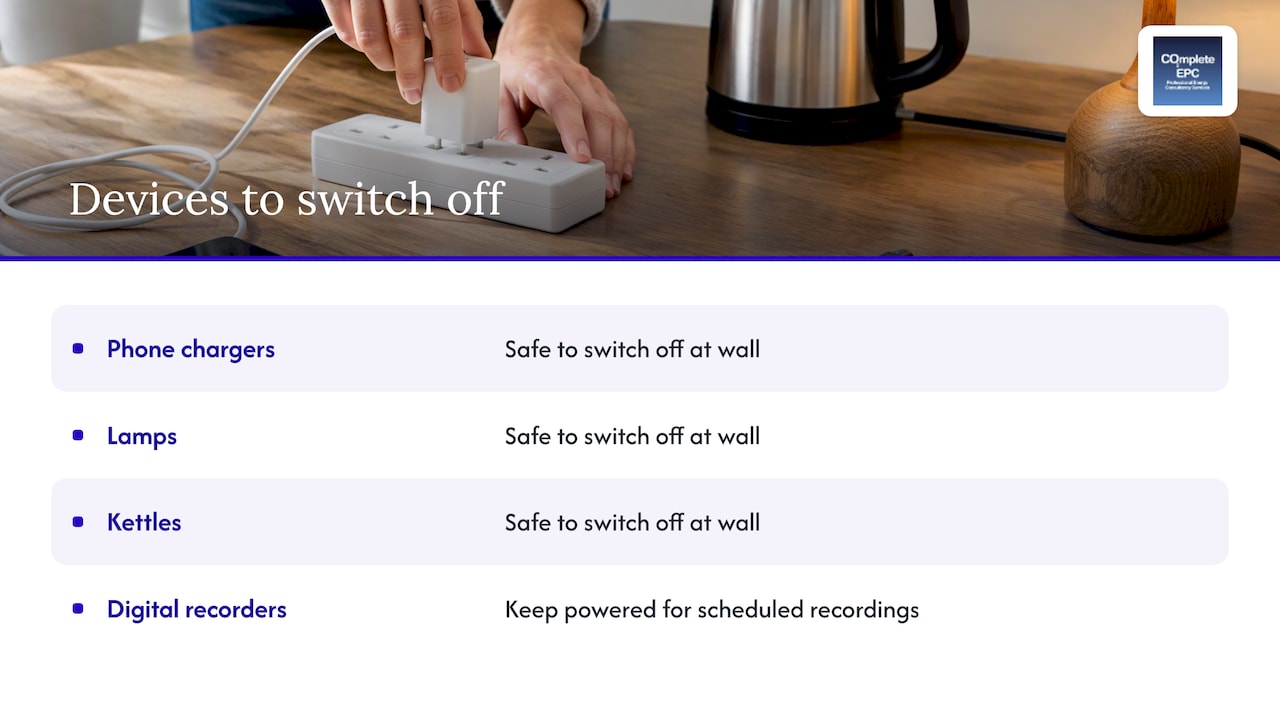
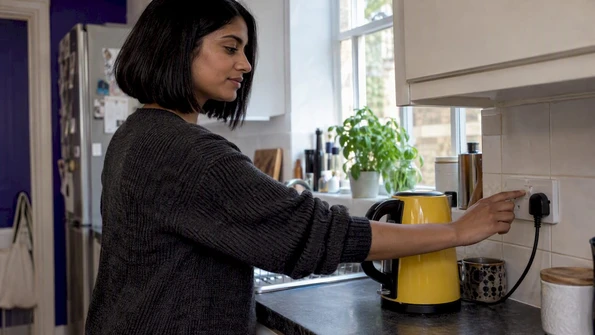
That also answers a question many people ask: does turning the kettle off at the wall save electricity? A kettle that is switched on at the socket but not in use is among the appliances Smart Energy GB lists as safe to switch off. The saving per kettle is small, but it costs nothing and builds a habit that you can apply to every device around the house.
Step 3: Stop heat leaking out
Once the free habits are in place, stop the heat you are paying for from escaping. Draught-proofing is cheap, quick and suits renters as well as owners.
Where to look
- Gaps around windows and door frames
- Letterboxes and keyholes
- Loft hatches
- Gaps between floorboards and skirting boards
- Unused chimneys
What to use
Self-adhesive strips for windows and doors, brush or flap covers for letterboxes, keyhole covers, and flexible filler for floorboard gaps are all available at hardware shops. Do not seal up ventilation points such as air bricks, extractor fans or trickle vents. Homes need controlled ventilation to avoid damp and mould, and gas appliances need a proper air supply.
A quick test: on a windy day, hold a hand near the edges of windows and doors. If you feel moving air, there is a gap to fix.

Step 4: Insulate the loft, walls and hot water
Insulation is the step that changes your bill most for a typical older home, because it reduces the amount of heat your boiler needs to produce every day of winter.
| Measure | What the evidence says | Source |
|---|---|---|
| Loft insulation (100 to 150mm of glass fibre) | Can reduce heat losses through the roof by up to 90% | UK Department of Energy and Climate Change, 2015 |
| Cavity wall insulation | Can reduce heat loss through the walls by two-thirds | UK Department of Energy and Climate Change, 2015 |
These figures are about heat loss through the part of the building treated, not a guaranteed cut in your bill. Actual savings depend on your home, how well it is already insulated, your heating and how you use it. They are, however, a clear sign of where the biggest gains sit.
Practical points
- Loft first. It is usually the simplest and cheapest major job. If your loft has only a thin layer, topping it up is worth considering.
- Check your walls. Many homes built from the 1920s onwards have cavity walls. A qualified installer can tell you whether yours are suitable and whether they are already filled.
- Solid walls, flats and listed buildings need different solutions, and in London many homes fall into those categories. An assessment of the actual building is the safest way to choose.
- Wrap hot water pipes and the tank. A well-fitted jacket on a hot water cylinder and lagging on exposed pipes keep heat where you paid for it.
Before you commit to any installation, ask for quotes from installers who are registered with a recognised scheme, and check what guarantee comes with the work.
Step 5: Take control of your heating
Heating controls let you heat only what you need, when you need it.
- Programmable or smart thermostats let you set schedules and, with some models, control heating from your phone.
- Thermostatic radiator valves (TRVs) control the temperature room by room, so a spare bedroom does not heat to the same level as the living room.
- Zoned systems divide a home into areas with separate timing and temperature. If you are renovating, multi-zone heating controls are worth discussing with your installer, along with the electrical protection that goes with them.
- Regular servicing. A boiler serviced yearly by a qualified engineer is more likely to run as intended and to flag faults early.
Controls only help if you use them. A smart thermostat that stays on a constant 23 degrees saves nothing. Set schedules to match how you live, and review them each season.
Step 6: Switch to efficient lighting and appliances
Lighting is one of the simplest upgrades. Ofgem reports that, according to the Energy Saving Trust, swapping old bulbs for LEDs can save up to £4 per bulb each year. In a house with 20 bulbs, the numbers add up fast, and LEDs last far longer than older types.
When an appliance fails, replace it with an efficient model and check the energy label. Fridges and freezers run all day, so their efficiency matters more than a machine you use twice a week. A few habits help whatever you own:
- Defrost freezers regularly and keep fridge doors closed.
- Run washing machines and dishwashers on full loads and on eco settings.
- Air-dry clothes when you can, rather than using a tumble dryer.
- Use a lid on pans, and match pan size to the hob ring.
Step 7: Check your tariff and the support available
Cutting use is one half of lower bills. The other half is paying a fair rate and claiming help you are entitled to.
- Know your tariff. Under the energy price cap, the unit rates for standard variable tariffs are set by the regulator and updated on a regular schedule. Ofgem’s guidance on saving money on your energy bill is the place to check the current position.
- Speak to your supplier. If you are struggling to pay, tell your supplier early. Suppliers are expected to offer support, and Ofgem explains what to expect.
- Look for grants. Government and local schemes change often and depend on your income, location and property. Check official sources for the current rules before booking any work, and be wary of unsolicited calls offering free upgrades.
Step 8: Use an EPC to choose upgrades that fit your property
Generic advice only goes so far. Every home is different, and an EPC gives you a property-specific starting point. It rates the building from A to G and lists recommended improvements, so you can put money where it counts instead of guessing.
If you are selling, letting or buying, an EPC is often a legal requirement anyway, which makes it a useful chance to get a clear list of upgrades. If you want one for a London home, our domestic EPC service is built for exactly that, and our guide to what landlords must know about domestic EPCs explains how the rating links to letting.
For landlords: lower bills and stay compliant
Landlords do not pay tenants’ bills, but the efficiency of the property still matters to them for three reasons:
- Compliance. Minimum energy efficiency standards (MEES) set rules about the EPC rating a rented property must reach. Rules have been changing, so check the current requirements on GOV.UK before planning work.
- Tenant demand. A warmer, cheaper-to-run home is easier to let and to keep let.
- Planning works. A clear EPC recommendation list helps you sequence upgrades, starting with the cheapest and most effective.
Electrical safety matters alongside energy upgrades. If you are fitting new controls or heating, a current electrical installation condition report (EICR) and, for appliances you supply, portable appliance testing (PAT) keep the property safe and the paperwork in order. We offer both alongside EPCs, via our main site.
For small businesses and commercial landlords
The household steps still apply, but commercial buildings add their own opportunities. The UK Department of Energy and Climate Change estimated in 2015 that small and medium-sized businesses could cut energy bills by 18% to 25%, with around 40% of those savings needing no capital spend. That is an older government estimate, so treat it as a guide to where savings tend to sit, not a forecast.
Practical priorities for a commercial space:
- Switch off lighting, computers and equipment outside working hours.
- Review heating, cooling and ventilation schedules against actual opening hours.
- Upgrade to LED lighting with sensors in rarely used areas.
- Maintain air conditioning and ventilation so they do not work harder than they need to.
- Get a commercial EPC and use its recommendations to plan capital spend.
If your premises have air conditioning above a certain size, a regular inspection may be required. Our TM44 air conditioning inspections cover this, and our commercial EPC service gives you the rating and the improvement list in one go. For a deeper read on rules in the capital, see our guide to commercial EPC requirements in London.
Perspective
Most people ask us which single upgrade will cut their bills. The honest answer is that it depends on the building, and that is why we start every conversation with the property itself rather than a product.
A certificate is not paperwork for its own sake. A properly done assessment looks at the fabric, heating, hot water and lighting, and it produces a ranked list of improvements. For a landlord, that list is a compliance plan. For an owner-occupier, it is a shopping list in a sensible order.
We work with London homes and businesses every week, from flats and conversions to commercial units, and the pattern is consistent: people who assess first spend less on the wrong fixes. Our assessors are qualified, our reports are detailed, and we stand behind our lowest-rate guarantee because we want assessment to be an easy first step, not a barrier.
If you are planning an extension, conversion or new build, the same thinking applies earlier. SAP calculations and energy statements show at design stage how the building will perform, when changes cost least.
Danny
Get a clear starting point with Complete EPC
If you want to know which of these steps will matter most for your property, begin with an assessment. We provide domestic and commercial EPCs across London, with qualified assessors and a detailed report on recommended improvements. Planning a build or major refurbishment? We also carry out SAP calculations for new builds, conversions and extensions. Book through the domestic EPC page or the commercial EPC page.
A simple order of action
| Order | Action | Typical cost | Best for |
|---|---|---|---|
| 1 | Read meters, check tariff | Free | Everyone |
| 2 | Standby, heating habits, hot water | Free | Everyone |
| 3 | Draught-proofing | Low | Owners and renters |
| 4 | LEDs | Low | Everyone |
| 5 | Heating controls, boiler service | Low to medium | Owners and landlords |
| 6 | Loft and wall insulation | Medium | Owners and landlords |
| 7 | EPC and a planned upgrade list | Fee | Owners, landlords, businesses |
Work down the table, and stop at the point where the next step no longer makes sense for your home or budget.
FAQ
What wastes the most electricity in a house?
It varies by home, but always-on devices, older fridge-freezers, electric heating and hot water tend to be the biggest users. Appliances left on standby add up quietly across a year. A smart meter or plug-in energy monitor shows you which items in your own home use the most.
Does turning the kettle off at the wall save electricity?
It can save a small amount if the socket is switched on while the kettle sits idle. Smart Energy GB lists kettles among the items that do not need to stay powered. The bigger saving is boiling only the water you need.
What is the cheapest way to lower energy bills?
Changing habits costs nothing: switch off standby, heat only the rooms you use, take shorter showers and wash at 30 degrees. After that, draught-proofing and LED bulbs are low-cost steps with a quick payback.
Will an EPC lower my bills?
An EPC does not lower your bills on its own. It rates your property and lists recommended improvements, which you can then act on in order of cost and benefit. The savings come from the upgrades, not from the certificate.