

TL;DR:
- Energy Performance Certificates rate a property’s energy efficiency on a scale from A to G, showing current and potential scores. The ratings impact legal compliance for rentals and influence marketability by indicating future savings and environmental impact. Improving low-cost measures first often yields the best return before investing in major upgrades.
Energy Performance Certificate (EPC) bands A–G tell you how energy-efficient a building is as a physical asset, what typical running costs look like, and which improvements would raise the score. The A–G scale is produced using the Standard Assessment Procedure (SAP or RdSAP for existing homes), and every certificate shows both a current rating and a potential rating.
Key facts every property owner, landlord, agent or solicitor must know:
- Marketing and disclosure: you must have a valid EPC before marketing a property for sale or let.
- MEES for lettings: since 1 April 2018, landlords cannot let a domestic property rated F or G under the Minimum Energy Efficiency Standards (MEES) without a registered exemption.
- Validity: certificates last 10 years from the date of issue.
- Two ratings on one certificate: the current band reflects the property as assessed; the potential band shows what is achievable if the listed cost-effective measures are installed.
Table of Contents
- Why the rating matters for letting, selling and running costs
- How an EPC is produced and what the certificate tells you
- A prioritised roadmap to improve your EPC rating
- How to commission an EPC and what to expect
- Key takeaways
- The EPC as a working tool, not just a compliance tick
- Completeepc: qualified assessors, clear pricing, fast turnaround
- Useful sources
- FAQ
Why the rating matters for letting, selling and running costs
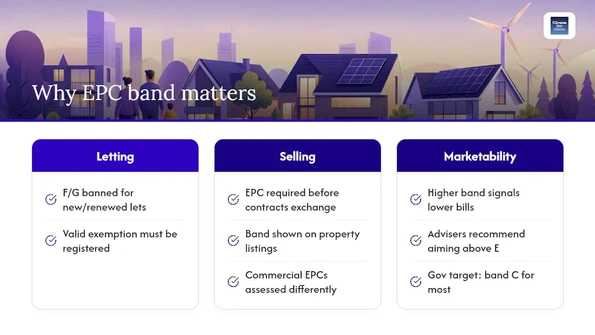
The legal consequences of a low band are immediate. Under MEES, a domestic private rented property rated F or G cannot be let on a new or renewed tenancy without a valid exemption registered on the national database. Selling is not restricted by band, but you must provide a valid EPC to prospective buyers before contracts exchange, and the band appears on property listings.
Beyond compliance, the rating directly affects marketability. A higher band signals lower bills to tenants and buyers, which increasingly influences offers and rental decisions. Industry advisers commonly recommend landlords aim above the legal minimum of E where finances allow; reaching band C improves tenant appeal and positions a property well ahead of any future tightening of MEES thresholds.
By the numbers: EPC data shows that band D is the most common rating in the existing UK housing stock, with a large proportion of homes sitting in the C–E range. Band C is the government’s target for most homes, making it the practical benchmark for landlords planning improvement works.
Commercial properties follow the same A–G scale but are assessed differently. Non-dwelling EPCs use different usage assumptions and benchmarks, so a band D on a commercial building carries a different meaning than band D on a house.
How an EPC is produced and what the certificate tells you
The rating is an asset rating, not a consumption reading. Assessors record the building fabric (wall, roof and floor insulation), fixed heating and hot water systems, ventilation, glazing, and fuel type, then apply RdSAP or SAP under standard occupancy assumptions. Because actual behaviour varies, real energy bills often differ from the EPC’s estimated costs.
The certificate itself contains several fields worth reading carefully:
- CO₂ emissions: a separate environmental impact rating. The EPC carries both an energy efficiency (cost) band and an environmental impact (CO₂) band; the headline public-facing band is always the efficiency rating.
Pro Tip: Before relying on an EPC for a tenancy or sale, check the assessor’s accreditation scheme membership (such as Elmhurst Energy or Stroma Certification) and verify the certificate ID against the national register at gov.uk. An unverified certificate is not legally valid.
A prioritised roadmap to improve your EPC rating
Work through improvements in cost-effectiveness order. The EPC recommendations list is already ranked, so use it as your starting point.
Quick wins (low cost, fast impact)
- Loft insulation top-up to 270 mm: typically low cost and one of the highest-impact measures for older properties.
- Cavity wall insulation: where the wall construction allows it, this delivers meaningful score improvement.
- Draught-proofing doors, windows and letterboxes.
- Switching to LED lighting throughout.
- Fitting a programmable or smart thermostat and thermostatic radiator valves.
Medium interventions
- Boiler replacement (replacing an old G-rated boiler with an A-rated condensing model): higher upfront cost but significant annual saving on gas bills.
- Improved glazing (double or triple glazing where single glazing remains): mid-range cost with comfort and efficiency benefits.
- Floor and pipe insulation upgrades.
Major works
- Solid wall insulation (internal or external): higher capital cost and disruption, but essential for pre-1920s solid-brick properties that cannot achieve band C otherwise.
- Air source or ground source heat pump installation: significant upfront investment; most effective when combined with good insulation fabric.
- Solar photovoltaic panels with battery storage: reduces dependence on grid electricity and can push a property into band B or A territory.
For a systematic approach to tracking improvement over time, energy benchmarking can help you monitor a building’s performance after retrofit works are completed.
| Measure | Indicative cost bracket | Typical impact |
|---|---|---|
| Loft insulation (top-up) | — | Band uplift of 1–2 points |
| Cavity wall insulation | — | Band uplift of 2 points |
| LED lighting | — | Minor score improvement |
| Condensing boiler replacement | — | Significant score improvement |
| Solid wall insulation | — | Major uplift; often 5–15 points |
| Heat pump installation | — | Large uplift; depends on fabric |
| Solar PV with storage | — | Can push to band B or A |
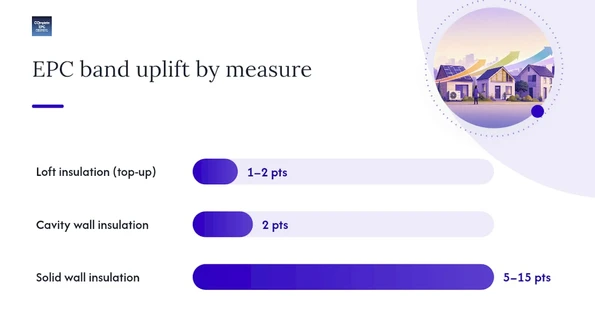
Indicative cost brackets are broad market ranges. Each EPC recommendation includes its own indicative cost and saving specific to the assessed property.
Pro Tip: Start with the measures flagged on your own EPC recommendations list before commissioning any work. Those measures are calculated against your property’s actual fabric and score, so they give a more accurate payback picture than generic guides.
How to commission an EPC and what to expect
Domestic EPC costs vary by property size, complexity and location, but most straightforward assessments fall in the range of £60–£120. Larger or more complex properties, or those in areas with limited assessor availability, may cost more.
On the day of assessment, the assessor will:
- Inspect wall, roof and floor construction and insulation.
- Record the heating system, boiler age and controls.
- Note glazing type, ventilation, and any renewable energy systems.
- Photograph key elements as evidence for the lodgement.
Prepare by having building plans or previous EPC certificates to hand, and ensuring the assessor has access to the loft, boiler cupboard and all rooms. The assessment typically takes 45 minutes to an hour for a standard house.
Trust signals to check before booking:
- Accreditation scheme membership (Elmhurst Energy, Stroma Certification, or another government-approved scheme).
- The assessor’s unique assessor ID, which will appear on the lodged certificate.
- Confirmation that the certificate will be lodged on the national EPC register.
Pro Tip: Book the assessment early enough that, if the result is lower than expected, you have time to carry out quick-win improvements and commission a reassessment before the marketing or tenancy start date.
Key takeaways
EPC bands A–G rate a property’s energy efficiency as a physical asset; band E is the legal minimum for domestic lettings under MEES, and F or G properties cannot be let without a registered exemption.
| Point | Details |
|---|---|
| Band meanings | A (92–100+) is most efficient; G (1–20) is least efficient; D is the UK average. |
| Legal minimum for lettings | MEES prohibits letting domestic properties rated F or G without a registered exemption. |
| Certificate validity | EPCs are valid for 10 years; always verify the issue date and certificate ID on the national register. |
| Improvement order | Start with quick wins from the EPC recommendations list before committing to major retrofit works. |
| Completeepc | Completeepc provides domestic EPC assessments and improvement guidance for London property owners and landlords. |
The EPC as a working tool, not just a compliance tick
Most clients arrive with one question: “What band am I?” The more useful question is: “What does the gap between my current and potential rating tell me about where to spend money first?”
An EPC is not a fixed verdict on a property. The potential rating is a roadmap, and the recommendations list is already prioritised by cost-effectiveness. The mistake many landlords make is commissioning expensive works, such as solid wall insulation or a heat pump, before addressing the low-cost measures that would have moved the band anyway. A condensing boiler replacement or a loft insulation top-up often delivers more band movement per pound spent than a major retrofit, particularly for properties in the D–E range.
For solicitors and agents, one practical point: always confirm the EPC certificate ID matches the one lodged on the national register before it appears in marketing materials or sale documents. An expired or unverified certificate creates compliance risk that is entirely avoidable.
Completeepc: qualified assessors, clear pricing, fast turnaround
Completeepc provides domestic EPC assessments for property owners, landlords, estate agents and solicitors across London. Every assessment is carried out by a qualified, accredited assessor, and the certificate is lodged on the national register the same day. Pricing is transparent, with no hidden fees, and Completeepc guarantees the lowest rates in the UK market.
Beyond the certificate itself, the team can help you interpret the recommendations list and identify which measures offer the best return for your property’s specific fabric and band position. Whether you need a certificate for a sale, a new tenancy, or a compliance check, the process is straightforward: book online, agree a convenient time, and receive your lodged certificate promptly.
Book your domestic EPC at completeepc.co.uk.
Useful sources
Legal requirements and official guidance
- A guide to Energy Performance Certificates for the marketing, sale and let of dwellings – GOV.UK
- Selling a home: Energy Performance Certificates – GOV.UK
- Domestic private rented property: minimum energy efficiency standard – landlord guidance – GOV.UK
- What is an EPC (Energy Performance Certificate)? | Rightmove Guides
- EPC Ratings A to G Explained | EPC Checker
- A guide to Energy Performance Certificates for the construction, sale and let of non‑dwellings – GOV.UK
- EPC ratings explained
Band scores, prevalence and practical explainers
- What is an EPC? Rightmove Guides — current vs potential ratings and band score ranges explained for buyers and tenants.
- EPC Ratings A to G Explained, EPC Checker — band score breakdowns and prevalence data.
- EPC ratings explained, epccertificate.uk — clarifies the difference between the energy efficiency rating and the environmental impact (CO₂) rating.
FAQ
What do EPC bands A–G mean for a UK property?
They rate the building’s energy efficiency on a scale from A (most efficient, score 92–100+) to G (least efficient, score 1–20), indicating typical running costs and carbon output under standard occupancy assumptions.
What is the minimum EPC rating for renting out a property?
Under MEES, domestic private rented properties must have a minimum rating of E. Landlords cannot let an F or G property without a valid exemption registered on the national database.
How long is an EPC valid for?
An EPC is valid for 10 years from the date of issue. Always check the issue date and verify the certificate ID on the national EPC register before relying on an existing certificate.
What is the difference between the current and potential EPC rating?
The current rating reflects the property as assessed today. The potential rating shows the band achievable if all cost-effective improvements listed on the certificate are carried out.
How do I get an EPC for my property in London?
Book a qualified, accredited assessor to visit the property. Completeepc offers domestic EPC assessments across London with same-day lodgement on the national register.