

In construction, EPC stands for Engineering, Procurement and Construction. It is a way of delivering a project in which one contractor designs it, buys everything it needs and builds it under a single contract. If you own, let or manage property in London, though, the EPC you are far more likely to need is the other one: the Energy Performance Certificate, the A to G rating document required when a building is built, sold or let. This guide explains both, shows where they overlap on a real project, and tells you which one applies to you.
The topic is worth getting straight because the two meanings sit in the same industry and are often mixed up. A landlord who asks a contractor about ‘the EPC’ can easily be talking about a different document from the one the contractor has in mind.
TL;DR
- EPC in construction means Engineering, Procurement and Construction: a turnkey contract where one contractor takes responsibility for design, purchasing, building and handover.
- It is used mainly for large industrial, energy and infrastructure projects, not for a typical London house, flat or shop refurbishment.
- An Energy Performance Certificate is a different thing: a rating from A to G for a building’s energy efficiency, needed when a property is newly constructed, sold or let.
- New builds, conversions and extensions often need energy calculations (SAP for homes, SBEM for commercial buildings) before the certificate can be issued.
- If you need the certificate or the calculations for a London property, we can help through our domestic, commercial and SAP services.
Table of Contents
- The two meanings of EPC at a glance
- What Engineering, Procurement and Construction means
- How an EPC contract works
- EPC contractor or general contractor?
- Advantages and risks of EPC delivery
- The EPC most London property owners actually need
- Which services fit which situation
- Our view: get the right EPC and get it early
- Getting your certificate or calculations in London
- FAQ
- Sources
The two meanings of EPC at a glance
| EPC (construction contract) | EPC (Energy Performance Certificate) | |
|---|---|---|
| Full name | Engineering, Procurement and Construction | Energy Performance Certificate |
| What it is | A project delivery model and contract type | A legal document rating a building’s energy efficiency |
| Who uses it | Project owners, lenders and large contractors | Owners, landlords, tenants, buyers, agents and solicitors |
| Typical setting | Power stations, solar farms, industrial plants, infrastructure | Homes and commercial premises being built, sold or let |
| Output | A finished, working facility handed over on a fixed price and date | A rating band and a list of recommended improvements |
If your question comes from a contract, a tender document or a project finance discussion, read the next three sections. If it comes from a sale, a lease or a planning condition on a London property, skip to the section on the energy certificate.
What Engineering, Procurement and Construction means
The three words are the three stages of the work, all handled by one contractor.
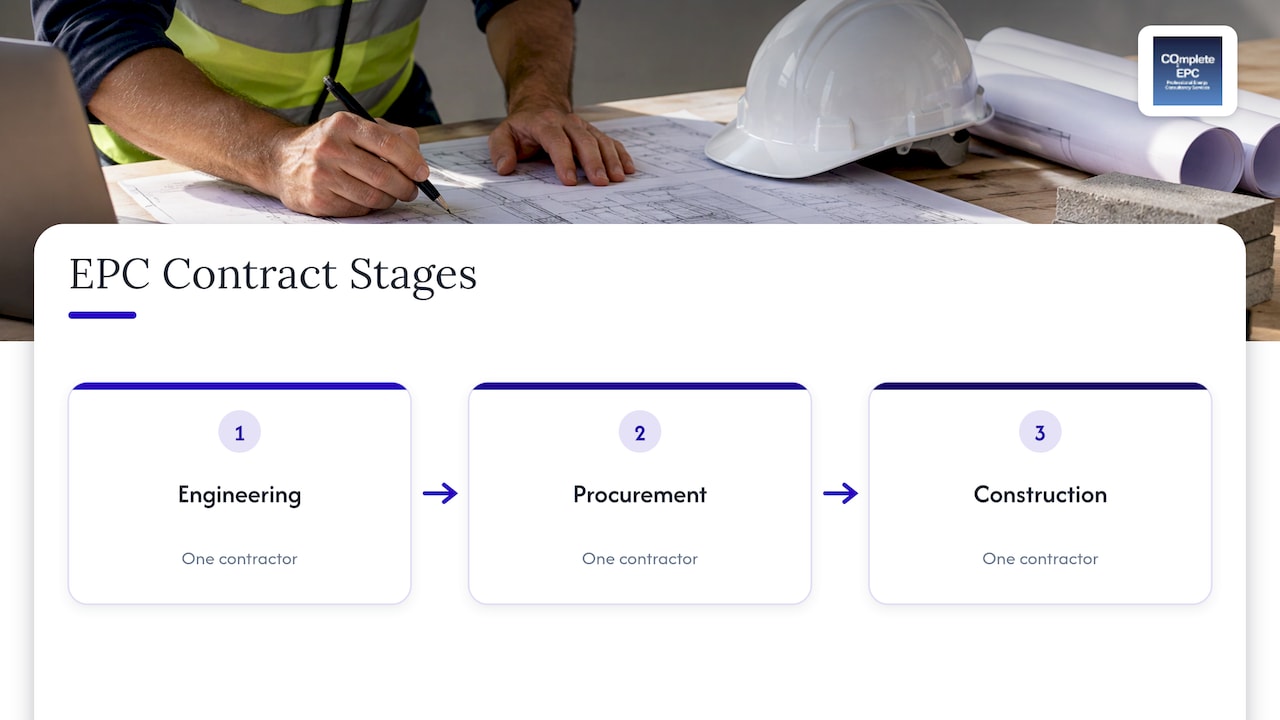
Engineering
This is the design stage. According to McCarthy’s explanation of EPC in construction, it runs from checking that the project is viable through to detailed design, making sure the plans fit the budget and schedule and meet codes and performance requirements. A beginner’s guide from S&B breaks it into feasibility studies, front-end engineering design (the early design work that fixes the scope and cost), detailed specifications and drawings, and reviews of how the thing will actually be built.
Procurement
Procurement means sourcing and buying the materials and equipment, and choosing the suppliers and subcontractors. McCarthy notes that it is ongoing throughout the project rather than a single step. The same S&B guide points to logistics as part of the job, including heavy lifts and oversized shipments, which is why the model suits large plant and equipment rather than small works.
Construction
The contractor then builds, managing subcontractors and site teams, overseeing safety and quality, and delivering the finished facility. Procore’s guide adds that the contractor is also responsible for commissioning, which means testing and validating every system before handover to the owner.
How an EPC contract works
An EPC contract is a type of turnkey contract: the owner turns the key and the facility works. NEC’s guidance on EPC contracts describes the contractor being appointed to design and plan the scheme to meet the client’s objectives, procure the plant, materials and subcontracts, and construct, test and commission the work. The client gives a performance-based output specification, hands more risk to the contractor and takes a more hands-off role. NEC is the body behind the NEC4 family of contracts widely used in UK construction, and it supports this approach through its Engineering and Construction Contract options.
LexisNexis UK’s legal guidance describes the typical features:
- a lump-sum price
- a fixed completion date
- performance guarantees
- liquidated damages (pre-agreed payments if the contractor is late or under-delivers)
- capped liability
- limited grounds for the contractor to claim extra time or money
It also makes a useful point for anyone reading contract documents: ‘EPC’ is a term of market usage, not a concept defined by legislation or case law. What a particular EPC contract means is therefore decided by its own wording.
You may see variants. Wikipedia’s overview lists lump sum turnkey (LSTK), EPIC (engineering, procurement, installation and commissioning) and EPCC, a version with an extra ‘commissioning’ letter. They all describe the same basic idea of single-contractor responsibility.
What it means in the UK
Procore’s UK and Ireland guide notes that an EPC contractor working in the UK must meet the Construction (Design and Management) Regulations 2015 duties, structural codes and Part L energy targets during engineering, and apply health and safety and quality-control procedures on site. Part L is the section of the Building Regulations that covers the conservation of fuel and power. That is the point where the construction EPC and energy performance certificates meet, and we come back to it below.
EPC contractor or general contractor?
The difference matters if you are weighing up how to procure a project. Autodesk’s comparison says an EPC contractor manages the whole lifecycle, usually under one contract with one point of responsibility, while a general contractor focuses on building from plans provided by others, under separate contracts with the owner, engineers and suppliers.
| EPC contractor | General contractor | |
|---|---|---|
| Scope | Design, procurement, construction, commissioning | Construction and site coordination |
| Contracts | Usually one | Several, with owner, designers and suppliers |
| Design responsibility | With the contractor | With the design team |
| Risk | Mostly with the contractor | Shared between contractor, owner and designers |
| Price | Fixed lump sum, often with a risk premium | Varies with the procurement route |
A third model, design-bid-build, splits design and construction between different parties in sequence. WSP’s project delivery page sets this against EPC and against EPCM, where the owner hires a consultant team to manage the work while a separate contractor builds it.
Advantages and risks of EPC delivery
For an owner, the attraction is certainty. Under the lump-sum structure described by the IEEE Technology Navigator, cost overruns from design changes or procurement problems fall to the contractor, not the client. The same source notes that lenders often prefer EPC or turnkey structures because they want certainty about construction risk, and LexisNexis links the model’s popularity in power and infrastructure to that ‘bankability’.
In return, the owner accepts a few trade-offs. A Clifford Chance procurement workshop lists a substantial risk premium on price, contractor control of design and construction, and the owner’s reduced involvement. PLC Construction puts the typical premium at 10 to 20 per cent against other delivery methods, because the contractor guarantees both price and completion date.
When EPC is the right fit
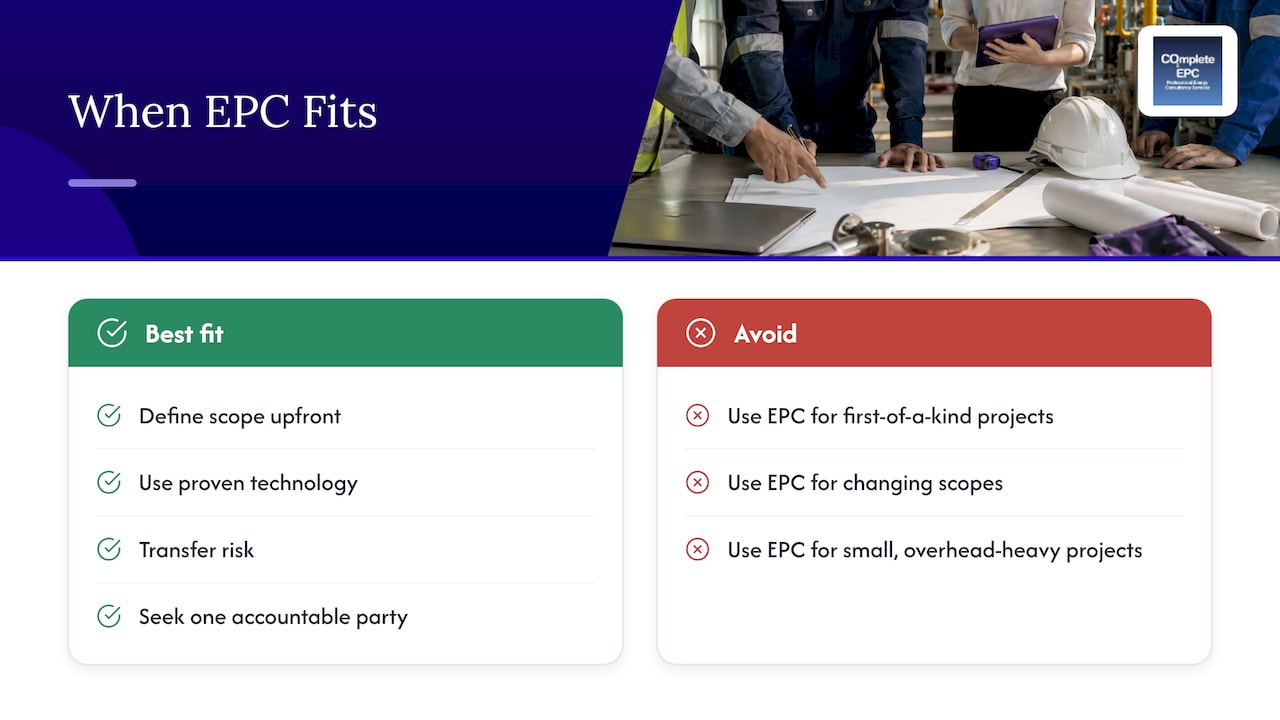
ATK Energy says EPC works best where the scope can be defined clearly at the start, the technology is proven, the owner wants risk transferred and a single point of accountability, and the owner wants to avoid managing several contractors. It is less suitable for first-of-a-kind projects, scopes that will change, and small projects where the overhead is out of proportion.
That last point is the practical one for most London property owners. A loft conversion, a rear extension, a shop fit-out or a block refurbishment is normally procured through a builder or general contractor, so you are unlikely to sign an EPC contract in the construction sense.
The EPC most London property owners actually need
An Energy Performance Certificate rates how energy efficient a building is and what it costs to run. According to the government’s statistical release on energy performance certificates, in England and Wales it shows a band from A to G (with A+ for non-domestic properties), is required when a building is newly constructed, sold or let, and is valid for 10 years. It also lists recommendations for improving the rating.
So the two EPCs are unrelated in meaning, but they can touch on the same project:
- A new build or conversion. Whoever delivers it, whether through an EPC contract or a conventional builder, the finished building needs an energy performance certificate. Energy calculations at design stage feed into that. For new homes, conversions and extensions this is typically a SAP calculation; for new commercial buildings it is an SBEM calculation.
- A sale or a let. The certificate has to be in place for the property being marketed, whatever its construction history.
- Planning and building control. Part L energy targets, mentioned above, are checked through these calculations and through energy statements for planning.
If you are a landlord, MEES (the Minimum Energy Efficiency Standards for rented property) is the rule to keep an eye on, because it ties the rating on your certificate to whether you can let the property. Check the government’s current guidance for the exact minimum rating and any changes before you plan upgrades.
Reading your certificate
When you receive an energy performance certificate, look at three things: the current band, the potential band if you carry out the listed improvements, and the recommendation list itself. Owners often find that a few of the lower-cost measures account for most of the possible improvement. For a practical overview of the kinds of upgrades that raise efficiency, this guide to energy efficiency improvements is a good starting point.
Which services fit which situation
| Your situation | What you typically need |
|---|---|
| Selling or letting a flat or house | Domestic energy performance certificate |
| Selling or letting an office, shop or other commercial space | Commercial energy performance certificate |
| New home, conversion or extension | SAP calculation, then the certificate |
| New commercial building | SBEM calculation, then the certificate |
| Air conditioning above the size threshold in a commercial building | TM44 inspection |
| Planning application with energy requirements | Energy statement |
| Residential scheme with overheating concerns | TM59 and TM52 assessment |
The terms in that last group are shorthand for compliance reports. TM44 is an inspection of air conditioning systems. TM52 and TM59 are methods for assessing overheating risk and thermal comfort, and dynamic simulation modelling is a more detailed way of testing how a building performs over time.
Our view: get the right EPC and get it early
We see the same confusion again and again: someone searches for EPC, finds pages about contractors and project finance, and is no closer to the certificate their sale or tenancy needs.
Our advice is to decide first which EPC you mean. If you are building, converting or extending in London, the energy calculations belong at the design stage, not at the end. Getting the SAP or SBEM figures early means the design can respond to them while it is still cheap to change.
If you are selling or letting, treat the certificate as part of preparing the property, not as a last-minute form. The recommendations it lists are a ready-made plan for improving efficiency, and for landlords they are the route to staying on the right side of MEES.
That is why we cover the whole chain in one place: domestic and commercial certificates, SAP and SBEM calculations, energy statements, overheating assessments and air conditioning inspections. Our UK lowest-rate guarantee is there so that doing it properly does not cost more than doing it late.
Danny
Getting your certificate or calculations in London
We provide energy performance certificates for domestic and commercial properties across London, and we work with property owners, landlords, estate agents and solicitors. Our assessors are qualified, and our pricing is backed by our UK lowest-rate guarantee.
- Selling or letting a home: domestic energy performance certificate
- Selling or letting commercial premises: commercial EPC
- New homes, conversions and extensions: SAP calculations
- New commercial buildings: SBEM calculations
If you are not sure which of these your project needs, start from our main site and tell us what the property is and what you are doing with it.
FAQ
What does EPC stand for in construction?
EPC stands for Engineering, Procurement and Construction. It describes a contract and delivery model in which one contractor is responsible for designing, buying for and building a project, then commissioning it before handover. It is typically used on large energy, industrial and infrastructure schemes.
Is an EPC contractor the same as a general contractor?
No. An EPC contractor takes on design, procurement, construction and commissioning, usually under one contract and carrying most of the risk. A general contractor mainly manages construction and subcontractors, working from plans prepared by a separate design team.
Is the EPC in construction the same as an Energy Performance Certificate?
No. The construction EPC is a type of contract. An Energy Performance Certificate is a document rating a building’s energy efficiency from A to G. In England and Wales it is required when a building is newly constructed, sold or let and lasts 10 years.
Do I need an EPC contract to build an extension in London?
Almost certainly not. EPC contracts suit large projects with a clearly defined scope and a need for single-point responsibility. Extensions and conversions are normally built through a builder or general contractor, although the finished work may still need energy calculations and a certificate.
Why would a landlord care about either EPC?
The Energy Performance Certificate decides whether and how you can market a property, and its rating is tied to the MEES rules for rented homes and commercial lets. The construction EPC only matters if you are commissioning a very large project.
Sources
- What Does EPC Mean in Construction? All About EPC Contracts, McCarthy
- What is EPC? A Beginner’s Guide, S&B
- EPC Contractor: The Role of Engineering, Procurement & Construction, Procore
- EPC Contractor in Construction: A Complete Guide for the UK and Ireland, Procore
- EPC contracts and NEC
- EPC contracts overview, LexisNexis UK
- Engineering, procurement, and construction, Wikipedia
- The Role of Engineering, Procurement, and Construction Contractors, Autodesk
- Project Delivery, WSP
- Turnkey project, IEEE Technology Navigator
- Procurement workshop, Clifford Chance
- EPC vs Design-Build, PLC Construction
- What Is an EPC Contractor?, ATK Energy
- Energy Performance of Buildings Certificates Statistical Release, GOV.UK
- Guide to energy efficiency improvements