

An EPC (Energy Performance Certificate) grades a building’s energy efficiency from A to G, based on its fabric and services rather than personal bills. You need one when you construct, sell or let a property in England, Wales or Northern Ireland, and it stays valid for 10 years. The seller, landlord or their agent must hand a copy to prospective buyers or tenants before marketing begins.
TL;DR:
- Most UK properties require a valid EPC before marketing, and the assessment mainly measures the building’s potential, not occupant habits or actual bills.
- Assessors need to verify insulation, heating, and renewable installations through paperwork, as their scores depend heavily on documented evidence.
- An EPC lasts for 10 years, but improvements only update the record after a new assessment, which can involve additional costs and time.
- Rushed or incomplete assessments risk inaccurate ratings, which can affect legal compliance, especially for properties near minimum energy standards.
- Booking a certified assessor and preparing documentation can reduce assessment time, improve accuracy, and prevent costly re-assessments.
Table of Contents
- What an EPC measures: the asset rating explained
- When you need an EPC and who must provide it
- What happens during an EPC assessment: the assessor’s process
- Preparing for your EPC visit: costs and turnaround
- Benefits, limits and misconceptions worth clearing up
- Why accuracy matters more than people expect
- Book a domestic or commercial EPC with Complete EPC
- Sources
- FAQ
What an EPC measures: the asset rating explained
An EPC is an asset rating, not a bill tracker. Assessors look at the building itself: insulation levels, glazing, heating systems, controls, ventilation and lighting. They then apply standard occupancy assumptions, a fixed set of rules about how many people live there and how they use the heating, so a three-bed semi in Croydon can be compared fairly against one in Carlisle.
That standardisation is deliberate. Two identical houses next door to each other could carry near-identical EPCs even though one household runs the heating constantly and the other barely touches the thermostat, because the certificate measures the building’s potential, not the occupants’ habits. Landlords sometimes assume a poor EPC reflects a tenant’s usage. It does not.
The rating bands run from A (most efficient) to G (least efficient), giving buyers and tenants a quick read on likely running costs and carbon output:
- A to B: Excellent efficiency, typically new builds or heavily retrofitted properties.
- C to D: Average performance, the range most existing UK housing sits in.
- E to F: Below-average efficiency, often flagging outdated heating or poor insulation.
- G: Lowest efficiency band, usually older properties with no significant upgrades.
Commercial buildings work on the same principle but sometimes use an extended A+ to G scale, reflecting the wider range of building types and services covered by non-domestic EPCs.
When you need an EPC and who must provide it
Three situations trigger a legal requirement: constructing a new building, selling a property, or letting it to a new tenant. A handful of exemptions exist, such as certain listed buildings or short-term lets under four months, but the default assumption should be that an EPC is needed.
- Validity: An EPC lasts 10 years from the date of assessment. A newer certificate always supersedes an older one, even if the old one hasn’t technically expired.
- Who provides it: The seller, the landlord, or their appointed agent must supply a valid EPC free of charge, and it needs to be available at the earliest point of marketing, not held back until an offer is made.
- Enforcement: Trading Standards can issue penalties where a property is marketed without a valid EPC in place, and the duty sits with the person marketing the property, not the buyer or tenant.
Estate agents in particular should treat this as a pre-listing checklist item. A property advertised without an EPC on file is a compliance gap that’s entirely avoidable, and one that solicitors will flag during due diligence regardless.
What happens during an EPC assessment: the assessor’s process
Only an accredited domestic or non-domestic energy assessor can legally produce an EPC. Once the assessment is complete, the assessor lodges the certificate on the official government register, and that lodgement is what makes the document valid, not the paper report itself.
A typical visit follows a consistent structure:
- Pre-assessment checks: The assessor confirms the property type, age and any prior EPC on record.
- Measurements and fabric inspection: Room dimensions, wall construction, glazing type and roof insulation get recorded.
- Services check: Boiler make and model, heating controls, hot water system and any renewable installations such as solar PV are assessed.
- Photographs and evidential notes: Visible insulation, meter locations and heating equipment are photographed to support the data entered.
- Data entry and lodgement: Findings are entered into approved software, which calculates the rating, and the certificate is lodged on the register digitally.
For a standard three-bedroom home, expect the visit itself to take 30 to 60 minutes. Larger or more complex commercial buildings take longer, sometimes considerably so if there are multiple heating zones or unusual layouts. Assessors carry out non-invasive checks only, meaning they won’t lift floorboards or drill into walls, so anything hidden behind finished surfaces has to be evidenced another way.
Pro Tip: Keep installer invoices and MCS certificates for anything like solar panels, external wall insulation or a new boiler somewhere accessible. Without that paperwork, an assessor has to mark the feature as “unknown,” which almost always drags the rating down even when the improvement is genuinely there.
Preparing for your EPC visit: costs and turnaround
A little preparation shortens the visit and reduces the risk of a lower score caused by missing evidence rather than an actual efficiency problem.
- Have the boiler make, model and age ready, along with any service records.
- Locate paperwork for insulation works, double glazing, or renewable installations such as PV panels.
- Clear access to lofts, meter cupboards and any plant rooms in commercial buildings.
- Have floor plans on hand if the property has an unusual layout.
- On the day, walk the assessor through anything not immediately visible rather than leaving them to guess.
Cost and turnaround vary with size, complexity and whether the property is domestic or commercial. A straightforward flat costs less and takes less time to certify than a multi-storey commercial unit with several heating systems and tenants. Once upgrades are made, insulation, glazing, a heat pump, the improved rating doesn’t appear automatically. The old certificate stays on record until a new assessment is commissioned, so landlords planning MEES compliance work should budget for a follow-up EPC once the works are finished.
Benefits, limits and misconceptions worth clearing up
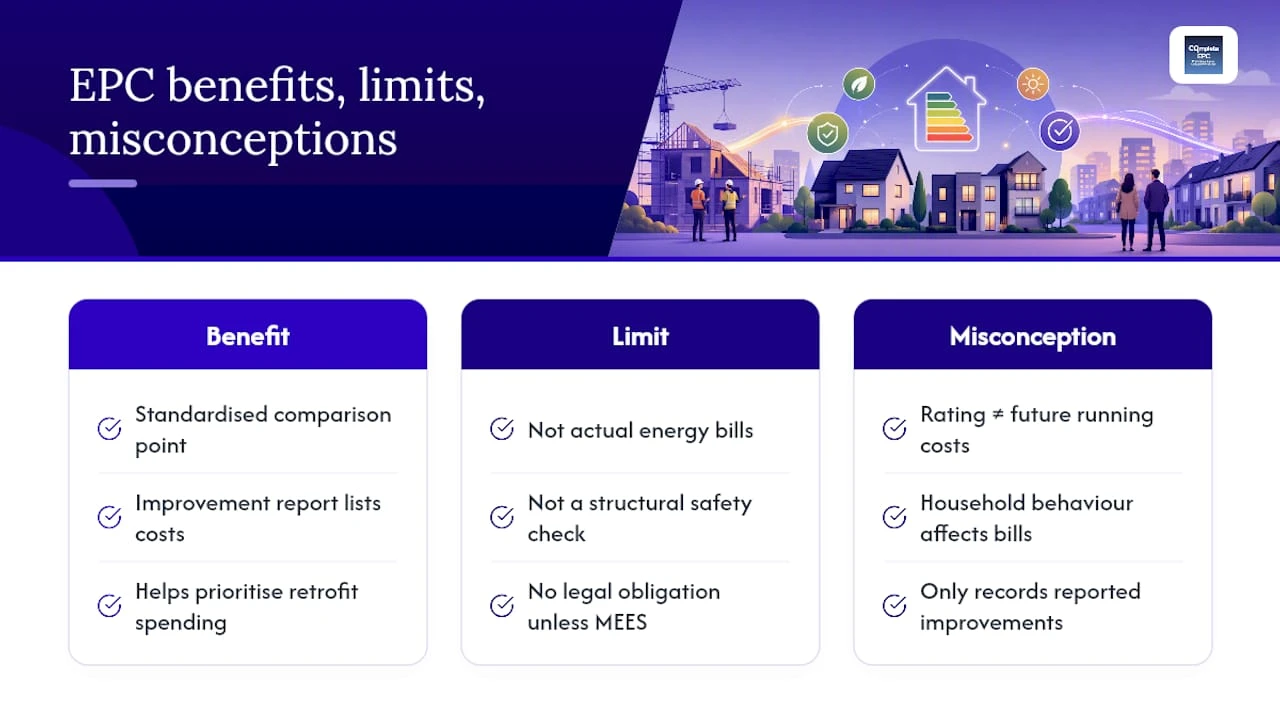
An EPC gives buyers and tenants a transparent, standardised comparison point between properties, and the recommendation report attached to it lists specific improvements along with indicative costs and payback estimates. That’s genuinely useful for prioritising retrofit spending, whether that’s loft insulation or a smarter approach to building services more broadly.
It has real limits too. An EPC doesn’t measure actual bills, doesn’t assess structural safety, and doesn’t check whether a building is fit for purpose beyond energy performance. The recommendations are advisory, not compulsory. A landlord isn’t legally obliged to act on every suggestion unless a separate scheme, MEES being the obvious example, mandates a minimum rating for that property type.
The most common misconception is treating the rating as a guarantee of future running costs. It isn’t. Two households in identical properties can spend very differently depending on how they live, and an EPC rating only reflects what improvements have actually been recorded, not what’s physically been done if nobody’s told the register about it.
Why accuracy matters more than people expect
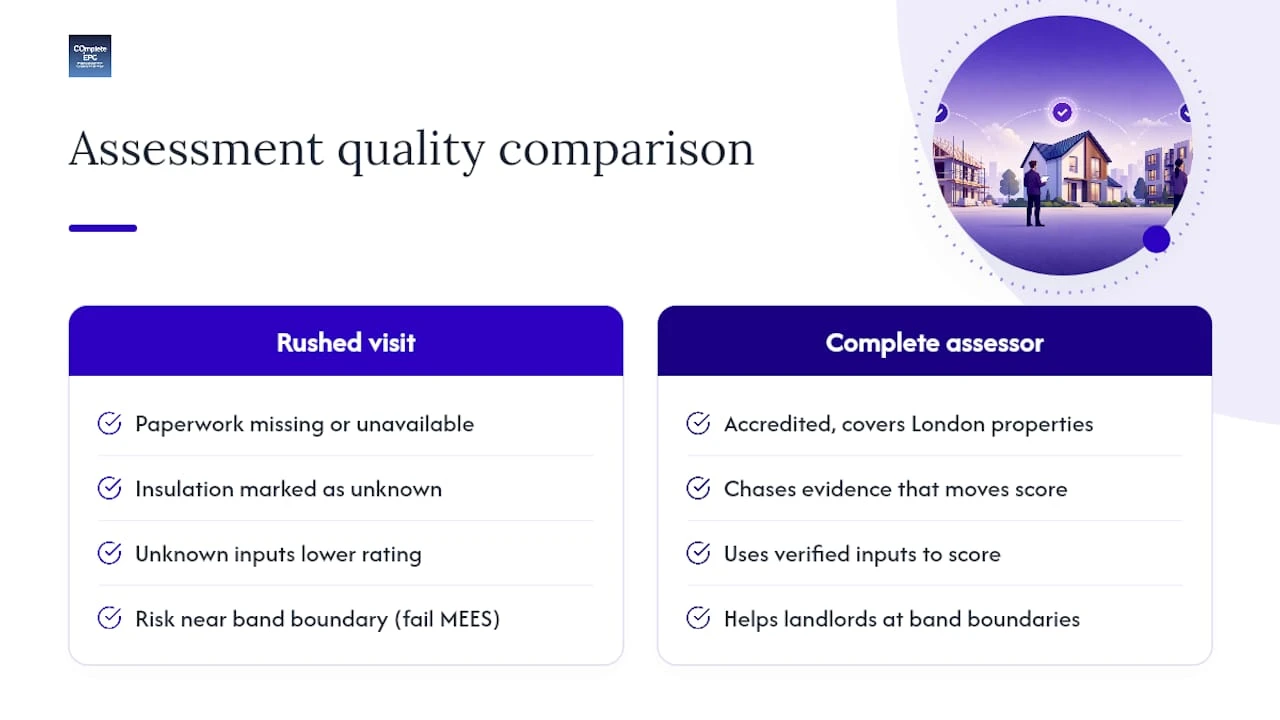
Most people assume an EPC assessment is a formality, a box ticked on the way to completion. That underestimates how much a rushed or poorly evidenced visit can cost a landlord later. An assessor who can’t verify insulation because the paperwork isn’t to hand has to score it as unknown, and unknown almost never helps the rating.
Complete EPC’s assessors are accredited, cover domestic and commercial properties across London, and are trained to chase down the evidence that actually moves a score, rather than defaulting to the conservative figure. That matters most for landlords sitting close to an EPC band boundary, where MEES compliance hinges on a single grade. Getting it right the first time, correct lodgement on the register, a recommendation report that’s actually actionable, saves a second visit and a second fee later.
— Danny
Book a domestic or commercial EPC with Complete EPC
Completeepc is the practical alternative to chasing multiple quotes and hoping an assessor turns up with the right expertise. Whether you’re a landlord letting a flat or a solicitor handling a commercial sale, you can book a domestic EPC or commercial EPC directly, with accredited assessors covering London and a guarantee on competitive pricing.
When booking, have the property address, access details and a rough sense of size ready, that’s enough for an accurate quote. After the visit, expect a digital EPC lodged on the official register along with a recommendation report you can actually act on. If you’re planning insulation, glazing or heating upgrades first, ask about SAP calculations or MEES compliance advice before you book, it can save a second assessment down the line. Get your quote and book your assessment today.
Sources
- Energy Performance of Buildings Certificates in England and Wales: technical notes
- What to expect from a Domestic EPC Assessment – Elmhurst Energy
FAQ
What does EPC mean?
EPC stands for Energy Performance Certificate, a rating from A to G that measures a building’s energy efficiency based on its fabric and services.
How long is an EPC valid for?
An EPC is generally valid for 10 years from the date of assessment, after which a new one is needed for marketing or letting.
Who has to provide the EPC when selling or letting?
The seller, landlord or their agent must supply a valid EPC free of charge, and it should be available before the property is marketed.
How long does an EPC assessment take?
A standard domestic assessment typically takes 30 to 60 minutes, though larger or commercial properties can take longer.
Do I need a new EPC after making energy efficiency improvements?
Improvements aren’t automatically reflected on an existing certificate, so you’ll need to commission a new assessment to formally record a better rating.
Can I be fined for not having an EPC?
Yes, marketing a property without a valid EPC in place can lead to a penalty from Trading Standards, since the duty sits with whoever is marketing it.